
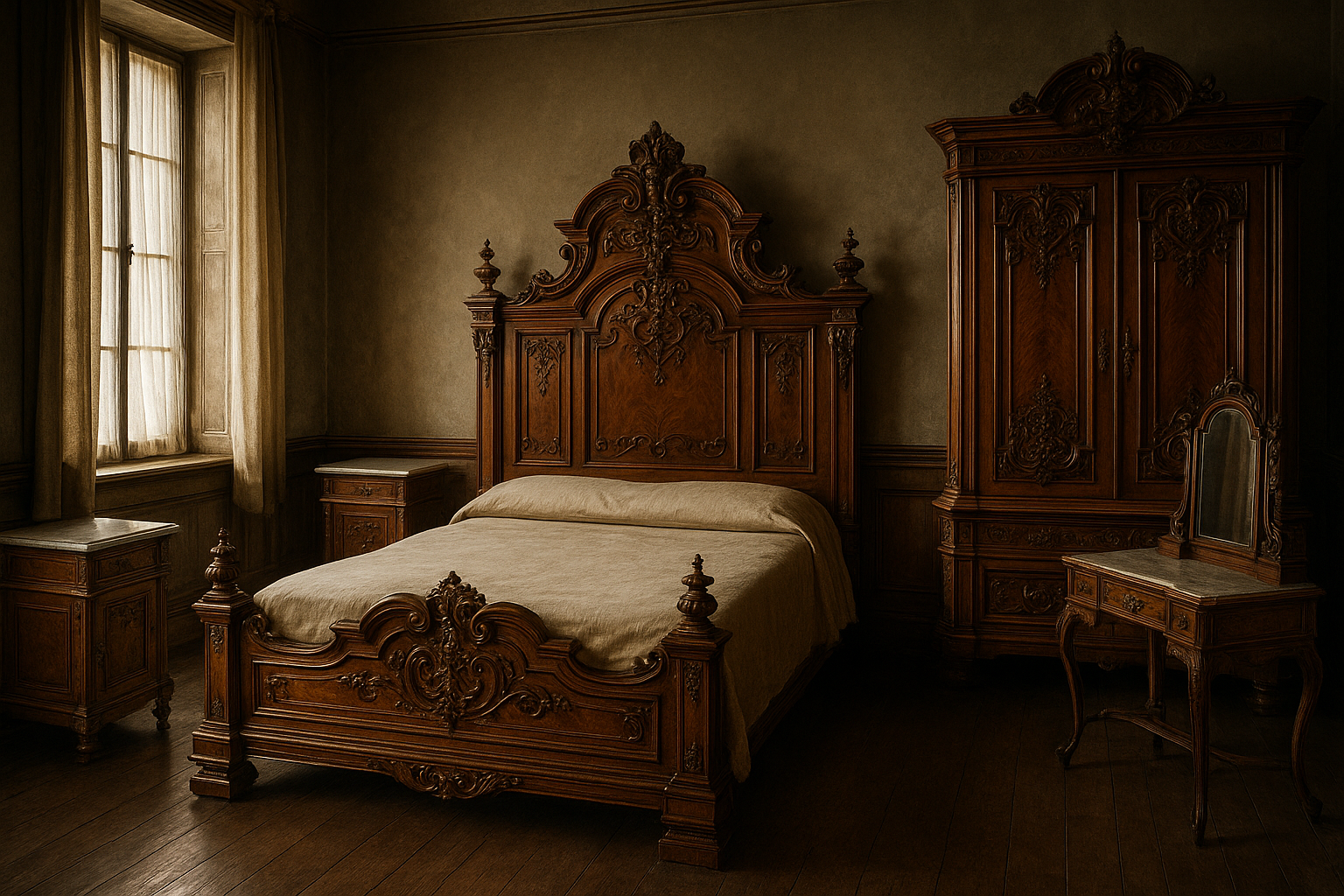
Early 19th-century European domestic life inherited an older architectural fact: in many elite and middling households, sleeping was not always a fully private act. In the 18th century, the bedchamber could function as a semi-public room—receiving visitors, managing household business, or marking rank through access and ceremony. Over the 1800s, however, changing ideas about hygiene, morality, gender, and sentiment redefined the bedroom as a protected interior. This shift did not happen uniformly across Europe, but the overall arc is clear in inventories, pattern books, and surviving suites: the bedroom becomes a specialized environment, increasingly separated from reception rooms and increasingly governed by notions of comfort and propriety.
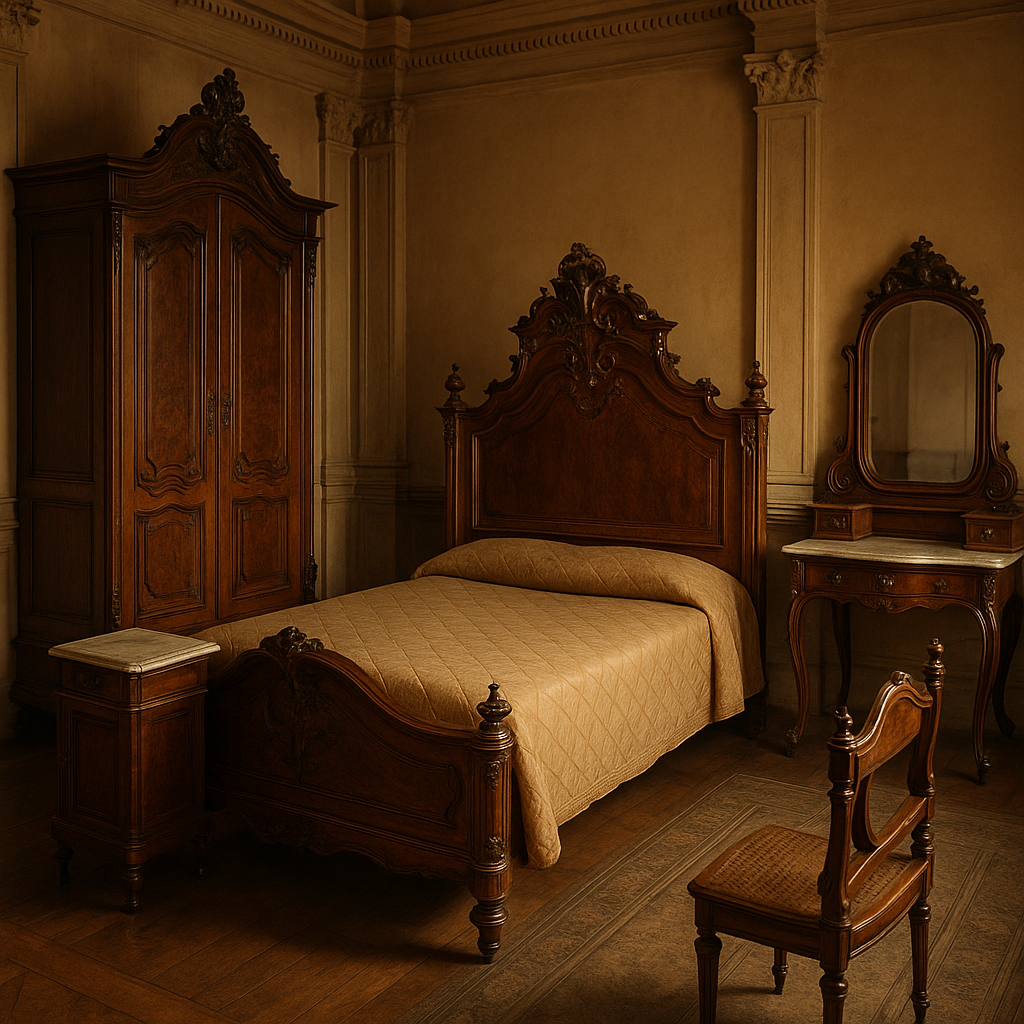
Architecture and social practice moved together. The rise of the corridor plan in urban apartments and larger houses, the increasing specialization of rooms, and the separation of servant circulation from family circulation made private life more “spatially legible.” A bedroom could now be imagined as a place for retreat and regulated intimacy rather than a room in which one might receive callers. This change had material consequences: the bed became less a throne-like emblem of state and more a focal object of domestic taste; wardrobes and dressing tables multiplied as storage, laundering, and the management of clothing became more complex; and the nightstand (or bedside cabinet) emerged as a useful mediator between the body and the new culture of personal objects—candles, watches, devotional items, and later, patented hygiene products.
The decorative intensification of the bedroom is often misunderstood as mere ornamentation. In fact, the 19th century made the interior into a moral and psychological theater. Advice literature—English household manuals, French guides to taste, Central European bourgeois conduct texts—mapped character onto furniture. The proper bedroom was meant to cultivate discipline, modesty, and health. The result was an environment that read as “private” not only because it was physically secluded, but because it was filled with objects that implied private routines: grooming sets, mirrors, lockable drawers, and specialized textiles.
Material evidence for these changes can be studied in surviving suites and in the documentary record. In Britain, the Victoria and Albert Museum preserves key examples and design drawings that show how bedroom furniture was marketed as an ensemble rather than as isolated pieces. In France, holdings and archives at the Musée des Arts Décoratifs (Paris) illuminate the commercial networks—ébénistes, bronziers, upholsterers—that allowed stylistic shifts to move quickly into domestic settings. In Central Europe, collections such as the MAK (Vienna) are particularly important for tracing the route from historicism into reform movements that ultimately fed Art Nouveau (Jugendstil), where bedroom design became a statement about modern life itself.
Empire to Early Victorian: Power, Order, and the Monumental Bed
Empire style (c. 1800–1830, with regional persistence later) translated the language of state into domestic furniture. Its forms are architectural, symmetrical, and often austere at a distance, but richly coded in detail: laurel wreaths, palmettes, anthemia, winged victories, and classical figures borrowed from Roman imperial imagery. Beds were frequently conceived as daybeds or boat-shaped forms (lit en bateau in France), with scrolled ends that echo ancient prototypes while also dramatizing the body’s place within a disciplined interior. Wardrobes and commodes gained weight and authority, their flat planes animated by applied gilt-bronze mounts or carefully placed columns and pilasters.
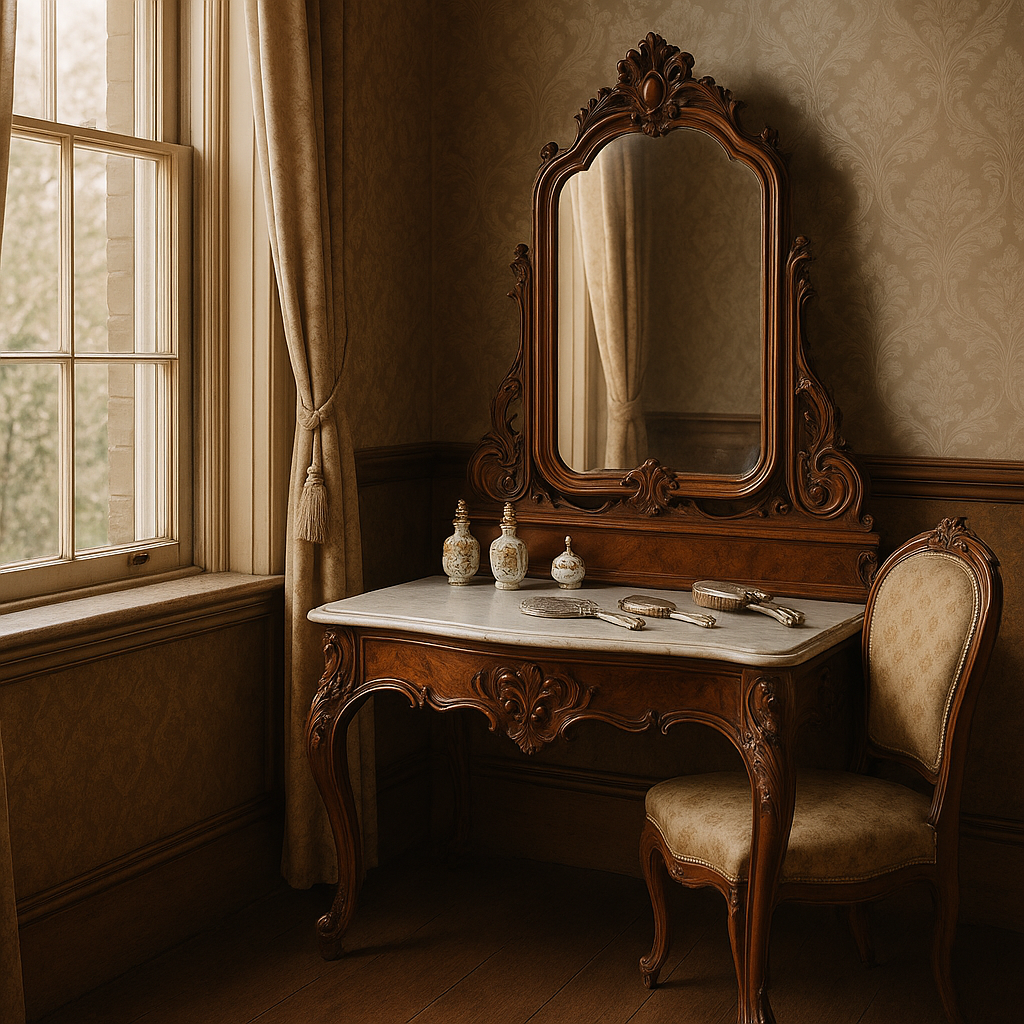
The bedroom suite in this period often reads as a coherent program: the bed anchors the room, while the armoire or wardrobe stands as a vertical monument of storage—suggesting not only wealth but the disciplined management of textiles and dress. Dressing tables expanded into more complex forms, sometimes integrating mirrors and small drawers for grooming instruments. Nightstands could be compact cabinets with doors, a practical response to candle storage and to the desire to conceal personal items. Even where ornament was restrained, the furniture’s massing conveyed status and control.
In Britain, the Regency variant softened some of the French severity but preserved its classical vocabulary. Mahogany remained a favored wood, valued for its deep color and workability, while ebony or ebonized details could heighten contrast. In France, rosewood and mahogany often met sophisticated bronze work—ormolu mounts, rosettes, and escutcheons that announced Parisian luxury trades. Central European interpretations, particularly in Habsburg territories, show a negotiation between imported French prestige and local woodworking traditions: strong case construction, pronounced veneers, and ornament borrowed from both neoclassical and regional sources.
The early Victorian period (c. 1837–1860) did not abandon grandeur so much as redirect it. Industrialization and expanding markets created a new middle-class appetite for suites that conveyed respectability. Bedroom furniture became more available in sets, and design was increasingly mediated through illustrated catalogues and pattern books. The bed’s headboard grew taller, often upholstered or framed with carved wood; wardrobes became more standardized; and the dressing table became a principal stage for mirrors, porcelain, and personal display—an object that helped define the bedroom as a realm of gendered routine and self-fashioning.
Museums and archives help trace these transitions beyond stylistic labels. Trade cards, bills, and workshop records—when they survive—show that many “period” bedrooms were composite in origin, assembled through networks rather than by a single maker. This matters for collectors today: a coherent look does not always mean a single commission, and an “Empire” bed may sit historically beside later objects in the same family, reflecting incremental refurnishing rather than a single moment of taste.
Rococo Revival and High Victorian Taste: Ornament, Display, and the Cult of Comfort
By mid-century, historicism became a primary engine of design. The Rococo Revival (roughly 1840s–1870s, uneven by region) revived 18th-century French curvilinear forms, but with 19th-century emphases: heavier carving, deeper relief, and a preference for dramatic surface play. In the bedroom, the Rococo Revival headboard often becomes a carved tableau—scrolls, shells, acanthus, and florals—suggesting a sensuous, enveloping environment. Dressing tables sprout mirrors framed like theatrical proscenia; wardrobes gain cresting and applied ornament; and nightstands become small curio-like cabinets, sometimes with marble tops, reflecting the era’s fascination with cleanliness and the management of surfaces.
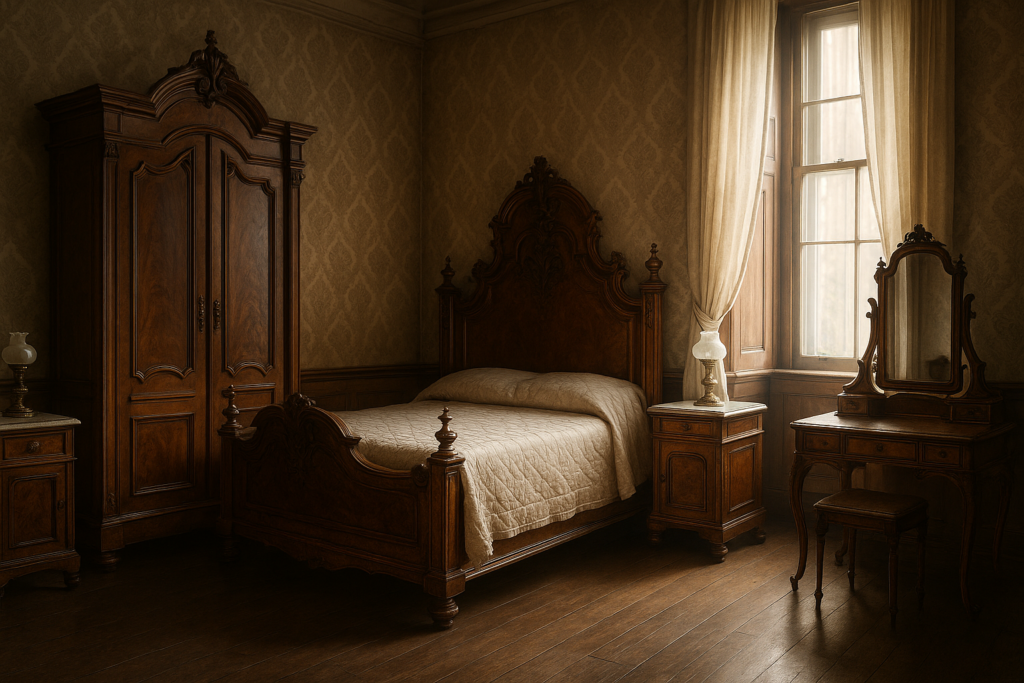
High Victorian design more broadly intensified the bedroom as a decorative field. The room became a site where comfort was engineered—through textiles, carpet, drapery, and increasingly stuffed upholstery—while also functioning as a moral tableau. The paradox is central: the bedroom is framed as private and virtuous, yet it is saturated with display. Furniture responded by emphasizing both concealment and elaboration: secret drawers, lockable compartments, and enclosed storage coexisted with exuberant carving and pattern. The culture of domesticity, particularly in Britain and its spheres of influence, encouraged the bedroom to communicate family respectability and personal refinement.
Craft practice in this era often blended hand skill with machine assistance. Carving could be partly roughed out by machine and then finished by hand; repeated motifs circulated through workshops; and the availability of steam-bent components and improved veneer technology allowed more adventurous shapes. The best work still reveals the cabinetmaker’s discipline: crisp undercutting in carving, clean joinery hidden beneath ornament, and well-planned veneer layouts that “read” symmetrically across doors and drawer fronts. Inferior work, by contrast, often substitutes shallow ornament for structure—an issue that becomes crucial when assessing authenticity and later repairs.
Materials also signal the period’s values. Walnut (especially in England and France) became widely fashionable for its warm tone and amenability to carving. Mahogany remained important, though sometimes as veneer over secondary woods. Rosewood—often as veneer—carried connotations of luxury and cosmopolitan trade, but it also becomes a site of later confusion for collectors, because rosewood veneers can be thin and vulnerable to restoration interventions. Oak persisted and re-emerged in various national revivals, valued for its strength and its associations with heritage and solidity, particularly in English and Central European contexts.
The museum record underscores how “Victorian” is not a monolith. The V&A’s holdings, for instance, show both heavily ornamented suites and comparatively restrained designs intended to look “correct” rather than lavish. In France, the Musée Carnavalet’s period rooms and related collections contextualize the bedroom within Parisian urban life, where apartment plans and social etiquette shaped furniture scale and arrangement. In Vienna and Prague, surviving bourgeois interiors and the MAK’s collections demonstrate how historicist furniture could carry a distinctly Central European gravity—dense materials, emphatic profiles, and local interpretations of French-derived ornament.
Craftsmanship and Materials: Cabinetmaking as Structure, Surface, and Illusion
Antique bedroom furniture of the 1800s is best understood as a negotiation between structure and surface. Most case pieces—wardrobes, chests, bedside cabinets—are built around carcase construction using secondary woods (pine, poplar, beech) with show surfaces in veneer or solid hardwood. Dovetailing, mortise-and-tenon joinery, and frame-and-panel construction dominate; drawers in better work show hand-cut dovetails and carefully fitted runners, while later and more industrial production may show machine-cut regularity. Beds, often subjected to mechanical stress, reveal quality through their rails, fastening systems, and the integrity of their posts or ends; many were designed to disassemble for moving, creating opportunities for later loss and replacement.
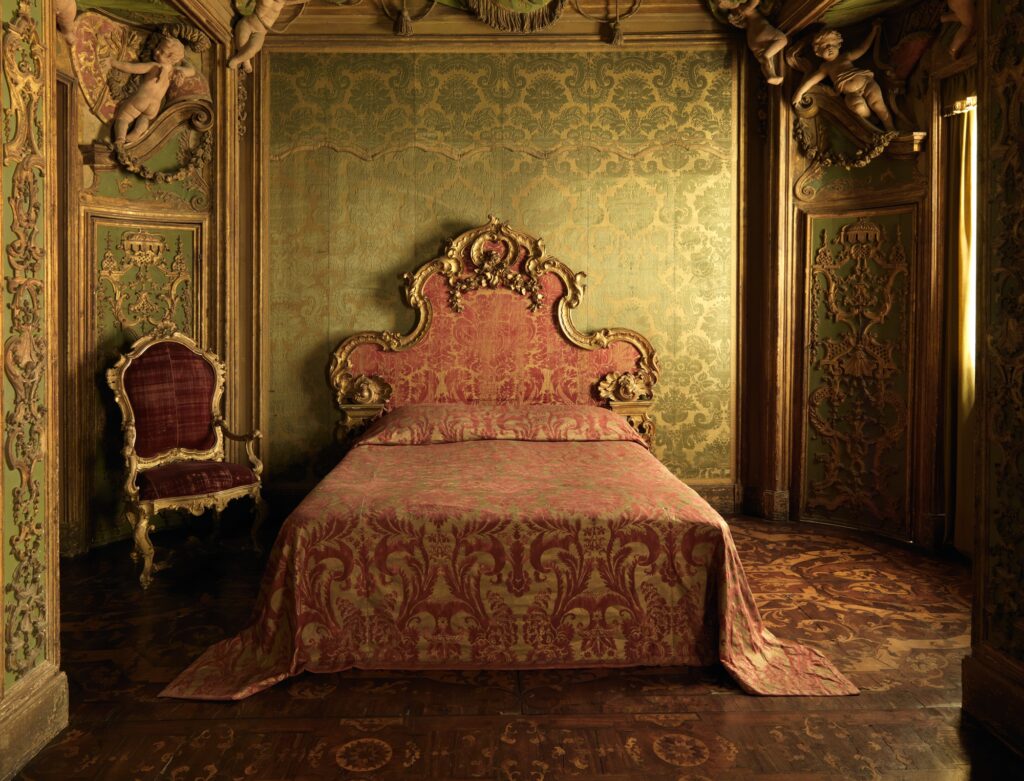
and Carpoforo Mazzetti Tencalla Swiss
Veneering in the 19th century was not a cheap compromise but a sophisticated art of illusion and resource management. Thin slices of mahogany, walnut, or rosewood could be laid in book-matched patterns to create mirrored grain effects, giving wardrobes and dressing tables a quiet visual drama. Crossbanding, stringing, and banded borders framed panels like pictures, reinforcing the sense that the bedroom suite was a carefully composed interior. Where marquetry appears—floral sprays, trophies, or neoclassical devices—it often acts as a form of narrative decoration, placing the bedroom within a symbolic world rather than merely embellishing it.
Carved ornamentation varies by region and by the economics of production. French work, particularly in the higher market, often integrates carved wood with gilt-bronze mounts, combining the cabinetmaker’s and metalworker’s arts into a unified statement. English carving in mid-century walnut furniture tends toward robust relief and a certain muscularity of scrollwork. Central European carving can be especially crisp and architectural, sometimes favoring deeper profiles and emphatic moldings that suit darker woods and heavier forms. In all cases, the best carving is not merely applied; it clarifies structure—highlighting corners, framing panels, and guiding the eye across transitions.
Gilding and metal mounts are more than decoration; they perform status and sometimes function. Ormolu mounts protect edges, corners, and keyholes—places prone to wear—while also signaling luxury. Gilded elements in bedrooms can appear surprising to modern eyes accustomed to thinking of bedrooms as quiet spaces, but for many 19th-century households the bedroom was an index of taste visible to family, close visitors, and servants. Gilding therefore mediates between privacy and display: it adds radiance to a room often lit by candles or gaslight, and it transforms utilitarian objects (locks, handles, feet) into heralds of refinement.
The choice of wood carried both practical and symbolic weight. Mahogany, tied to Atlantic trade and long associated with elite furniture, connoted durability and established taste. Walnut suggested warmth and modern domesticity, while rosewood carried an aura of exotic luxury that could be sharpened through high polish. Oak, depending on context, could signal national heritage, moral “honesty,” or a turn toward medieval and vernacular revivals. These meanings were not fixed; they shifted with fashion, political culture, and the availability of materials through global commerce.
Cultural and Symbolic Meaning: What Bedroom Furniture “Said” About Its Owners
Bedroom furniture in the 19th century is saturated with social meaning because it sits at the junction of body, property, and reputation. The bed—its scale, ornament, and textiles—registered not only wealth but notions of propriety. A monumental Empire bed could imply disciplined authority; a Rococo Revival bed with a deeply carved crest might signal comfort and cultivated taste; an austere later-century suite could represent modern restraint. In each case, furniture translated social ideals into wood, fabric, and metal—an interior language legible to contemporaries even when it appears merely “decorative” to us.
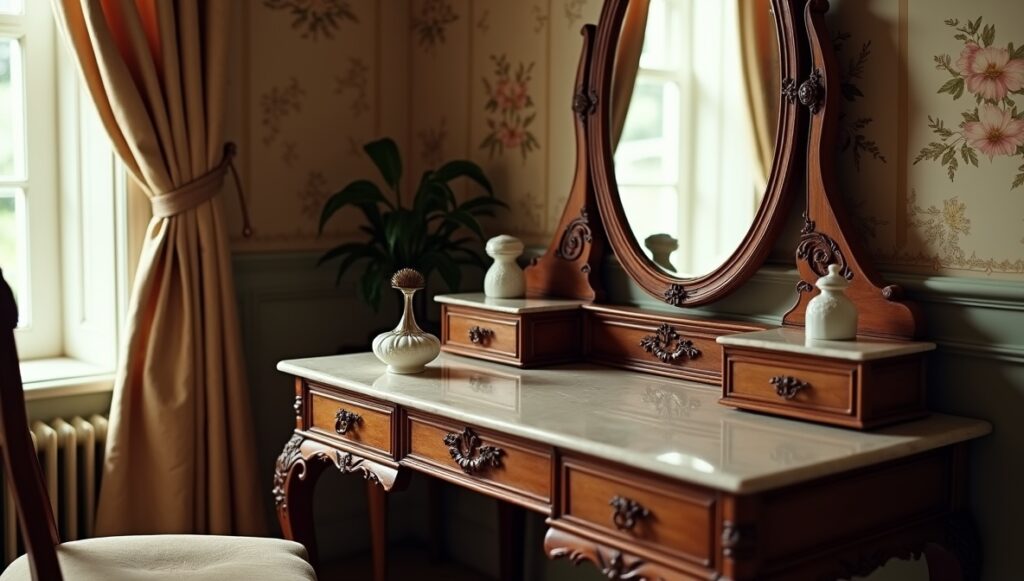
Wardrobes and dressing tables carried particularly strong symbolic associations because they addressed self-management. The wardrobe (or French armoire) stood as a monument to the control of clothing and linen, a material expression of order, cleanliness, and social presentation. The dressing table, with mirror and compartments, created a small theater of self-fashioning. In bourgeois culture, especially, grooming was moralized: to be neat was to be respectable, to manage one’s appearance was to manage one’s social identity. The furniture that enabled these practices thus acquired a seriousness beyond its immediate function.
Ornament functioned as a symbolic system. Neoclassical motifs—laurel, urns, anthemia—aligned the household with ideals of education, civic virtue, and cultured restraint. Rococo Revival shells and florals could suggest abundance, pleasure, and a feminized domestic sphere, though these associations are historically contingent and often contested. Gothic or medievalizing details, where they appear, could imply ancestry, piety, or national tradition. Even the choice between polished surfaces and “honest” grain could stage a debate about authenticity and display—one that becomes especially sharp toward the century’s end.
The bedroom also encoded relationships of labor. The very existence of multi-piece suites—beds with matching nightstands, wardrobes, dressing tables—implies systems of maintenance: cleaning, polishing, laundering, repairing. In large households, servants interacted with bedroom furniture daily, and design sometimes reflects this. Lockable compartments controlled access; durable surfaces acknowledged wear; and standardized forms made ordering and replacement easier. The 19th-century bedroom thus sits within a social history that includes not only owners’ identities but the often-unseen labor that sustained the interior as a moral and aesthetic space.
Finally, the evolution of bedroom furniture reveals shifting attitudes to intimacy and the self. As privacy became an architectural and cultural value, the bedroom absorbed more personal narrative: photographs, keepsakes, devotional objects, and eventually small technologies. Furniture adapted by offering shelves, mirrors, and compartments—micro-architectures for a life increasingly imagined as interior, personal, and psychologically distinct. In this sense, the 19th-century bedroom is an ancestor of modern interiority: it is where social history meets the history of the self.
French, English, and Central European Suites: National Traditions and Shared Markets
French bedroom furniture across the century often displays a distinctive integration of the luxury trades. Even in more modest examples, one finds a sensitivity to silhouette and surface that reflects Paris’s role as a design capital. Empire and later historicist pieces frequently use gilt-bronze mounts with a precision that is both decorative and protective, while veneers can be laid with striking symmetry. French armoires tend to assert themselves as sculptural volumes within the room, sometimes with bold cornices and carefully orchestrated panels—furniture that reads as architecture in miniature.

English bedroom sets frequently express a different balance: a strong emphasis on practicality and robust construction, paired with stylistic borrowing from France and from Britain’s own revival movements. The English fascination with walnut in the mid-century aligns with a taste for rich carving and warm surfaces, and the market for standardized suites—distributed through retailers and catalogues—encouraged recognizable forms. English beds often develop tall headboards suited to heavier textile schemes, while dressing tables and washstands (a crucial category in an era of pitcher-and-basin hygiene) reflect the ritualization of cleanliness within the bedroom or adjoining dressing room.
Central European production—encompassing German-speaking regions, Bohemia, and the Habsburg sphere—cannot be reduced to a single look, but it is often marked by a certain structural seriousness and by the coexistence of local craft traditions with international fashion. Furniture from Vienna, Prague, or Budapest may adopt French-derived motifs while retaining heavier proportions and a preference for emphatic moldings. The later-century shift toward reform design and Jugendstil is especially significant here: Central European designers and workshops became key laboratories for the move from historicism to a modern language of line and organic ornament.
Despite these differences, the 19th-century furniture market was increasingly international. Designs traveled through engravings, exhibitions, and the movement of artisans. World’s fairs and industrial exhibitions—London’s Great Exhibition of 1851 being the most famous—helped circulate styles and manufacturing ideals, while also sharpening national branding. The result is that “French,” “English,” and “Central European” labels sometimes describe aspiration as much as origin: a suite made in one region might be designed to look like another, complicating today’s attribution.
Museum collections and archives are essential for navigating these complexities. The V&A provides comparative material for British production and its dialogues with continental styles. The Musée des Arts Décoratifs and the Louvre’s decorative arts collections offer reference points for French materials and ornament systems. The MAK in Vienna is particularly valuable for tracing the transition into early modern design and for contextualizing Jugendstil bedroom pieces within a broader reform culture that included architecture, graphics, and household objects.
From Late Victorian to Early Art Nouveau: Toward the Modern Bedroom
By the late 19th century, fatigue with historicist repetition contributed to the emergence of new design ideals. Early Art Nouveau (c. 1890–1910, with national variants) did not merely add new ornament; it proposed a new relationship between structure and decoration. Instead of borrowing motifs from the past, Art Nouveau sought to make ornament feel generated by the object itself—line becoming tendril, support becoming stem, curvature becoming a logic of growth. In the bedroom, this could soften the heavy architectural mass of earlier wardrobes and dressing tables, replacing rigid paneling with flowing contours and integrated handles or mounts.
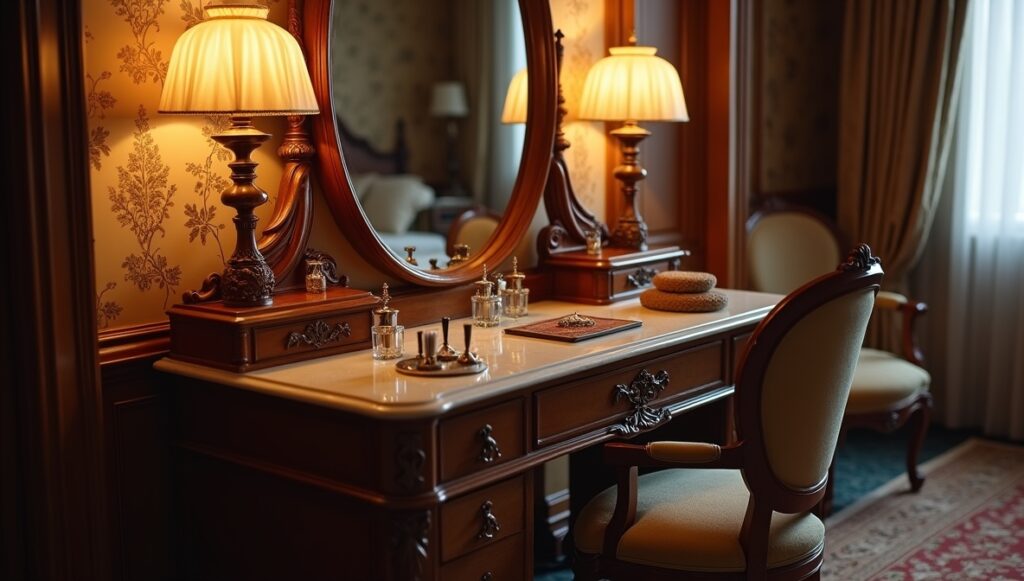
Beds in early Art Nouveau often shift from monumental presence to designed environment. Headboards might be framed by whiplash curves, stylized flora, or linear inlay rather than deep carving. Wardrobes and dressing tables sometimes adopt lighter visual rhythms, emphasizing verticality and graphic pattern. Nightstands—small but highly visible—become opportunities for inventive joinery and surface design, sometimes with delicate inlay or subtle relief carving. Yet these pieces are not necessarily “lighter” in construction; many are technically demanding, requiring careful bending, joinery, and finishing.
Materials remain continuous with the century—walnut and oak are especially important—but are used differently. Oak, once associated with heritage solidity, can be reimagined as a modern material through simplified forms and expressive grain. Marquetry and inlay persist, but instead of neoclassical trophies or Rococo bouquets, they may depict stylized irises, lilies, dragonflies, or abstracted botanical systems. Gilding is less dominant in many Art Nouveau contexts, replaced by the drama of line, the glow of polished wood, and the interplay of matte and gloss finishes.
The cultural meaning of the Art Nouveau bedroom is tied to modernity and reform. It often implies a new concept of the household as an integrated aesthetic organism—furniture, textiles, and architecture conceived together. At the same time, it reflects anxieties about industrial life: the return to nature in ornament can be read as critique, compensation, or aspiration. In Central Europe, where reform movements were especially vigorous, the bedroom becomes a testing ground for the “total work of art” ideal, anticipating 20th-century modernism’s interest in unified interiors.
For collectors, early Art Nouveau also marks a shift in how authenticity is judged. Because these designs often rely on subtle joinery, integrated fittings, and consistent design language across a suite, later alterations can be easier to spot—an replaced handle interrupts the line, an altered finish flattens intended contrasts, a repaired veneer disrupts a graphic pattern. In other words, Art Nouveau tends to announce its integrity (or loss of integrity) quickly to the trained eye.
Collector Perspective: Identifying Authentic 1800s Bedroom Furniture Today
Authenticating 19th-century bedroom furniture begins with construction, not ornament. Tool marks, joinery, and secondary woods often provide more reliable evidence than surface style, which can be revived, imitated, or altered. Hand-cut dovetails, irregularities consistent with hand planing, and period-appropriate hardware (including screw types and keyhole forms) help establish a baseline. Machine-cut uniform dovetails, modern Phillips screws, or synthetic glues are not automatically disqualifying—repairs happen—but they should trigger careful questions about what has been replaced, when, and how extensively.
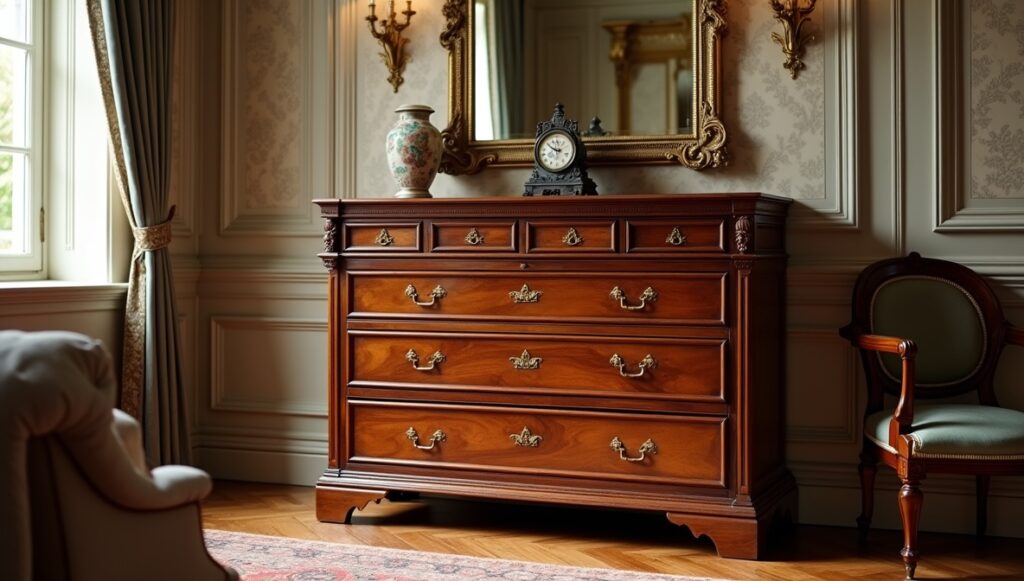
Veneer and finish are major diagnostic fields. Many authentic 1800s pieces used shellac or related finishes that develop a particular depth and patina over time. Over-stripping and refinishing can erase this evidence, leaving surfaces unnaturally flat or uniformly colored. Collectors look for coherent wear patterns: gentle rounding on frequently touched edges, consistent fading where light would hit, and oxidation that makes sense across the suite. Conversely, a wardrobe with “perfect” surfaces beside a heavily worn nightstand may suggest marriages of unrelated pieces—common in the trade and not inherently unethical if disclosed, but important for historical understanding and valuation.
Provenance and documentation can be decisive but are rare. Labels, stamps, retailer marks, and old invoices—sometimes tucked into drawers—provide valuable anchors. A suite linked to a known maker or a documented household can be historically significant even if condition is imperfect. When documentation is absent, comparative study matters: consulting museum databases, examining illustrated catalogues, and using archives of design drawings can help place a piece within a plausible timeframe and region. The goal is not merely to assign a style label, but to understand the object’s place within production and use.
One of the most persistent collector errors is over-reliance on “matching” as a criterion. Many 19th-century bedrooms were assembled gradually, and textiles and wall coverings changed more frequently than major furniture. A perfectly matched set may be original, but it may also be an assembled grouping made to satisfy modern expectations. Another common mistake is misreading later revival furniture (including late 19th- and early 20th-century reproductions) as earlier simply because it repeats older motifs. The safest approach is cumulative: construction evidence, material study, hardware, proportion, and documented comparisons should converge before firm conclusions are drawn.
Finally, collectors should attend to function-specific clues. Washstands, for example, are frequently misidentified as dressing tables; their marble tops, towel bars, and basin accommodations reflect hygiene practices and can help date and place them. Bed rail systems and cast fittings can also be period-typical, and missing elements—common in beds—have significant implications for both authenticity and cost. A bed that looks right but lacks original rails, fittings, or headboard structure may be closer to a decorative fragment than a usable antique.
Restoration Insights: Ethical Repair, Common Mistakes, and Conservation Thinking
Restoration of 19th-century bedroom furniture is always an interpretive act. The guiding question should be: are we preserving historical evidence, or replacing it with a contemporary idea of “newness”? Over-cleaning, aggressive sanding, and wholesale refinishing can erase tool marks, patina, and finish layers that are part of an object’s history. In museum contexts, conservation typically favors minimal intervention and reversibility; private collectors need not replicate museum standards exactly, but the same logic helps prevent irreversible loss.
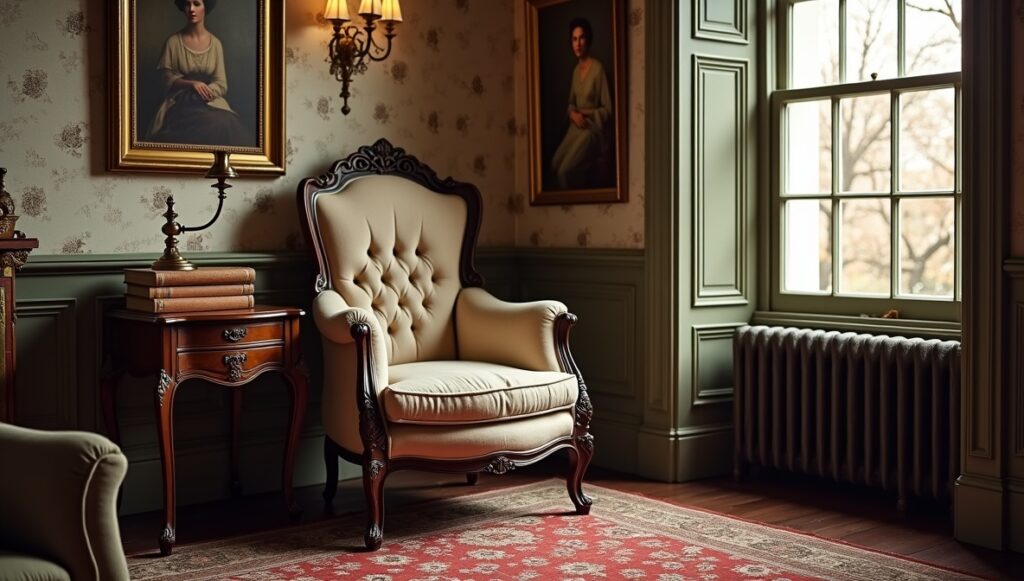
Veneer repairs are among the most mishandled interventions. Lifting veneer should be addressed with appropriate adhesives and clamping methods rather than modern fillers that create hard, discolored patches. Replacing missing veneer with mismatched grain or incorrect species can visually and materially falsify a piece. Equally problematic is the temptation to “improve” symmetry by replacing one damaged panel and leaving another original: the result is an object that reads as partially synthetic. Careful conservation aims for visual coherence while retaining as much original fabric as possible.
Hardware and metalwork raise their own issues. Original locks, escutcheons, and handles are historically informative, and their wear patterns often correspond to the object’s use. Replacing them with modern reproductions may improve immediate appearance but can reduce historical integrity and confuse future study. When replacement is necessary—because a bed cannot function safely without correct fittings—the best practice is to document changes, keep removed parts, and use period-appropriate materials and forms where possible. In gilt-bronze mounts or gilded details, over-polishing can destroy surface finishes and soften crisp modeling, diminishing both beauty and value.
Structural repairs should respect original joinery logic. Adding metal brackets, modern screws, or excessive glue can create new stresses and future failures. Beds are especially prone to compromised stability due to repeated disassembly; repairs should prioritize safe load-bearing solutions that do not require cutting away original material. Wardrobes and tall case pieces often suffer from warped doors or shifted carcases; correcting these problems can be delicate and should avoid forcing components into alignment in ways that crack veneer or split frames.
Collectors often underestimate the informational value of “imperfections.” Small stains, candle marks, or worn drawer runners may be part of the object’s lived history. The goal of ethical restoration is not to make an antique indistinguishable from new furniture, but to stabilize it, allow it to function (when appropriate), and preserve the traces that connect it to 19th-century domestic life. Documentation—photographs before and after, notes on materials used—is not bureaucratic fussiness; it is a form of stewardship.
Market Interest and Value: Demand, Rarity, and the Economics of Integrity
The market for authentic 19th-century bedroom furniture is shaped by a tension between scale and modern living. Large wardrobes, heavy beds, and extensive suites can be difficult to place in contemporary interiors, which affects demand even when objects are historically important. Consequently, the market often rewards pieces that balance historical character with manageable size: bedside cabinets, smaller wardrobes, dressing tables, and select beds with adaptable dimensions. Provenance, condition, and exceptional craftsmanship can override these practical constraints, but they remain significant factors in typical transactions.
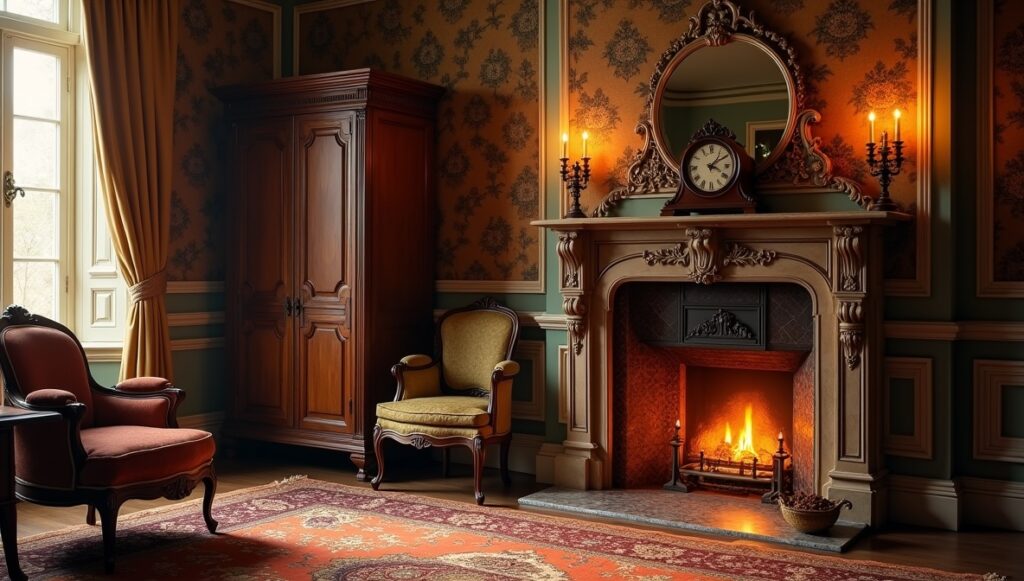
Value is closely tied to integrity. A suite with consistent materials, original fittings, and minimal invasive restoration tends to be more desirable to serious collectors and institutions. Conversely, heavily refinished surfaces, replaced veneers, and “married” groupings may trade primarily as decorative furnishings rather than as historical artifacts, even when they are composed of genuine 19th-century parts. National and regional attributions also influence value: French pieces with high-quality mounts, for example, may command attention for their luxury trades, while Central European Jugendstil can attract collectors focused on design reform and early modernism.
Rarity operates in nuanced ways. Certain categories—complete beds with original rails and hardware, or intact matching suites with strong provenance—are scarcer than wardrobes or commodes, simply because beds were more likely to be altered, resized, or discarded. Materials also matter: rosewood veneered suites in good condition are less common due to veneer fragility, while oak furniture may survive structurally but can suffer from later over-stripping that reduces its historical surface. High-quality marquetry and sophisticated carving can increase value, but only if the work is well preserved and clearly of the period rather than later pastiche.
Museum interest can affect scholarly attention more than prices, but the two sometimes intersect. When institutions exhibit or publish certain designers, workshops, or regional schools, collectors often follow with renewed focus. However, the most stable long-term value tends to belong to pieces that can withstand connoisseurship: well-made furniture, with coherent construction evidence, strong design, and minimal distortion by modern interventions. In other words, the market ultimately circles back to the historian’s criteria—structure, material truth, and intelligible history.
For collectors, the practical advice is consistent with academic caution: buy the best-preserved example you can afford, prioritize integrity over superficial shine, and seek objects whose repairs are disclosed and understandable. Because the bedroom suite is an ensemble genre, collectors should also consider whether they value historical accuracy (period-appropriate but not necessarily matching groupings) or visual uniformity (matching sets that may or may not be originally united). Each approach is legitimate, but they belong to different relationships with the past.
Why 19th-Century Bedroom Furniture Still Matters
Antique bedroom furniture of the 1800s matters because it records a profound cultural transformation: the creation of modern privacy and the domestication of identity. Beds, wardrobes, dressing tables, and nightstands were not passive props but active instruments through which people organized bodies, clothing, hygiene, labor, and social reputation. From Empire’s disciplined grandeur to Victorian historicism’s ornamental intensity and Art Nouveau’s search for a new language of form, the bedroom reveals how aesthetics and everyday life continually shaped one another.
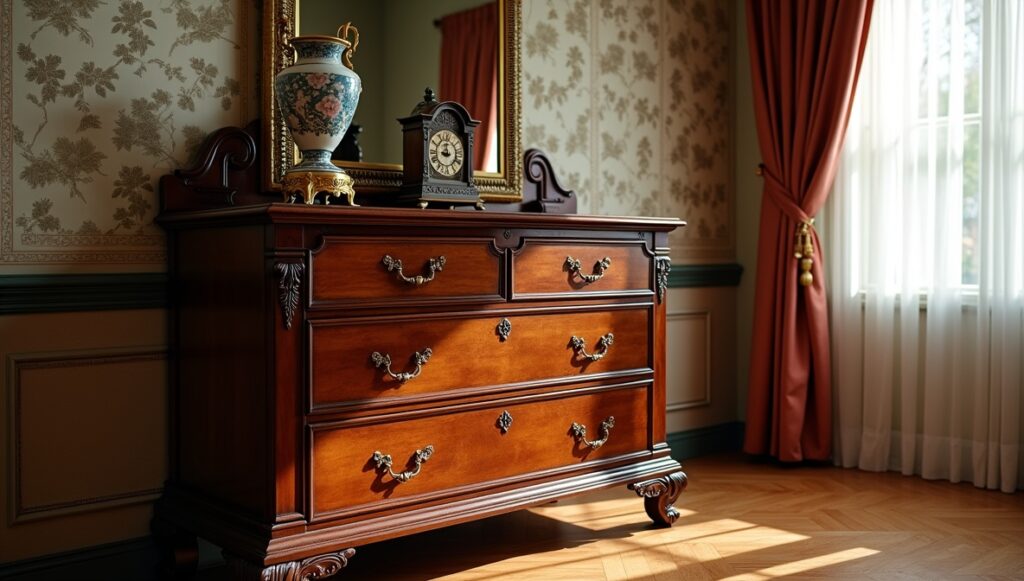
These objects also matter as evidence of craft—of the cabinetmaker’s capacity to join structure to surface, to turn global materials into local meanings, and to translate social ideals into tactile form. When we study marquetry patterns, carved motifs, and the wear of hands on handles, we are reading a history written in wood and finish rather than in text alone. Museums and archives help us place these readings within broader narratives, but private stewardship plays an equally important role in preserving what survives.
For collectors and historians alike, the stakes are ethical as well as aesthetic. Restoration choices can either preserve or erase the object’s capacity to speak. In an era that often prizes the new and the seamless, 19th-century bedroom furniture invites a different attentiveness: to patina, to repair, to the visibility of time. Its continued relevance lies precisely here—in reminding us that interiors are not merely designed, but lived, maintained, and inherited, and that the most intimate spaces of the past can still illuminate how we live now.