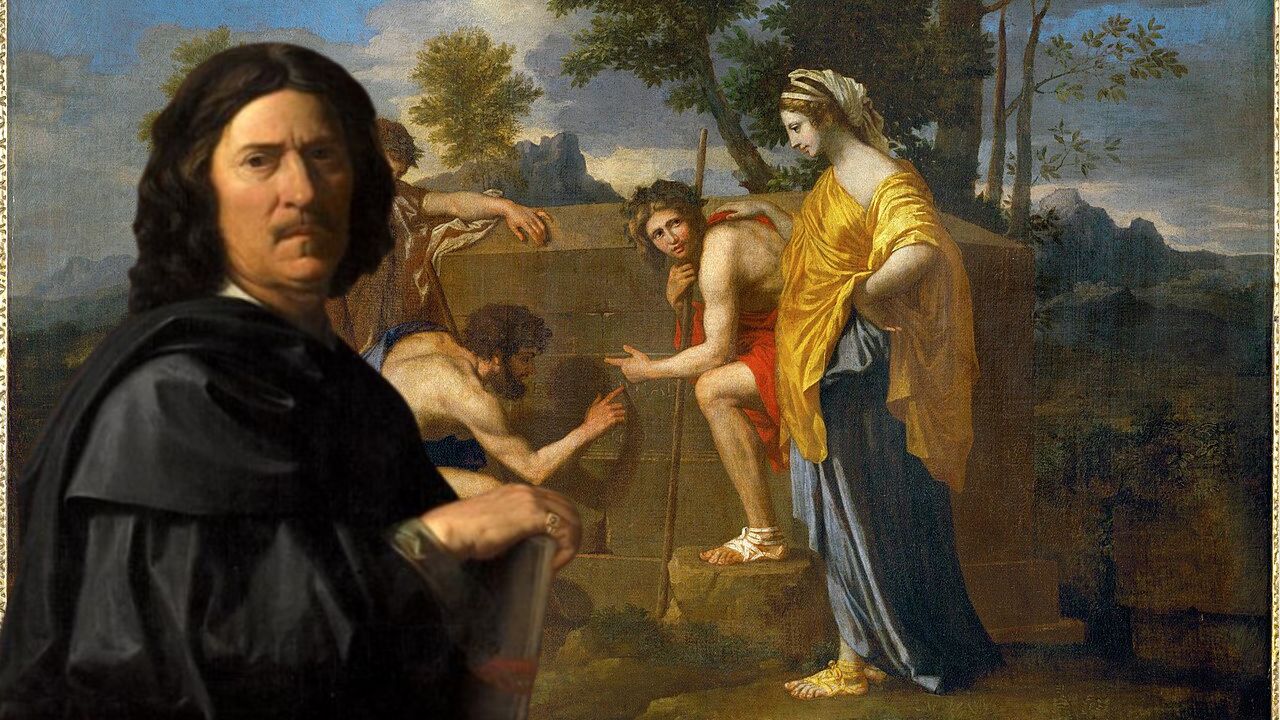
Nicolas Poussin (1594–1665) holds a unique place among 17th-century painters, a French artist who made Rome his spiritual home and created a painting of temperate passion, archaeological accuracy and religious seriousness. It is within the culture of learned allusion that characterized artistic discourse in Rome in the 1630s and 1660s a world of poets, painters, collectors, and priests sharing a common understanding of the literature and visual culture of antiquity that one must seek the ‘secret symbol’ in the paintings of Poussin. Symbols of this kind in his work were generally not arbitrary in the sense of being randomly associated or coded in a personal way; they were instead prompt signals to be ‘read’ by those equipped to interpret them according to the same set of references.
The notion of a secret within Poussin‘s work isn‘t a post-modern obsession, but an appreciation of how his paintings operate. Poussin‘s clients and intellectual sparring partners including Cassiano dal Pozzo (the magnificent Roman “paper museum” collector), antiquarian-minded clergymen, and art connoisseurs appreciated paintings they could keep looking at. The “secret” often has to do with size: a small object, a small writing, a classical image hidden away within a relief, or so on. This was just what went well with cabinet viewing, with paintings examined at close range in studioli rather than at a distance.
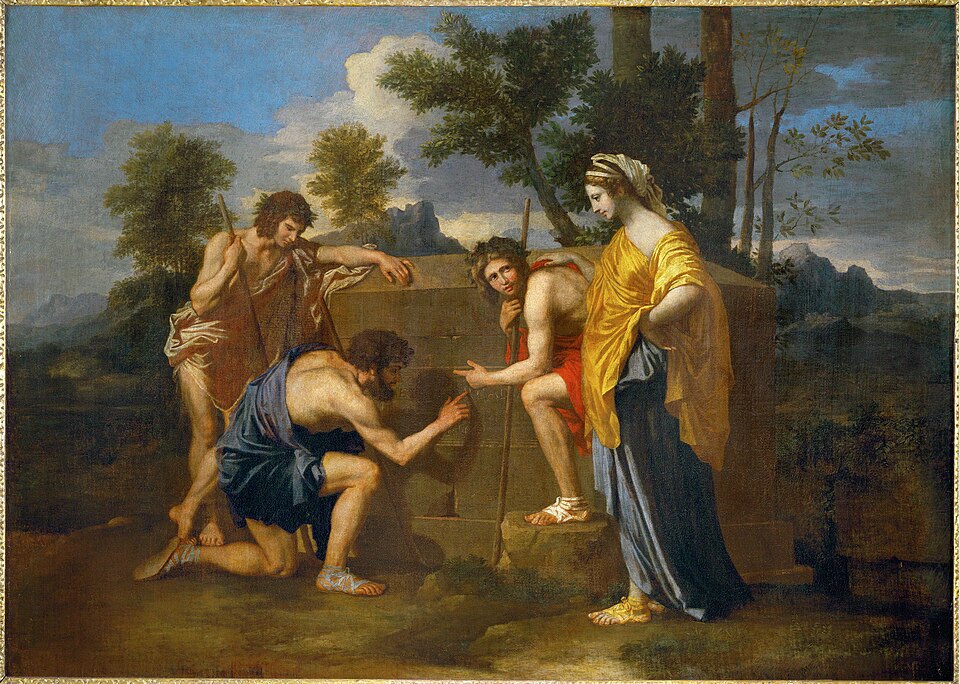
An imaginary and in the last resort factually verifiable “hidden clue” from Poussin is not a cipher in the present-day sense, but an emblem, an archaic sign: a relief on an artificially constructed sarcophagus, a herm, a cippus (stele), a laurel or a subtly placed inscription. Poussin‘s penchant for grounding stories in historically and archaeologically suggestive, albeit often fictitious, objects with interpretive potential has been discussed at length. The model here is the legendary Arcadia inscription ET IN ARCADIA EGO in Les Bergers d’Arcadie (The Shepherd of Arcadia, Louvre), which is both object and inscription and has been modified from version to version in its treatment.
This is the historical ground on which “experts reveal a hidden clue”: through technical study (infrared reflectography, raking light, pigment analysis), close reading of iconography, and archival triangulation. While the headline suggests a singular discovery, the more accurate scholarly picture is cumulative: interpretive breakthroughs often arise when connoisseurship, conservation science, and documentary research converge. Institutions such as the Louvre, the Musée Condé at Chantilly, the National Gallery (London), and the Metropolitan Museum of Art have, over decades, built a critical apparatus that makes these “hidden” elements legible again.
“In Poussin, the smallest antique fragment can carry the heaviest moral burden; the clue is not decorative surplus but the hinge of meaning.”
—paraphrased from the critical tradition of Poussin studies in museum and academic literature
Cultural and symbolic meaning
But Poussin‘s symbols are generally not personal enigmas: they are moral tools. His paintings repeatedly dramatize the intersection of human deeds with grand frameworks (history, Providence, nature, fate), often through the filter of antiquity. A mystery symbol in this context becomes an interpretative prop: a meditation on death (skull, tomb, sarcophagus, sepulchral inscription); a sign of civil or religious authority (altars, fasces, tablets); or a token of poetic recollection (garlands, urns, laurel). These signs were easily readable to a seventeenth-century audience well versed in Livy, Ovid, Virgil, and the various books of emblems circulating in France and Italy.
The Arcadian inscription serves as a model for it appears to be innocuous but defies facile interpretation. Et in Arcadia ego, as if inscribed into the marble of the painted scene, compels the spectator to ask who is speaking? Death? the departed? an “I” which is itself memory? Poussin transmutes a pastorale into a philosophical argument. He uses the inscription to achieve temporal collapse. Arcadian innocence the idyll harbors death itself. In this case, the “secret” is not one of concealment, but semantic openness, enacted as archaeology as the shepherds decipher the inscription.
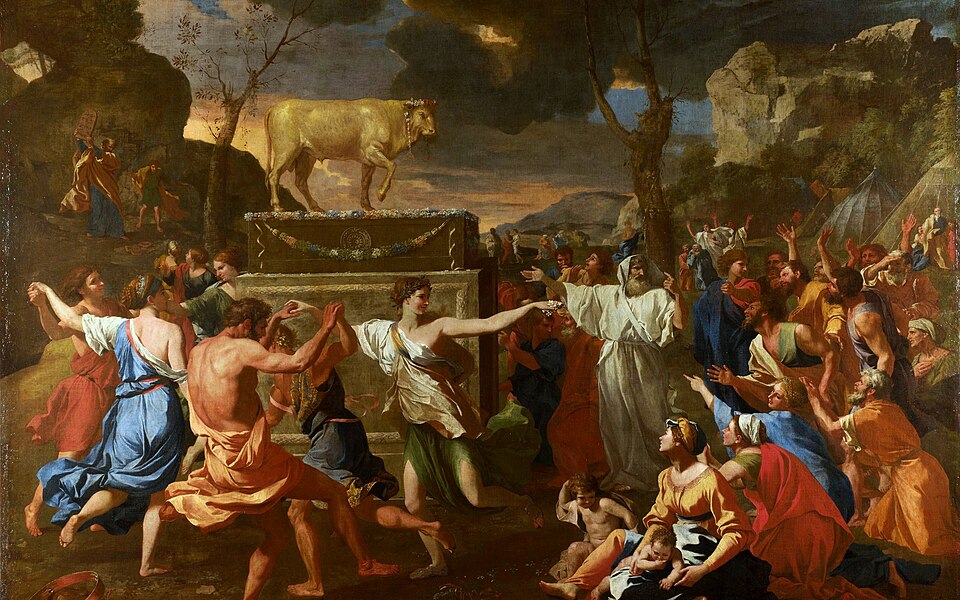
In addition to inscriptions, other elements in Poussin‘s symbol-language are antique-looking objects designed to evoke Roman material culture, often appearing as reliefs, urns, herms, or fragments. They are, however, more than simple props: Poussin uses them as what we might call indexical objects, objects that refer outwards to bodies of external knowledge, like the conventions of Roman funerary practice, or the icons of pagan gods and virtues. So a relief of a sacrificial ceremony can turn a scene into a meditation on ritual, while a broken column might become an icon for political destruction. Poussin‘s classicism is not just stylistic, it is also epistemic knowledge has become material.
It is also important to acknowledge the seventeenth-century taste for layered reading. Courtly and clerical audiences relished the interplay between text and image—inscriptions, mottoes, and emblematic objects invited a mode of viewing that oscillated between looking and reading. Poussin’s art belongs to this culture without being reducible to it. Where many emblematic images deliver a neat moral, Poussin tends toward productive tension: serenity and catastrophe, order and contingency, beauty and loss. The “hidden clue” is often a pivot that turns a story into a meditation.
Finally, the symbolic program in Poussin is inseparable from the period’s intellectual networks. Cassiano dal Pozzo’s circle, with its obsessive attention to antiquities, encourages us to see Poussin’s symbols as a kind of painted antiquarianism—an art that invents objects to feel archaeologically true. The clue is “hidden” because it is set at the level of objects rather than gestures; it sits in the world of things, which Poussin renders with an authority that tempts us to trust them as historical evidence, even when they are imaginative reconstructions.
Craftsmanship and materials
Poussin‘s studio practice a blend of Roman training and French discipline can help account for how symbols go unnoticed: with largely oil on canvas compositions (there are also some on panel), his works are constructed in a measured accumulation of layers that favor clear shapes and easy-to-follow stories. In that clarity, tiny details can be extremely efficient: several brushstrokes suffice to create a carved letter, the border of a carving, the shine of bronze, or the powdery patina of marble.
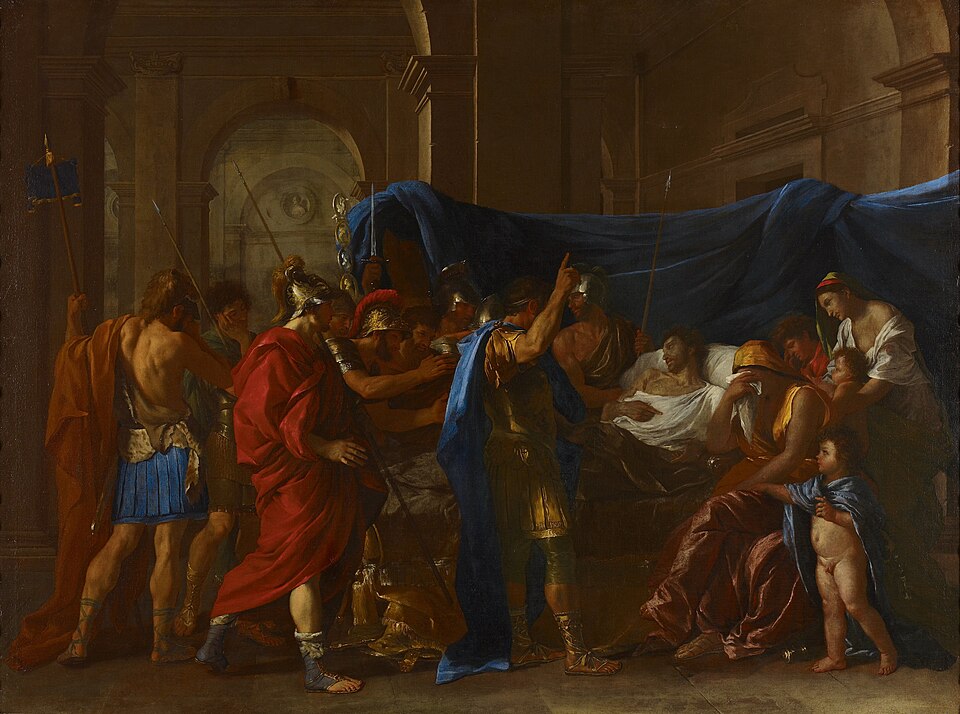
On the level of the decorative arts, Poussin‘s pretend materials are an integral component of the symbolic program. Poussin paints his stones not as stone-like but differently stone-like. Travertine is warm, marble cool, limestone worn, all specified in color temperature and handling. This is crucial to how the “hidden clue,” generally inscribed or sculpted or otherwise incised, presents itself to the eye on stone. The artifice of Poussin‘s rendering is the precondition for the symbol‘s presence as an artifact.
He is even adept at representing materials and cloths that are themselves iconic. Bronze can stand for the stability of law or worship, gold for divine or royal power, cloths can be marked by their color and drape to refer to status, virtue or worship. If a symbol is ‘hidden’ it may be hidden by material reason hidden in the shadow as actual inscriptions or partial ruin, as would happen to actual ancient items. Poussin seemed to sense that a real object derives authority from its not being presented too openly.
Technical examination undertaken by major museums has repeatedly shown how Poussin revised details at the level where symbols often live. Pentimenti (changes during painting) can shift the placement of an object, clarify an inscription, or adjust the emphasis of a relief. Such revisions are not merely compositional; they can be interpretive. A tomb moved closer to the figures changes the psychology of the scene; an inscription made more legible changes the painting’s rhetoric. In this sense, material study is not separate from iconography—it is one of the primary ways iconography becomes historically secure.
The following table summarizes the kinds of “symbol-bearing objects” most often implicated when scholars speak of hidden clues in Poussin:
| Object type | Material simulated | Common location in composition | Typical symbolic function |
|---|---|---|---|
| Sarcophagus / tomb | Stone (marble/limestone) | Foreground or midground | Mortality, memory, historical time |
| Cippus / inscribed stele | Stone | Near figures as a “readable” object | Textual cue; moral or philosophical hinge |
| Antique relief fragment | Stone | Embedded in architecture | Ritual, precedent, civil order |
| Urn / vessel | Stone or metal | Near mourners or altars | Ashes, legacy, commemoration |
| Laurel / garland | Plant matter | Worn or draped | Poetic fame, victory, apotheosis |
Historical locations, museums, and archives
Poussin‘s Roman life and afterlife unfold through a series of sites: the temples and palaces, collections and churches of the city; the libraries and archives to which the antiquarian culture added volume upon volume; and, finally, the museums, where Poussin’s paintings became the standards of “classical” painting. Rome was the medium‘s archive; ancient monuments and the circulation of newly uncovered material provided an artists’ lexicon; and much of Poussin‘s iconography can be read as a reply to its material history.
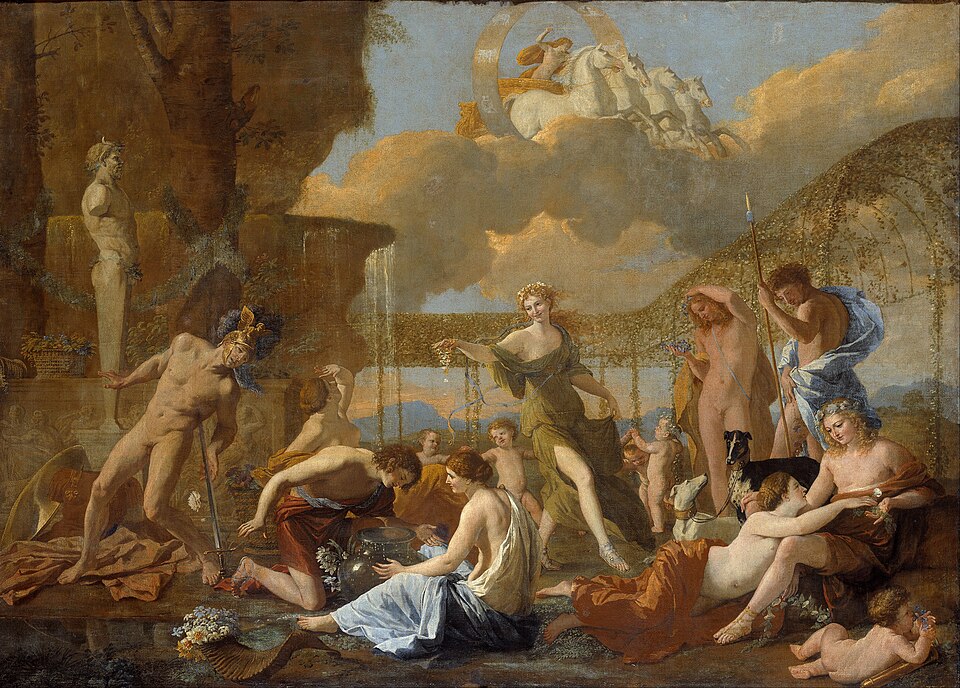
Today the museum offers access plus interpretive infrastructure. The Louvre, owner of a number of major Poussin canvases, has been involved time and again in conservation efforts and exhibitions that reveal new information about surface condition and iconographic details. The National Gallery of London has regularly published conservation results in its bulletins that illuminate underdrawings, Pentimenti, and the state of the paint film, information that may promote an incidental mark to an intended one.
Equally important are the archives and documentary corpora. Such sources as letters, inventoies, or early accounts tell us what was expected of the spectator. In particular, the culture of scholarly investigation fostered by Cassiano dal Pozzo, whose ‘Paper Museum’ now dispersed among collections in the Royal Collection, the British Library, and elsewhere represents the type of inventory of antiquities Poussin transforms into paint, is key to understanding his works. Even where a single drawing cannot be directly linked to a particular painting, the general practice of careful examination provides part of the explanation of why Poussin’s works are rife with artifact-like signs.
Historical locations also shape reception. Chantilly’s Musée Condé, for example, is inseparable from nineteenth-century French collecting and the construction of Poussin as a national classic. That later period reframed his symbols as emblems of rational order and civic virtue, sometimes smoothing out the ambiguity that earlier viewers may have felt more acutely. When “experts” today announce hidden clues, they often mean: we are recovering the seventeenth-century texture of meaning that later classicizing narratives simplified.
Finally, the “hidden clue” narrative is strengthened by the fact that Poussin’s works have traveled, been reframed, and sometimes been cut down, lined, or darkened by varnish. Museum histories are therefore integral to symbol histories. A detail may have been visible in a candlelit cabinet, then dulled by oxidized varnish, then revived by cleaning, then reinterpreted by scholarship. The object’s interpretive life is inseparable from its institutional life.
Collector perspective
To understand why Poussin’s symbolic details mattered, one must imagine the collector’s room rather than the modern gallery wall. Seventeenth-century collectors often experienced paintings as part of an ensemble: antiquities, medals, books, drawings, and small bronzes arranged to produce a learned environment. In such a setting, a painted inscription or relief is not only an image; it is a conversational partner to the objects nearby. The collector’s pleasure lay in recognition and comparison—an ethical and intellectual exercise as much as an aesthetic one.
Poussin’s paintings, in particular, reward this kind of close, slow attention. A collector trained in classical literature might read the narrative, then return to the objects: Why this urn? Why this relief? Why an inscription here? The “hidden clue” becomes a prompt for interpretive performance, a means by which the owner demonstrates learning to guests and to himself. This is not vanity alone; it is a period practice in which virtue, taste, and knowledge were intertwined.
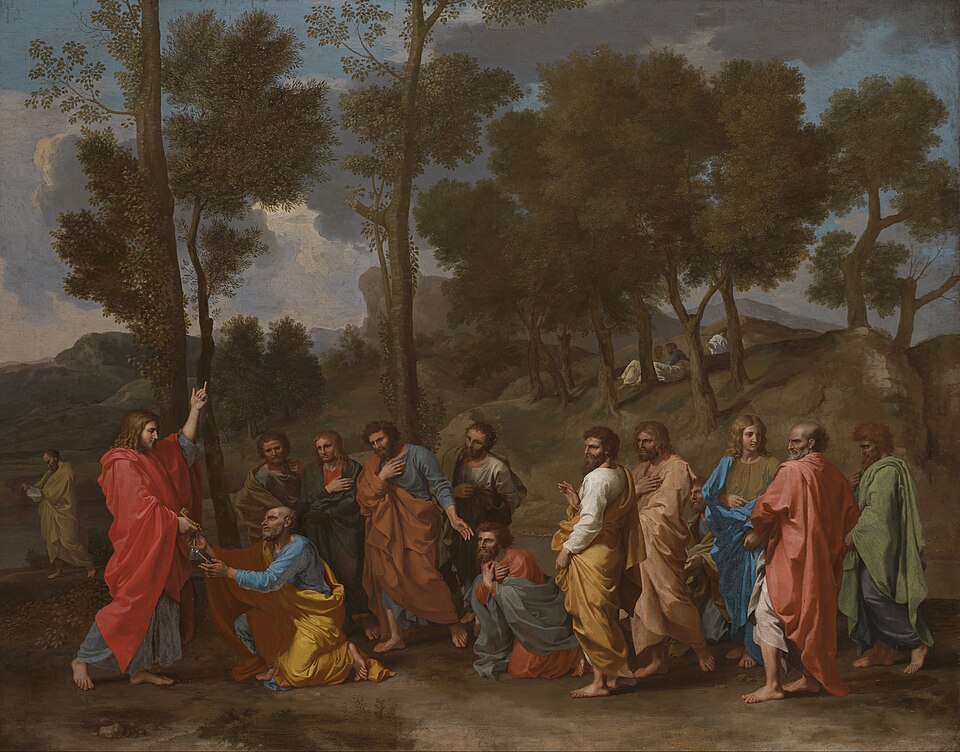
From the standpoint of later collecting, especially in eighteenth- and nineteenth-century Europe, Poussin acquired a reputational aura as the painter of reason and design. That reputation encouraged collectors to value his works as exemplars—almost didactic models—within aristocratic or institutional collections. Yet it could also lead to selective looking: grand compositional structure was celebrated, while small symbolic objects were treated as subordinate. Modern connoisseurship has partially reversed this by showing how those subordinate objects are often structurally necessary.
In today’s collector culture, “hidden clues” influence not only interpretation but attribution and desirability. A painting with a convincingly Poussinesque antique fragment—handled with the right mixture of archaeological plausibility and painterly restraint—can support arguments about authorship or date. Conversely, an oddly theatrical symbol, too sharply spelled out, may raise questions about workshop participation or later intervention. Collectors, conservators, and scholars therefore share a methodological interest: the symbol is not only meaning but evidence.
Restoration insights
It is in restoration, of course, that clues are most physically recovered. Poussin‘s palette and surface are especially prone to the optical distortion that occurs when varnish begins to deteriorate: the darker, viscous resins flatten both the tonal range and low-lying painted “carving” (as well as making inscriptions in plain view illegible). If cleaning can be achieved with careful testing and documentation, the tonal separation needed to see a letter as separate from stone, or a relief as read, can be recovered. But even cleaning is dangerous. Too much can leave paintings without glazes that make stone transparent or textiles deep.
With Poussin, the most significant conservation challenges are always about proportion more than dazzle. The relationship between things must be kept right for his classicism, and that includes the relationship of figure and ground, light and dark, color and line. If a conservation process exaggerates highlight while failing to reconstruct mid-tone, or if retouching makes an outline over-assertive, then the icon is made to speak too loudly.
Technical imaging has a disciplinary life of its own, too. Infrared reflectography can uncover underlying drawings and design choices. X-radiography will show areas of high pigment concentration orstructural changes. Microscopy can determine original paint from later overpaint. Such analysis can clarify whether an inscription was intended all along, adjusted partway through the process, or made much later; all meaningful for distinguishing a “hidden clue.” An icon visible only in a repainting has a separate history from one that was part of the original design.
Restoration files—held in museum conservation departments—are therefore a kind of archive parallel to letters and inventories. When responsibly published, they allow interpretations to be tethered to material facts: what is original, what is abraded, what has been reconstructed, what is uncertain. For an artist like Poussin, whose authority rests on disciplined intention, such anchoring is especially important. The most credible “expert reveal” is one that shows its work: imaging, comparative study, and transparent limits.
Market interest and collector demand
Market interest in Poussin is shaped by rarity, condition, provenance, and scholarly consensus. Major autograph works are uncommon on the open market, and when they do appear, they carry the weight of institutional comparison: every object is measured against museum-held benchmarks. In this context, symbolic details can become part of the evaluative apparatus. A painting that convincingly integrates Poussin’s antique-minded objects—neither too generic nor too showy—may be judged closer to the master’s hand or to his immediate circle.
Collector demand also intersects with the broader appetite for works that can be narrated. A “hidden clue” provides an interpretive handle, but serious collectors and curators tend to resist simplistic decoding. What matters is whether the symbol opens historically plausible readings and whether those readings are supported by technical and documentary evidence. The most valued works are those that remain intellectually active: they do not collapse into a single “solution,” but they are not arbitrary either.
Condition plays a particularly decisive role for symbol-bearing passages. If an inscription is compromised by abrasion, or if a relief is softened by heavy lining and overpaint, the painting’s interpretive intensity can diminish. Conversely, a well-preserved surface can reveal the delicacy with which Poussin calibrated legibility. Collectors often consult conservation reports precisely because in Poussin the smallest passages—stone letters, carved borders, tiny offerings—can be essential to meaning.
Finally, provenance and historical visibility matter. Paintings documented in early collections, or connected to known patrons and Roman networks, have a different market gravity than works that emerge without archival anchors. The “hidden clue” can sometimes assist provenance research: an identifiable motif may link a painting to a description in an inventory or to a pattern of subjects favored by a patron. But the market is cautious: interpretive ingenuity cannot substitute for documentation. Demand, at its most responsible, follows the triangulation of evidence.
Poussin‘s “secret symbol” is better thought of not as an encrypted message but as a disciplined method of building meaning on canvas. His “clues” (inscriptions, classical fragments, cult objects) were artifacts from a 17th-century world where knowledge was physical, reading was visual, and paintings could be made a tool of thought. When scholars “uncover” them today, they are often uncovering a lost connection between the surfaces of a picture and the meanings they serve such as the power of even a small, artifact-like detail to refocus the entire story on memory, death, or a moral dilemma.
Why does it still resonate? Because the theme encapsulates a model of perception. In a culture that favors the rapid ingestion of images, Poussin shows that attention is an ethical act. It implies a slowing down, a comparison, a suspicion, a return. His allusions remind us that things, whether actual antique statuettes collected in a cabinet or the painted rocks of Arcady, hold stories, individual and social. And they reveal why museums, archives and conservation studios are necessarily, still, and more than ever not sites of production of the new, but of renewed legibility of the old: through scrupulous and accountable work.