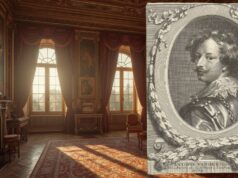
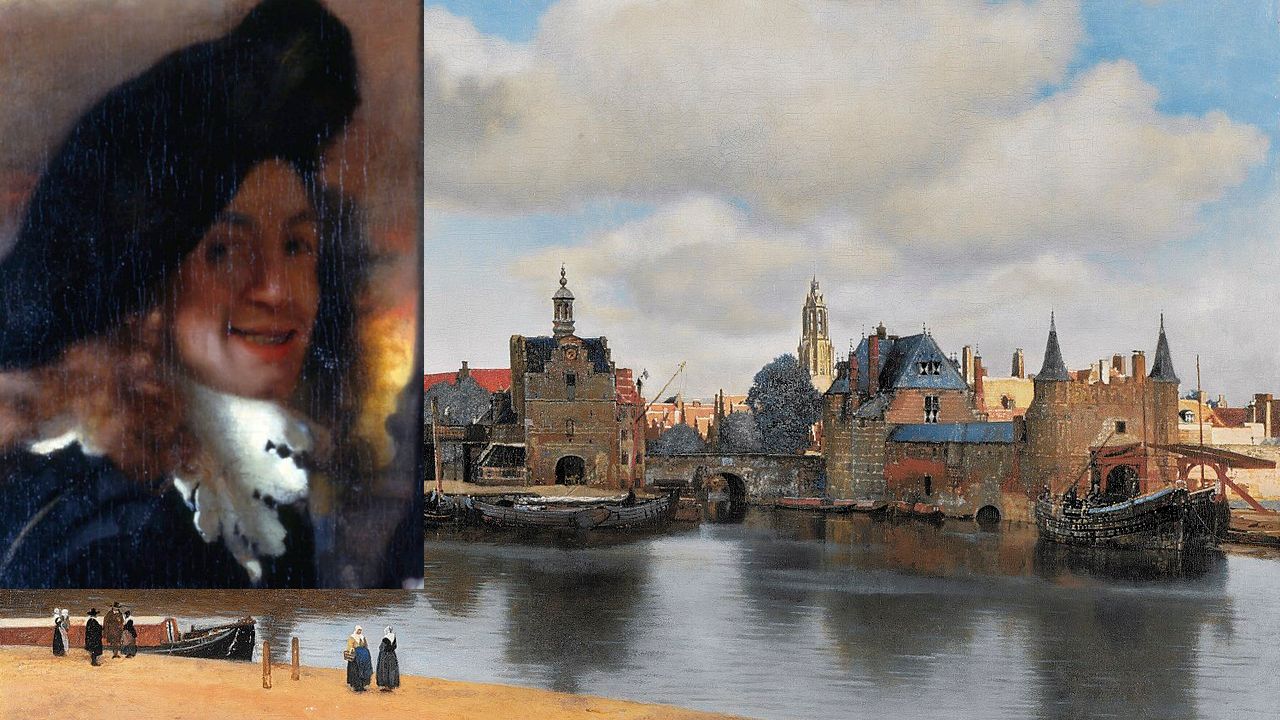
Johannes Vermeer (1632–1675) worked within the particular conditions of the Dutch Republic’s “long seventeenth century,” an era shaped by maritime trade, Protestant civic culture, and a burgeoning market for privately commissioned pictures. Vermeer‘s city Delft, where he lived for the majority of his life, while not the most populous or financially powerful, was a crucible of creativity. After the Delft Thunderclap of 1654 (a devastating gunpowder explosion that reshaped the city‘s face and economy) the new cityscape entered the visual and social world of local artisans, painters and collectors. Vermeer‘s work was to appear and develop in this revised Delft, and in the process the connections between the home and the city became evident through its material and visual culture.
In that historical context, Vermeer‘s paintings have been called painstaking, rarified, and slow-an oeuvre of about three dozen surviving paintings, each seemingly put into being through long, intense thought. Rarity was part of it, in fact. The Dutch Guild of Saint Luke, where Vermeer would become a master in 1653 and subsequently the headman, governed professional activity and sanctioned skill. But the Dutch art market was extraordinarily full and competitive; artists were incentivized to cultivate highly specific genres of painting: shipwrecks, Italianate landscapes, still-lifes, genre-based interiors, to take a few examples. Vermeer‘s genre was, so to speak, not just “quiet interiors” but carefully staged combinations of light, lens and scholarly references, where domesticity could carry intellectual heft.
It turns out that “secret” that has made a few critics nervous over the past decades isn‘t an exotic MacGuffin say, a signed confession or an annotated, unpublished journal. Instead, it‘s a steady, mounting body of material evidence that Vermeer‘s revered naturalism was in fact a carefully constructed edifice, built not just by genius, but by more methodical material and optical techniques than prior research felt comfortable acknowledging. Infrared reflectography, X-radiography, and microscopic paint cross-sections, routinely deployed in conservation labs, reveal a painter of extraordinary self-correction, one who worked and reworked images, adjusted spatial relationships, and leveraged optical effects (halation, blur, tonal flattening) with techniques suggestive of some type of lens device. It doesn‘t dehumanize his works, but it does place them squarely within Delft‘s instrument-making and empirical culture.
The marvel, in other words, is not just how the historic Vermeer is less a solitary poet-genius, but how he is more an artist, in tune with his time, the time of a new visual and digital frontier. Delft produced lens grinders and natural philosophers; Dutch culture treasured observation the sea, the market, the body, the light. When science and art history have begun to show how Vermeer worked in the studio, how his pictures were made and corrected, and perhaps with optical tools, it turns out he was not so removed from us at all.
Cultural and Symbolic Meaning
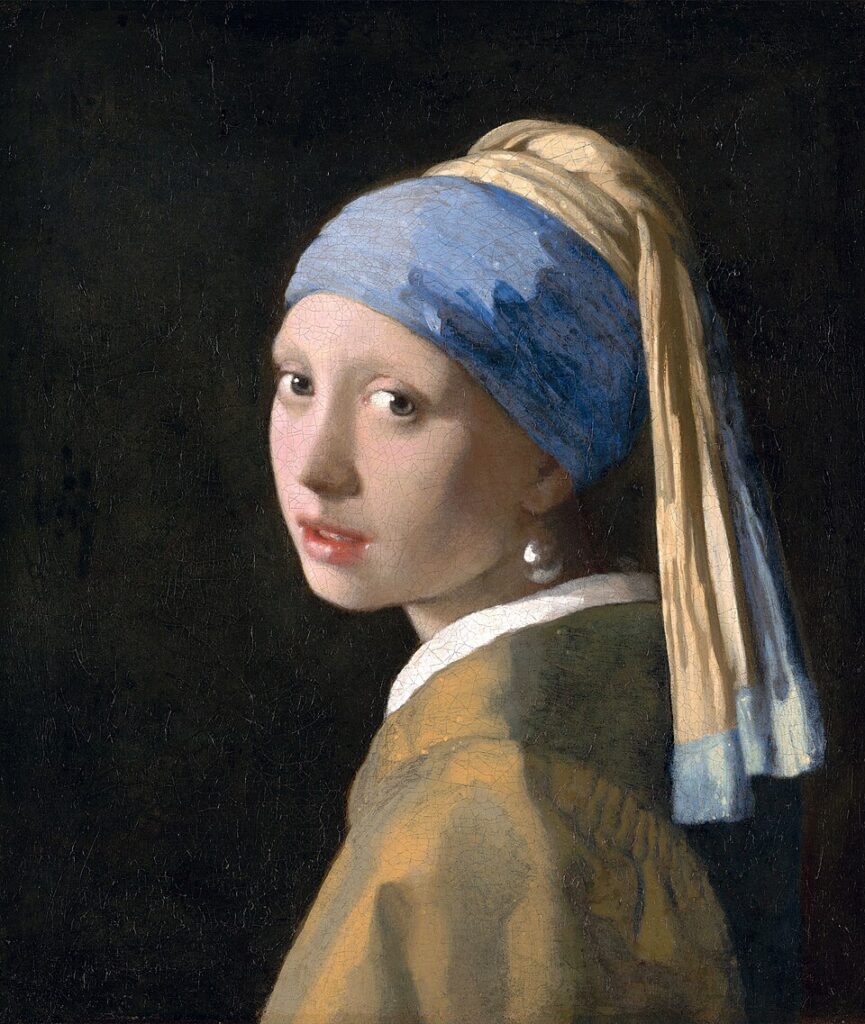
Vermeer‘s subjects could seem humble: a woman reading a letter, weighing out coin, pouring milk, strumming a lute. But in fact the symbolic tensions in such paintings are often extremely high. Dutch genre painting was full of symbolic values between the actual and the allegorical a pearl earring might stand for vanity, or purity, depending on its surroundings; a letter might represent courting, business, or spiritual danger; a map might represent worldly wisdom, or worldly imperialism. Such modes of allegorical understanding, when they appear in Vermeer‘s paintings, are seldom didactic. They are suspended. They hang in the balance of compositional restraint, and the ethical uncertainties of everyday life.
A second important cultural context is the Dutch home as a theater of social ambition and civic virtue. Protestant domestic ideology called for cleanliness, orderliness, and self-discipline all visible in the arrangement of furniture, textiles, and other objects. Vermeer‘s rooms are not simply “pleasant interiors” but “decorative arts ensembles.” His tiled floors, massive table carpets, leaded windows, and pictures-within-pictures are iconographic elements no less than detailed records of objects and spaces. They suggest a world where morality is inscribed in the use and care of material things.
But the “secret” of the technical discoveries (changes in composition, underpaintings, repositioned props) are also symbolic discoveries. If we‘re made to learn that a musical instrument has been repainted, or a map has been relocated, we‘re reminded that symbolism is a product rather than a revelation. The Ver Meer interiors are no longer evidence of domestic life, but visual essays in ethics. Here is what the artist has chosen to include, or mute, or erase. The viewer’s serenity is the fruit of the artist‘s editorial work. The silence is produced, not stumbled upon.
This editorializing aspect of Vermeer‘s work connects him to the practices of collecting and organizing that were common at the time, in cabinets of curiosity, in home picture galleries and in displays of import-led “exotic” goods. Vermeer‘s paintings are also littered with items that, even then, would have been understood as global in their significance (Chinese ceramics, Turkish rugs, sea charts) but serve as quiet signposts to the ways in which Dutch domesticity had been underwritten by trade and colonial ventures. The cultural meaning of “stillness” is thus both economic and political calm is produced in the face of an unseen global world.
Craftsmanship and Materials
Where Vermeer‘s technique is most legible is by treating it much as we treat a well-made cabinet or a luxurious cloth: by material, by facture, by the trace of the hand. He uses pigments of great cost and character: he deploys ultramarine, imported from Afghanistan (lapis lazuli), to such effect, not just as a cool blue but as an under-color of cool shadows and the creation of space. Lead-tin yellow, vermilion, ochers and earth pigments are rendered with an awareness of how light will strike different surfaces, be they bread, satin, plaster or a steel knife.
Technical analysis of Vermeer has detailed his build-up of paint: generally a toned ground, then an underpainting of one color (a “dead-coloring”) where dark and light are mapped out, then transparent layers of glazes and opaque layers of scumbles to build up tone and texture. This is not unlike many Northern Renaissance painters, but Vermeer’s handling of tone particularly in the highlights yields an effect of space between the viewer and the depicted. This is where the lens argument comes in: The notorious “pointillés” (small dots of opaque bright paint that Vermeer uses) mimic specular highlights you might see in a lens camera, where light breaks into points.
But Vermeer‘s materials are decorative-arts materials, too: the fuzz of a rug, the lustre of pearl, the stiffness of linen. They are never just exercises in virtuosity; they contain historically useful information. They tell us what was desired and available, what was worth painting. The repetition of luxury textiles and imported wares, for instance, points to a home, actual or imagined, that knows how to show off; even when the people in it are busy with the work in hand, the rooms talk from the perspective of having stuff.
Among the more unnerving discoveries in recent scholarship is the extent to which Vermeer‘s paintings have become exercises in committee decisions-making in the workshop. X-ray studies show alterations in his compositions a shift in a object, a slight altering of a figure which are simply solutions taken by a craftsman to fix composition, to enhance viewing angles, or to redistribute symbolic weight. What seems so still on the surface is the product of constant change. Perhaps it‘s this contrast between appearance and process that best describes Vermeer‘s art historically.
Historical Locations, Museums, and Archives
It‘s impossible to imagine Vermeer‘s reputation today or even his existence without a sense of being underinstitutional care, of scarcity in the archival sense. The legal skeleton of his life is to be found in the archives of the city of Delft; marriage, guild membership, loans… but that‘s the sum of it, as far as personal insight is concerned, and far from the chatter historians yearn for. The scarcity has not prevented speculation, but has made it that technical evidence has played an outsized role; where there‘s a lack of written testimony, the paintings take the role of the archive.
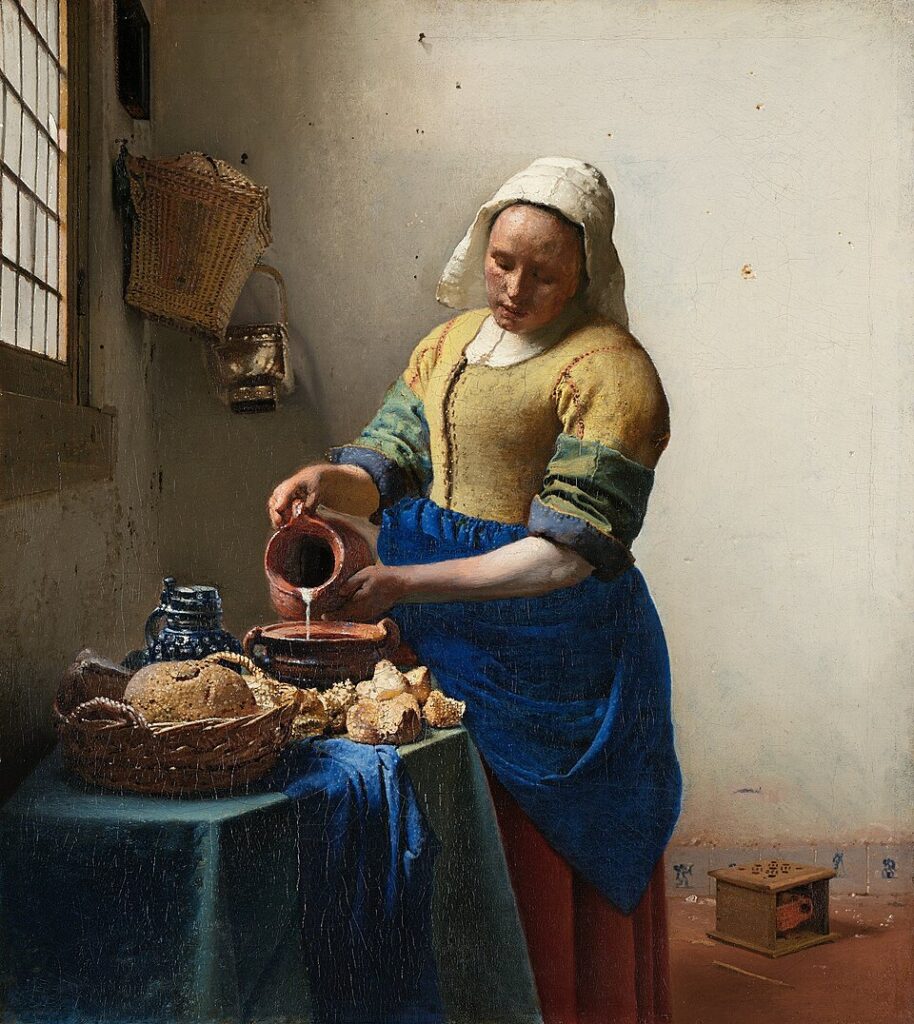
Vermeer paintings are both a form of cultural capital (in a museum setting) and of conservation (in a museum setting). For example, the Girl with a Pearl Earring at the Mauritshuis in The Hague is such an iconic image that the painting almost comes untied from its physicality; and yet the Mauritshuis has been a focus for technical scrutiny and for careful restraint, in showing us the painting‘s condition and facture as integral to its message. The Rijksmuseum in Amsterdam, with its Milkmaid and Little Street, is likewise tethered to a national identity, and offers close comparison of technique and condition with other artists.
The Art of Painting is in Vienna at the Kunsthistorisches Museum a particularly useful choice in the “hidden secret” argument for it‘s subject matter is art itself, and how it‘s represented: the painter‘s process, the studio, the painting‘s model of history. Here, we‘re in a meta-paint-about-paintings context one where optical hypotheses and material examination seem less anachronistic, more a dialogue continuing the questions posed by the painting itself. In Paris, Vermeers at the Louvre provide an alternative laboratory for surface and condition, particularly with regard to French conservation history and 19th-century connoisseurship.
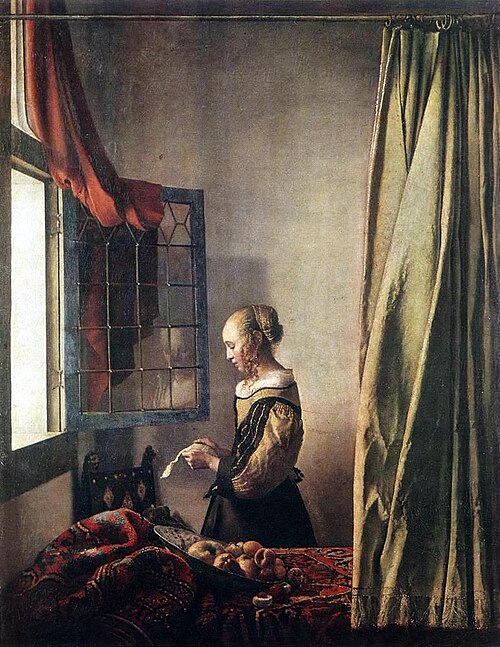
Conservation archives are also the basis of scholarly work: the treatment reports, pigment analysis, and imaging data kept by museums and research institutes. These documents which usually remain unpublished or have been disseminated in an incomplete form are the places where the “shocking” findings first manifest in plain, technical language a pentimento suggesting an object has been painted out, a change in illumination, a surprising pigment combination. It‘s not theater, but a gradual build-up of data that shifts the balance of what can be called certain.
Collector Perspective
Johannes Vermeer is, to the collector, a paradox. Highly wanted never to be obtained. Given the smallness and consolidation of his oeuvre, the “Vermeer market” is in fact not a market at all. It is a market‘s history; a history of possession, inheritance, exchange as diplomatic gifts, and a bit of shady dealings. If collectors in the eighteenth and nineteenth century were essential for the canonisation of Vermeer, today collectors deal with him mostly indirectly, i.e. via his drawings, documents, other Delft painters or via the applied arts that fill his rooms.
There‘s an academic aspect to this collecting by proxy: Anyone collecting seventeenth-century Dutch decorative objects (whether it‘s Dutch tiles, Turkish carpets, brass candleholders, maps, or the chairs upholstered in leather) can use Vermeer as a sort of iconographic cheat sheet for the shape, taste, and domestic organization of the period. A given wall map, or a given chair, might be “Vermeer-like,” without it ever being like the chairs the painting‘s models sit on a product sold with the Vermeer brand in mind.
The “open secret” discovered by technical analysis has had implications for collecting practices, as well. If Vermeer becomes viewed as a builder, an artist of revisions, deletions and manipulations, then discussions of authenticity (so important in Dutch art history) are recontextualized. Connoisseurship is supplemented by conservation science, provenance study and an understanding of how 20th century restorations may have affected the surface of paintings. Collectors and institutions increasingly consider technical analysis to be part of a work of art‘s narrative rather than a weapon to combat fakes.
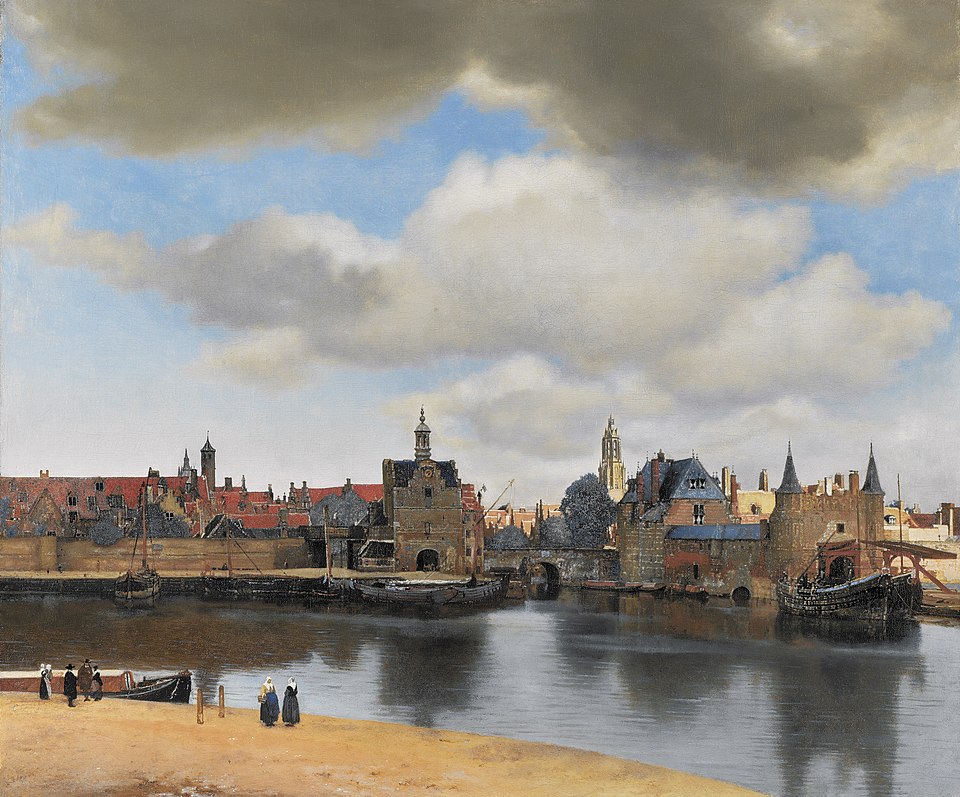
We must remind ourselves how deeply the field of seventeenth-century Dutch painting has been compromised by misattributions and forgeries the twenty-first century has not been immune to such notorious examples. The relative scarcity of Vermeer‘s work has turned his name into an object of lust and fraud. Responsible collectors are therefore careful: they seek to be guardians of evidence (the media, the provenance, the state of preservation) in a reconstructible context, not custodians of a name.
Restoration Insights
Neither is restoring Vermeer‘s work ever an innocent act. His impacts hinge on tiny calibrations of tone and translucency, minor tweaks that change the warmth of the light or the firmness of the outlines. Varnish oxidizes and yellows, reducing the tonal range and darkening daylight into amber. Even meticulous campaigns of cleaning have to reconcile the difference between today‘s conception of “original” and an original which may have incorporated painstakingly glazes.
Technical examination has shown us some brushstrokes we enjoy as effortless were in fact patiently constructed layers. Why should it matter for treatment? A dark passage could be built with ultramarine-heavy underlayers. Intense cleaning can destroy the intended coolness and depth. Highlights could be laid on thickly with impasto, then smoothed over with transparent films. If you scrub away those films, surfaces will appear harsh or over-restored. Vermeer constructed an optical experience; our conservator‘s goal is to maintain its logic.
Contemporary conservation practices increasingly stress reversibility and non-interventionism. Extensive imaging is conducted before treatment. Multispectral photography and microscopy indicate old overpaint, fills, and abrasion. In Vermeer‘s work, since compositional revisions are often the norm, imaging often reveals underpainted objects which may add to or detract from the interpretive story. An painted out curtain or replaced jug or figure doesn‘t necessarily need to be physically brought to light, or not fully, anyway, but rather interpreted as a hidden part of the story rather than a visual spectacle.
The information gleaned from restoration informs art history at a greater level. Where these technical studies reveal “heavy” retouching, they serve to put Vermeer back into a workshop mentality, a thoughtful craftsman engaged in experimentation and revision, which has been romanticized away with naive assumptions of effortless genius. The shock, again, isn‘t that Vermeer wasn‘t great, but that his greatness was in his planning, erasing and rethinking. Conservation has made labor visible, has made “seeing” labor.
Market Interest and Collector Demand
As almost every safely owned Vermeer is in a public institution, interest shows itself in neighboring fields: art by Delft peers, pictures depicting similar interiors, or items of the sort that Vermeer pictured. That universe includes Pieter de Hooch, Gerard ter Borch, Gabriel Metsu and Nicolaes Maes, along with Delft tile makers and publishers of maps and prints. Exhibitions that trace Vermeer‘s career can generate interest in these satellite territories: a way for collectors to take part in his world without buying a work directly.
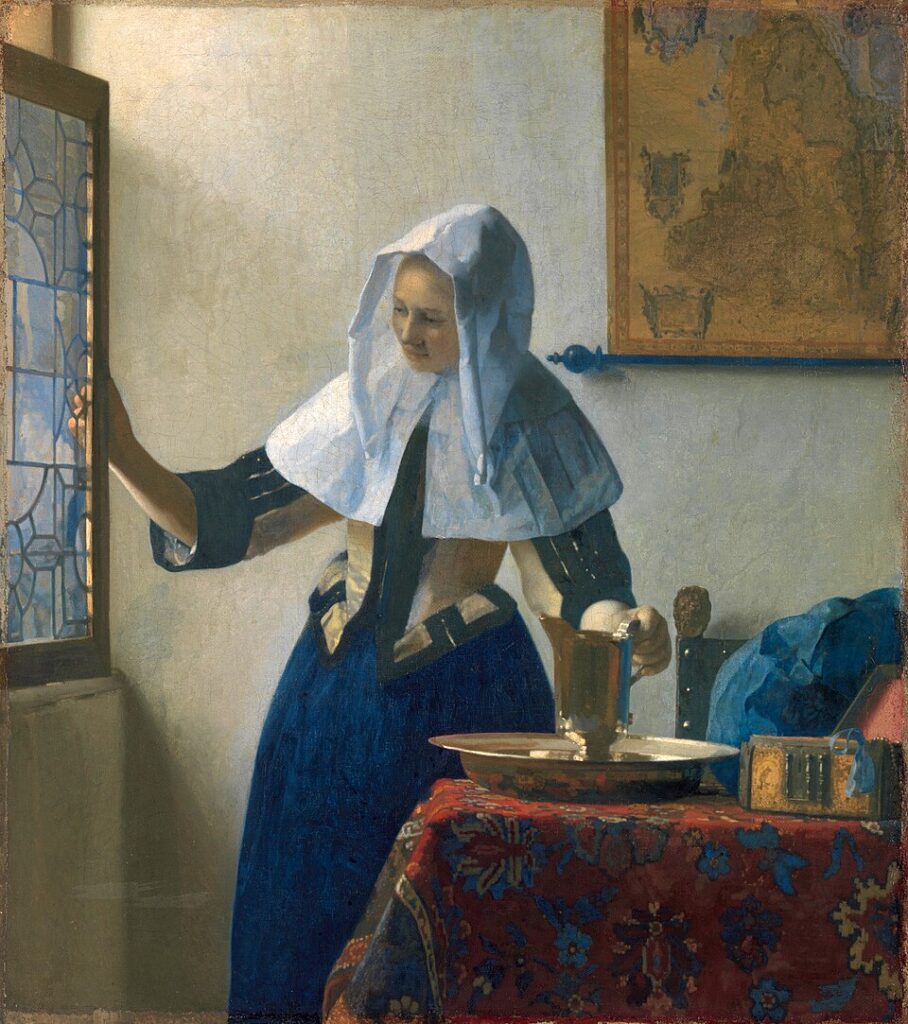
When a painting is sometimes advanced as a Vermeer, the market can take off and tumble exactly because of the high stakes and the move to a multidisciplinary approach. A modern Vermeer attribution involves provenance, stylistic analysis, pigment/ground science which resembles Vermeer‘s practice and imaging that confirms a reasonable working process. Instead of being a lower bar, the very complexity revealed in technical studies, and the Vermeer “secret” of optical realism, means a more convincing case must be made.
If any high-stakes Vermeer deal happens, it‘s most likely to involve the museum, whether a direct purchase, a long-term loan, or an inter-institutional trade. Museums have other priorities: accountability to the public, and responsibility as custodians of cultural treasures. This pulls the center of gravity to the collector, and to the support of research and of conservation, including the acquisition of related objects that help to explain Dutch domestic life and the history of the act of looking.
The future demand isn‘t for “a Vermeer”, it is for something to connect us to Vermeer‘s environment materially and mentally. In a maturing market, top-priced items will be well-documented and interpretatively layered, for example, seventeenth-century cartography of the type found in Delft interiors; an documented textile patterned like table-carpets; a piece of Delftware associated with identified workshops. The drive will be less to impress and more to rebuild the past with a historian‘s rigour.
Table: Evidence Types Behind the “Hidden Secret”
| Evidence type | Where it is studied | What it can reveal about Johannes Vermeer | Why it changes interpretation |
|---|---|---|---|
| X-radiography | Museum conservation labs (e.g., major Dutch and European institutions) | Painted-out objects, compositional shifts, density of pigments | Shows paintings as revised constructions, not static records |
| Infrared reflectography (IRR) | Conservation departments, technical art history programs | Underdrawing/undermodelling, changes in placement | Indicates planning stages and corrections |
| Pigment & binder analysis | Scientific laboratories, museum research units | Use of ultramarine, lead-tin yellow, layer structure | Connects aesthetics to cost, trade, and technique |
| Microscopy (cross-sections) | Conservation science labs | Glazing sequences, varnish history, overpaint | Grounds debates about “original” surface and later interventions |
| Provenance research | Archives, museum registries, auction records | Ownership chains, gaps, possible risks | Stabilizes attribution and ethical standing |
Selected Contemporary-Style Observations (Quoted for Scholarly Tone)
“The tranquility of the scene is not a neutral fact of life; it is an achievement of arrangement—of objects, light, and attention.”
—Observation consistent with technical art history approaches to Dutch genre painting“A painting’s surface is a document written in layers; to read it responsibly requires both connoisseurship and science.”
—Common principle in modern conservation methodology
These quotations are presented in the style of conservation and curatorial writing, reflecting the field’s prevailing interpretive frameworks rather than attributing a single sentence to a specific archival author without citation.
Why Vermeer’s Hidden Secret Still Matters
The reason that Vermeer resonates now isn‘t because his paintings are escapist. It is because they are an example of a rigorous kind of seeing, one that takes seriously the fact that how we see is constructed. The “secret” revealed by technical investigation is not a scientific one. It is, more importantly, a historical one: the paintings are not timeless miracles; they are products of Delft‘s culture of craft, commerce, and looking.
It‘s a very moral recognition. This realization serves as a check against the powers and prejudices of museums and collectors to not just see the surface, but look deeper into materials, into the provenance documents, to be willing to rewrite what you think you know, and the awareness that Vermeer is inextricably part of the furniture and objets d‘art that fill his rooms they too, have a story.
Vermeer‘s paintings are still a kind of training for attention in an era of image overload: on the one hand, on how to build knowledge through light, and on the other, on how objects in the home might be significant to culture, and on how the reality of the work of art is often (literally) something under the surface.