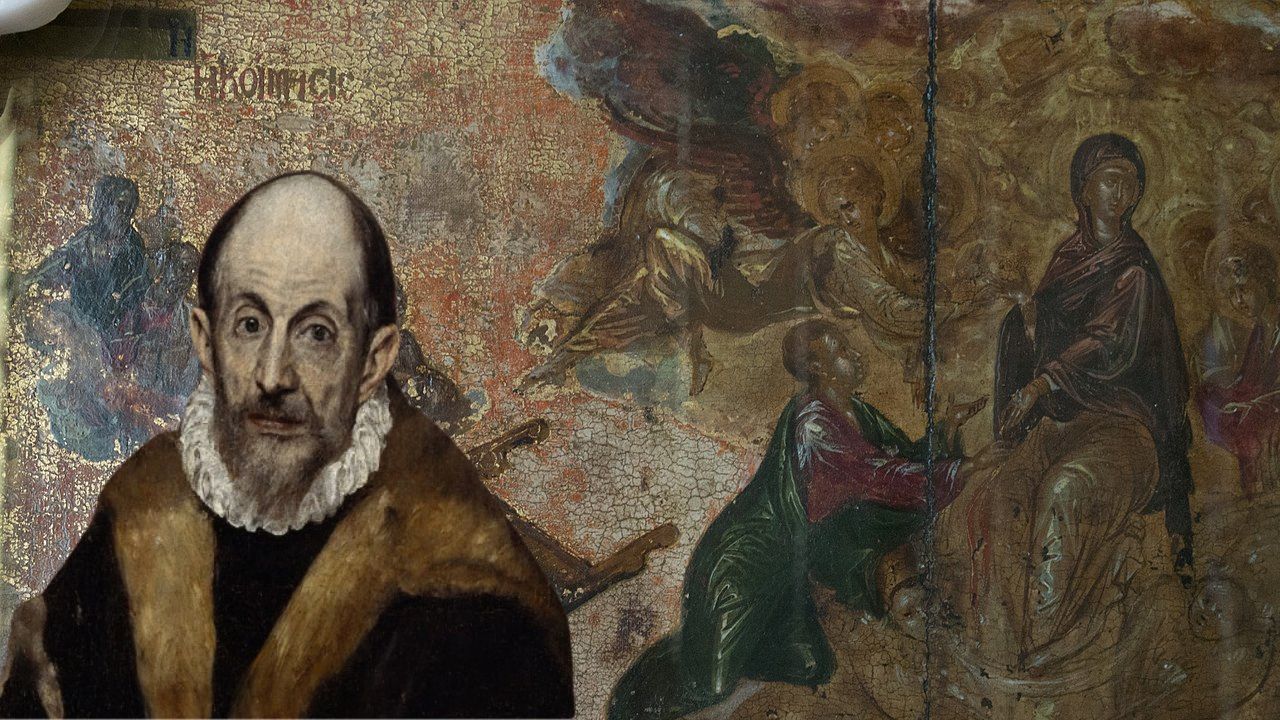
El Greco’s life reads like a migration map of early modern art: born in Venetian-ruled Crete, trained in the icon tradition of the Greek East, refined in Venice and Rome, and finally transformed—sometimes celebrated, sometimes resisted—within the charged spiritual and political climate of Counter-Reformation Spain. What makes this story more than a sequence of places is the way El Greco (Doménikos Theotokópoulos) used each stop to invent a visual language that could speak to mysticism, institutional power, and personal ambition all at once. His “strangeness” was not a quirky accident of temperament but a hard-won synthesis—built from contracts, patrons, rivalries, and the demands of a city that wanted art to instruct the faithful while also proclaiming status. In Toledo, El Greco found the stage on which his hybrid identity could become a new kind of Spanish painting, even as that same stage limited his reach.
El Greco Arrives: An Outsider Shocks Spain
1. The Untold Story of El Greco: How an Outsider Remade Spanish Painting
When El Greco arrived in Spain in the late 1570s, he was not a provincial newcomer but an artist formed in the great workshops of the Mediterranean. Born in 1541 in Candia (modern Heraklion) on Crete—then part of the Venetian maritime empire—he had already absorbed the icon tradition before moving west to Venice and then Rome. By the time he set his sights on Spain, he carried credentials rare in the peninsula: he had seen Titian’s color up close, studied Tintoretto’s daring compositions, and measured himself against Roman debates about disegno and decorum (Pacheco, 1649; Honour & Fleming, 2009).
Spain in the 1570s was not merely seeking painters; it was building an imperial image. Philip II’s court promoted an art of doctrinal clarity, moral gravity, and controlled grandeur, especially around the vast project of El Escorial. El Greco tested those expectations. His The Martyrdom of Saint Maurice (1580–82), painted for Philip II, offered a complex, divided narrative and a heightened spiritual atmosphere that did not align with the king’s preference for immediate legibility—an episode that illustrates how an outsider’s sophistication could read as disobedience at court (Museo del Prado; Kamen, 1997).
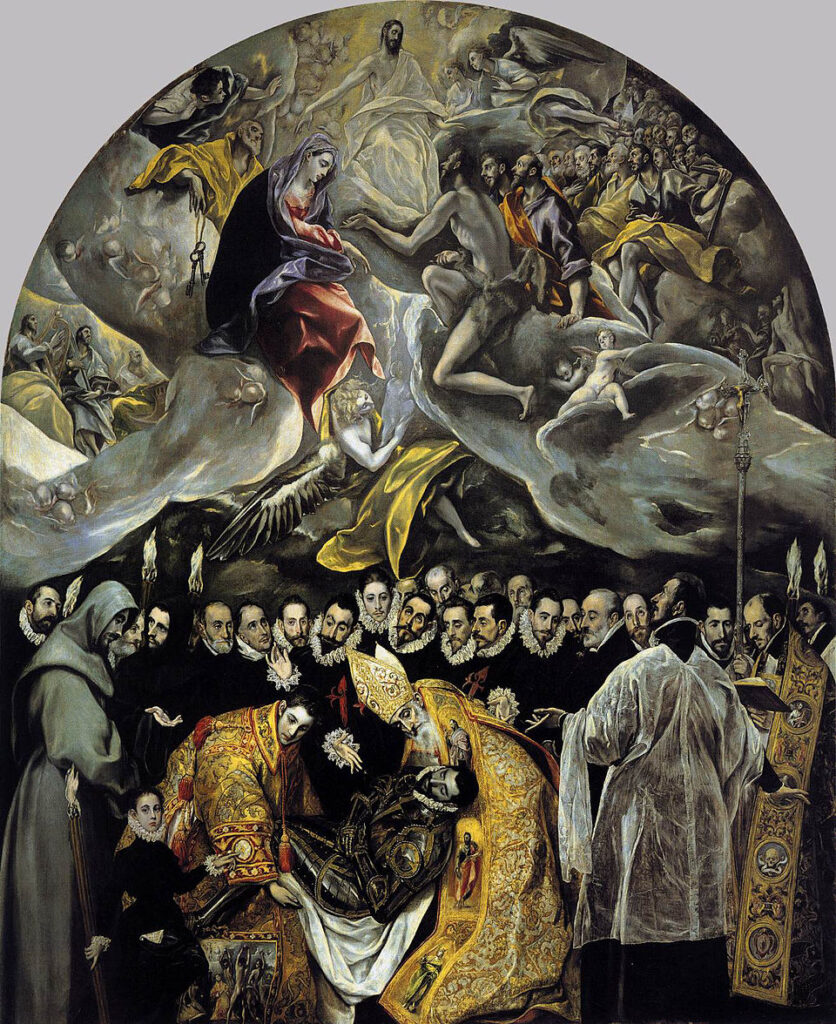
Yet the deeper “remaking” happened not at court but in Toledo, where El Greco built a body of religious painting that made inward experience visible. Instead of relying on serene balance, he pushed verticality, intensified color, and dramatized gesture to convey spiritual urgency. What matters historically is that he helped widen what Spanish sacred art could do: not only teach doctrine, but stage ecstasy, dread, and transcendence as lived states.
2. What History Reveals About El Greco’s “Strange” Style—and Why It Wasn’t an Accident
The long-standing myth that El Greco painted oddly because of poor eyesight or eccentric instability does not survive contact with the evidence. His distortions are consistent, purposeful, and tuned to context—traits more compatible with intention than impairment. Contemporary sources already recognized his deliberate manner: Francisco Pacheco, who visited El Greco in Toledo in 1611, described his working methods and the artist’s intellectual self-confidence, not a man overwhelmed by accident (Pacheco, 1649).
Established fact: El Greco’s style evolved through identifiable phases—Cretan icon clarity, Venetian color and painterly freedom, Roman ambition and debate, and finally the Toledan synthesis. Historical interpretation: many scholars argue that his elongations and compressed space function as spiritual rhetoric, a way of “unmooring” the viewer from ordinary perception so that the supernatural feels imminent (Álvarez Lopera, 2005). The significance lies in timing: in Counter-Reformation Spain, art had to move hearts while staying within acceptable bounds; El Greco’s solution was to intensify the sacred without turning it into mere spectacle.
This “strangeness” also served a social purpose. Toledo’s elite—cathedral clergy, confraternities, and learned patrons—responded to images that could signal refinement and inward devotion. In that setting, stylistic singularity was a form of distinction. El Greco’s manner announced not only faith, but cultural capital: an art that looked like nothing else in Spain precisely because it carried Europe within it.
3. El Greco in Toledo: The City That Made (and Contained) a Genius
Toledo was an old capital with a formidable ecclesiastical presence, a city whose prestige rested on the cathedral, ancient traditions, and a dense network of religious institutions. It also offered something El Greco needed after the court disappointment: a market capable of sustaining a major workshop. By 1577 he was receiving significant commissions, including works connected to Santo Domingo el Antiguo, which helped establish him as a leading painter in the city (Museo del Prado; Metropolitan Museum of Art).
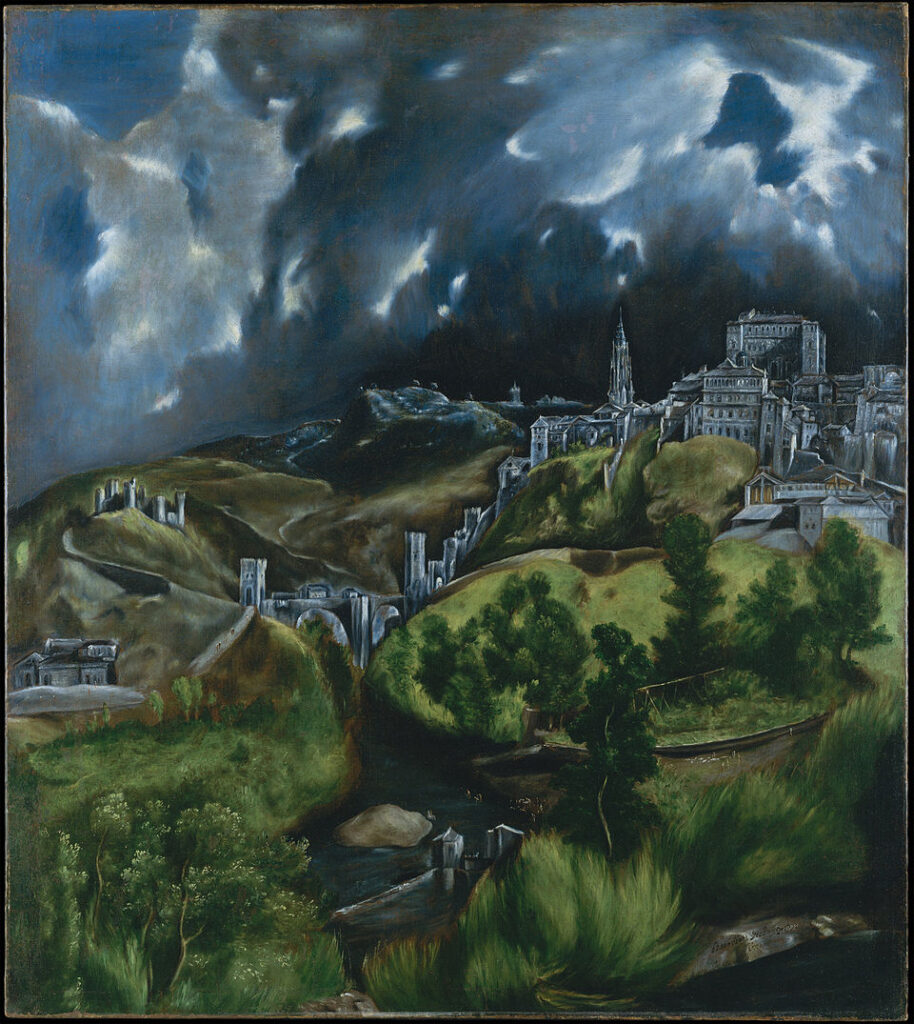
The city “made” him by providing patrons who valued intellectual and spiritual intensity. The Disrobing of Christ (El Espolio, 1577–79), painted for Toledo Cathedral, is both a masterpiece and a document of negotiation: its dramatic crowding and high-key color create a sense of ritual violence, while the composition forces the viewer into proximity with the sacred body. What makes this especially significant is that the painting’s very power became part of the controversy over payment and propriety—Toledo wanted greatness, but on its own terms.
Toledo also “contained” him. Unlike Madrid, it did not offer endless courtly opportunities, and its patronage networks could be insular. El Greco became indispensable locally yet remained vulnerable to local tastes, disputes, and institutional pressures. His genius therefore looks less like solitary freedom and more like a constant bargaining with a city that admired his fire but watched its boundaries closely.
4. The Rise and Fall of El Greco’s Reputation: From Celebrated Master to “Mad” Painter—and Back Again
In his lifetime, El Greco was neither ignored nor universally adored; he was a recognized master in Toledo, with prestigious commissions and a thriving studio. Yet within decades of his death in 1614, his reputation began to dim. Spain’s artistic center of gravity shifted, and Baroque naturalism—exemplified by Velázquez and later Zurbarán—made El Greco’s charged abstraction seem old-fashioned or excessive. The decline was not merely aesthetic; it reflected changing devotional and institutional preferences for clarity, restraint, and persuasive realism.
By the 17th and 18th centuries, El Greco’s manner was often framed as aberration. Antonio Palomino’s influential biographies helped shape taste, and later writers sometimes reduced El Greco to a cautionary tale of genius warped into error (Palomino, 1724). Here we must distinguish fact from interpretation: it is a fact that later criticism often pathologized his style; it is an interpretation that such pathologizing served broader cultural needs—defining “good taste” by excluding what did not fit academic norms.
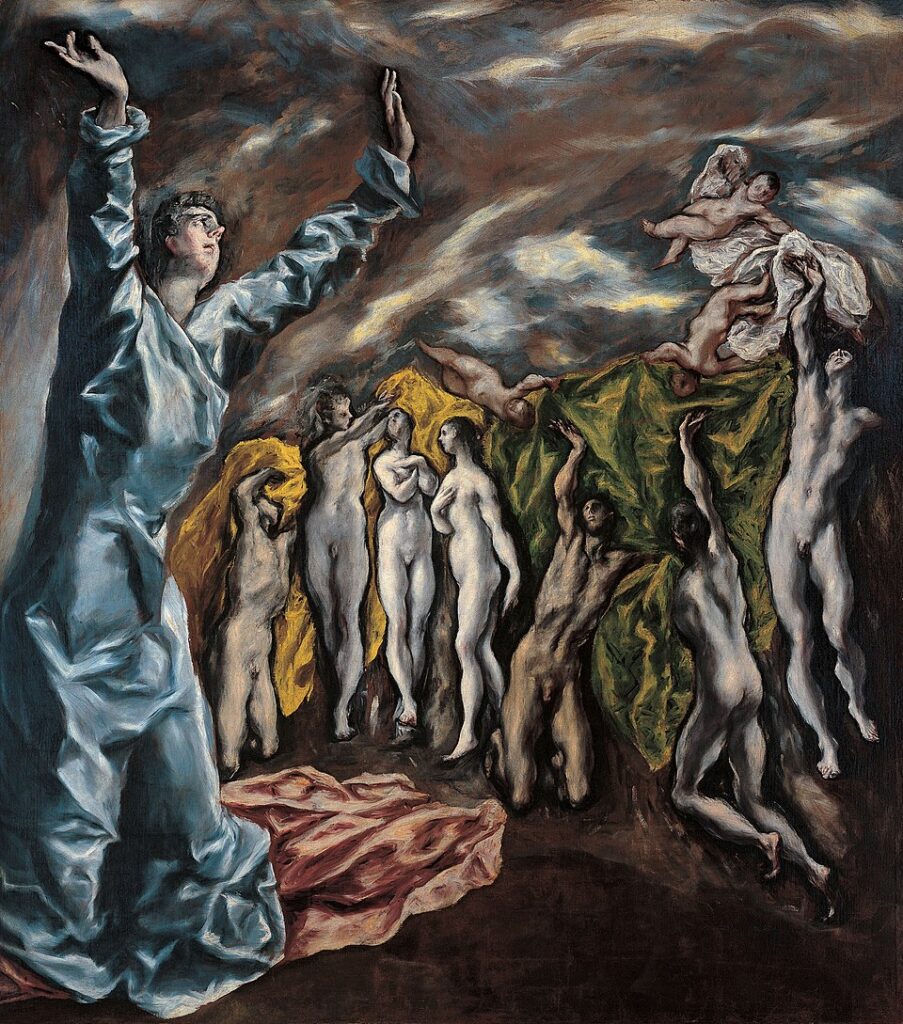
The reversal came with modernity. From the late 19th century onward, artists and critics searching for expressive distortion and spiritual intensity rediscovered him. Museums such as the Museo del Prado and institutions like the Metropolitan Museum of Art helped canonize him internationally through collecting, exhibitions, and scholarship. El Greco’s “madness” began to look like foresight—not because he predicted modern art, but because modern art learned to value what earlier academies had policed: subjective vision made visible.
5. The Untold Story of El Greco’s Origins: From Crete’s Icons to Spain’s Altarpieces
El Greco’s Cretan beginnings are not an exotic footnote; they are foundational to his mature language. Crete in the 16th century was a major center of post-Byzantine icon painting under Venetian rule, where artists navigated Orthodox tradition and Western influences. El Greco likely trained within this environment, learning the icon’s hieratic frontalities, rhythmic drapery, and spiritual directness—tools that would later reappear, transformed, in his Spanish altarpieces (Álvarez Lopera, 2005).
Established fact: documents associate him with icon-painting and the title of “master” in Crete before his departure. Historical interpretation: scholars debate how consciously he retained icon logic later on, but many see in his Toledan saints a reimagined icon presence—figures that confront the viewer not as portraits of flesh but as emissaries of another register of reality (Honour & Fleming, 2009). This matters because it reframes his “Spanish” achievement as a Mediterranean synthesis rather than a sudden local invention.
When El Greco built altarpieces in Spain, he was not abandoning the icon so much as enlarging it. The Spanish retablo demanded theatrical scale and narrative programming, yet El Greco often preserved the icon’s essential demand: to look, and be looked at, in a moral encounter. His saints do not merely occupy space; they press toward the viewer as if the painting were a threshold.
6. What History Reveals About El Greco’s Patrons: The Power Networks Behind His Most Famous Works
El Greco’s patrons were not generic “churchmen” but specific actors in Toledo’s power ecology: cathedral administrators, monastic communities, confraternities, and noble households whose commissions asserted both devotion and authority. The cathedral’s role in El Espolio shows how an image could be a theological statement and a public negotiation over money and status at once. Contracts, valuations, and disputes—preserved in archives and studied by modern historians—reveal that El Greco’s art circulated within legal and institutional frameworks, not romantic isolation (Museo del Prado; Brown, 1998).
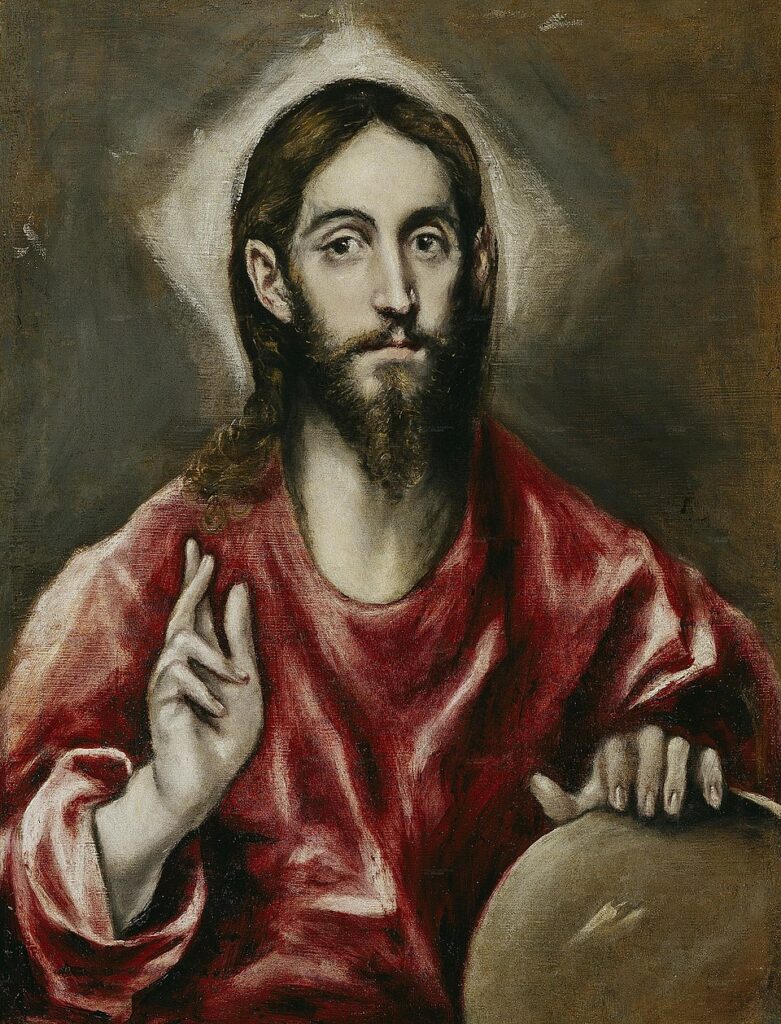
A key node in this network was the circle of educated clerics and humanists who prized learned invention. El Greco’s portraits—such as those of clerical and civic elites—also functioned as political objects, stabilizing identity in a city where lineage, office, and orthodoxy mattered. The relationship between patron and painter was therefore reciprocal: patrons enabled experimentation, but they also shaped what kinds of experimentation could survive.
Historians continue to debate the degree of El Greco’s autonomy. One school emphasizes his strong personality and negotiation tactics; another stresses that even his boldest works remain legible within Counter-Reformation goals of affective piety (Brown, 1998). What makes this debate significant is that it changes how we read the paintings: either as personal visions imposed on patrons, or as sophisticated collaborations in which patrons selected El Greco precisely because he could visualize spiritual intensity with unmatched force.
From Crete to Venice: El Greco’s Making Abroad
7. El Greco’s Lost Years: The Venetian and Roman Lessons Hidden in His Spanish Paintings
El Greco’s years in Venice (around 1567–70) and Rome (around 1570–76) are sometimes treated as a prelude, but they are the engine of his later impact. In Venice he absorbed a painterly approach to color and light associated with Titian and the city’s broader culture of oil painting. In Rome he encountered an art world obsessed with theory, competition, and the legacy of Michelangelo—an encounter that sharpened his ambition and his willingness to depart from local norms (Honour & Fleming, 2009).
Some evidence suggests he joined or interacted with Roman artistic circles, and sources record his outspoken judgments—stories that may be partly shaped by later anecdote, but consistent with an artist determined to be more than a provincial craftsman. Established fact: he produced works in Italy that demonstrate assimilation of Venetian colorism and Roman figural drama. Interpretation: scholars often read his later Toledan skies, light, and spatial compression as Italian lessons intensified into spiritual weather—an atmosphere that functions as theology by other means.
What matters is not merely influence but transformation. Many painters borrowed from Italy; El Greco internalized Italy’s arguments about what painting should be—whether it should imitate nature, surpass it, or reveal truths nature cannot show. In Spain, he answered by pushing representation toward revelation.
8. The Untold Story of El Greco and the Church: How Faith, Politics, and Art Collided in Toledo
Counter-Reformation Catholicism demanded that images teach, move, and remain doctrinally safe. Toledo, as an ecclesiastical powerhouse, was especially sensitive to this mandate. El Greco’s commissions thus sat at the intersection of private devotion and public orthodoxy, where the Church’s authority was reaffirmed through visual culture. The collision came when inventive painting met institutional scrutiny—over iconography, decorum, and cost.
El Espolio is the clearest case: the cathedral chapter contested aspects of the composition and resisted the price, leading to prolonged conflict. This was not merely a quarrel about money; it was a clash over who controlled the meaning and value of sacred images. El Greco’s insistence on artistic authority—his claim that invention and excellence warranted high payment—challenged a system that often treated painters as skilled suppliers rather than intellectual creators (Brown, 1998; Museo del Prado).
At the same time, the Church did not simply repress him. Many ecclesiastical patrons repeatedly hired him, suggesting that his work met core devotional needs even when it irritated administrators. Historically, this duality is crucial: El Greco’s Toledo was not a place where faith crushed art, but where faith and art negotiated a tense partnership—one that produced images of extraordinary spiritual charge precisely because they were made under pressure.
9. What History Reveals About El Greco’s Elongated Figures: A Visual Language of Mysticism, Not “Mistakes”
El Greco’s elongated bodies and small heads have generated endless speculation, but the most persuasive historical reading treats them as expressive strategy. They create vertical pull, as if the body were being drawn upward by grace. They also deny the viewer the comfort of ordinary anatomy, nudging perception toward the uncanny—an apt register for visions, saints, and apocalyptic scenes. Whatever one’s taste, the internal consistency of these forms across decades argues against accident.
Mysticism was not marginal in Spain; it was one of the era’s most powerful spiritual currents, associated with figures like Teresa of Ávila and John of the Cross. While we should be cautious about claiming direct links between El Greco and specific mystic texts without documentary proof, the broader cultural climate makes an art of ecstasy intelligible. Interpretation: many scholars propose that El Greco’s distortions visualize spiritual intensity by making the body a conduit rather than a weight (Álvarez Lopera, 2005).
This matters because it shifts our understanding of “realism” in sacred art. El Greco’s saints are not meant to be medically credible; they are meant to be spiritually persuasive. His style asks a historical question still relevant today: should religious painting imitate the world, or remake the world to show what belief claims lies behind it?
10. El Greco and the Price of Genius: The Lawsuits, Contracts, and Conflicts Behind the Masterpieces
El Greco’s career in Toledo was punctuated by contracts and lawsuits that reveal the economic realities of early modern art. Payment disputes—especially around major ecclesiastical commissions—show that even celebrated painters faced institutional bargaining, expert appraisals, and delayed compensation. The documentary record makes one thing plain: masterpieces were also legal objects, defined by deliverables, deadlines, and valuations.
The conflicts also illuminate El Greco’s self-conception. He priced his work high and defended its worth, aligning himself with the Italian ideal of the artist as intellectual creator rather than mere artisan. Historical interpretation: his litigiousness can be read as arrogance, but it can also be understood as a strategy for sustaining a large workshop and maintaining status in a competitive market where institutions routinely tried to reduce costs (Brown, 1998).
What makes this especially significant is how these disputes shaped the art itself. When patrons contested iconography or composition, El Greco had to justify invention in terms that administrators could accept. In that sense, the paperwork did not merely follow the paintings; it helped form the boundaries within which his visionary language could operate.
11. The Untold Story of El Greco’s Workshop: Who Helped Build the Legend in Toledo?
El Greco did not work alone. Like most successful painters of his time, he ran a workshop capable of producing large altarpieces, replicas, and related works. Assistants prepared canvases, laid in compositions, and executed secondary passages—practices that complicate modern desires to locate the “pure” hand of the master in every square inch.
A central figure was his son, Jorge Manuel Theotokópoulos, who trained as a painter and later became an architect and collaborator on commissions. Established fact: Jorge Manuel was active in El Greco’s later years and helped sustain the business after 1614. Interpretation and debate: scholars continue to attribute certain late works to varying degrees of workshop participation, using connoisseurship and technical study to separate hands—an area where museum research, including conservation findings, has been especially influential (Metropolitan Museum of Art; Museo del Prado).
Why it matters: the workshop model explains both the breadth of El Greco’s output and the unevenness sometimes noted in late repetitions. More importantly, it reveals how “genius” functioned historically—not as solitary production, but as a brand of invention sustained by trained labor, patron demand, and a recognizable style that could be extended beyond a single pair of hands.
12. What History Reveals About El Greco’s Afterlife: How Modern Artists Turned Him Into a Proto-Modern Icon
El Greco’s modern revival was not a neutral rediscovery; it was a reframing. Late 19th- and early 20th-century artists and critics, searching for ancestors of expressive distortion, saw in him a precedent for modern subjectivity. Museums accelerated this afterlife by exhibiting and publishing him as a major European master, allowing his Toledan works to circulate as images and ideas far beyond Spain (Museo del Prado; Louvre collections).
Interpretation: calling El Greco “proto-modern” risks flattening historical difference, as if his purpose were the same as modernist experimentation. Yet the comparison can still be meaningful if handled carefully. His distortions and spiritual atmospheres demonstrate that radical form is not exclusive to secular modernity; it can emerge from religious urgency, institutional negotiation, and cross-cultural formation.
The deeper historical lesson is about reception itself. El Greco’s reputation rose, fell, and rose again because art history is not simply a record of quality—it is a record of what different eras need to see. In the age of academies, he looked like error; in the age of expression, he looked like prophecy. The paintings did not change, but the questions viewers brought to them did.
El Greco’s story is most revealing when it is kept chronological and earthly: a Cretan-trained icon painter becomes a Venetian colorist, a Roman aspirant, and finally Toledo’s uncompromising master—building an art that answered Counter-Reformation needs while stretching them to their limit. His elongated saints, storm-lit heavens, and compressed spaces were not visual accidents but choices forged in contact with patrons, institutions, and the legal machinery of commissions. The result was an outsider’s remaking of Spanish painting: not by rejecting Spain, but by showing it a new grammar of the sacred—one that later centuries could misread as madness, and modern eyes could finally recognize as deliberate power.
Key Facts Summary
| Category | Details |
|---|---|
| Date | 1541–1614 (El Greco’s lifespan); Spain from 1577 onward; El Espolio 1577–79; Saint Maurice 1580–82 |
| Location | Born in Candia (Crete, Venetian rule); worked in Venice and Rome; based in Toledo, Spain |
| Key Figures | El Greco (Doménikos Theotokópoulos); Philip II; Francisco Pacheco; Jorge Manuel Theotokópoulos |
| Historical Impact | Expanded the expressive possibilities of Spanish sacred painting; became a key case study in shifting artistic taste and modern rediscovery |
| Interesting Detail | Major masterpieces were shaped by contracts and disputes—especially over payment and decorum—showing art as both spiritual object and legal commodity |
Historical Interpretations & Debates
| Historian / School | Interpretation |
|---|---|
| Jonathan Brown (early modern Spanish art scholarship) | El Greco’s career in Toledo shows the tight linkage between art, patronage systems, and institutional power—genius negotiated through contracts and expectations (Brown, 1998). |
| José Álvarez Lopera (Prado-linked scholarship) | Emphasizes El Greco’s formation across Crete/Italy/Spain and reads his style as an intentional expressive system rather than an anomaly (Álvarez Lopera, 2005). |
| Reception-history approach (19th–20th c. modernist reframing) | El Greco’s “proto-modern” status reflects modern values projected backward; useful if treated as reception history, not as his original intention (Museo del Prado; Louvre collections). |
Sources & References
- Museo Nacional del Prado (Madrid), artist and collection documentation on El Greco; object entries for El Espolio and other works.
- Metropolitan Museum of Art (New York), Heilbrunn Timeline and collection essays on El Greco and Spanish painting.
- Pacheco, Francisco. El arte de la pintura (1649) — primary-source perspective from a near-contemporary visitor to El Greco.
- Palomino, Antonio. El museo pictórico y escala óptica (1724) — influential early biography shaping later taste and criticism.
- Brown, Jonathan. Painting in Spain 1500–1700 (Yale University Press, 1998).
- Álvarez Lopera, José. El Greco (Madrid/Prado-associated scholarship; widely cited monographic work, 2005).