Few works of art confront the viewer as directly—and as uncomfortably—as Hans Holbein the Younger’s The Body of the Dead Christ in the Tomb (often shortened in discussion to “Dead Christ Holbein”). Painted in the early 16th century, it strips away idealization and presents Christ as a human corpse: slack flesh, greenish pallor, and the stillness of death pressed into a narrow tomb. Standing before it, many viewers feel less like they’re witnessing a devotional image and more like they’re encountering a forensic record. That shock is precisely the point: Holbein forced Renaissance Europe to face what the Crucifixion actually implies—mortality, decay, and the precariousness of faith.
Holbein’s painting is not merely “grim.” It is a carefully constructed theological and artistic argument, made during a period when Europe’s religious foundations were being shaken by the Reformation and by new forms of naturalism in art. Its power has endured for centuries, influencing writers, theologians, and artists who have grappled with the tension between belief and physical reality.
Today, the painting’s authority rests not only on its emotional impact but on its historical specificity: a master painter at the crossroads of Northern Renaissance craft, Basel’s humanist culture, and a Europe increasingly divided over how sacred images should look and what they should do.
Holbein, Basel, and the Reformation-Era Eye
Hans Holbein the Younger (c. 1497–1543) worked in Basel, a major center of printing and humanist scholarship in the early 1500s. Basel was home to influential intellectual networks and publishers, and it was also a city where religious reform and debates over images intensified. In this climate, paintings were not neutral objects; they were part of a contested visual culture in which realism could be read as either devotional truth or dangerous provocation.
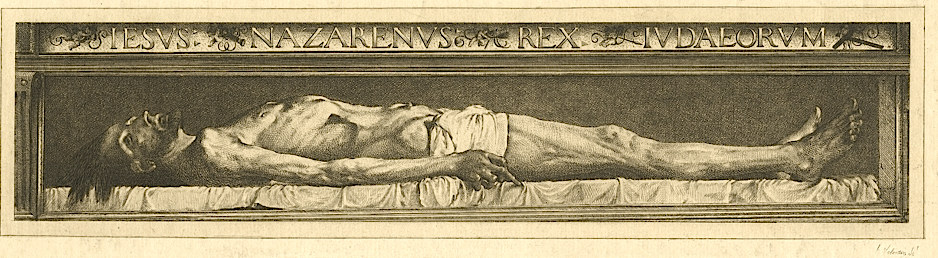
The Dead Christ is typically dated to 1521–1522, a moment when Martin Luther’s challenge to Rome had already spread widely and iconoclasm was a real threat in many regions. Holbein was not painting in isolation from these upheavals. Even if the work was made for a specific patron and devotional context, the painting’s austere, unembellished realism resonates with an era skeptical of easy religious consolation.
The painting’s current home—the Kunstmuseum Basel—reinforces its embeddedness in that regional history. Basel’s institutional stewardship matters: the city preserves Holbein not as a generic “Old Master” but as a local figure whose art documents a particular cultural and religious fault line in early modern Europe. That institutional context helps explain why the work continues to be studied as a turning point in sacred representation.
What Makes the Painting So Disturbing—and So Modern
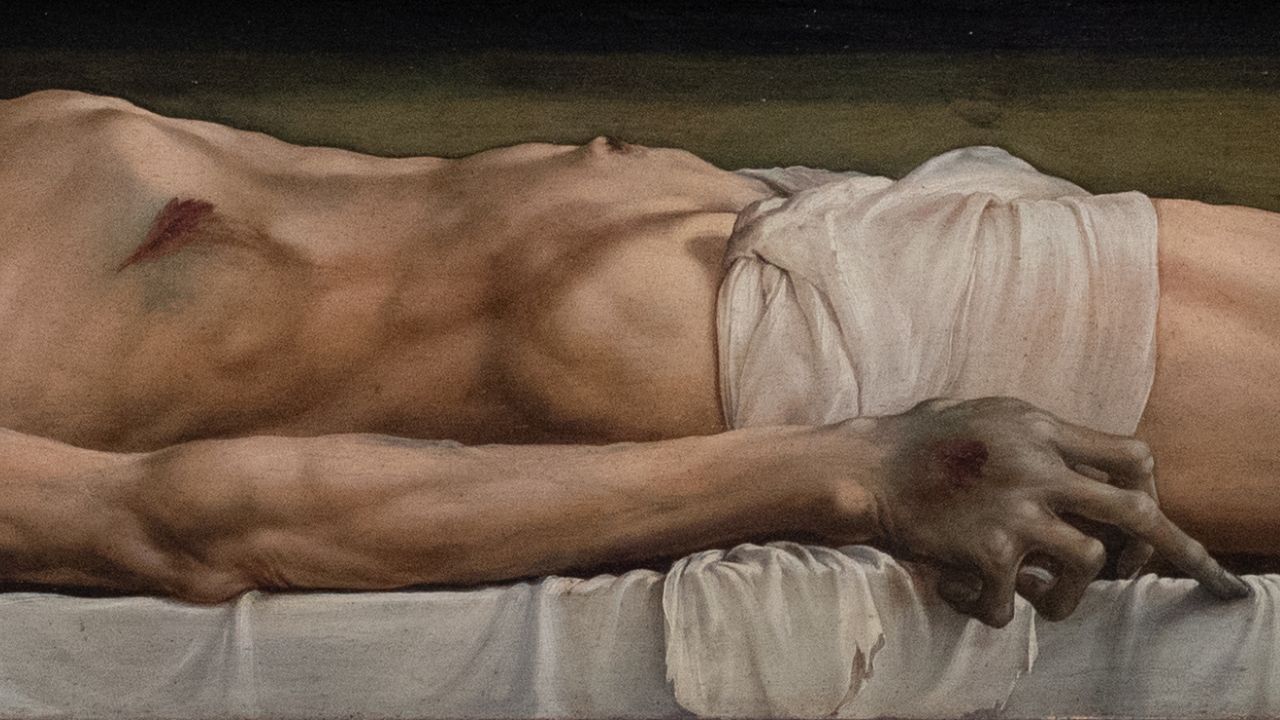
Holbein’s composition is famously horizontal and claustrophobic: Christ’s body is pressed into a shallow tomb space, forcing the viewer into close proximity. There is no triumphant symbolism, no hovering angels, and no softened anatomy. Instead, Holbein insists on the corporeal—sunken eyes, rigid limbs, and the color of flesh that has begun to change after death. The effect is both intimate and unsettling, as though the viewer is standing at the threshold of the sepulcher.
This realism is not accidental virtuosity; it is an aesthetic decision that redefines the function of a sacred image. In many Renaissance depictions, Christ’s death is shown with an underlying promise of transcendence—beauty and harmony serving theology. Holbein does something harsher: he makes the doctrine of Incarnation (God made flesh) inseparable from flesh’s vulnerability to decomposition. The painting becomes a meditation on whether faith can persist when the body looks wholly defeated.
The 19th-century novelist Fyodor Dostoevsky famously responded to such imagery with a line often quoted in discussions of Holbein’s work: “This picture might make one lose his faith.” While Dostoevsky’s remark is associated with his encounter with Holbein’s Dead Christ in Basel and echoes in The Idiot, its continuing citation underscores the painting’s uniquely destabilizing power. It does not guide the viewer toward belief; it tests belief.
Technique, Symbolism, and Key Characteristics (At a Glance)
Holbein was a master draftsman and painter associated with the precision of the Northern Renaissance, known for meticulous observation and material clarity. In Dead Christ, that technical discipline becomes a vehicle for stark truth. The controlled handling of form, the careful modeling of anatomy, and the restrained setting all collaborate to eliminate narrative distraction. Instead of telling a story, the painting confronts the viewer with an event’s aftermath.
Symbolically, the work’s restraint is its argument. By refusing overt signs of glory, Holbein intensifies the theological paradox: Christianity depends on resurrection, yet here is a body that appears wholly subject to nature’s laws. Rather than illustrating triumph, Holbein stages the moment when triumph seems impossible. The painting’s authority lies in how rigorously it sustains this tension.
Below is a summary of key characteristics often discussed by art historians and museum educators when analyzing the painting’s impact:
| Key Characteristic | What the Viewer Sees | Why It Matters |
|---|---|---|
| Extreme realism | A corpse-like body with signs of death | Forces confrontation with mortality; challenges idealized sacred art |
| Constricted format | Narrow, tomb-like space | Creates claustrophobia; intensifies intimacy and unease |
| Minimal narrative cues | No surrounding figures or dramatic setting | Shifts focus from story to physical fact and theological dilemma |
| Northern Renaissance precision | Detailed anatomy and surface treatment | Demonstrates Holbein’s technical authority and observational rigor |
| Theological ambiguity | No explicit sign of impending resurrection | Makes the viewer supply faith; invites doubt as part of devotion |
Museum Authority and Why Institutions Matter for Interpreting Holbein
Major museums shape how we understand works like Holbein’s Dead Christ by situating them within broader histories of European art, religion, and material culture. Institutions such as The Metropolitan Museum of Art and the Victoria and Albert Museum provide extensive scholarship on Renaissance visual traditions—portraiture, devotional objects, and the technical developments of the period. Their catalog essays and educational resources help clarify why Northern artists often pursued a different kind of realism than their Italian contemporaries, grounded in detailed observation and tactile surfaces.
Similarly, the Louvre Museum frames Renaissance art within pan-European exchanges—how ideas, materials, and styles circulated across regions and courts. This matters for Holbein, whose career would later connect Basel to larger political and cultural systems, including his work in England at the Tudor court. Even when discussing a Basel painting, the Louvre’s broader Renaissance context helps viewers understand the era’s artistic stakes: what “truth” in painting could mean, and why the body became an arena for philosophical and theological claims.
For an additional lens, the Smithsonian Institution offers public-facing scholarship on how images communicate belief, authority, and social norms—especially useful when considering why certain religious artworks provoke intense reactions. While the Smithsonian may not be the primary repository for Holbein’s masterpiece, its educational approach to cultural history reinforces a key point: art does not only reflect faith; it shapes how faith is felt, questioned, and maintained in public life.
Authoritative institutional perspectives often converge on one principle: Renaissance realism is not mere imitation but interpretation. As the Metropolitan Museum of Art has emphasized in its discussions of Northern Renaissance practice, close observation and material specificity can carry intellectual and spiritual meaning—not just descriptive accuracy. In Holbein’s hands, that principle becomes unforgettable.
Frequently Asked Questions
1) What is “Dead Christ Holbein”?
It commonly refers to Hans Holbein the Younger’s The Body of the Dead Christ in the Tomb, an early 16th-century painting showing Christ’s corpse laid out in a tomb with uncompromising realism.
The work is celebrated—and debated—because it minimizes traditional signs of divinity and concentrates on physical death. That choice makes it a landmark in the history of Christian imagery.
It is most closely associated with Basel and is housed in the Kunstmuseum Basel, a key institution for Holbein’s legacy.
2) Why did Holbein paint Christ so realistically?
Holbein worked in a Northern Renaissance tradition that valued precision, close observation, and tangible detail. In Basel’s Reformation-adjacent climate, realism could also function as a bracing corrective to sentimental or overly decorative religious imagery.
Theologically, the painting can be read as insisting on the full consequences of the Incarnation: if Christ is fully human, then death must look real—not beautified.
The result is a work that does not “illustrate” doctrine so much as press the viewer into contemplating it under pressure.
3) Is the painting meant to undermine faith?
Many viewers experience it as a challenge, and Dostoevsky’s famous reaction—“This picture might make one lose his faith”—captures that danger. Yet the painting can also be understood as a severe form of devotion: faith that survives after confronting death without consolation.
Rather than preaching doubt, Holbein may be staging the moment where faith becomes costly—where belief must be chosen against the evidence of decay.
Its enduring status comes from this ambiguity: it can be read as either a crisis of faith or a profound invitation to deeper belief.
4) How do major museums help interpret works like this?
Museums such as The Met, the V&A, the Louvre, and the Smithsonian provide scholarly frameworks—cataloging, conservation science, and historical interpretation—that show how technique, patronage, and religious context shape meaning.
They also place individual works within larger movements: the Northern Renaissance, Reformation-era image debates, and evolving ideas of realism.
In short, museums help us see that the painting’s shock is historically grounded, not merely personal taste.
“Dead Christ Holbein” endures because it refuses easy answers. Painted in Reformation-era Europe and preserved within Basel’s cultural memory, Holbein’s The Body of the Dead Christ in the Tomb uses Northern Renaissance precision to pose a question that remains modern: what happens to belief when confronted with unvarnished physical reality? The painting’s authority lies in its honesty—and in the centuries of viewers, scholars, and institutions that continue to take its challenge seriously.