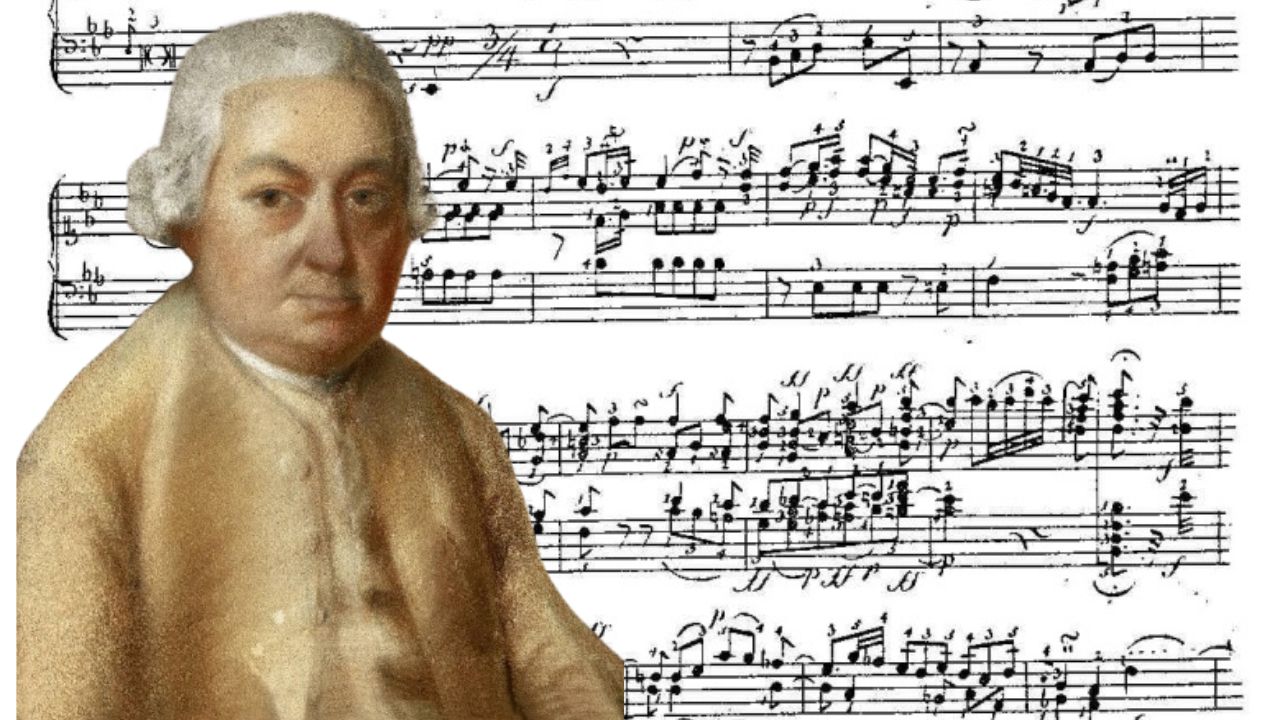
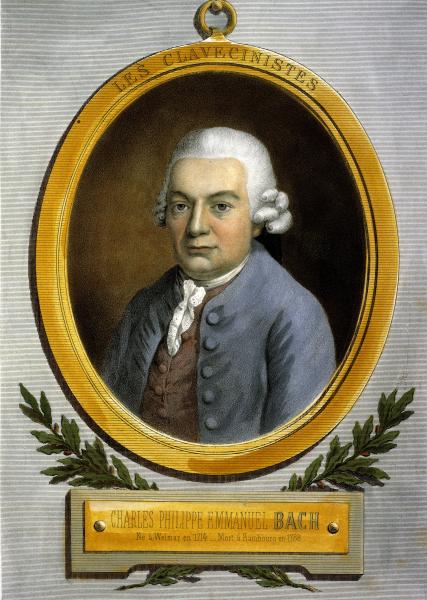
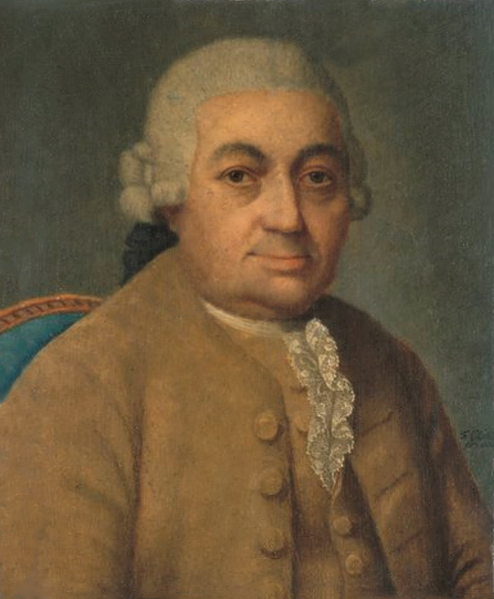
At the turning point between the intellectual counterpoint of the late Baroque and the new rhetoric of expression of the Empfindsamer Stil (sensitive style) and nascent Classicism, stands Carl Philipp Emanuel Bach (1714–1788). Second son of J. S. Bach to survive childhood, Emanuel took over not just a famous family name, with all its associated expectations; he was also implicitly schooled in private as an apprentice composer in his own father’s ateliers. However, whereas his father spent his career in ecclesiastical employ in Leipzig, Emanuel’s working life was centered around the court and public life of Prussian Berlin, Potsdam and, latterly, the city of Hamburg in mid-eighteenth-century. The ‘lost manuscript’ featured in this article dates from this transitional period, when music was still distributed almost as much through scribal copies as through printed sources, and via private cabinets, domestic libraries, and court collections.
A “lost” work can reappear through this kind of scenario and still be historically plausible, since the chains of custody for music manuscripts in the 18th century were tenuous. Manuscripts were working objects, and therefore were not preserved meticulously. They were read, marked up, and recopied. They could be distributed by will, torn apart by heirs, or used to bind other books. In 18th century Berlin, where C. P. E. Bach labored for Frederick II (“Frederick the Great”) from 1740 to 1768, his scores circulated through a vast ecosystem of bureaucracy that included the king‘s collections, copyists, private music circles, and more. In Hamburg, where Bach took over in 1768 as musical director of the city‘s main churches, his works joined a network of civilian and ecclesiastical music collections, including parish records, cantorial libraries, merchants’ collections, and libraries of amateurs. A package could be ripped from its place in the historical record by an estate inventory, an auction, or even just the binder of a ledger.
“Changed music” is not sensationalistic; it denotes how new autograph findings particularly those that firm up dating, instrumentation, or performance practice may adjust our scholarly stories of stylistic shifts. Even if it‘s a seemingly tiny document, the finding can refocus our conception of the development of keyboard rhetoric, harmonic jolt, and structural innovation during the 1740s-70s in the music of C. P. E. Bach whose music we‘ve been so confident in describing as an important precursor for Haydn, Mozart, and Beethoven. It can, similarly, resolve certain ambiguities or inaccuracies in modern editions derived from later copies of earlier manuscripts containing layered revisions or differing movements and ornamentation.
This “lost manuscript” narrative is more than a literary device from a cultural history perspective it reflects the fragmented nature of production in the eighteenth century, just as some silver-gilt tableware, music books, or lacquer cabinets may turn up dislodged from their original sets. A group of Meissen figures might be in separate museums for exactly the same archival reason that a composer‘s works may end up scattered through different libraries and private collections. What changes when the manuscript is recovered, isn‘t just repertoire, but the entire social and material economy of music-making in this period. Who commissioned it, transcribed it, performed it, or saved it?
Carl Philipp Emanuel: cultural and symbolic meaning
Carl Philipp Emanuel Bach‘s manuscripts are emblems in a manner that has seldom been more literally that of a decorative art. They are not just ‘works’; they are a physical embodiment of a maker: ink pressure, the angle of the pen, ruling lines, the density of notation across the page all articulate a hand in process. An autograph score, in the language of museum institutions, is akin to a designer-engraved design by a court goldsmith both are records of intention and at the same time visual traces of making. Given that the composer is defined by the Empfindsamkeit ideal, these traces are even more so: immediacy, interrupted thinking, expressive surprise are hallmarks of the style and are often enhanced in early drafts.
The cultural significance of a “lost” manuscript being found includes the way it disrupts smooth teleologies. Carl Philipp Emanuel Bach has sometimes been framed as a “bridge” between Bach and Mozart, an interpretative shortcut which has the tendency to diminish his originality. A newly found source can instead illuminate his singularity his attempts at keyboard gestures in the style of recitative, his bold modulatory leaps, his affect with the highly delineated manner in which he articulates his emotions. These are not stepping stones; they form a unified aesthetic connected with Enlightenment rhetoric, sensibility, and the practice of private feeling in home music-making.
I like to think that in symbolic terms, manuscripts exist at the crossroads of public power and private memory. In Berlin, Bach was employed by Frederick II and lived in a court that valued French taste and mediated exhibition; in Hamburg, he belonged to a bourgeois public that knew about concerts, publication, and critique. A manuscript passed from one locale to another would necessarily bear traces of a shift in patronage. Was the original dedication scratched out or replaced by a different one? Did the title page change to accommodate a civic event? And did the instrumentation increase to meet the demands of public performance? These were not superficial issues but reflected how music, in manuscript, functioned to forge a sense of who you were whether you were refined in court, virtous in civic life, or learned in concert halls.
Still another layer of symbolism: legacy. Emanuel‘s meticulously guarded manuscripts (he passed down dozens of his father‘s texts) ensure he is a keeper of the Bach legacy. If an Emanuel autograph turns up, it stands in relation to this archive. It asks if he quoted, adapted or broke away from the given contrapuntal tradition. A “lost manuscript” then, is material evidence on the central eighteenth-century question of tradition, curation and the legitimacy of innovation.
“Nothing is more necessary than the cultivation of true taste.”
—Carl Philipp Emanuel Bach, Versuch über die wahre Art das Clavier zu spielen (Essay on the True Art of Playing Keyboard Instruments), 1753/1762
Craftsmanship and materials
The manuscript score is an object, and its substance, its composition, is legible and can be examined just as keenly as marquetry, or the vellum binding on the volume, or its japanned finish. The paper used for an 18th-century music manuscript is usually made with rags, and there will be a watermark telling us the region, the mill, and giving us an estimate of the date of use. The paper may have been pre-lined (with a multi-nibbed ruling pen called a rastrum) to guide the scribe and keep the staves parallel. It is similar to applying a ground layer before gilding. The width of the staves, the regularity of the lining, the margins, can be revealing autograph, professional copy, or collaborative effort.
But even without such testing, we can often still do ink analysis through observation: iron gall ink often turns brown, and sometimes creates faint rings of acidity spread into surrounding paper. Evidence of revision might include areas scraped clean (as if with a knife which has taken fiber with it), text erased and rewritten over, or passages pasted on top. These are the pentimenti of the manuscript, the manuscript equivalents of re-worked decoration in chasing or re-cut plates in engraving. For Carl Philipp Emanuel Bach, with his marked-up sudden shifts of rhetoric, manuscript hesitation (inserted measures, re-barred bars, revised dynamics) is evidence not just of transcription, but of thought.
Bindings and congregations are also important. Many of the earliest extant musical manuscripts are in the form of loose bifolia, which were sometimes stitched into a rough cover, while others were collected and bound in later, often luxury, bindings to suit the taste or status of collectors, libraries, and estates. These later bindings, such as the half-calf that adorns many 19th-century editions of earlier works, can be a boon to preservation, but can also hide traces of earlier ordering. Analyzing the quire structures of extant sections of music will help determine if a “missing” work was once a part of a larger series (a collection of sonatas, a cycle of church cantatas, an anthology compiled for a patron, etc.). In the vocabulary of the decorative arts, one could say it is like reassembling a fractured cabinet set from the fragments of mounts and panels.
Last, paratextual elements-title leaves, ownership marks, shelf marks, and performance annotations-contain cultural meaning just as armorials decorate porcelain or plaques adorn clocks. A phrase like “fur die Prinzessin” or “Hamburg” is a note of provenance, and a keyboard finger, ornament, or tempo indication, frequently German (and sometimes Italian) in written form, offers insight into a past performance practice. These annotations are more than simple scribbles: they are traces of human hand, evidence of a lived artifact, not a purely archival document.
Material diagnostics often examined (non-invasive)
| Feature | What historians look for | Why it matters |
|---|---|---|
| Watermark / countermark | Motifs (e.g., post horn, crown), initials | Dating and geographic attribution of paper |
| Rastrum ruling | Staff spacing, pressure consistency | Identifies workshop habits, composer vs. copyist |
| Ink tone and corrosion | Browning, haloing, paper burn-through | Conservation risk; phase of writing |
| Corrections and insertions | Scraping, overwriting, pasted slips | Compositional process; authenticity indicators |
| Edge wear and folding | Creases, trimmed margins | Evidence of portability and performance use |
Historical locations, museums, and archives
C. P. E. Bach’s documentary footprint is distributed across institutions whose collecting histories reflect nineteenth- and twentieth-century scholarship, nationalism, and library professionalization. The Staatsbibliothek zu Berlin (Berlin State Library) holds significant Bach-related sources, benefiting from Prussian collecting traditions and later scholarly acquisition. Hamburg’s Staats- und Universitätsbibliothek Carl von Ossietzky preserves materials tied to the city’s musical life, while church archives in Hamburg—where Bach’s official duties were liturgical—remain crucial for contextual documentation. The very fact of dispersal underscores why “lost” manuscripts can remain unrecognized: cataloging practices vary, and earlier descriptions may be incomplete or based on mistaken attributions.
Leipzig, although more directly associated with Johann Sebastian Bach, is essential in the broader Bach family narrative. The Bach-Archiv Leipzig has long shaped research through exhibitions, editions, and provenance study, often collaborating with libraries that hold primary sources. While the Bach-Archiv’s mandate emphasizes J. S. Bach, the family context makes Carl Philipp Emanuel Bach’s materials relevant, especially where Emanuel acted as editor, collector, or transmitter. A manuscript that surfaces outside these central nodes—perhaps in a regional archive or private collection—must be evaluated against known holdings and source concordances.
Museum collections enter the story because music manuscripts were historically treated as autograph relics, not only as carriers of performable text. In the nineteenth century, autograph collecting became a scholarly and cultural practice, with manuscripts entering cabinets of curiosities, then public museums and libraries. Institutions such as the British Library (London) and the Bibliothèque nationale de France (Paris) are pertinent not because Emanuel lived there, but because European collecting and the antiquarian trade moved documents across borders. A manuscript might be “lost” to German musicology while sitting quietly in a foreign autograph album.
Provenance research often resembles tracing a piece of silver through merchant ledgers. One follows estate auctions, book dealers’ catalogs, ownership stamps, and accession registers. When a manuscript is re-identified, it is usually through convergence of paleography (handwriting comparison), paper study, and concordance with thematic catalogs. The process is cumulative and institutional: archives preserve reference points that allow private discoveries to be tested against established knowledge. In the best cases, rediscovered items are digitized and linked to existing catalog ecosystems, reducing the chance of future losses through invisibility.
Collector perspective: connoisseurship, provenance, and the ethics of custody
From a collector’s vantage, a C. P. E. Bach manuscript occupies a particular niche: less iconic to the general public than Mozart, yet profoundly important to specialists and increasingly valued as scholarship re-centers the eighteenth century’s “middle generation.” Collectors of music autographs tend to be unusually documentation-driven; connoisseurship rests on the triangulation of handwriting, historical context, and paper evidence rather than on signature alone. A “lost manuscript” story often begins when a collector notices an unfamiliar incipit, an anomalous watermark, or an attribution line that seems inconsistent with the musical content.
The ethics of custody are unavoidable. Manuscripts are cultural patrimony, yet they have long moved through private hands, sometimes legitimately, sometimes through wartime displacement or disordered estate dispersals. Responsible collecting requires attention to legal title, export regulations, and the moral question of accessibility. In the present scholarly climate, a private owner’s willingness to permit digitization, scholarly consultation, or deposit in an archive increasingly defines the object’s cultural value. This is not a philanthropic embellishment but a continuation of eighteenth-century practice, when music circulated through copying and sharing rather than through exclusivity.
Connoisseurship also includes sensitivity to compilation. A collector may possess not a single “work,” but a fascicle of pieces, perhaps bound later under one cover. In such cases, the relationships among items—paper match, ruling, ink, and annotations—may matter more than any single page. Collectors with decorative-arts training often recognize this instinctively: ensembles and sets carry meanings that isolated objects lose. A “lost manuscript” can be “found” in the sense that its original companionship—other pieces, related drafts—can be reconstructed, restoring context that changes interpretation.
Finally, there is the question of what “changed music” means to collectors. For many, it is less about a sensational premiere than about documentary authority: an autograph that confirms original articulation, embellishment, or even an alternative movement order. Such details can influence critical editions and, downstream, performance. In that chain, collectors—often viewed as peripheral—can become inadvertent stewards of historical evidence, provided they accept the responsibilities that accompany custody.
Restoration insights: conservation as historical interpretation
The conservation of eighteenth-century manuscripts is an exercise in restraint, guided by the principle that the object’s informational content includes its wear, repairs, and usage marks. Typical condition issues include edge tears, weakened folds, ink corrosion from iron gall ink, staining, and distortions from humidity. A “lost” manuscript that survived in an attic trunk may show tide lines and planar deformation; one used in performance may show repeated page turns, finger smudges, and reinforcement at corners. These are not merely damages; they are records of life.
Restoration begins with stabilization rather than cosmetic improvement. Surface cleaning is minimal and controlled; washing is rare and controversial because it can alter inks and remove historically meaningful residues. Tears may be repaired with thin Japanese tissue and wheat starch paste—materials chosen for reversibility and compatibility. Flattening, when necessary, is done under humidification with careful monitoring to avoid ink offsetting. In conservation terms, the aim is to slow deterioration while preserving the manuscript’s evidentiary character.
The most difficult cases involve ink corrosion, where iron gall ink literally eats into the paper fibers. Treatment decisions require balancing legibility, structural stability, and risk. Conservators may employ localized reinforcement and controlled environmental storage rather than aggressive chemical interventions. Importantly, the conservation report becomes part of the object’s modern provenance, documenting condition, interventions, and the rationale behind them—much as conservation files for furniture record veneer replacements or finish analysis.
Digitization intersects with conservation as both a protective and interpretive act. High-resolution imaging reduces handling and can reveal features invisible to the naked eye: drypoint ruling, erased measures, and watermark fragments. Multispectral imaging, when available, can recover faded inscriptions without physical intervention. In the best institutional settings, digitization is accompanied by robust metadata—paper, watermark, foliation, and provenance notes—so that the manuscript’s historical “objecthood” is not flattened into mere musical text.
“To preserve is also to interpret: every choice of repair, housing, and imaging frames what future scholars can see.”
—Conservation maxim common to manuscript departments (paraphrased from professional practice)
Market interest and collector demand: scholarship-driven valuation
Market interest in Carl Philipp Emanuel Bach materials is shaped by a distinctive dynamic: value is strongly correlated with documentary significance and provenance clarity rather than with broad-name recognition. Autograph leaves, complete scores, annotated copies linked to performance, and items connected to the composer’s treatise culture (such as pedagogical annotations echoing the Versuch) can attract institutional attention because they fill gaps in source transmission. In auctions and private sales, the difference between an autograph, a contemporary copy, and a later manuscript can be decisive; correspondingly, authentication standards are exacting.
Institutional demand—libraries, archives, and research centers—tends to prioritize accessibility and catalog integration. A newly surfaced manuscript that can be securely dated (via watermark concordance, handwriting comparison, or contextual references) is more likely to be pursued, because it strengthens catalog infrastructures and critical edition work. Conversely, uncertain attribution depresses demand, not for lack of interest but because responsible institutions must justify acquisitions as evidence-based stewardship. The market here is, in effect, regulated by scholarship.
Private collector demand often follows adjacent collecting fields: autograph letters, Enlightenment-era book culture, and fine bindings. A Carl Philipp Emanuel Bach manuscript may be valued as part of an eighteenth-century cultural cabinet—alongside scientific instruments, prints, or salon ephemera—because it embodies the era’s fusion of art and reason. Yet the most serious private buyers increasingly mirror institutional practices: they commission condition reports, consult thematic catalogs, and seek peer review from musicologists and paper historians. This convergence has quietly raised standards across the field.
The “lost manuscript” narrative can distort perception if treated as a guarantee of importance. Many rediscoveries are minor variants or fragments; their significance lies in nuance—ornament signs, tempo words, or corrected harmonies—rather than in an entirely unknown masterpiece. But nuance is precisely what can “change music” in the long view: it can reshape editorial choices and performance traditions. The market, at its most intellectually responsible, recognizes this and attaches value to the manuscript as evidence, not as trophy.
Factors influencing demand (institutional and private)
| Demand driver | Why it matters for C. P. E. Bach | Typical evidentiary basis |
|---|---|---|
| Autograph status | Direct witness to compositional intent | Handwriting comparison, revisions, ink/paper match |
| Provenance clarity | Ethical and legal security; historical context | Stamps, inventories, sale catalogs, accession records |
| Scholarly gap-filling | Improves thematic catalogs and editions | Concordance with known sources; unique readings |
| Condition and stability | Long-term preservability | Conservation assessment; ink corrosion risk |
| Accessibility potential | Digitization and research use | Rights, owner cooperation, institutional capacity |
Carl Philipp Emanuel Bach is worth our attention today not in that he is a pleasant jumping-off point to better-known monuments, but that his music provides a case study in one historically specific vision of affect, form, and taste at a moment when European musical vernaculars were in process of being refitted. The discovery “of a lost manuscript,” be it a finished score, a working sketch, or a performing edition, is important for the same reason a newly found sketch design for wallpaper is important for the decorative arts: it reintroduces process, re-installs context, and complicates the narratives into which we have fallen. It allows us to see how a composer “thought” with his hand, how the paper and the ink were the materials of creation, and how music was a material process enacted in the parlors, palaces and churches of the period.
Our rediscovered manuscripts also show us that history is largely assembled from lucky, precarious survivals. The canon itself is a kind of survival: what was cataloged and what deemed worthy? What was saved from destruction, what wrongly attributed? When documents surprise us, they fill out the repertory, but also illuminate the survival and absence mechanisms of the archives, collectors, restorers and editors of the eighteenth century, by which it is reconstructed. In this light, the “lost manuscript” is less a romantic tale of salvation, than an ethical one.
The final reason is that this topic is important, because it maintains that music is not simply an acoustic entity but rather a material entity with its own life, construction process, decay, and owners. If you are engaged in the analysis of a freshly published score from Carl Philipp Emanuel Bach you are engaged in a very particular locus of meaning contained in the fiber of the paper, the decay of the paper, the notation, and the evidence of human hands. At a time when our contact with culture is increasingly streaming and disembodied, the manuscript serves as a reminder of the stubbornly and effectively expressive reality of how culture is manufactured and what outlasts and modifies us is often outlasts us and modifies us by chance, selection, and ownership.