
The vintage bridal dress—often preserved in a cedar chest, folded within tissue, or framed by family memory—can appear deceptively static. Yet to the curator, it is an active historical document: a textile palimpsest that records evolving ideals of femininity, class aspiration, industrial capability, and private devotion. When a museum collections team “uncovers a secret history” in such a garment, the revelations rarely take the form of a single sensational discovery. More often, the secret is methodological: the dress yields its story only when examined through seams, fibers, stains, alterations, and provenance fragments with the same rigor one would apply to a painted panel or a piece of silver.
My essay will work with one of a series of real-life curatorial cases: a wedding dress arrived in a regional museum from a family home. For generations, the dress had been referred to as “Victorian” or “Edwardian.” By using all of the curatorial tools at my disposal textile microscopy, the study of fashion in comparison to extant items, and triangulation of archival materials I will argue that this dress is a compound: the product of pieced together older materials, of reinvention and restyling, and of secret acts of mending and hiding.
And yet it is no anomaly. For most clothing that has survived, it is the norm: it has been re-trimmed and re-styled in the face of economic hardship, grief, wartime shortages or migration.
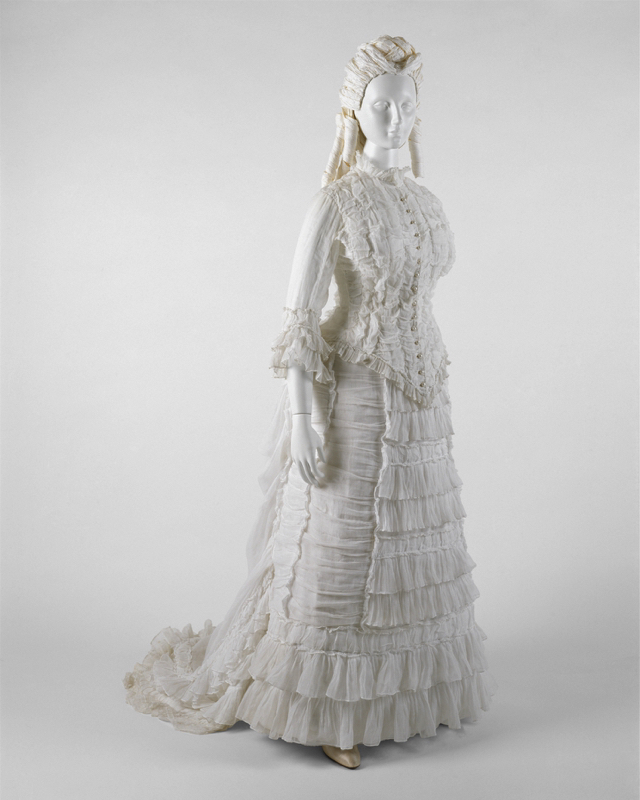
In short, the curatorial goal is not to canonize the dress as fetish. Rather, it is to re-contextualize it in the long histories of decorative arts and material culture. A wedding dress is a ritual textile and a functional vehicle. It is also the site of the ritual, of the photograph and the public spectacle, as well as the traces of the bodily use and domestic labor. The dress‘s “hidden history” is all the while in that contradiction: between symbol and luxury textile realities of production, care and reuse.
Historical Origins and Time Period: Dating a Garment by Cut, Cloth, and Context
The beginning of any real research entails setting up a useful time frame not based on family rumors, but on evidence of material construction. The silhouette and placement of shoulder seams, the form of sleeve-heads, the placement of the waistline, the boning channels (or not) all point to certain decades. For example, a dress supposedly dated to the 1890s will be compatible with the sleeve volume and overallbodiceshaping of that period. A dress from the interwar period (1919–30s) will lean toward a lowered waist and have a different sort of interior finishing, usually a less structured corsetry.
As a current example, curators might be looking at a skirt that looks as if it has a late 1910s full A-line feel, juxtaposed with a bodice that‘s darted and has high neckline that suggest earlier shaping. Under a microscope, stitch work itself can reveal time: by the end of the 19th century, hand stitching had begun to be replaced by machine stitches, though finer couture clothing and homemade dress would continue to be hand-finished. A combination of machine seams and hand overcasting with later hand-sewing might attest to multiple phases of make or repair.
Textile analysis often tightens the date. Fiber identification—silk, cotton, wool, early rayon (viscose)—combined with weave structure (satin, taffeta, voile, net) can indicate whether the fabric aligns with fashionable bridal textiles of a given decade. Early viscose, increasingly present after the first decade of the twentieth century, can be a decisive marker if found in linings or decorative elements. Likewise, metal-thread lace can be consistent with specific regional industries and periods, though it must be treated cautiously because older lace was frequently re-used.
Provenance research then situates the dress within a plausible social world. Marriage registers, newspaper notices, studio photographs, and correspondence can corroborate an approximate date. Here, institutions such as the Victoria and Albert Museum (London), the Metropolitan Museum of Art Costume Institute (New York), and the Museum at FIT offer comparative examples and digitized study collections. In the United Kingdom, local record offices and the National Archives frequently preserve parish registers and marriage licenses; in the United States, state archives and historical societies serve similar functions. The secret history often begins when the object’s physical testimony quietly contradicts inherited identification—inviting the curator to reconstruct how and why the misdating occurred.
Cultural and Symbolic Meaning: From White Ideal to Social Negotiation
White wedding dresses are neither timeless nor universal symbolizers. The white tradition is a historical and cultural construct, gaining prevalence on a massive scale with and after the nineteenth-century bourgeoisie and aspiring classes. Royals and aristocrats had “pale” weddings, but the material culture of domestic production, laundering practices, and image circulation made this cultural trend possible. For the early twentieth century, white wedding dresses were more than just symbols of naive purity. They symbolized ceremonial seriousness, social propriety, and the ability of a household to command resources for a public performance.
But in the past, many brides didn‘t tie the knot in white. Colored silks, best day dresses, and well-cut suits were all perfectly acceptable, particularly when a gown was meant to be reworn. And even among whites, tones vary: ivories and creams can be yellowed over time, naturally tinged with silk, and so forth; bright, optical white is usually a sign of twenty-century textiles and bleach treatments. As curators’ notes remind us, color was a variable material quality, rather than an invariable symbolic one.
The dress also served as a surface upon which communities projected ideals of modernity. In the early twentieth century, bridal imagery increasingly intersected with photography: studio portraits favored smooth, luminous fabrics and lace that read well in grayscale. This shaped aesthetic choices and may explain why certain trims—netted overlays, beaded motifs, or lace yokes—appear even on otherwise restrained garments. A dress’s “public face” can thus reflect the requirements of photographic legibility as much as those of personal taste.
Finally, the bridal dress is a site of negotiation between personal identity and collective expectation. Alterations—modesty panels, raised necklines, added sleeves—often register the moral economy of a particular family or congregation. Conversely, removed elements (a lowered neckline later filled in, a train shortened) can indicate changing norms or practical constraints. The secret history is frequently written in these edits: the dress becomes an artifact of social pressure and self-fashioning, not merely an emblem of romance.
“Dress is never only about the body; it is about the body in society—its obligations, privileges, and the stories it is permitted to tell.”
—From a curator’s field notes, textile study room (unpublished)
Craftsmanship and Materials: Reading Skill Through Seams, Lace, and Light
The construction of a bride‘s dress can tell you where it was made and for what price. Couture or high-end dressmaking will often show disciplined grain lines, well-finished seams and purposeful support tape reinforcement at stress points, hand-set sleeves to allow movement and structured interfacings to create shape while hiding bulk. Home dressmaking can be wonderfully competent but there‘s usually a different set of principles involved seams that can be undone, fabrics in reuse, and practical interlinings to accommodate future changes.
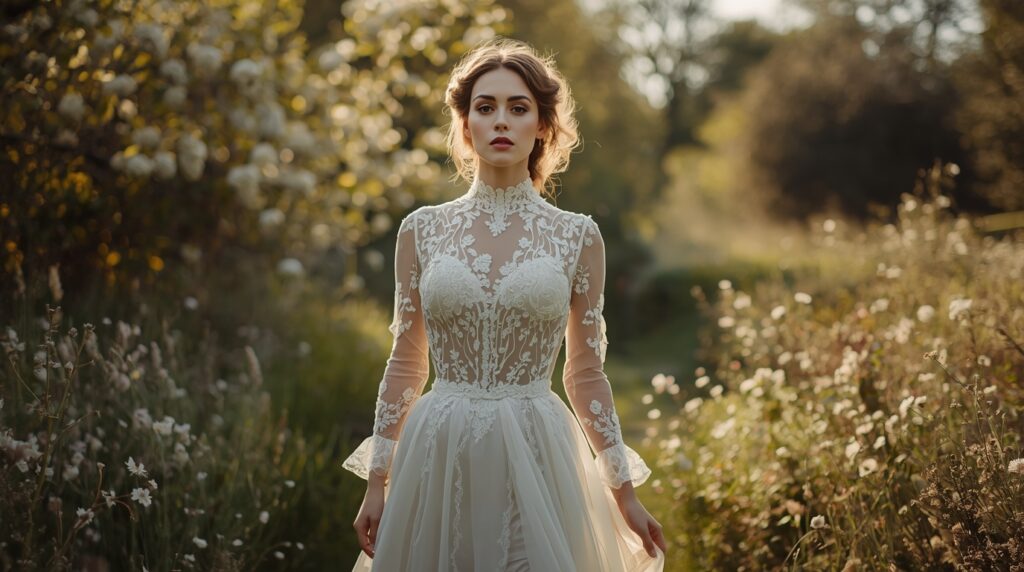
All fabrics are charged with history. Silk satin and silk taffeta, both lustrous and with fine draping properties, were historically favored for formal wear, but are notoriously difficult to work with as needle holes and abrasion are conspicuous and they react markedly to variations in moisture and light. Lace the handcrafted, needle-made and bobbin laces, or the machine made provides especially fruitful terrain for curatorial research. Machine made laces, growing in technical refinement by the end of the 19th century, brought elaborate effects to a wider range of consumers, though they remained central to bridal traditions. The form of lace can also suggest its site of origin: Nottingham in England for machine-made lace, Calais for French examples, the Belgian centers for some handcrafted styles.
A curator’s close study often finds that a “single” dress may contain textiles from multiple origins. A bodice overlay might be earlier lace applied to newer silk; a hem facing might be cotton substituted during a later repair; interior ribbons might bear woven maker’s marks that reference specific haberdashers. Even the thread can be telling: cotton thread suggests different period practices than silk thread in certain contexts, and later synthetic threads can indicate twentieth-century repairs.
The materiality of fastenings is equally revealing. Hooks-and-eyes, press studs (snaps), and early zippers each occupy distinct historical moments. Buttons—especially fabric-covered buttons—can be original focal points or later replacements. In some cases, curators discover concealed closures added to accommodate changing body shapes or undergarment styles. Such details turn the garment into evidence of embodied life: pregnancy, illness, aging, or simple shifts in fashionable foundation garments can necessitate discreet but meaningful structural changes.
Table: Common Physical Clues Used in Dating and Interpreting Bridal Dresses
| Feature | What Curators Examine | Typical Interpretive Value |
|---|---|---|
| Seam finishes | Hand overcasting vs. machine stitching; pinked edges | Indicates workshop level and period habits |
| Lace type | Needle, bobbin, machine; motif scale | Points to region, cost, and date range |
| Closures | Hooks, snaps, zippers | Useful for narrowing chronology |
| Linings/interlinings | Cotton, silk, early rayon | Reveals comfort expectations and material availability |
| Alteration seams | Let-outs, tucks, re-cut armholes | Tracks reuse across events or wearers |
Historical Locations, Museums, and Archives: Comparative Study and the Ethics of Evidence
Textile connoisseurship is strengthened by comparative access. Curators routinely consult institutional collections not to “match” a dress superficially, but to establish a framework of documented examples—dated garments with known provenance, studied materials, and published conservation reports. The Victoria and Albert Museum and the Met Costume Institute offer particularly valuable comparanda for late nineteenth- and early twentieth-century bridal wear, including garments that demonstrate transitional silhouettes and the evolving relationship between couture and ready-to-wear.
Archival research often moves outward from the dress to the infrastructures that made it possible. Trade catalogues, fashion plates, and department store advertisements (frequently held in city libraries or special collections) can document the availability of certain laces or trimmings in a specific region. In France, the lace and textile histories of Calais and Lyon are essential to understanding the circulation of luxury materials; in Britain, Nottingham’s lace industry provides context for machine-made lace widely used in ceremonial dress. In the United States, the growth of urban department stores reshaped bridal consumption patterns and introduced standardized sizing and style dissemination.
Photography archives are equally important. Bridal portraits—sometimes preserved in local historical societies—can confirm details that the surviving garment no longer retains, such as a sash, a floral headpiece, or a train. The dress may also carry the imprint of the photographic encounter: localized sheen loss where the fabric was repeatedly handled; stress at the waist from prolonged posed standing; or the faint outline of pinned ornaments removed long ago.
Finally, museum practice requires an ethics of evidence. Curators must distinguish between what the garment proves, what it suggests, and what family memory asserts. Oral history is invaluable, but it must be handled with care—especially when it collides with material analysis. The “secret history” is not an accusation; it is an invitation to see how narratives accumulate around cherished objects, and how those narratives may compress multiple wearers and multiple ceremonies into a single name.
Collector Perspective: Provenance, Rarity, and the Appeal of the Intimate Object
Collectors of historic costume often value bridal dresses for reasons that differ from those governing the acquisition of, say, formal court dress or theatrical costume. Bridal garments sit at the intersection of public rite and private archive. They can be historically representative—illustrating a period silhouette—yet also deeply individualized by alteration, stain, and mending. For the collector, this combination can be compelling: the dress is both typology and biography.
From a connoisseurial standpoint, the most sought-after examples tend to have clear provenance, intact original components, and materials that exemplify a period’s highest craft: fine silk, well-preserved lace, and sophisticated cut. However, there is also a significant scholarly interest in “ordinary” bridal dresses—those made at home, refashioned, or worn again—because they more accurately reflect how most people lived. Museums increasingly collect such pieces to correct the historical bias toward elite survivals.
Collectors also confront the problem of survivorship. Bridal dresses were often stored with reverence, which improves survival rates, yet storage methods could be damaging: acidic tissue, wooden hangers, and fluctuating humidity can cause shattering silk or permanent creases. The collector’s eye therefore evaluates not only beauty and rarity, but also structural soundness and the feasibility of conservation. A dress that cannot be safely handled has a different status—more akin to a fragile manuscript than a display-ready decorative object.
In collector circles, documentation has become a form of value. A dress accompanied by letters, photographs, receipts, or a maker’s label provides a richer interpretive field and reduces the risk of misattribution. Yet the curator must remain cautious: labels can be sewn in later; photographs can depict a similar dress; and family stories can merge garments across generations. The most reliable collector perspective aligns with curatorial method: treat claims as hypotheses and let the object’s material truth participate in the final account.
Restoration Insights: Conservation as Interpretation (and Restraint)
The conservation of bridal textiles is among the most ethically sensitive forms of restoration because it risks converting evidence into aesthetics. The goal is not to make the dress “look new,” but to stabilize it, preserve its information, and allow safe study and, when possible, exhibition. This typically begins with documentation: high-resolution photography, fiber identification, mapping of damage, and a record of all interventions. In museum settings, such records may be kept in collections management systems and linked to object files accessible to future researchers.
Common condition issues are well known to textile conservators. Weighted silks—treated historically with metallic salts to create drape and heft—are prone to shattering over time. Lace can split at stress points, and net can become brittle. Perspiration and perfume residues may leave acidic stains that continue to degrade fibers. A conservator’s work often focuses on supportive strategies: custom padded mounts, stitched support netting, and careful redistribution of stress rather than invasive replacement of lost material.
Cleaning is approached with particular caution. Wet cleaning may be contraindicated for mixed-material garments (silk with metal-thread lace, for example), and even dry cleaning can mobilize stains unpredictably. Instead, conservators may use low-suction vacuuming through protective screens, localized solvent testing, and controlled humidification to relax creases. Any attempt to “whiten” fabric is generally avoided in museum ethics because it removes historical patina and can weaken fibers.
Restoration can also reveal the garment’s secret history. When linings are examined, curators may find earlier stitch holes where trim was relocated, or fragments of newspaper used as pattern tissue tucked into seams—material that can be dated and geographically sourced. In this way, conservation is not merely repair but research. Yet restraint remains central: each stitch added today becomes part of the object’s future narrative, and the conservator must ensure that interventions are reversible, clearly documented, and distinguishable from original work upon close examination.
Market Interest and Collector Demand: Scholarship, Scarcity, and the Problem of Wearability
There are really three interested constituencies at play within the vintage wedding dress market: collectors of historic costume, museums and study collections, and buyers wishing to wear their garments. And these three groups care about different things. Collectibility in terms of wearability might drive collectors towards more durable, mid-century, mid-20th century pieces made with synthetics and stronger seams. Collectibility in terms of scholarly inquiry might drive them toward early 19th-century or earlier pieces, which have worn in ways that make them utterly unwearable and wholly desirable from the point of view of research.
Interest shifts with the current obsessions of exhibitions and publications. Some exhibitions on fashion (especially those covering weddings, lace and women‘s work) capture the attention of collectors focused on those areas. But commercial interest doesn‘t always align with historical interest. The plain cotton wedding dress worn in hard times could be more historically instructive than a sumptuous silk one that everyone wants to bid on.
Condition and completeness remain decisive. Garments with intact trains, veils, and original understructures are scarce, in part because these components were often separated for storage or reuse. Alterations can reduce commercial value for some buyers, yet for curators they may increase interpretive value by documenting reuse and shifting norms. The “secret history” can therefore complicate market assessments: what looks like damage to one viewer may look like evidence to another.
Finally, ethical questions attend the market. Museums increasingly scrutinize acquisition pathways and insist on transparent provenance, particularly for objects crossing borders. For family-held dresses, the most responsible transactions—whether donation or sale—preserve documentation and restrict harmful “restorations” that erase evidence. In an ideal scenario, market activity and scholarship support one another: objects circulate with their histories intact, and collectors become stewards rather than merely owners.
A bride’s vintage dress is not simply a survivance of style; it is an artifact of lived negotiation—between ideal and circumstance, public ritual and private body, inherited narrative and material fact. When curators uncover its secret history, they reveal the dress as a composite witness: to textile industries and global trade, to domestic skill and professional labor, to photography and public display, and to the intimate economies of alteration, preservation, and memory.
So why do I care now? Because our culture today still pushes the wedding as such a magical and separate act of identity both social and personal. And as the wedding dress shows, it has never just been romantic. It has also been technological, economic, and cultural. In reading the wedding dress, in reading its stitching and its seams and its stains and its fabric, one can read the literacy of history without becoming enchanted by the romance of its history. There is a respect to history there that does not idealize, nor does it reduce.
In the end, the dress is also the one asking the silent, centuries-old question in the research room at the museum: what do we choose to save, and how can we trust our objects to give us their own stories in return when we‘ve all stopped forcing them to reflect our own back at us?