
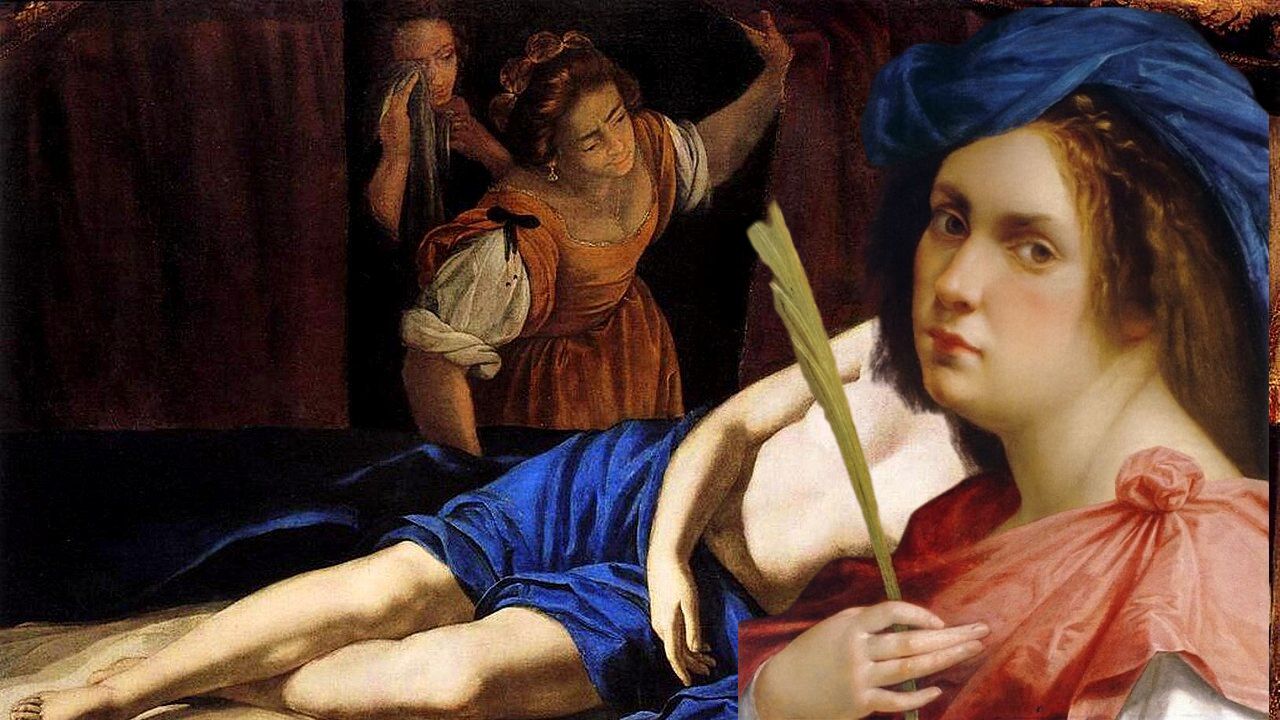
“Secret legacy” makes for a good headline, but in the world of Artemisia Gentileschi it‘s a term more for a gradual, cumulative adjustment than the sudden, sensational revelation. The past half-century spurred by imaging techniques, archival research, and a more sophisticated understanding of early modern workshops has witnessed art historians’ recognition that her work extended far beyond the easel: into frames, decorative ensembles, courtly gift-giving, and the objects of paintings. The experts are “stunned,” not by a newly uncovered signature, but by the sheer bulk of proof that Gentileschi‘s work and fame are comprehensible only as part of the decorative arts economy of 17th-century Europe: of patrons, furniture, and painting as cherished objects.
With this article, I move Gentileschi across to the category of a cultural worker active in a world in which pictures are furniture-adjacent things: hung, re-framed, moved around, reduced and magnified, re-interpreted. Placing her oeuvre alongside the histories of collecting, restoring and the market helps to map a kind of legacy that is materially grounded and historically credible, but far more interesting than the mythic tale of the lone, visionary artist. Gentileschi‘s works are read today as not only iconographic statements, but constructed objects, imprinted with the traces of time, taste and the intervention of others.
Historical origins and time period
Artemisia Gentileschi (1593–c.1654) emerged in Rome at a moment when painting was deeply entangled with the city’s artisanal economy. Her earliest formation occurred within the orbit of her father, Orazio Gentileschi, whose refinement of Caravaggesque naturalism depended on precise drawing, controlled illumination, and an elegant surface finish. Rome in the 1610s was an arena of competing visual languages—Caravaggio’s dramatic chiaroscuro and psychological immediacy, the classicizing alternatives of the Carracci circle, and a broader marketplace of workshops producing altarpieces, cabinet pictures, and decorative cycles for a clientele that was both local and international.
We can interpret Gentileschi‘s life course Rome-Florence-Naples-Venice/England as following the itinerary of art patronage and artist mobility instead of a personal story. The court environment of 1620s Florence not only provided Medici sponsorship but also art exchanges mediated by diplomatic gift-giving and the display and interior design of the Palazzo Pitti. Naples was a rich viceregal capital that required vast quantities of sacred and religious paintings and led to artist associations with the Spanish civil service and international trade networks originating in the Mediterranean. These cities influenced the dimensions of their commissions, the purchase of pigments and supports and the display arrangements for frames and installations.
Part of her “secret” heritage is archivally distributed. The primary records, the receipts and the letters and the inventory listings, have always been scattered across various archives and often only implicitly tell us something. As researchers have moved in and out of the different archival collections and different record groups (Florence, Naples, Rome, London), we‘ve begun to treat Gentileschi‘s paintings as a corpus that has a documentary perimeter: a series of patrons’ names, addresses in flux, connections with intermediaries and agents within various courts, and, of course, all the specific details that an inventory naturally records (size, medium, frame type). The nature of this information never offers anything resembling an epiphany; rather, it incrementally clarifies to the first-time museum visitor the status of what they are looking at not as painting in the abstract but as an item that was assigned a monetary value and a physical locus.
Then there is the moment. Pictures were, in the 17th century, seen differently, the art world less defined between ‘fine’ and ‘decorative’. Paintings dialogued with textiles, gold leather wall-hangings, tables of pietre dure and furniture of ebony or walnut. Within such a framework, Gentileschi‘s powerful images of women whose physical powers are intricately bound up with their ethical powers were both visual narratives and decorative objects, eye-catching presence in spaces of hospitality, business and exhibition.
Cultural and symbolic meaning
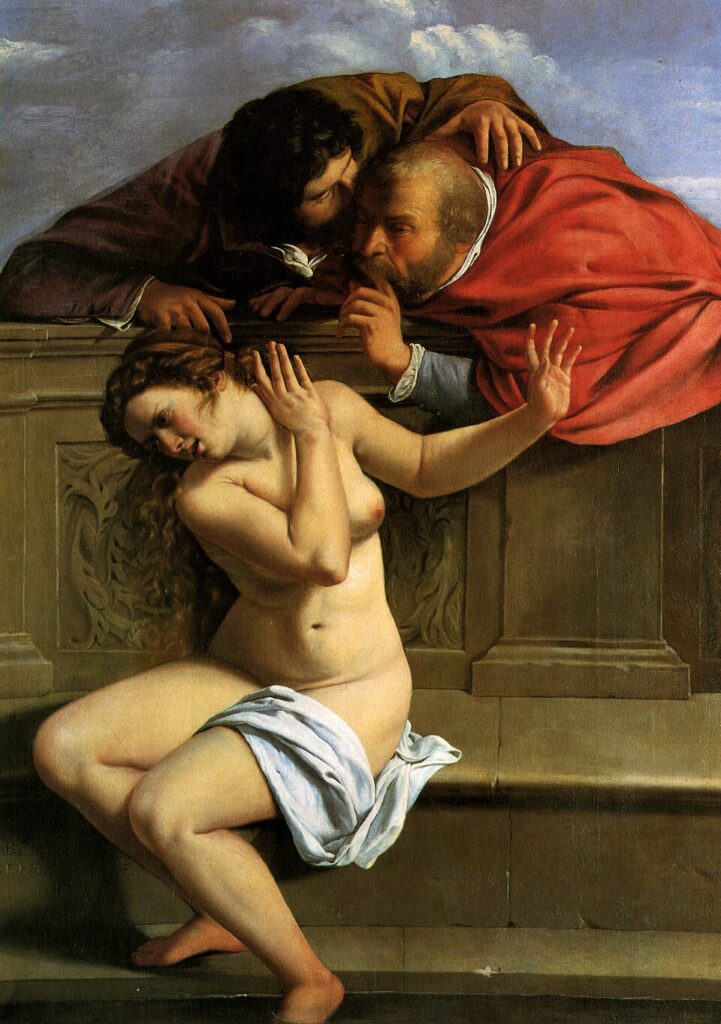
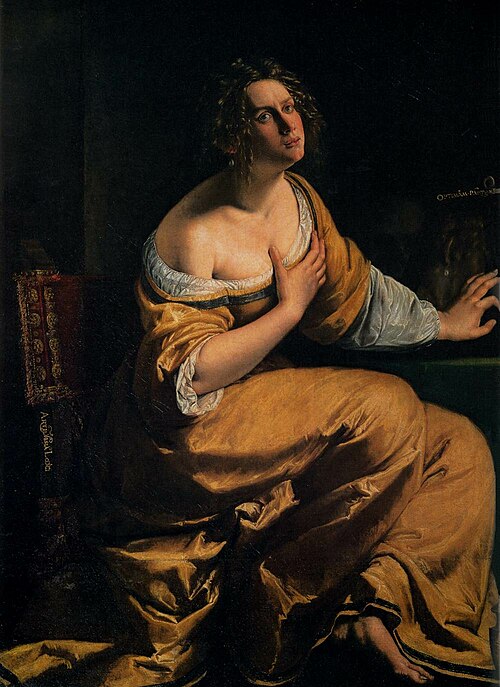
Gentileschi’s subjects—Judith, Susanna, Lucretia, Cleopatra, Mary Magdalene—have often been read through the lens of biography and gendered experience. A more historically grounded approach recognizes that these themes were also extraordinarily legible in early modern moral discourse and in the emblematic culture that circulated through prints, sermons, and courtly conversation. Judith’s violence, for example, was not merely sensational; it could embody political prudence, divine justice, and the triumph of virtue under threat. For collectors, such narratives were intellectually “useful,” enabling learned interpretation and signaling a household’s alignment with certain values.
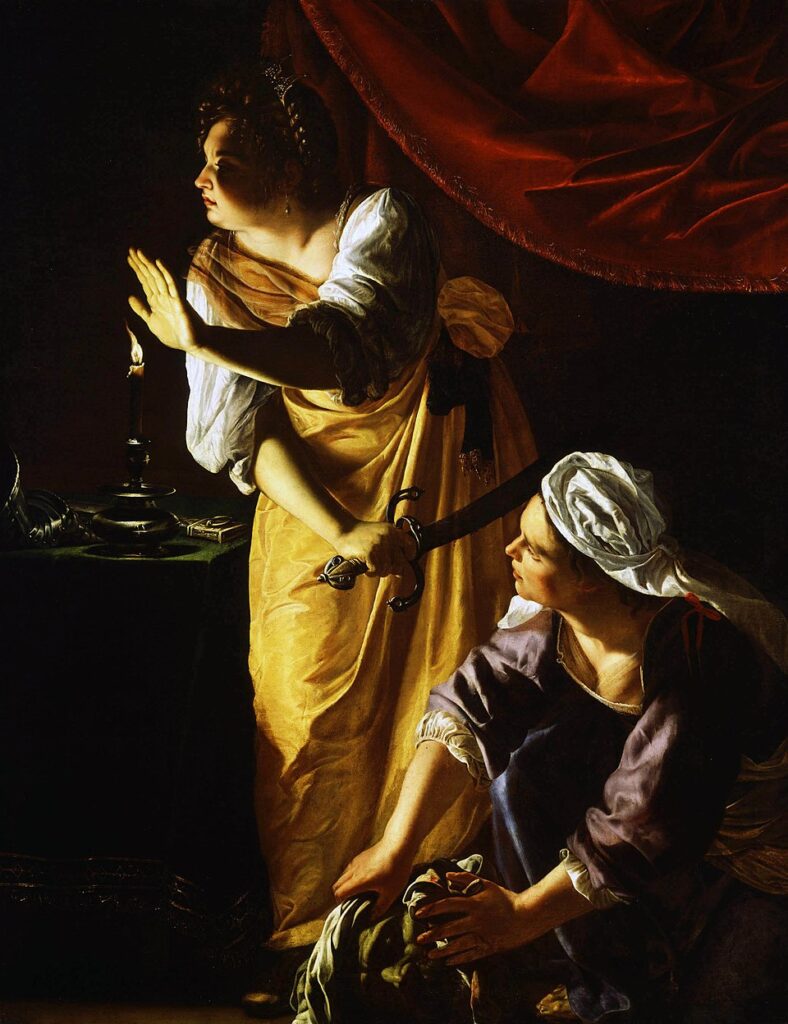
The symbolic charge of Gentileschi’s pictures also depended on how they were staged materially. A Judith could be displayed in a semi-private gallery where invited viewers performed connoisseurship, while a Magdalene might occupy a more devotional space. The same subject could be tuned toward different moral registers through framing, inscription, and companion pieces. In decorative terms, an ensemble’s cohesion mattered: a strong chiaroscuro canvas could be deliberately juxtaposed with lighter-toned works, or set against dark wall coverings to intensify the candlelit effect in evening viewing.
Gentileschi’s painterly language—figures emerging from darkness, textiles rendered with persuasive tactility—functioned as a kind of symbolic realism. Drapery is not incidental in her work; it is a carrier of meaning. Silk, velvet, and brocade index social status and bodily vulnerability simultaneously, allowing viewers to read the heroine’s predicament through the texture of her world. That sensitivity aligns with a broader Baroque fascination with surfaces, where the visible world is both seduction and evidence.
A final symbolic layer lies in the reception history: Gentileschi’s art has become a site where modern institutions negotiate narratives of authorship, agency, and historical injustice. The “legacy” is therefore double: what seventeenth-century viewers saw, and what later centuries needed her to represent. Museums and scholars must hold both realities in view, resisting anachronism while acknowledging that the interpretive life of her work is itself part of cultural history.
“A picture is not only an invention; it is a thing made—handled, moved, reframed, repaired—whose meanings change with its setting.”
—A principle often reiterated in conservation and decorative arts historiography
Craftsmanship and materials
From a connoisseurial perspective of the decorative arts, you start with the object‘s composition: ground, support, medium, surface. Gentileschi mostly painted on canvas. By the time she was active, it was the primary support for large works in Italy designed for grand palatial chambers and churches. The quality of the canvas, its thread count, tension, and preparation, affects the way paint sits and wears over time. The ground layers could vary in color, some darker or warmer to create contrast between light and dark for the purposes of chiaroscuro; this is a choice of technique rather than anything else, but also expression, how highlight “flares” out of shadow.
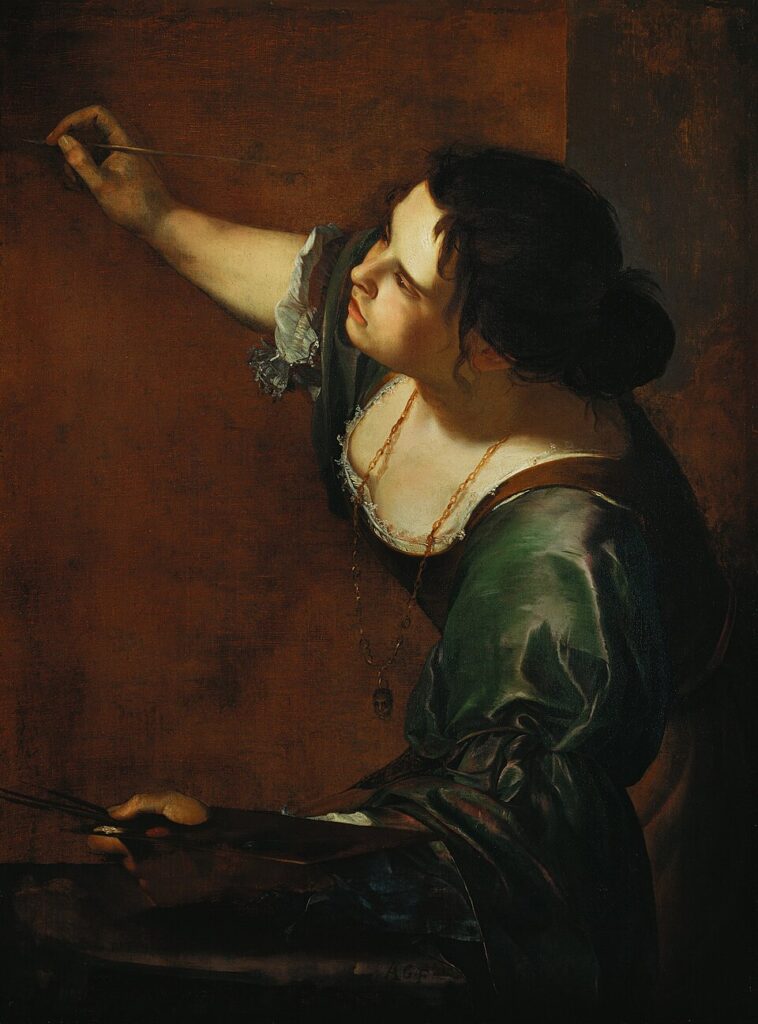
The application of paint can also be read as material in nature. Rendering of flesh often involve finesse rather than heavy application with glazes and opaques carefully blended and stroked to render contours. In contrast, costume and clothes were rendered more aggressively using thicker paint and highlights to convey the texture of shimmer, while jewelry, hair and metallic ornamentation are the result of precise dab strokes reflecting light. The ability of a painter to manipulate light so skillfully is not simply pictorial; it speaks to the interests of a collecting culture that prized realistic depiction and rejoiced at the skill of a painter to fool the eye.
These are perhaps least focused on in any monographic study on Gentileschi but are central to understanding her objects as ornament. Although original frames rarely survive undisputed, carved and gilded wood frames from the period profoundly affected how paintings were consumed within a domestic context. A strong Baroque frame with heavy carved elements might enhance the dramatic nature of the painting and underline its status as a pricey commodity. A more restrained profile could point to a Classicising arrangement. Research into framing is not simply decorative for collectors and curators working today; it is a means of recreating past installations and separating plausible 17th-century choices from post-creation revisions.
And pigments and binders. Ultramarine. From lapis lazuli, it meant “this was expensive and strategically placed” (see: in clothing, or in the sky). Reds could be cochineal-based lakes or mineral ones. Yellows were a spectrum, from earth colors to more elaborate blends. Each of these affects conservation: “lakes can degrade, some blacks change”. It‘s all part of the secret legacy that scientific work unlocks.
Historical locations, museums, and archives
Gentileschi’s afterlife is inseparable from the institutions that have preserved, displayed, and documented her works. The Uffizi Galleries in Florence, with its long Medici collecting history, provide a particularly resonant context for considering how her paintings entered the grand narrative of Italian art. Florence also offers archival terrains—court records, household inventories, artists’ correspondence—through which art historians reconstruct networks of commission and ownership. Such documents rarely speak in modern art-critical language; they speak in the language of objects, prices, sizes, and rooms.
Rome remains essential for understanding origins and early reputation. It is a city of interlocking archives—ecclesiastical, notarial, and familial—where traces of commissions and disputes can surface in unexpected places. Naples, similarly, is a locus for her mature activity and for the broader picture of the southern Italian art market, where Spanish governance intersected with a cosmopolitan port economy. London enters the map through her documented presence in England and the Stuart court milieu, reminding us that her career was not confined within Italian borders.
Museums have also shaped what counts as “Gentileschi.” Attribution has been contested, revised, and sometimes reversed, influenced by connoisseurship and by technical examination. When a painting moves from “circle of” to “by,” the consequences are curatorial (wall labels, catalog entries), economic (insurance and valuation), and cultural (what stories museums tell about women artists and Baroque painting). These shifts underscore the importance of transparent scholarship and the careful publication of technical findings.
The modern archive includes more than paper. Conservation files, infrared reflectograms, X-radiographs, pigment analyses, and stretcher histories constitute a parallel documentation system. Many museums maintain internal conservation dossiers that, when responsibly cited, allow scholars to understand not only what a painting depicts but how it has survived: where it was lined, when varnish was removed, which retouches were reduced. For decorative arts historians, such records are akin to a provenance of touch—an inventory of interventions.
Collector perspective
The collectors of Gentileschi‘s time bought pictures to suit a variety of tastes: visual, ethical and societal. After all, who wouldn‘t want to start a dinner party discourse with a thrilling biblical heroine on the gallery wall, a woman that proved her collector‘s inclination for justice, piety and virtue? The trained eye of the collector longed for maniera (style), for realism in textures, and for the power to move the spectator. All Gentileschi provided in a lingua franca that travelled
During the late eighteenth and nineteenth centuries, Gentileschi‘s reputation waned as tastes changed and attributions, often guided by paternal and familial associations, relegated women artists to male-associated schools or family ties. This is why today, purchasing a Gentileschi (or a picture strongly linked to her) is often a form of historical rectification, but one that has to be tempered with discretion. Provenance, condition and documentation are more important, historically, than they would be with other Baroque artists for the simple reason that the market benefits from inflation of attributions. A careful collector will assess a presumed Gentileschi just as they would a Caravaggio: with the expectation of technical reports, chain of ownership, and Scholarly comparisons.
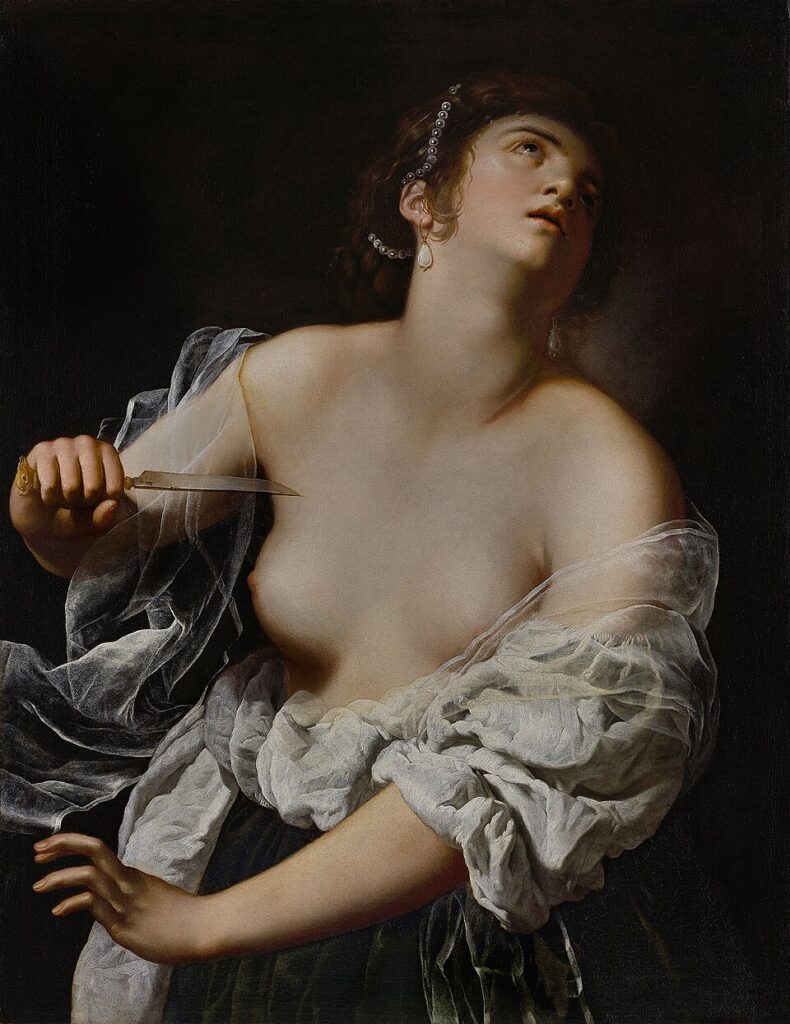
The collector‘s point of view is also defined by display constraints. Gentileschi‘s canvases need to breathe; their tonal structure falls flat when they are overexposed or when they are installed on a wall of the wrong color. Collectors acquainted with period interiors dark fabrics, gilded frames, targeted light sources recreate an old house setting that is less costume drama than interpretive tool. The painting is seen as an object that has been created to live inside a created space.
The other reason collectors pay such respect, or so I‘m told, is the “object biography” of the paintings. That is to say, that work has been reframed, relined, cleaned, sometimes truncated and sometimes extended. These are not scars; they are the tracks of the history of use. So perhaps Gentileschi‘s secret legacy is the continued existence of her paintings as lived objects a history inscribed by those who have touched her work to keep it read, and current, and in one piece.
Restoration insights
Restoration has been decisive in reshaping Gentileschi’s modern reputation. Many seventeenth-century canvases reached the twentieth century under discolored varnishes that dulled contrasts and obscured subtle modeling. When conservators remove aged varnish and reduce non-original overpaint—guided by microscopy, solvent testing, and ethical standards of minimal intervention—Gentileschi’s palette and spatial clarity can re-emerge with striking force. The result is sometimes perceived as “new,” but it is more accurately a recovery of relationships between light, color, and surface.
Structural treatments tell another part of the story. Baroque canvases often underwent lining (adhering a new canvas to the reverse) to stabilize weakened fabric. While lining can preserve, it can also flatten impasto and alter the painting’s mechanical response to humidity. Modern conservation tends to be more cautious, preferring localized repairs and controlled environments where possible. Understanding whether a Gentileschi has been lined, and when, can help explain differences in surface texture across her corpus.
Retouching is especially significant in works with large dark passages. Losses in shadows can be visually disruptive, prompting past restorers to “fill in” expanses of darkness in ways that inadvertently simplify Gentileschi’s nuanced tonal gradations. Contemporary practice aims to keep retouching reversible and discernible upon close inspection, preserving the artist’s original complexity. For scholars and collectors alike, reading a conservation report is not optional; it is part of understanding authorship, condition, and the integrity of the visual statement.
The most illuminating restorations are those accompanied by publication: before-and-after documentation, imaging plates, and clear differentiation between original paint and later additions. Such transparency supports trust in attribution and interpretation. It also reinforces a decorative arts insight: the painting’s surface is a palimpsest where aesthetic experience is inseparable from material history.
Market interest and collector demand
Market interest in Artemisia Gentileschi has intensified alongside institutional reappraisal and public scholarship. Yet demand should not be reduced to fashion. The surge reflects a broader correction in Baroque studies: acknowledging that Gentileschi was not an exception appended to a male canon, but a central practitioner whose work competes in ambition and quality with her contemporaries. As museums seek to represent the seventeenth century more accurately, acquisition priorities shift, affecting private market behavior.
From a market-analysis perspective, several forces shape demand: rarity of secure autograph works; attribution volatility; and the premium placed on well-documented provenance and condition. A painting with strong historical documentation and a clean conservation history will attract more serious bidding than a visually impressive but poorly documented work. This is especially true because Gentileschi’s workshop context, followers, and later copies complicate the field. Connoisseurship must be buttressed by technical evidence and published scholarship to reach the highest levels of confidence.
Collectors also respond to subject matter. Judith scenes, in particular, carry a powerful interpretive charge and have become emblematic of Gentileschi in modern discourse. However, this emblematic status can skew the market toward certain narratives, while quieter works—devotional images, portraits, or less overtly violent heroines—may offer equally significant insights into her range. Institutional collecting can counterbalance this by valuing representativeness over iconicity.
The market is also influenced by frame and presentation. Period-appropriate frames, or historically informed reframing supported by research, can materially affect both scholarly reception and market perception. This is not superficial: framing is part of how the object meets the viewer. In a field where the line between “painting” and “decorative object” is historically porous, such considerations are fully legitimate components of value—cultural as much as financial.
Table: What specialists look for when assessing a Gentileschi in the market
| Evidence category | What is evaluated | Why it matters for Gentileschi |
|---|---|---|
| Provenance | Ownership chain, inventory mentions, export records | Attribution confidence and legal/ethical clarity |
| Technical imaging | X-ray, IRR, UV fluorescence | Reveals underdrawing, changes, later overpaint, structural issues |
| Materials analysis | Pigments, ground, canvas weave | Helps situate work in time/place and compare with accepted works |
| Condition/restoration history | Varnish, lining, retouching extent | Affects legibility and scholarly trust |
| Frame and format history | Original size, cut-down/added strips, frame type | Indicates historical display and later modifications |
Why Artemisia Gentileschi’s legacy still matters
The continuing relevance of Artemisia Gentileschi lies in the way her works insist on being read as both images and objects—products of skill, patronage, and material circumstance that survived through collecting, reframing, and restoration. What appears “secret” is often what is most historically real: the slow accrual of documentary traces, the revelations of technical examination, and the recognition that a painting’s meaning is inseparable from its physical life in rooms, collections, and institutions. Gentileschi’s art endures not because it can be made to serve a single modern story, but because it withstands sustained scrutiny from multiple disciplines.
For decorative arts and cultural history, her case is exemplary. It demonstrates how the study of materials, frames, interiors, and conservation records can deepen—rather than distract from—iconographic and stylistic interpretation. It also models a more responsible connoisseurship, one that treats attribution as an evidentiary argument rather than a proclamation. Finally, Gentileschi matters because her oeuvre offers a rigorous test of how we build cultural memory: through archives, through objects, and through the ethical practices of museums and collectors tasked with preserving and interpreting the Baroque past.