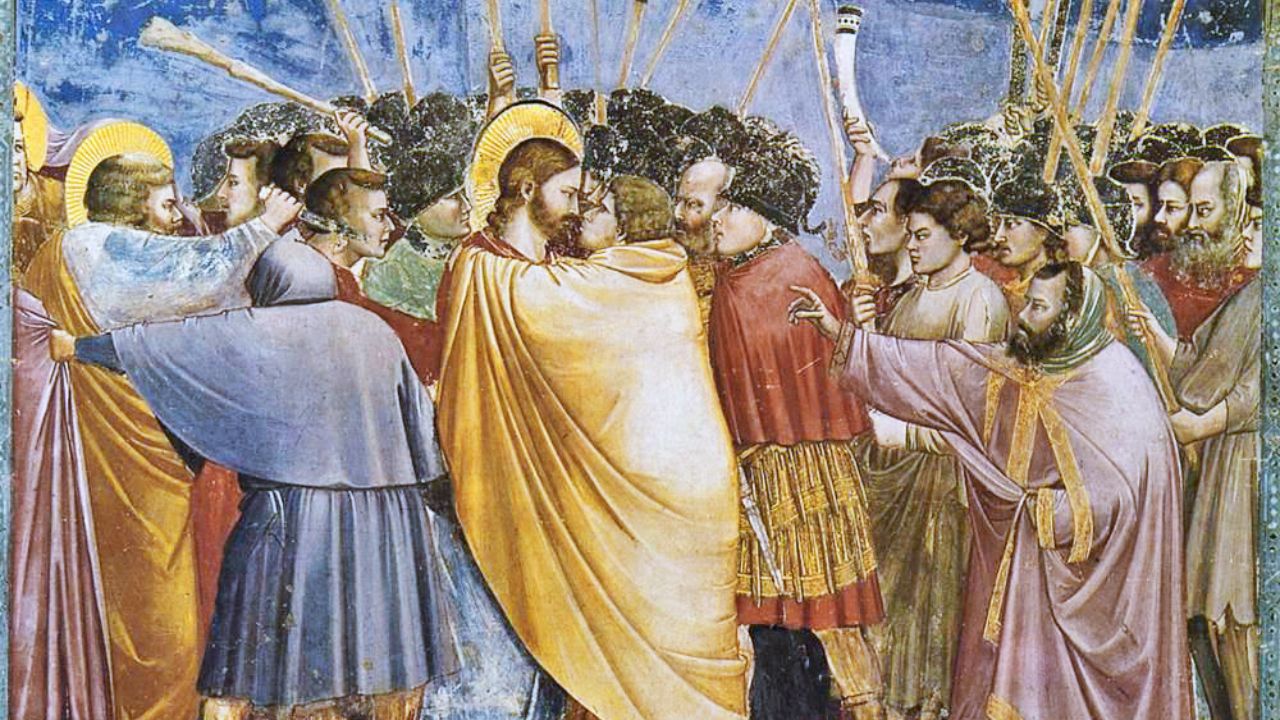
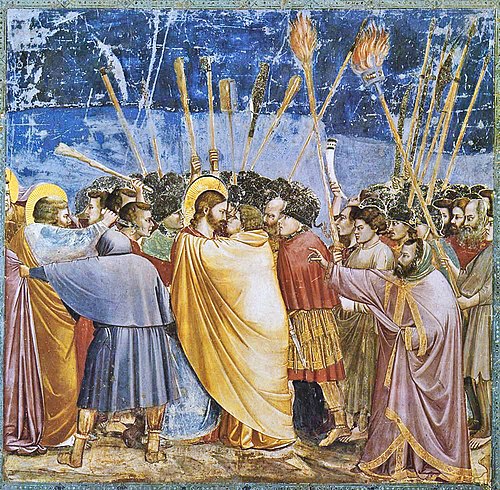
In a single clash of faces—Christ calm, Judas pressing forward with a suffocating kiss—Giotto di Bondone transforms an episode from the Gospels into a scene that feels startlingly present. The Arrest of Christ (often called The Kiss of Judas) is not simply an illustration of betrayal; it is a turning point in Western art. Painted in the early 14th century, it condenses fear, loyalty, violence, and moral choice into a tightly staged encounter, and it does so with a new visual language: weighty bodies, believable space, and human emotion rendered with unprecedented clarity. This fresco remains one of the most studied images in medieval art because it signals the moment painting began to think in terms of lived reality.
Historical Context: Giotto, the Early Renaissance, and the Scrovegni Chapel
Giotto di Bondone (c. 1290–1337) painted at the crossing of the late medieval and early renaissance worlds. Italy was at this time a mixture of city-states and church authority and notable artistic centers included Florence, Padua, and Rome. The stylistic tradition before Giotto, the style sometimes called Byzantine or Italo-Byzantine in Italy, favored hieratic figures, gold backgrounds, and religious symbolism over the depiction of realistic space. Giotto did not forsake the spiritual meaning of religious pictures but he treated sacred stories with the drama of human events.
The Arrest of Christ comes during the Scrovegni ( Arena) Chapel fresco cycle, a commission from Enrico Scrovegni, which was painted from about 1303 to 1305. The chapel cycle begins with the stories of Joachim and Anna, then the Virgin Mary, and continues on to Christ‘s preaching, ministry, and Passion. Within this context, The Arrest of Christ is hardly a work unto itself. It is a thrilling moment of escalation in a meticulously designed story, a dramatic climax of the sacred drama, as Christ heads to his crucifixion.
Giotto‘s triumph is embraced by all of the most important institutions that display European early painting. Thus, at The Metropolitan Museum of Art in New York, Giotto is positioned as a leader of naturalism and clarity in the early 14th century. Similarly, at the Victoria and Albert Museum in London, the Italian artists of the 14th century are shown as innovating storytelling and depiction in ways that informed subsequent Renaissance developments. The importance of these judgments lies in the fact that they derive from ongoing professional agreement rather than a mere present-day consensus.
Visual Analysis: Composition, Emotion, and the Geometry of Betrayal
All hell breaks loose in a monumentally simple arrangement. We see the two faces in close-up, at dead center: Christ tilted back, his mouth tightly closed; Judas leaning in, his bright yellow cloak wrapping around his own neck, creating a vortex of betrayal. The figures press themselves into the picture plane until their collision feels palpable, visceral. Here is the magic of Giotto‘s storytelling genius: he closes off “breathing room,” trapping us in the instant.
The surrounding commotion seems to heighten the sense of core inactivity. To the right Saint Peter swipes a sword and chops off the ear of Malchus (as recorded in the gospels). The soldiers advance with spears and clubs the helmets and torches flash men are angry and scared, their faces contort but still, the greatest psychological drama is between Christ and Judas‘s eyes. Previously this sort of drama was usually achieved through gesture and symbol. Giotto makes it a more direct human interaction peaceful to violent; willing to forced.
This compositional space also enhances the emotional power. The multitude is a heavy mass but it‘s not flat; the figures are stacked, with overlap and convincing weight and direction to give it depth. The torches and spears all angle inwards, like arrows toward the center. As art historians are apt to point out, Giotto‘s figures hang in space as if under the influence of gravity. So much so, indeed, that Cennino Cennini, the early Italian author of Il Libro dell’Arte, was later to say that Giotto “translated the art of painting from Greek to Latin” an Italian saying meaning he adapted the Byzantine style to a more Western naturalism. This is certainly an oversimplification but the core point is true: Giotto changed painting.
Technique and Innovation: Fresco, Naturalism, and Narrative Authority
The Arrest of Christ is a fresco, executed with pigments applied to wet plaster (buon fresco), a demanding technique that requires speed, planning, and confident drawing. The medium rewards clarity and structural thinking: forms must be designed to read decisively from a distance, and large compositions must be organized into coherent daily sections (giornate). Giotto’s control is evident in the legibility of the crowd and the firmness of the principal figures.
One of Giotto’s most consequential innovations is the sense of volume—heads feel round, bodies feel substantial, drapery hangs with weight. This is not Renaissance perspective in the later scientific sense, but it is a major step toward it: space is treated as a stage for action rather than a decorative surface. The result is narrative credibility. Viewers do not merely recognize biblical characters; they perceive a believable event unfolding.
Authoritative institutions consistently frame Giotto’s work as foundational for later developments in European painting. The Metropolitan Museum of Art describes the shift in early Italian art toward greater naturalism and emotional engagement, and Giotto stands at the center of that story. The Louvre Museum (Paris), in its broader presentation of medieval and early Renaissance visual culture, likewise emphasizes the period’s growing interest in corporeality, human expression, and narrative drama. Even when these museums discuss different objects than the Scrovegni frescoes, they reinforce the same scholarly baseline: the early 14th century in Italy marks a profound transformation in pictorial thought.
Key Characteristics of The Arrest of Christ (Giotto) — Summary Table
| Aspect | What You See | Why It Matters |
|---|---|---|
| Central focus | Christ and Judas face-to-face | Psychological drama becomes the core of the narrative |
| Composition | Dense crowd compressing inward | Forces immediacy; betrayal feels physically inescapable |
| Emotion | Calm vs. aggression | Humanizes sacred history; moral tension becomes readable |
| Light cues | Torches and angled spears | Direct the eye to the central confrontation |
| Figural volume | Rounded forms, weighty drapery | Break from flatter Italo-Byzantine conventions |
| Narrative detail | Peter cutting off Malchus’ ear | Reinforces realism and the chaos of the arrest |
| Medium | Buon fresco | Demonstrates planning, mastery, and monumental ambition |
Frequently Asked Questions (FAQ)
1) Where is Giotto’s The Arrest of Christ located?
It is in the Scrovegni (Arena) Chapel in Padua, Italy, painted as part of the chapel’s fresco cycle (c. 1303–1305). The chapel is a major monument of late medieval Italian art and an essential site for studying early Renaissance naturalism.
2) Why is The Arrest of Christ considered revolutionary?
Because it treats a sacred narrative with unprecedented psychological intensity, bodily realism, and compositional control. The scene reads like a lived event rather than a symbolic arrangement, helping to set the stage for later Renaissance developments in space, anatomy, and storytelling.
3) What biblical moment does the fresco depict?
It depicts Christ’s arrest in Gethsemane, including Judas’ identifying kiss and the violent reaction of Peter (cutting off the ear of the high priest’s servant). Giotto synthesizes multiple Gospel details into a single, cohesive visual climax.
4) What should I pay attention to when viewing it?
Focus on the locked gaze of Christ and Judas, the yellow cloak’s engulfing shape, the directional thrust of spears and torches, and the contrast between stillness at the center and turbulence at the edges. These choices reveal Giotto’s mastery of narrative staging.
5) How do museums and institutions help us understand Giotto’s impact?
Institutions such as The Metropolitan Museum of Art, the Victoria and Albert Museum, the Louvre Museum, and the Smithsonian Institution support research-based interpretations through curatorial scholarship, conservation science, and historical contextualization of medieval and early Renaissance art.
Authoritative Sources (Selected)
- The Metropolitan Museum of Art (Heilbrunn Timeline of Art History) — essays on early Italian painting and the move toward naturalism in the 13th–14th centuries.
- Victoria and Albert Museum — collections and interpretive materials on medieval and early Renaissance art and techniques.
- Louvre Museum — resources on medieval/early Renaissance visual culture and the development of European painting.
- Smithsonian Institution — educational materials on art history, conservation, and historical methods for interpreting objects and images.
- Cennino Cennini, Il Libro dell’Arte — primary-source perspective (late 14th–early 15th century) on Italian painting and its transformation.
Quote (primary-source tradition): Cennino Cennini famously credits Giotto with transforming painting “from Greek to Latin,” encapsulating the perceived shift away from Byzantine convention toward a new naturalism.
It is Giotto di Bondone‘s Adoration of the Magi not for portraying betrayal, but for its struggle with betrayal that we remember him even now centuries later. With his unique ability to compress time and space, his bold sculpture sense, and his profound understanding of human psychology, Giotto brought humanity and intimacy to the Passion, transforming Western Art forever. The frescoes of the Scrovegni Chapel are, at their creation, among the most profound accomplishments of the 14th century and the turning of devotional into unmistakable human drama.