Antique wedding dress lace is more than a decorative trim—it is a surviving record of craftsmanship, trade, technology, and social history stitched into bridal clothing. Whether it’s a whisper-thin Brussels appliqué edging a bodice or sturdy handmade filet forming a veil border, antique lace carries clues about where it was made, how it was produced, and what it signified in its time. For collectors, brides, and conservators alike, understanding these clues is the difference between owning “old lace” and preserving a genuine historic textile with documented value.
What “Antique Wedding Dress Lace” Really Means (and Why It Matters)
“Antique” usually means 100 years old or more in the world of collecting and textiles. “Antiquity” in terms of market application can be more fluid, however. This 100-year line is important in lace for wedding dresses because it often corresponds to major changes in lace manufacturing: The turn of the last century marked a point where machine-made lace began to become broadly accessible, while prior to that point, lace was made by hand. Museums and historians of textiles consider these changes when determining the age and origin of a piece of lace.
Vintage wedding lace also plays a role because lace has inherent structural instability. Lace is essentially holes in a textile and can be distorted, frayed, or permanently weakened by light exposure or incorrect storage. It‘s why places like The Victoria and Albert Museum (The V&A) and The Metropolitan Museum of Art (The Met) keep lace in their collection. Not just to look at, but because lace is first and foremost a record of women‘s work, the local economy and ingenuity in Europe and beyond.
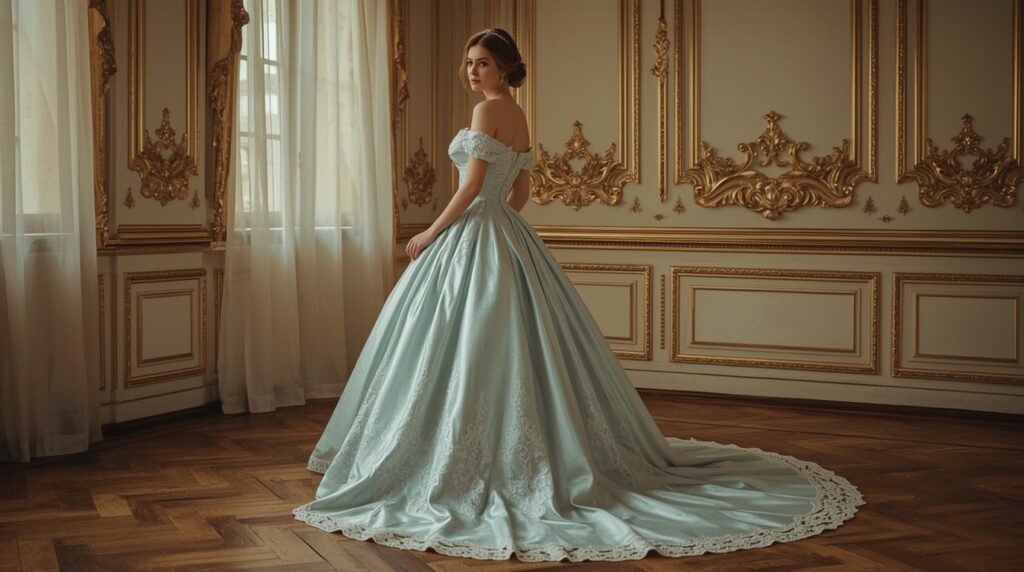
Finally, bridal lace is culturally charged. White wedding fashion, popularized in the 19th century after Queen Victoria’s 1840 wedding, increased demand for white textiles, including lace, and helped cement lace as a signifier of refinement and ceremony. While not all antique bridal garments are white, lace in bridal wear consistently communicates formality and status—making authentic pieces especially sought after in collecting and heirloom reuse.
A Brief History of Lace in Bridal Fashion: From Courts to Couture
From being an elite fabric produced in centers such as Italy (Venice) and Flanders (Brussels and Mechelen) in the early modern period, lace grew to symbolise status in the European courts of the 17th and 18th centuries. When lace is found on historical wedding dresses it can be considered a reflection of the period‘s wider fashion language, such as ornate decoration, traditional motives (wheat, flowers, scrolls) and the specific traditions of lace making within each center (based on scale and net).
The 19th century was an exciting time for lace. The advent of mechanization fundamentally reshaped the industry with the explosion of machine-made net and lace production in places like Nottingham, England. That doesn‘t mean handmade lace disappeared it became part of a spectrum: couturiers and garments made for the rich or royal could still be made entirely of handmade lace, while wedding gowns in the middle-class came increasingly to be made of machine-made lace and then further accented with handmade lace. You see examples of both at the Met and the V&A museum where there are paired examples of handmade and machine-made pieces.
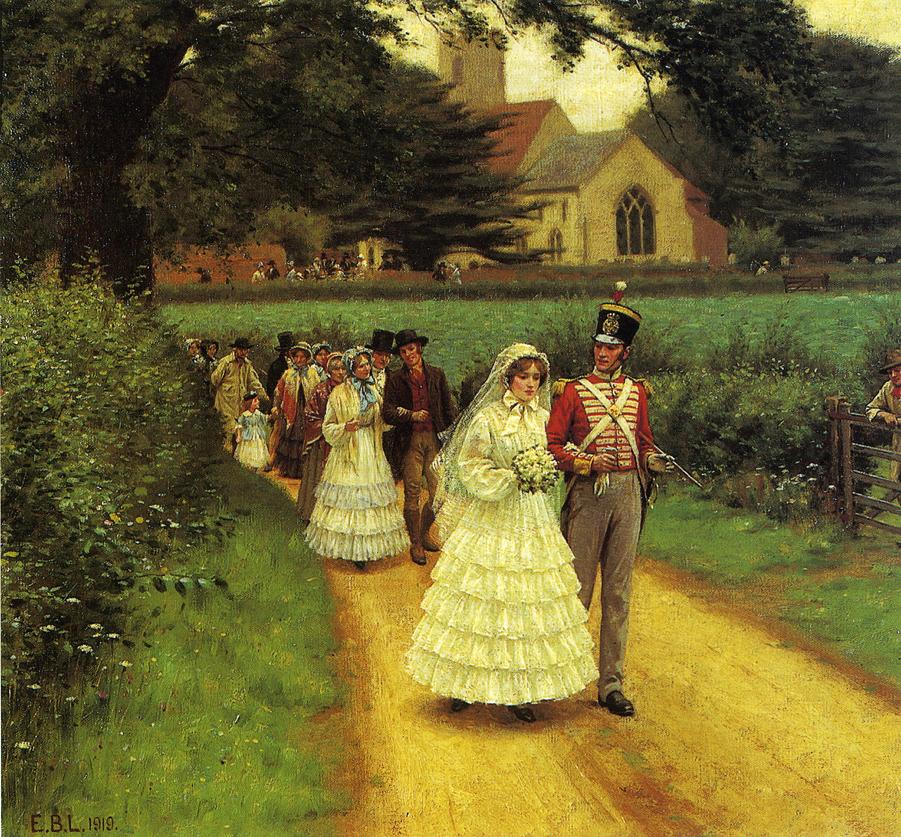
By the Belle Époque (roughly 1890–1914) and into the 1920s, bridal silhouettes changed (high collars and long sleeves shifting to lighter, freer lines), and lace adapted with them. Museums such as The Met and the V&A preserve wedding dresses and lace accessories from this period that demonstrate how lace moved from heavy trims to airy overlays, veils, and flounced hems—an evolution that helps date antique wedding lace when the garment’s provenance is incomplete.
Identifying Antique Lace Types Used in Wedding Dresses
The traditional antique laces you‘ll likely find most frequently in a bridal setting are bobbin lace (think Flanders, sections of France), needle lace (especially Italian), and netted laces (such as Brussels applique designs stitched onto a netted background). Each of these have structural tells; needle lace can often appear “drawn” or stitched in appearance, whereas you‘ll frequently see the braids or plaits that are the hallmark of bobbin lace, along with a patterned repeat in the net.
Chantilly lace, often black in its traditional iteration, but seen in bridal accoutrements and later white versions, like the one in the photograph, is another type of needle lace. Then there is Alencon lace, a French lace (sometimes known as “Queen of Laces”), that is characterized by intricate needle-threading with a cordonnet essentially an outline stitched around the design. As the V&A itself notes in its own scholarship on lace and collections: “Names can vary some are descriptive of techniques, some of origins, some are trade names, and some may have been adapted from other types of lace.”
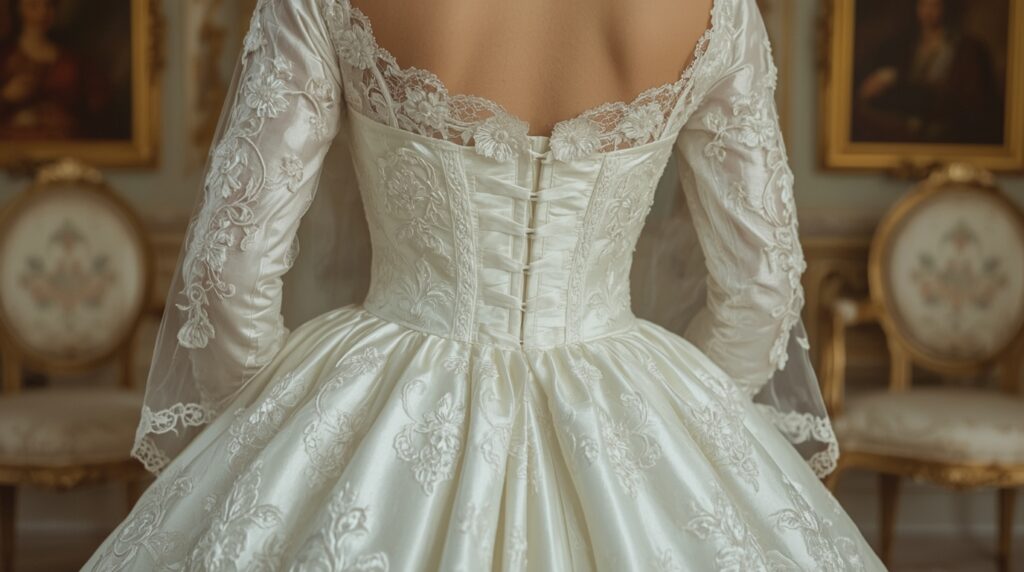
A useful way to approach identification is to combine (1) technique, (2) pattern style, and (3) ground structure. The Smithsonian Institution and major costume collections often stress that fiber content and construction details are more reliable than family lore alone. In practice, a magnifier, good lighting, and comparison with museum examples (high-resolution online collections at The Met and the V&A are invaluable) can significantly improve accuracy.
Key characteristics table
| Lace type commonly seen on antique wedding dress lace | Main technique | Typical cues | Common period in bridal use | Notes on authenticity checks |
|---|---|---|---|---|
| Brussels appliqué | Handmade motifs applied to net | Separate floral motifs stitched onto fine net | Late 19th–early 20th c. | Look for hand-applied motif edges and irregular stitch tension |
| Alençon | Needle lace | Raised cordonnet outline, dense detailed motifs | 18th–19th c.; elite bridal | Examine for needle-made bars/filling stitches rather than machine uniformity |
| Bobbin lace (various Flemish/French types) | Bobbin (pillow) lace | Plaited threads, consistent ground patterns | 18th–early 20th c. | Check for slight irregularities and thread joins consistent with handwork |
| Machine-made lace (Nottingham and others) | Industrial | Repeating precision, uniform threads | Late 19th c. onward | Uniformity is not “bad,” but it is not the same as earlier handmade lace |
Authenticity, Condition, and Conservation: What Experts Look For
Authentication begins with construction. Conservators often look for telltale signs of handwork: thread irregularities, tiny repairs, hand-rolled hems on net, and non-uniform repeats. Machine-made lace can still be historically significant, but it typically exhibits high regularity and standardized motifs. Matching the lace type to the garment’s silhouette and materials also matters—an 1870s bodice paired with a lace style more typical of the 1920s is a red flag unless there’s documentation of later alteration.
Condition assessment is equally crucial because lace degrades through stress, light, and prior cleaning. Splits along fold lines, shattered silk threads, oxidation (yellowing/browning), and old starch residues are common issues. The Smithsonian Institution’s conservation resources emphasize preventative care: stable storage, minimal handling, and avoidance of harsh detergents are key for fragile textiles.
Authoritative institutions consistently stress gentleness and documentation. As the V&A advises in its care guidance for textiles, avoid unnecessary washing and prioritize proper support and storage to prevent strain. The Met’s Costume Institute and textile conservation practice similarly center on stabilization rather than “restoration” that erases history. A practical takeaway: if you acquire antique wedding dress lace, photograph it, note measurements and any repairs, and store it flat in acid-free tissue—because provenance and condition records protect both historical and market value.
Buying and Wearing Antique Wedding Dress Lace Today (Ethically and Beautifully)
Vintage lace makes a truly special sustainable accent to any modern wedding. However, such treasured vintage items require a gentle hand. Where possible, we lace is used as an overlay and is carefully sewn to a stable base fabric. Rather than cutting it into pieces, our skilled ateliers will integrate it as an overlay onto the bodice, the sleeves or even as part of a veil ensuring no seams or pressure points impact on the delicate lace.
Provenance is key. Ethical sourcing stems from transparency. Responsible dealers will disclose why they date an item, if it has been repaired, or if the lace was cut out from an item. Ask for provenance, documentation, and cross reference with the museum database. Sites with collection databases from The Met, the V&A, or The Louvre (if you are looking for Decorative Arts and Textiles) may help set the visual standard.
Finally, recognize that “perfect” is not the goal. Antique lace often bears signs of life: tiny mends, slight tone variation, softened edges. Those qualities can be aesthetically compelling and historically honest. As a guiding principle echoed across museum conservation, preserving original material and minimizing intervention is the most responsible way to keep antique wedding dress lace wearable—if it can be worn at all—without sacrificing its integrity.
Frequently Asked Questions
How can I tell if lace on a wedding dress is truly antique?
Look for construction evidence (handworked joins, slight irregularity, hand-finished edges) and confirm the lace style matches the dress era. Compare with high-resolution examples from institutions like The Met and the V&A. When in doubt, consult a textile appraiser or conservator.
Is machine-made lace ever considered antique?
Yes. Lace made on 19th-century machines can be antique by age and historically important, especially tied to industrial centers such as Nottingham. “Antique” refers to age; “handmade” refers to method.
Can antique wedding dress lace be safely cleaned?
Sometimes, but cleaning can be risky. Museums generally favor minimal intervention. If cleaning is necessary, consult a textile conservator; avoid bleach, enzymes, and vigorous agitation.
What is the most valuable type of antique bridal lace?
Value depends on rarity, condition, provenance, and craftsmanship. Fine needle laces (e.g., Alençon) and exceptional handmade Brussels appliqué can command higher prices, but documented provenance can elevate any type.
How should I store antique lace?
Store flat, supported with acid-free tissue, away from light and humidity. Avoid plastic that traps moisture. Handle with clean hands and support the lace fully to prevent stretching.
Antique wedding dress lace sits at the intersection of artistry and history: it reflects regional techniques, shifting technologies, and the evolving language of bridal style from European courts to modern ceremonies. By learning to identify lace types, respecting conservation best practices, and using museum collections as reference points, you can appreciate—and responsibly preserve—these remarkable textiles for the next generation.
Authoritative sources referenced for further study: The Metropolitan Museum of Art (Costume Institute collections), the Victoria and Albert Museum (lace collections and textile care guidance), the Louvre Museum (decorative arts and textiles), and the Smithsonian Institution (textile conservation resources).