
Antique and vintage writing desks are more than attractive furniture—they are time-stamped witnesses to how people worked, learned, governed, and corresponded across centuries. From candlelit letter writing in Georgian parlors to ink-stained paperwork in early 20th‑century offices, the writing desk shaped daily life and left behind clues in its wood, hardware, proportions, and wear. If you’re considering buying, collecting, or restoring an antique vintage writing desk, understanding its history and construction is the difference between owning “old furniture” and stewarding a meaningful object with cultural and material integrity.
What Defines an Antique Vintage Writing Desk?
In the trade, an antique writing desk is commonly defined as 100+ years old, whereas vintage will likely designate pieces from the 20th century (though this term can be quite broad; think mid-century). Whether a style is formal (with drawers or nested interiors) or simply used for light writing and correspondence (think writing tables), the distinctions are useful. The terms are important for museums because their usage varied a “bureau”, “secretaire” or “escritoire” is not the same as a “partners’ desk” even if many contemporary dealers lump all these categories into one.
Historically, writing desks measured literacy, and government, and the new professional man. In 17th and 18th-century Europe, commercial and bureaucratic middle classes developed purpose-built writing furniture. In Georgian-era England (1714–1830), or during the French Louis XV and Louis XVI eras in the 18th century, specific writing tables complete with leather writing surfaces, pigeonholes, and secret drawers indicated wealth and education.
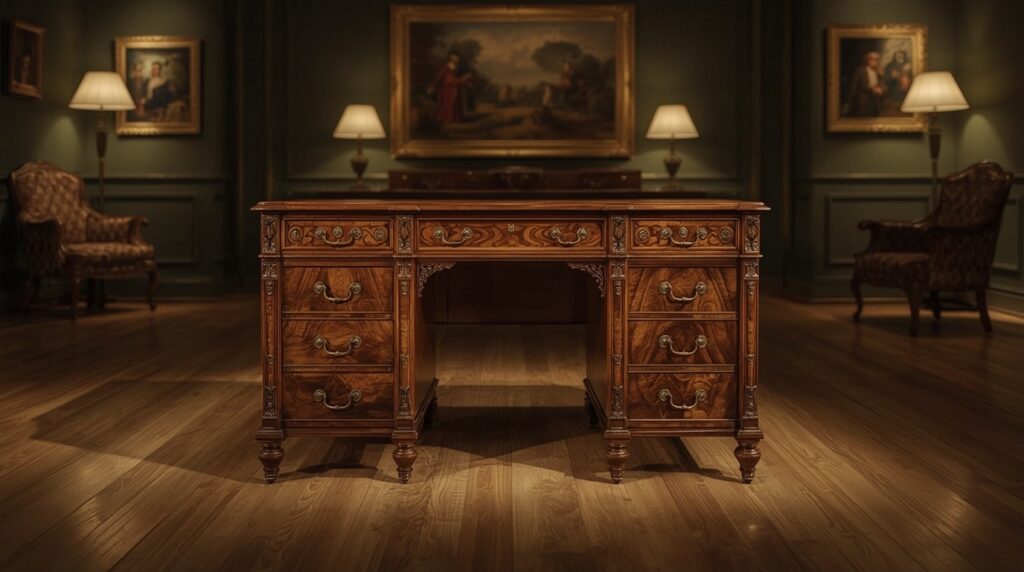
We rely on the archives of the major museum collections to understand these distinctions with specific dated pieces. The V&A, the Met the great museums meticulously catalogue their desks by maker, material, origin, and date. These are the beacons for a collector attempting to differentiate between a genuine period piece and something inspired by the era, but created much later. “Antique” is not merely a matter of age, but of pedigree.
A Brief History: From Bureaucracy to the Home Office
The design history of the desk tracks alongside shifts in bureaucracy and culture. In 18th-century France, writing tables, the bureau plat and cylinder desk being prime examples, were shaped by courtly life and administrative practice, and produced in luxurious woods with marquetry and gilt bronze fixtures. British desks of the Georgian and Regency periods, 1811 to 1820, favored joinery and decoration of a more subtle character, with a tradition of mahogany, and eventually satinwood, furniture. In the United States, Federal and later Victorian desking charted new artistic currents, industrial realities and an rise in home literacy.
Late 19th and early 20th century developments saw the writing desk further splintered into styles. Roll-top and “campaign” desk styles were adopted for offices, travel and increasingly, for the burgeoning middle-class home. In its writings on how industrialization changed work in America, the Smithsonian Institution charts the increasing use of writing desks for mass-produced forms and white-collar professions, while European trends still held sway at the design schools and street workshops of Paris, London and Vienna.

The evolution can be seen in the minute details of those pieces, like dovetailed joinery (cut by hand, not the slick machine cut) and species of woods and thickness of veneers, and the hardware used. If you study museum pieces at the V&A in London or The Louvre in Paris, you can see that function dictates form. Desk designs made to accommodate quills are not the same desk design made to hold typewriters, and neither is the design for home offices. These are all factors buyers can use to sniff out anachronisms, such as using a “Louis XVI” desk with obvious “modern” screws or plastic coating.
Identifying Authenticity and Quality: Materials, Construction, and Patina
Authentic antique vintage writing desks tend to reveal themselves in construction. Look for solid joinery (hand-cut dovetails in older drawers), consistent tool marks, and wood movement that makes sense for age. Veneer work can be a sign of quality—especially in high-style European furniture—when it is thin, book-matched, and carefully laid. A too-perfect surface, uniform “distress,” or unusually sharp edges can indicate modern reproduction or aggressive refinishing.
Patina matters, but it should be believable. Areas of natural wear—drawer pulls, writing edges, foot rails—should align with how the desk was used. A leather writing surface may show gentle burnishing rather than uniform cracking. Replaced hardware isn’t automatically disqualifying, but it should be disclosed and consistent with period forms. The V&A’s object records often describe original materials and later alterations, underscoring that change over time is common—but transparency is essential.
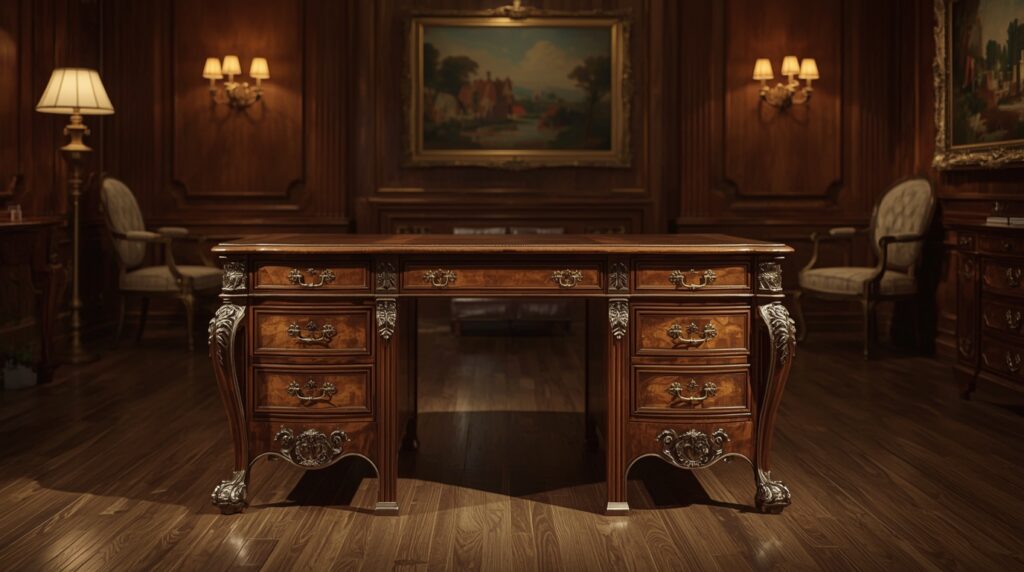
When evaluating claims, rely on documentation and expert comparison. As The Metropolitan Museum of Art notes in its collections and educational materials, careful study of materials and techniques is foundational to attribution and dating. In practice, that means comparing your desk’s proportions, drawer layout, feet, and ornament to museum examples and reputable reference books—not just marketplace listings.
Key Characteristics at a Glance
| Feature | Antique (approx. pre-1926) | Vintage (approx. 1920s–late 20th c.) | What It Suggests |
|---|---|---|---|
| Joinery | More hand-cut dovetails; irregularity | More machine-cut consistency | Age and production method |
| Materials | Mahogany, walnut, oak; fine veneers | Mixed hardwoods, plywood appears more | Period norms and cost |
| Hardware | Brass with wear; slot screws common | Phillips screws appear later | Dating clue (not absolute) |
| Finish | Shellac, wax; mellow oxidation | Lacquer and later synthetics more common | Restoration vs originality |
| Form | Bureau, secretaire, writing table | Office/task desks; modernist lines | Use-case and era |
Caring for an Antique Vintage Writing Desk (Without Ruining Its Value)
Conservation-minded care preserves value and history. Avoid harsh refinishing unless the desk is structurally compromised or previously stripped; original surfaces can be historically important. Museum conservation departments generally favor minimal intervention—cleaning, stabilization, and reversible repairs—over sanding and modern polyurethane. This approach aligns with professional standards used across major institutions.
For everyday care, keep the desk out of direct sunlight and away from radiators or vents to prevent veneer lifting and joint stress. Use a soft cloth, gentle cleaning methods, and avoid silicone-heavy polishes that can contaminate surfaces and complicate future restoration. If the desk has a leather writing inset, maintain stable humidity and consider a specialist for conditioning—improper products can darken or weaken antique leather.
If repairs are needed, choose a conservator or furniture restorer experienced with period methods (hide glue, appropriate veneers, historically sympathetic finishes). The point is not to make the desk look “new,” but to keep it sound and honest. As the Smithsonian Institution emphasizes in its preservation guidance, good stewardship balances use with long-term preservation—especially for objects that carry cultural and historical information.
Collecting and Buying: Provenance, Ethical Trade, and Market Realities
Good buying begins with questions: Who is this made by? Do you have paperwork? Estate records? Maker‘s marks? Dealer information? Invoices, past and present? Provenance, meaning records of origin, is key to taking a desk from decorative to “investment” quality; it can go from “old desk” to “piece from a certain workshop,” “from a certain region (Paris, London, Massachusetts),” or “from a certain collection.” Reputable dealers should be open to a more probing inspection, offering a condition report and talking about any restorations.
Authenticity isn‘t just stylistic, but moral. Be wary of certain protected items (e.g. antique ivory inlay, certain endangered woods), as export/import regulations may apply. Ethical dealers comply with them and have nothing to hide. If you are unsure, hire an appraiser belonging to a recognized professional association and check similar items in museum databases. The Met, the V&A and The Louvre all have online collection databases where you can look up similar items.
First and foremost, invest in a good structure and proportional piece. You don‘t want a wobbly desk, one with many missing pieces of active veneer, or a piece which has been substantially restored. Damage which is merely cosmetic (and it is, to me) is a sign of honest use. Condition (active veneer loss, structure), rarity, maker, and the popularity of the style of desk (a mid-century modern writing desk can be expensive while many late Victorian examples are inexpensive) contribute to the value.
Authoritative Perspectives (Quotes)
“Conservation is the careful management of change.” — This principle is widely used in museum conservation practice and reflects the professional approach seen across major institutions, including conservation guidance associated with the Smithsonian and other museum programs.
“Style is a kind of language.” — While often attributed in design discourse, the underlying point is reinforced by museum interpretation: furniture forms communicate period taste, technology, and social life. Studying desks in the V&A or The Met makes this “language” visible through documented objects and context.
(For collecting decisions, pair memorable principles like these with verifiable object records from museum databases and written condition reports from qualified professionals.)
Frequently Asked Questions
How can I tell if my writing desk is truly antique?
Start with construction (joinery, screws, tool marks), materials (solid wood vs plywood), and finish (shellac/wax vs modern coatings). Then compare form and details to dated examples in collections from The Met and the V&A.
Does refinishing reduce value?
Often, yes—especially for higher-quality or rarer desks. Stripping and sanding can erase original finish, soften edges, and reduce historical integrity. Light conservation and reversible repairs are usually preferred.
What styles are most commonly found?
Common types include writing tables, bureaus, secretaires, roll-top desks, and partners’ desks. Period examples appear across Georgian, Victorian, Art Deco, and mid-century eras, each with recognizable proportions and materials.
Are antique desks practical for modern work?
Many are, particularly sturdy writing tables and larger desks. Consider legroom, drawer function, and surface height. You may want a protective writing mat to preserve original leather or wood.
Where should I research before buying?
Use museum databases and trusted references. Start with online collections and educational content from The Metropolitan Museum of Art, the Victoria and Albert Museum, The Louvre Museum, and the Smithsonian Institution, then consult a qualified appraiser or conservator for hands-on evaluation.
Conclusion
An antique vintage writing desk can be a functional centerpiece and a serious historical object at the same time. When you learn to read its materials, construction, and period cues—and when you care for it using conservation-minded practices—you preserve not just a piece of furniture, but a fragment of the working and intellectual life that shaped modern society.