In museum work, “secrets” rarely take the form of a hidden compartment or a sensational attribution. More often they are patterns—repeated technical decisions, consistent repairs, or quietly radical choices—that only become legible when hundreds of garments are studied side by side. In the case of antique-style wedding dresses and original antique bridal gowns, archivists and textile curators have increasingly converged on a revealing conclusion: the most “traditional” bridal gowns were frequently the most adaptive objects in a woman’s wardrobe, designed (and repeatedly altered) for reuse, social legibility, and family memory rather than singular display.
The awareness doesn‘t come from a single, “aha” moment, but from years of observing the storage rooms of museums: seams unpicking themselves and being restitched, bodices refitted for another pregnancy, train hooks added decades later, and lace appliques shifting from one dress to the next. In museums, it also becomes apparent that hems have been pulled up for different shoes and that subtle gussets have been added. When these alterations are connected to diaries, household accounts, and studio photography plates, the antique wedding dress is more than just a time capsule of “one big day,” but rather a family textile that has lived a long life.
Institutions that archive dress like the V&A (London), The Met‘s Costume Institute (New York City), the Fashion Museum in Bath, or smaller local archives focused on the area have the kind of material for that comparison that is absent from portraits. They can demonstrate “bridal” wasn‘t always an item in the dress category; in other words, the idea of using a white gown once for a wedding is not a given. So the “secret,” really, is a matter of method; gowns are historical evidence and if you learn to read them, they tell us about economies, industry, technology and symbolism in ways portraits cannot.
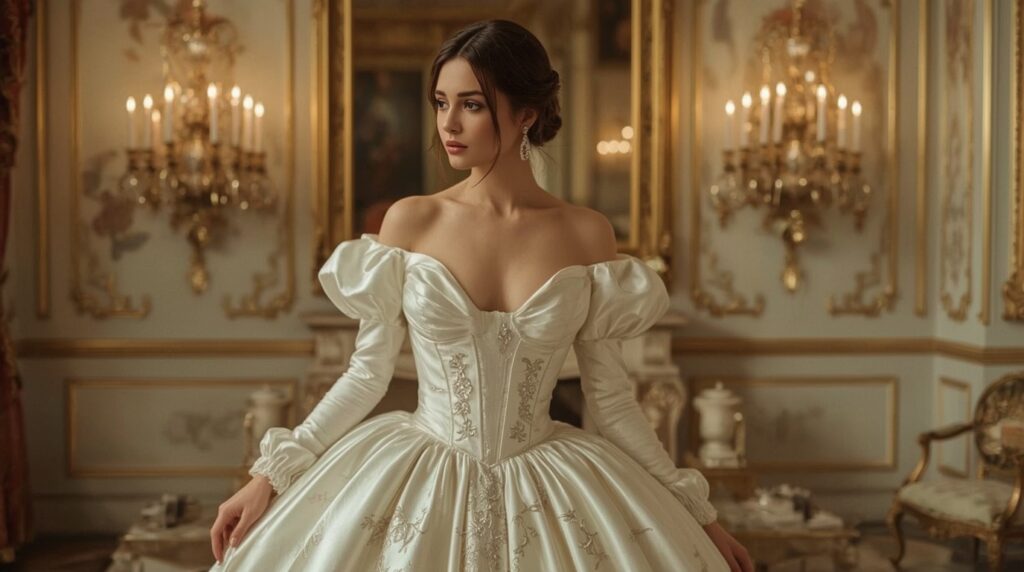
This article examines antique bridal gowns as decorative arts objects—constructed surfaces that mediate taste, status, and emotion. It places antique-style wedding dresses in historical context, explores their symbolic meanings, details their materials and craftsmanship, and addresses the collector’s perspective, conservation practices, and market dynamics. Throughout, the emphasis remains on what can be demonstrated by close looking, documentary corroboration, and curatorial comparison.
Historical Origins and Time Period: From “Best Dress” to Bridal Category
Until the 1850s, women across Europe and North America typically exchanged vows in their everyday finest: colored silk, good wool, a chic day dress. These marriage garments are seen in surviving examples, and their life continued after the vows were said: they were worn to church, to court presentations, to official visits. But what of the postnuptial future of the gown? It was far from an afterthought; it was very much a rationale for purchase. In a world where fabrics were expensive and time-consuming to produce, the concept of a garment worn just once was likely frivolous and perhaps immoral to many.
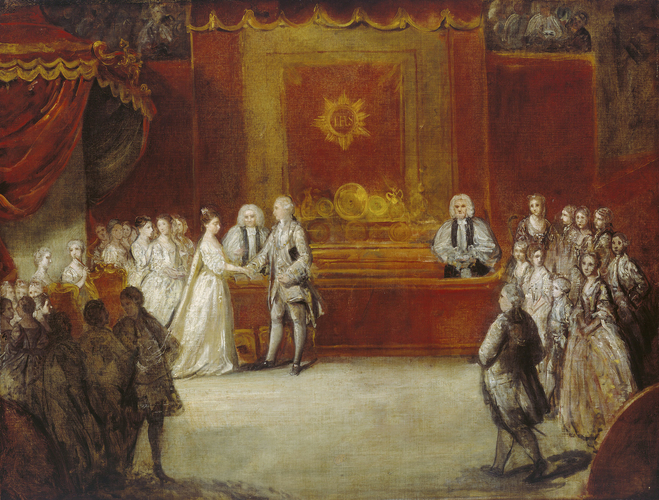
Although the commonly referenced “turning point,” Queen Victoria‘s 1840 wedding and the white bridal dress that followed, was widely reproduced and spread, it was not adopted as a standard or an easy marker for some time. White had already been a trend for the wealthy. However, the 1840 wedding did help secure white‘s status as part of the bridal spectacle at a time of spreading illustrated newspapers and print culture, machine-made fabrics, and increasing accessibility to manufactured goods. Nevertheless, white was a more nuanced marker; it signaled modern fashionable status, a willingness and ability to pay for laundering, or a dedication to the refined ideal of domestic femininity.
By the late 19th and early 20th centuries, “bridal” becomes increasingly legible as a category, especially in urban centers connected to department stores and professional dressmaking. Surviving gowns from the 1890s through the 1910s demonstrate this shift: more specialized trimmings, emblematic veiling, orange blossoms (real or artificial), and a silhouette aligned with contemporary fashion rather than purely pragmatic reuse. Yet even here, archivists repeatedly find evidence of later adaptation—suggesting the gown remained a textile resource within a family economy.
Interwar bridal fashion (1920s–1930s) illustrates another historical layer. Shorter hemlines, lighter structures, and a modernist preference for simplified lines often make these gowns appear “more wearable” to contemporary eyes. However, their very delicacy—fine silk crepe, fragile rayon blends, early plastics, and metallic laces—has made them disproportionately vulnerable in museum collections. The record of survival is therefore uneven, skewing what we can readily study and collect.
Finally, mid-20th-century bridal dresses (1940s–1950s) occupy a threshold between “antique” and “vintage.” Wartime rationing, utility textiles, and postwar abundance each left distinct signatures in cut and cloth. Many gowns were made from parachute silk, repurposed satin, or carefully rationed yardage—again reinforcing the archivists’ observation that bridal garments frequently document adaptation rather than purely ceremonial excess.
Cultural and Symbolic Meaning: White, Memory, and Social Legibility
The racial significance of the bridal dress is historically anything but fixed. The now-almost-unthinkingly-feminine-and-pure association with white can be, at various times, a means of advertising wealth (you‘re not dirty and you can afford laundry) or belonging to a kind of globalized visual culture (fashion plates and photo studios). The color can be at one and the same time the sign of commitment, of aspirational performativity and of modernity.
Bridal gowns are more and more being read by museums as things of social legibility. Wedding garb helped signify family relationships, religious group affiliation, and even geographical origin. Sleeve shape, neckline coverage, veil length, and glove wearing all conveyed meaning in certain situations. Veiling in a Catholic context could invoke Marian iconography; a Protestant wedding dress might signal virtue through plainness. Everywhere, the wedding costume organized public storytelling about the bride.
The “secret” that emerges from archives is how often symbolic components were detachable and transferable. Veils, wreaths, orange blossom sprigs, and lace collars appear in collections as separate artifacts, sometimes preserved even when the gown itself deteriorated. These components could be loaned within a kin network, turning bridal symbolism into an inheritable system of signs. A wreath might be rewired for a new hairstyle; a veil re-hemmed; lace re-set onto a different bodice. The symbolism persisted, but it traveled.
Photography intensified this symbolic economy. Once studio portraits became customary, the gown needed to “read” in black-and-white: sheen, contrast, and texture mattered. Archivists sometimes note strategic choices—matte satin paired with glossy trimming, or lace arranged to produce legible patterning—suggesting brides and dressmakers anticipated the camera. The surviving photograph and the surviving dress then become mutually illuminating documents.
A further layer of meaning lies in the tension between public ritual and private materiality. Many gowns carry intimate traces: underarm staining, perspiration lines, perfume residues, and hand-sewn repairs that speak of comfort and bodily change. Museums treat such traces cautiously—balancing respect for the wearer with the garment’s evidentiary value. Yet these marks are precisely what shifts interpretation from idealized symbolism toward lived experience.
“Dress is not merely a reflection of taste; it is a material record of choices made under constraint—economic, social, and bodily.”
—Curatorial note (typical interpretive framing in dress collections cataloging)
Craftsmanship and Materials: The Technical Grammar of Bridal Making
Antique wedding dresses are also, firstly, intricate manufactured garments, and construction generally articulates the tension between trendy silhouette and the constraints of delicate fabric. In pieces from the 19th century, there‘s lots of hand-sewing (running stitch, back stitch, whip stitch), sometimes with unbelievable precision. Machine sewing made its way into the home, but many fine-finishing details at the couture level are still handled by hand: tiny hems, lace placement, and inside-working channels for bones.
Each fiber has its own story. Silk satin, taffeta, faille, and moire are ubiquitous; they each “age” differently. Silk which has been weighted with metallic salts a practice widely adopted in the late 19th and early 20th centuries to create the illusion of heavy, supple fabric can break down over time, splitting in ways that can seem “miraculous” to those without specialist knowledge.
Lace is a particularly rich field for analysis. Handmade bobbin lace, needle lace, and later machine-made laces (including chemical lace and early Leavers lace) can be differentiated through magnification and structural study. Museums often document lace not merely as trimming but as a portable asset—valuable enough to be removed, stored, and re-applied. A gown with mismatched lace panels may not indicate poor workmanship; it may record a family’s careful redeployment of heirloom lace.
Construction techniques also disclose the role of professional makers. The presence of a maker’s label, consistent seam finishes, and refined internal architecture suggest urban dressmaking establishments, while more idiosyncratic patterning and mixed stitching methods can indicate home sewing or community assistance. Yet these categories overlap: a gown might begin in a dressmaker’s workroom and be altered at home. The garment becomes a palimpsest of hands.
The table below summarizes common materials and what conservators learn from them:
| Material / Feature | Common Period(s) | What It Signifies Historically | Typical Condition Issues |
|---|---|---|---|
| Silk satin / taffeta | 1840s–1950s | Status display; access to luxury trade | Shattering (weighted silk), splitting at stress points |
| Cotton lawn / muslin | 18th–20th c. | Practicality; washable “best dress” traditions | Yellowing, oxidized stains |
| Handmade lace (bobbin/needle) | 18th–early 20th c. | Portable wealth; heirloom continuity | Tears at motifs; repairs with later threads |
| Machine lace (Leavers/chemical) | late 19th–20th c. | Industrial fashion democratization | Brittleness; distortion |
| Metallic threads | 19th–20th c. | Ceremonial emphasis; ecclesiastical influence | Tarnish, galvanic corrosion, fiber cuts |
| Wax/orange blossom wreaths | 19th–early 20th c. | Fertility iconography; bridal icon | Fragility; crushing; adhesive failure |
Evidence from Historical Locations, Museums, and Archives: Reading the Gown as Document
There‘s not just a dress in the museum archives, but the information that gives the dress meaning. In accession files, letters from donors, and old catalog cards, one can find details never to be captured elsewhere, details of marriages and places of habitation and family sagas, which the curators use along with the material of the dress itself to work out patterns of use. A donor may mention that the gown “was worn by my grandmother,” while the dress itself shows evidence of two lives the zipper is a later addition, the hemline was raised in the 1920s that could not have occurred without the time-compression of memory.
Some of our major museums, like the V&A and the Met, are already producing object-based research that exemplifies this type of analysis describing the fiber content, weave structure, modifications, while connecting them back to the broader social landscape. However, these more local institutions, which are frequently overlooked, can offer the clearest way into this type of research as their collections remain connected to local craftspeople, churches, and photographers studios. Here it‘s often possible to triangulate a gown with church records, newspaper notices of marriage, and the works of a particular dressmaker.
Archives also hold the paper shadow of bridal consumption: department store catalogs, fashion plates, and dressmaking manuals. These documents show the prescriptive ideal, while surviving gowns show the pragmatic reality—how ideals were adjusted to bodies, budgets, and available cloth. A pattern diagram might specify a train length impossible in a modest household; the surviving gown shows a shorter train with added lace to simulate fullness. The “secret” is in the compromise.
Historic houses contribute another dimension. In some estates, bridal garments remain in situ—stored in trunks, wrapped in tissue, associated with bedrooms or dressing rooms that preserve the performative geography of marriage. When such objects enter museums, conservators frequently discover that storage methods (wooden trunks, acidic papers, damp basements) have shaped the garment’s present condition as much as its original materials.
Finally, photographic archives—whether in museums, libraries, or municipal collections—allow dress historians to test garment silhouettes against dated images. This is especially helpful when a gown has been altered: the photograph may capture an earlier neckline or sleeve volume that the garment no longer has. Thus the archive “uncovers” the garment’s multiple lives, revealing bridal dress not as a static artifact but as a sequence of states.
Authenticity, Provenance, and the Ethics of Desire
Collectors of antique bridal gowns often begin with aesthetics—lace, silhouette, and the romance of patina—but serious collecting quickly becomes an exercise in method. Authenticity is not only about age; it is about coherence between materials, construction, and documented provenance. A gown with a purported 1860s date but containing a 20th-century zipper or synthetic netting demands re-evaluation. Conversely, a gown with later repairs may still be a valuable historical object precisely because it documents continuity and change.
The provenance of bridal items can be particularly tricky, because family lore, though well-intentioned, isn‘t always accurate. Responsible collectors will, as museums do, check the story against the object itself. They look at chronology (date of fashion, in the form of sleeves, waistlines, bustle supports), textile identification (what is the fiber? what kind of weave? what type of lace?), and the history of fasteners (hooks and eyes, early snaps, zippers). The best object is the one for which the story and object match, or the discrepancies are explainable through documented alterations.
The collector‘s market has also formed the survival narrative. Certain periods, whether it‘s Edwardian lace dresses or 1920s silk, are considered more valuable and therefore more prone to excessive cleaning, hack-y “restyling,” or even being deconstructed to make use of trim. While some collectors may be more relaxed about this, museums (and most ethical collectors) consider it an erosion of evidence: a dress is not just raw material for lace it is a constructed text; its seams are just as valuable as its embellishments.
Collectors also face a practical question: whether a gown can be worn. From a conservation standpoint, wearing a fragile antique garment is often incompatible with preservation. Even careful handling introduces stress at seams and underarms. Many collectors therefore treat antique bridal gowns as study pieces, display them with proper support, or use them as references for antique-style wedding dresses made from new materials.
In this sense, collecting can become a form of informal scholarship. The best private collections are those accompanied by notes, comparative photographs, and conservation-aware storage. When such collections are later donated, they can strengthen institutional holdings—provided the documentation is rigorous and the objects have not been compromised by earlier interventions.
Restoration Insights: Conservation, Not Rejuvenation
Textile conservation approaches bridal gowns as unstable composites of fiber, dye, metal, and prior repairs. The guiding principle is minimal intervention with maximum documentation. Cleaning, if undertaken, is conservative and case-specific: wet cleaning may be impossible for weighted silk, while solvent-based methods carry risks to dyes and finishes. Often, the most responsible decision is to stabilize rather than to “brighten.”
Archivists frequently note that the most damaging well-intentioned act is improper storage: plastic garment bags that trap moisture, metal hangers that distort shoulders, or tissue paper that is acidic. Museums store gowns horizontally when necessary, padded with inert materials, and supported to prevent creasing. The aim is to slow deterioration, not to return the gown to an imagined original state.
Structural repairs focus on support. Underlays of conservation net can be stitched to shattered silk, allowing the surface to be read without forcing the original fibers to bear weight. Lace can be couched onto new support fabrics to prevent further tearing. Importantly, conservators choose threads and fabrics that are stable and visually recessive, and they document every step so future conservators can distinguish original from intervention.
Restoration becomes ethically fraught when aesthetic goals eclipse evidentiary ones. Replacing missing sections with modern lace that “matches” may create a pleasing appearance but can mislead future study. Museums prefer reversible methods and visually distinguishable infills when appropriate. The goal is honest legibility: to allow viewers and researchers to understand what is original, what is altered, and what has been stabilized.
“Conservation is the art of making an object safe to study without making it pretend to be young.”
—A standard principle echoed in conservation training and museum practice
Market Interest and Collector Demand: Scarcity, Condition, and Historical Value
What we do see with a preference for vintage wedding dresses is a crossover in fashion sense of past and present. Nostalgia for the past, collecting tradition, and the art of collecting any textiles. But the market has to come from fragility. The more antique it is, the more likely it is to have been damaged, and the whiter the dress, the longer the storage life, or the more mystery cleaning will have been involved.
The state of the garment determines the price and supply. Woven silk dresses, the most common style for women in the late 19th and early 20th centuries, tend to rip, making them hard to find in good condition. Lace is also a fabric that deteriorates differently depending on the fiber and how it was kept. Even tiny accessories such as wreaths or veils can be exceptionally expensive due to the scarcity of complete sets. What is desired is the whole: the wedding dress, veil, head-covering and gloves, and even the shoes (if they can be date-stamped or have a specific occasion associated with them).
Institutional collecting also influences the market. When museums mount exhibitions on wedding fashion or women’s lives, they often seek representative examples across classes and regions, not only high-style couture. This can shift attention toward “ordinary” gowns with strong documentation—garments that once might have been overlooked. The result is a more historically nuanced market in which social history value can rival purely aesthetic appeal.
Demand is also shaped by the contemporary practice of commissioning antique-style wedding dresses. Designers and clients often consult museum collections, digitized archives, and published catalog essays to understand period-accurate silhouettes and materials. This does not necessarily increase demand for wearable antiques; rather, it increases demand for knowledge—high-resolution images, pattern research, and technical analysis. In that sense, museums’ scholarly apparatus becomes part of the cultural economy surrounding bridal fashion, even when the antique objects remain in storage
Antique bridal gowns matter because they are unusually dense historical documents—objects where intimate life intersects with industrial change, aesthetic ideology, and social ritual. Museum archivists “uncover” their secret not by romanticizing them, but by attending to the evidence embedded in seams and stains, in replaced fasteners and migrated lace. These gowns reveal that what later generations call “tradition” was often a practice of adaptation: garments remade to fit new bodies, new fashions, and new circumstances, while continuing to carry symbolic weight.
But they are also important as they draw our attention to women‘s labor the paid labor of dressmakers, yes, but also the unpaid labor of sewing, laundering, storing, and mending fabrics at home. The wedding dress is not just a symbol of marriage it‘s a testament to expertise and time, technological choices, and the invisible labor that makes up an illusion of unstudied innocence or beauty.
Finally, antique bridal gowns are relevant because they reveal cultural meanings are porous. White means many things and not always one thing; lace is not only decorative and “heirloom” not always unchanged. Analyzing these objects in museum and archive, as well as in caring private hands teaches us to interpret history with both more fidelity and humility. In the threads and fastenings of antique bridal gowns we are reminded that material objects do not provide a mere backdrop for history. They are an archive of its survival.