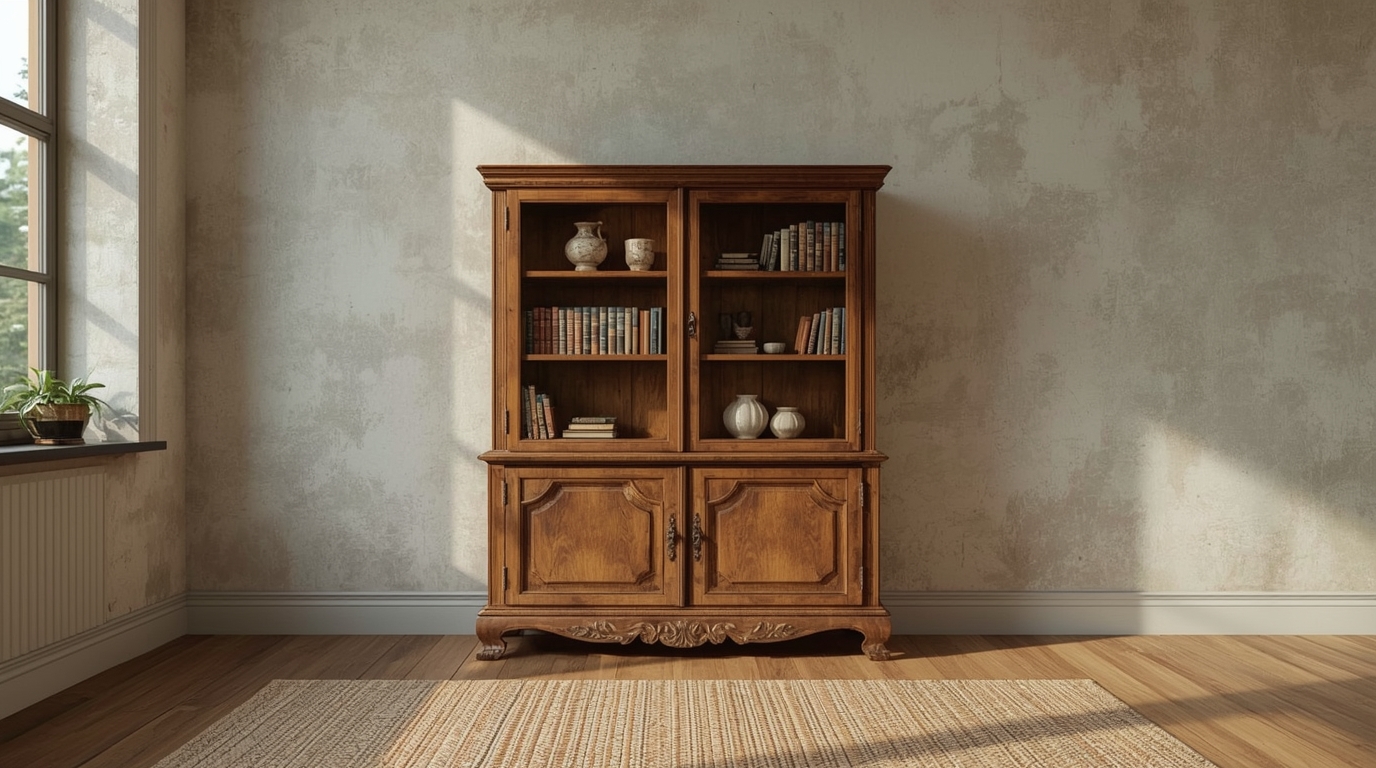
Antique furniture has a way of changing a room’s tempo: it slows you down, invites you to look closer, and quietly signals that the home values longevity over trends. Few pieces do this as effectively as an antique low bookcase—a compact, human-scale storage form that emerged from real historical needs: organizing books, pamphlets, ledgers, and music in an era when paper was expensive and literacy was rising. Unlike towering library cases built for grand estates, the low bookcase sits closer to everyday life—beneath windows, along corridors, or beside a writing desk—where its proportions make it both practical and visually grounding.
What Defines an Antique Low Bookcase (and Why It Matters)
An antique low bookcase, roughly put, is a bookshelf, lower than your average height (the reason for its height was often to go underneath a dado rail or window), and created prior to the mid-20th century (though a lot of us consider 100 years to be the standard line that separates antique). They can either have glass doors, open shelves or panelled cupboard sections, and also feature the joinery styles, wood types and surface treatments favored in the period. The reason for its “low” design is structural and not just visual: it correlates with the heating, lighting and lifestyle of the time.
Low cases do not arise uniquely from this tradition, in European and American contexts. Low bookcases were installed in town houses and professional offices of Georgian Britain (1714–1830), in which volumes were intended to be reached without the use of a ladder. In French furniture, during the period of Louis XV and XVI, corresponding types of pieces, notably low bibliotheque cases and meuble d‘appui storage units, facilitated salon life which prioritized intellectual exchange and writing above vast library walls. The Victorian era witnessed rising middle-class literacy and the growth of the book publishing industry, leading to the increasing popularity of lower cases, scaled for smaller spaces.
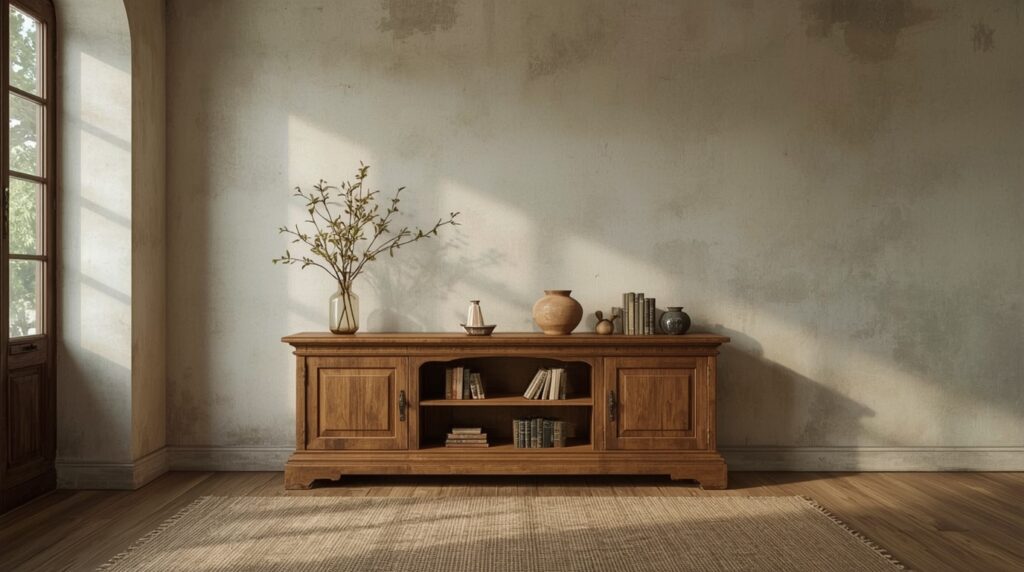
Moreover, museums often emphasize the value of furniture as cultural artifacts, rather than objects for display. The V&A collections suggest that furniture records “how people lived” and reveal “changes in technology, taste and attitudes” (V&A Collections). In addition, the Metropolitan Museum of Art writes that Decorative Arts provide an “inside view of the workshop and home” and “hold examples that trace the vocabulary of materials, construction, and design” (The Met Collection).
Historical Styles and Periods to Know
Most period antique low bookcases are easy to pinpoint thanks to their period characteristics. Georgian and Regency (UK) models usually feature mahogany or oak, with minimal decoration, crisp cornices and spaced shelving. Pieces that lean on the style of Sheraton and Hepplewhite (late 1700s) tend to have lighter visual lines, inlays, and well-proportioned attributes perfect for drawing rooms or studies. By contrast, Victorian low bookcases span the gamut from basic utility office models to incredibly detailed gothic and renaissance revival examples.
Across the continent, French and Dutch furnishings provided additional points of reference. Parisian 18th-century cabinet work could be highly ornate with a graceful profile and meticulous mounts on expensive forms, while the more provincial equivalents relied on native woods and vernacular woodworking methods. Dutch and Flemish cases tended to be solid, functionally sized, and often have heavier moldings. When not an out-and-out “bookcase” in the strict sense, related low storage items such as a credence cabinet with shelves would often be adapted to hold books.
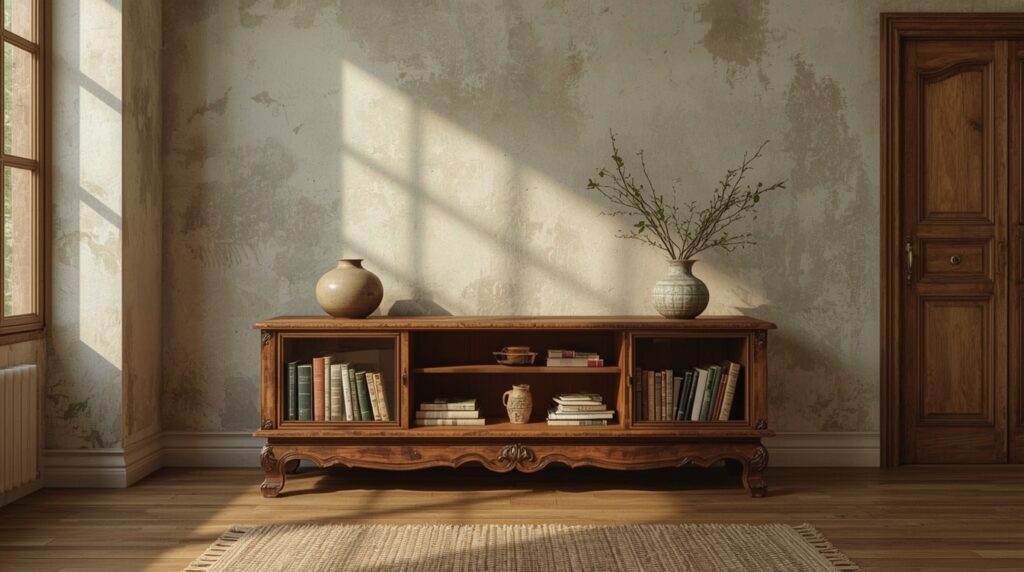
This use of low bookcases grew in America from the 19th to early 20th centuries, especially the Arts and Crafts/Mission styles where joinery was straightforward, and they were made of dense woods such as oak. The Smithsonian collections contain examples of decorative arts recording the story of American craftsmanship and manufacturing. The furnishings collections contain pieces that reflect recent changes to American lifestyles and methods of production (Smithsonian collections). These are a helpful reminder that we can tie our stylistic assertions to real objects from actual periods, instead of making unsupported guesses.
Materials, Construction, and Authenticity Markers
Construction is the first factor in a reliable assessment. Older low antique bookcases tend to have dovetail joints (hand-cut in much 18th- and 19th-century work) and mortise-and-tenon construction. The backboards can be simple, broad planks. Marks of tools are helpful: hand-planed surfaces, variations, and imperfections suggest pre-industrial craft; precisely machined and cut joints suggest machine production (although not necessarily fake, just later).
Wood type can also be a good clue to the age, though it needs to be treated with care. Mahogany (often traded through the Atlantic route) can be found in all Georgian and Regency furniture; oak exists through a range of centuries, including Arts and Crafts; walnut is frequently found in earlier European and Revival pieces. Where there are veneer elements, these can be first-rate and original to the period; however, lifted, replaced and mis-matched veneer often signifies repair which can be fine, or value-sapping in the extreme, if concealed.
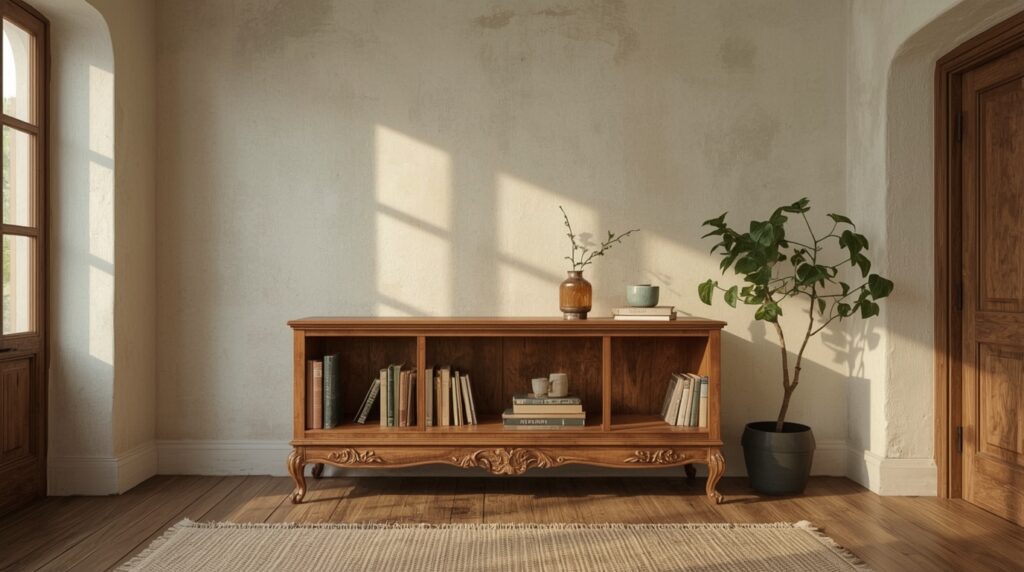
Just as the materials used are as significant as provenance. An auction house records; dealer‘s invoice; even black and white photographs can demonstrate a traceable line of provenance. The Louvre has understood this with its decorative arts, explaining that its pieces aren‘t viewed solely for aesthetics, but rather as an illustration of “technique, materials and historical context” (Louvre collections and curatorial notes). An “antique low bookcase” takes on a gravitas if its provenance backs up its provenance.
Key Characteristics at a Glance
| Feature | Common Antique Indicators | What to Watch For |
|---|---|---|
| Height/Proportions | Below typical standing eye level; designed for accessibility | Overly “modern” proportions can suggest later reproduction |
| Joinery | Hand-cut dovetails; mortise-and-tenon frames; pegged joints | Perfectly uniform joints may indicate later machine work |
| Woods | Mahogany, oak, walnut; period-appropriate veneers | Unusual wood for claimed period; mismatched replacement boards |
| Back & Base | Wide plank backs; evidence of age and shrinkage | New plywood backs often indicate major alteration |
| Hardware | Period hinges/locks; wear consistent with use | Bright new screws, mismatched plates, recently installed locks |
| Patina | Layered finish, handling wear at edges, shelf wear | Artificial distressing; uniform “antiquing” without use patterns |
Collecting, Care, and Ethical Restoration
Buying well begins with clarity about your goal: a museum-grade piece, a functional household bookcase, or an entry-level antique with honest repairs. Reputable dealers will distinguish between original condition, period-appropriate restoration, and later alterations (such as replaced doors or a modified interior). Ask for condition reports and look for consistent wear: shelf rub marks where books sat for decades often look different from fresh sanding.
Conservation best practices generally favor minimal intervention. The Metropolitan Museum of Art and other major institutions emphasize that preserving original material is central to conservation ethics; over-restoration can erase tool marks, finishes, and evidence of use that scholars and collectors value. As a widely cited principle in conservation practice: “Conservation is not about making objects look new; it is about preserving their history.” (A view consistent with museum conservation departments and professional conservation codes.)
Day-to-day care should be practical and gentle. Keep the antique low bookcase away from direct heat sources and strong sunlight to reduce cracking and fading. Maintain stable humidity if possible, and avoid silicone-heavy polishes that can contaminate surfaces and complicate future conservation. If the piece will hold books, ensure shelves are structurally sound; adding discreet support battens can be preferable to forcing a sagging shelf to carry weight.
Frequently Asked Questions
How can I tell if a low bookcase is truly antique or a reproduction?
Check joinery, back construction, tool marks, hardware, and finish layering. Provenance and a credible seller’s documentation help. A single “old-looking” surface is not enough—construction should match the claimed period.
Which periods are most commonly associated with antique low bookcases?
Georgian and Regency Britain, 19th-century Victorian and Edwardian periods, and early 20th-century Arts and Crafts/Mission in the U.S. French 18th–19th-century low storage forms can also function as bookcases.
Is restoration bad for value?
Not always. Sensitive, documented restoration (stabilizing joints, repairing veneer, replacing missing moldings with period-appropriate methods) can preserve usability and value. Heavy refinishing that removes original patina typically lowers value for serious collectors.
What woods are most desirable?
Mahogany and walnut are often prized for color and figure; oak is valued for durability and Arts and Crafts associations. Desirability depends on period accuracy, condition, and craftsmanship rather than species alone.
Can I safely use an antique low bookcase for everyday storage?
Yes, if it is structurally sound. Avoid overloading shelves, keep conditions stable, and address loose joints early. Functional antiques can be enjoyed daily when cared for responsibly.
19th century low bookcase: it‘s not just storage for your books. it is a responsive format reflecting changes in literacy, interior layout and joinery from Georgian to French styles, Victorian to Arts and Crafts. But when read as a constructed, owned, saved object (using museum standards, such as the Met, V&A, The Louvre, Smithsonian) it‘s both furniture, and a testament to someone‘s lived history.