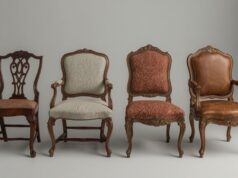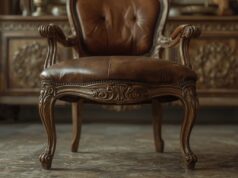
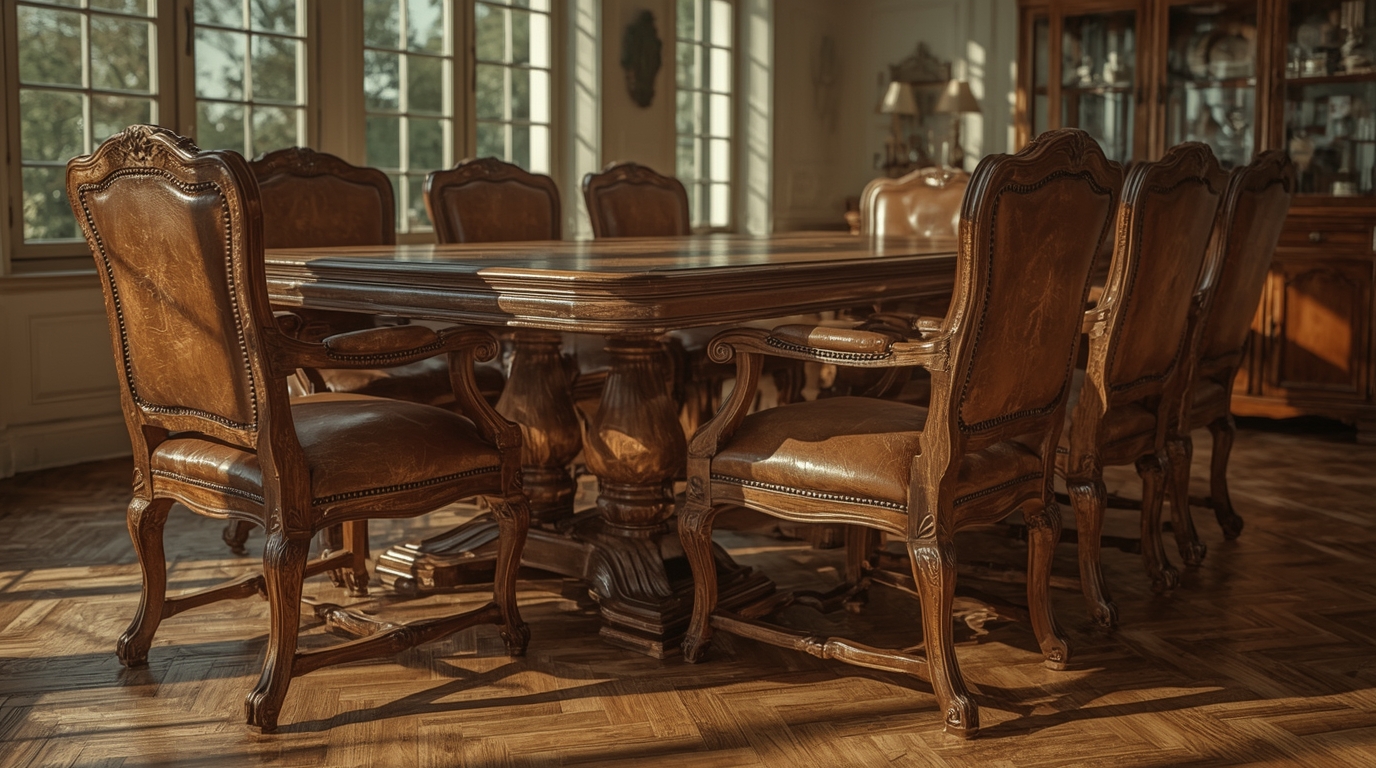
Antique leather dining room chairs have a rare ability to make history feel usable. They are both functional seating and material evidence of how people dined, hosted, and displayed status across centuries—whether in an 18th‑century English townhouse, a French hôtel particulier, or an American Gilded Age dining room. The best examples still carry the signature traits of their era: hand-cut leather with nailhead trim, crisp joinery, time-darkened patina, and frames that reveal the aesthetics and technology of their makers. For collectors and homeowners alike, these chairs are not simply “old”—they are cultural artifacts that happen to have a seat.
What Antique Leather Dining Room Chairs Are—and Why They Matter
Dining room chairs over 100 years old that were originally used at the dining table, that are covered in leather (with stuffing typically comprised of horsehair, etc.) and, many times, are part of a matched set (though most sets available today are put together over a period of time). The “leather” can include full hides, panels, tooled leather, and can be combined with wood furniture including walnut, oak, and mahogany frames.
What gives them their value is the confluence of hand-craftsmanship and history. Museums like The Met and The Victoria and Albert Museum collect antique furniture as objects that communicate the social context and context of how design and construction intersected at different time periods. While few museums are devoted only to dining chairs, their collections of European and American furniture create a touchstone for how real chairs are made.
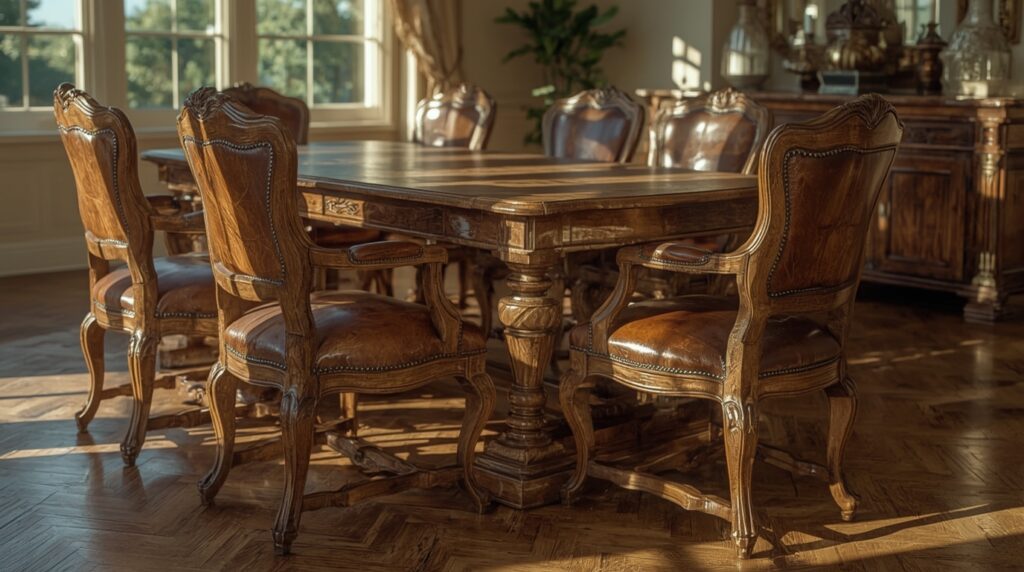
And whereas fabric wears down uniformly, leather gains character through wear. Signs like patination, cracking on the surface, repairwork, or differences in coloration can show evidence of age and wear. The Victoria and Albert Museum remarks in its writing about furniture and materials: “The effects of wear or finish have been considered in assessing original use, restoration or repair.”
Key Historical Styles and Periods to Know
The leather-seated chair began to proliferate in Europe during the late seventeenth and early eighteenth centuries, first as a component of Baroque design, and later of William and Mary furniture. The latter styles focused on verticality and formality, with turned legs, stretchers, and tall backs. Oak and walnut frames provided the structural support for English and Low Country chairs, where the leather was commonly embossed or tooled. Brass nailheads were often used to both decorate the chair and to attach the leather to the frame.
For Great Britain and its colonial American context, the Georgian period (1714–1830) presented slimmer silhouettes and refined backs with balanced proportion transitioning in the back from Queen Anne cabriole legs to the neoclassicism of Hepplewhite and Sheraton. Leather might be a seat covering on dining chairs used heavily. Louis XV and Louis XVI furniture in France frequently utilized upholstered seats, leather did not dominate the market compared to silks and tapestry; it was more common in masculine or practical designs.
Dining rooms in the 19th century grew increasingly specialized and ritualistic, particularly the Victorian dining room and its American counterpart, the Gilded Age. Oak “revival” styles, like Gothic Revival and Renaissance Revival, were commonly covered in leather or leather-like fabrics (often tufted), along with elaborately carved frames. The Smithsonian Institution‘s decorative arts collection, along with its scholarship on American interior design of the era, illustrates dining furniture‘s role as an expression of taste, manufacturing power, and social aspiration.
Materials, Craftsmanship, and How to Identify Quality
High-quality antique leather dining room chairs typically show evidence of handwork: mortise-and-tenon joinery, pegged joints, and frames shaped with chisels and planes rather than uniform machine rounding. Look underneath seats and inside rails when possible. A chair can be visually beautiful yet structurally compromised, so assessing joinery is as important as assessing leather.
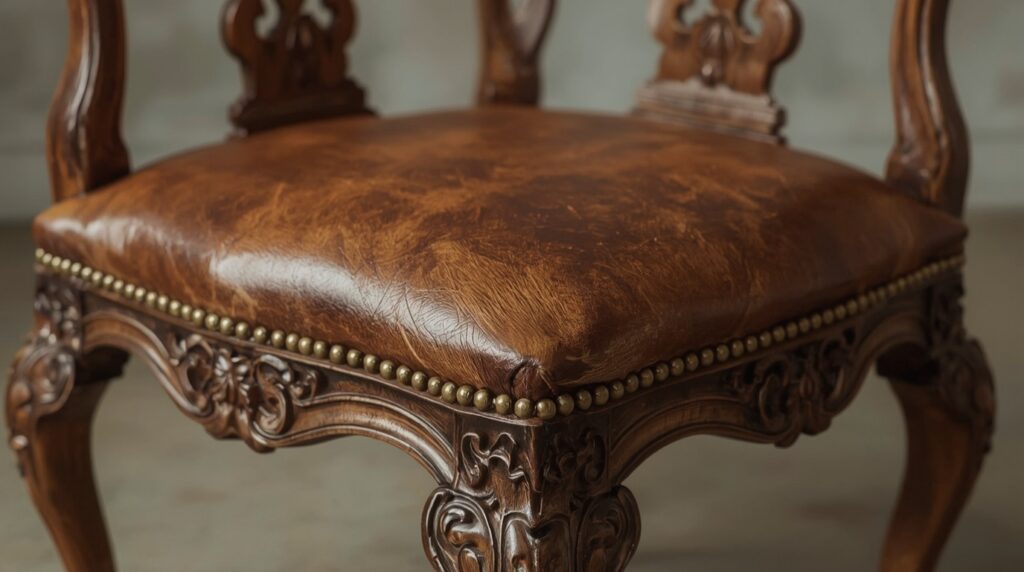
Leather itself can be diagnostic. Older leather may be thicker and less uniform than modern upholstery hides, with a surface that has oxidized into a deep, nuanced tone. Nailheads are often individually placed and slightly irregular, unlike perfectly spaced modern strips. Tooling or embossing—common in some Spanish and Continental traditions—should show depth and variation rather than shallow repetition.
Museums reinforce the importance of construction details. As a general principle echoed across conservation departments, “the object itself is the primary document.” The Metropolitan Museum of Art’s furniture studies emphasize close looking—tool marks, wood species, and structural logic—as the foundation of attribution and dating. When evaluating chairs, that mindset is invaluable: the underside and the joints often “speak” louder than the visible leather.
Condition, Conservation, and Responsible Restoration
Condition isn‘t all about good looks; it also dictates safety, survival and value. Loose joints, replaced stretchers, recovered seats, the splitting of the leather at areas of strain, and the later varnishing or staining of the wooden frame, all diminish the value and the likelihood that the chair has been truly loved and used over its lifetime.
Ethical conservation is about conserving not erasing. “My idea of conservation, and I think a lot of major museums do have this mind-set, is it‘s good if something can be reversed and if something can be done with as little intervention as possible to hold onto the data of an object,” says Markalunas. For you, it means steering clear of heavy strippers and modern high-gloss polyurethanes, or being too generous with the stuffing, which can change an object‘s profile and height.
If leather is dry, brittle, and cracking, exercise caution when conditioning. Many conservators do not advise using heavy oils that can darken and compromise the structure of leather over the years. If professional intervention is desired for conditioned leather, contact a conservator who specializes in historical leather furniture. If structural issues include wobbly chairs, you may want to contact an experienced furniture restorer who can use historical woodglues and techniques to reglue loose joints; a goal of some restorer/conservators is the retention of original glue and joint geometry, whenever possible.
Buying, Authenticating, and Valuing Antique Leather Dining Room Chairs
Start with provenance and documentation when available: estate histories, old invoices, auction records, or dealer notes. Reputable dealers should be willing to discuss what is original, what has been replaced, and how they arrived at their dating. Beware of vague claims like “18th-century style” being presented as truly 18th century.
Authentication relies on a convergence of factors: period-appropriate construction, wood species consistent with region and date, wear patterns that match age, and upholstery techniques aligned with the era. Cross-checking with institutional collections can sharpen your eye. The Louvre Museum, the V&A, and The Met provide online collection images that allow comparison of motifs, leg forms, and chair proportions across periods.
Value depends on rarity, condition, completeness of a set, and design significance. A matched set of six or eight chairs in strong structural condition typically commands more than single chairs. High-quality carving, documented makers, and exceptional original leather (rare) can raise value substantially. Conversely, extensive modern replacements—especially if they change silhouette—often reduce collector appeal, even if the chairs look “fresh.”
Table: Key Characteristics of Antique Leather Dining Room Chairs
| Feature | What to Look For | Why It Matters |
|---|---|---|
| Joinery | Mortise-and-tenon, pegged joints, hand-fit rails | Signals period construction and durability |
| Leather surface | Patina, natural variation, age-appropriate cracking | Helps indicate authenticity and honest wear |
| Nailheads | Individually placed, slightly irregular spacing | Suggests hand-upholstery rather than modern trim |
| Frame wood | Oak, walnut, mahogany (region/period dependent) | Supports accurate dating and attribution |
| Proportions | Seat height, back angle, leg form consistent with era | Reveals whether the chair has been altered |
| Repairs | Old, sympathetic repairs vs. heavy refinishing | Affects value and historical integrity |
Frequently Asked Questions
Are antique leather dining room chairs comfortable for daily use?
Many are comfortable, but comfort varies by period: earlier chairs can be upright and formal. If you plan daily use, prioritize structural soundness and consider using removable cushions rather than altering original upholstery.
How can I tell if the leather is original?
Original leather is uncommon on heavily used dining chairs. Look for age-consistent wear, early nail patterns, and upholstery layers that make sense historically. A conservator or experienced dealer can often identify later leather by thickness, backing materials, and staple use (staples generally indicate later work).
Is it bad if chairs have been reupholstered?
Not necessarily. Reupholstery is often practical and sometimes historically consistent if done with appropriate materials and profile. Value tends to be higher when restoration is documented and sympathetic rather than transformative.
What historical periods most commonly feature leather dining chairs?
Leather appears across periods, but it is especially common in certain English and Continental traditions (17th–18th centuries) and in 19th-century revival styles. American examples often reflect European influence, particularly in the 19th century.
Where can I research authentic examples?
Start with online collections and essays from The Metropolitan Museum of Art, the Victoria and Albert Museum, the Louvre Museum, and the Smithsonian Institution. Their high-quality images and curatorial notes help you compare construction and stylistic details.
Antique leather dining room chairs endure because they unite artistry, utility, and historical presence in a single object. By learning the hallmarks of period design, examining construction with a disciplined eye, and favoring responsible conservation, you can choose chairs that are not only beautiful but also credible, stable, and historically meaningful—worthy of both daily life and long-term stewardship.
Authoritative sources for further study: The Metropolitan Museum of Art (The Met) collection and furniture essays; the Victoria and Albert Museum (V&A) furniture collections and conservation resources; the Louvre Museum decorative arts collections; the Smithsonian Institution collections and conservation scholarship.