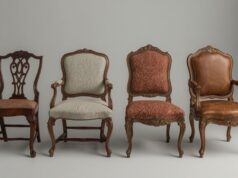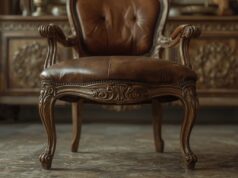
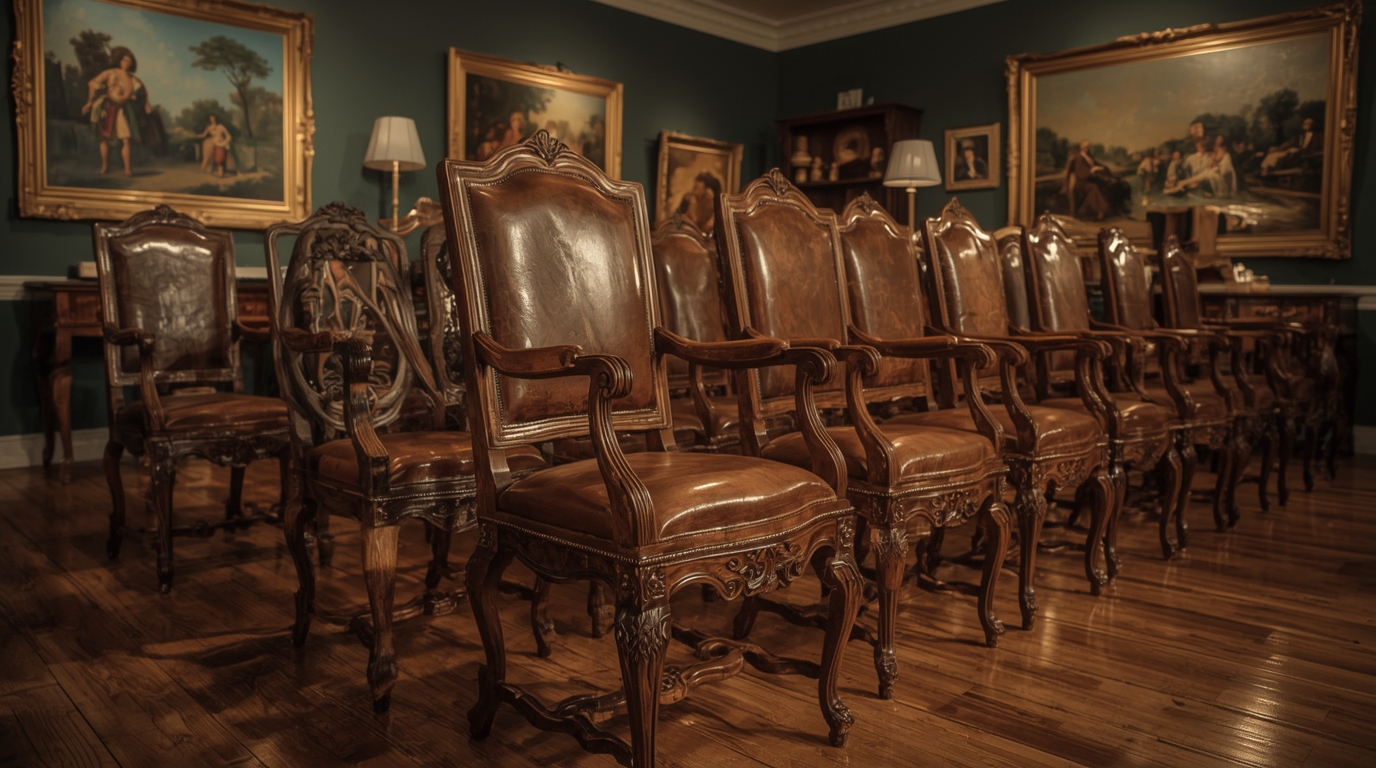
Antique dining chairs with leather seats can transform a room in a way few objects can: they carry the imprint of centuries of craftsmanship, the patina of use, and the unmistakable authority of historic design. A well-made leather-seated chair doesn’t just “match” a dining table—it anchors the atmosphere, suggesting a specific place and time, from an English Georgian townhouse to a French Empire dining room. For collectors and everyday homeowners alike, these chairs offer a rare blend of beauty, utility, and provenance that modern reproductions struggle to replicate.
What Makes Antique Dining Chairs with Leather Seats Distinctive?
Age is not enough to label a dining chair “antique” (especially one with leather seats). It must feature wooden frames (made from oak, walnut, mahogany, or beech) with traditional construction methods, period-appropriate scale, and in this case leather cushioning (often pulled taut over webbing and stuffing, then hammered with decorative brass tacks). Unlike many factory-produced chairs, vintage versions will show signs of being handmade, from the inconsistent nail heads and tool marks to the overall irregularity.
In the past, leather seating offered both practicality and prestige. It was easier to keep clean than many upholstery fabrics in the smoke and candlelight of period rooms, yet it had an air of distinction. Museums now house countless period examples showing how makers accommodated it: drop-in seats, stitched Spanish leather panels, later sprung units etc. Reliable resources for when judging form and authenticity are the collections at the Victoria and Albert Museum, London, and the Metropolitan Museum of Art, New York, whose furniture spans the Renaissance up to the 19th century.
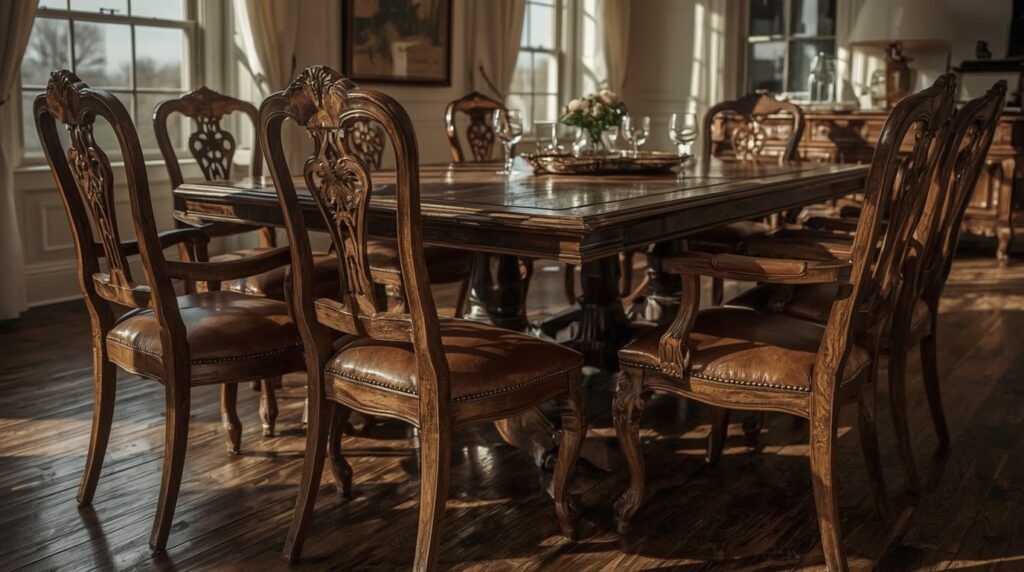
Lastly, real old leather ages differently. Real aged leather wears differently with the darkening of high points, mellow cracking, and patina. These subtle nuances are difficult to reproduce perfectly even with artificial aging. While the degree of wear can still be a factor (dryness, tearing, repair history), wear can sometimes even add value if it‘s done tastefully for its age.
Historical Periods and Styles to Know
Baroque and early Georgian furniture had massive legs, stretchers, and leather-covered seats studded with rows of tiny nails, just like these early 18th-century English chairs made of oak or walnut, based on local timber and carpentry. You may have seen a preserved room in a major museum or institution, where these chairs sit not as exhibits but as work-horse furniture. They are robust, reparable and sure of themselves.
In the 18th century, styles become more elegant. The French Rococo and Louis XV tastes favored more curved and lighter frames, while in England, the Georgian style moved away from Queen Anne cabriole legs towards the rectilinear austerity of Hepplewhite and Sheraton. Leather, however, still retained prominence for use at the dining room or the library table, providing a durable yet comfortable seating option. French museum collections, for example, in the Decorative Arts at the Louvre Museum, trace the development of seating along with evolving court and domestic lifestyles.
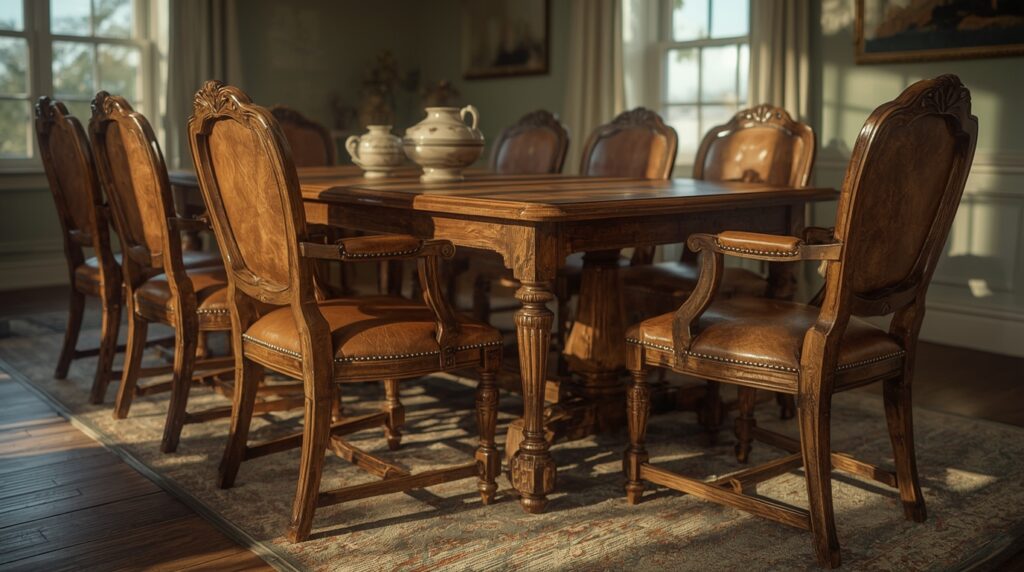
By the early 19th-century (Regency in the UK, Empire in France) the chairs were getting more architectural splayed saber legs, classical ornamentation, deeper carved furniture in dark mahogany or gilt for important people. Toward the latter half of the Victorian age, chairs came to be produced en masse, although the very best workshops still produced lovely leather-seated dining chairs with spring seats, deep upholstery and all. Chair style should match the chair construction.
Materials, Craftsmanship, and Construction Details
Proper valuation begins with the frame. Vintage leather-seated dining chairs generally came together with wooden pegs and mortise and tenon joints, not today‘s screws at key structural areas. Look for the wear marks of frequent use rounded edges on the top rails, shining arm fronts (if any), and oxidation in cracks and corners. Age is not the same as looseness a well-built chair, with care, can be strong for centuries.
The way a chair is made of leather will differ by time period. Older chairs might have large hides, sometimes carved or embossed, stretched taut and nailed down; in later chairs, we might see stitched upholstery, horse hair stuffing, and coil springs (particularly in the mid- to late-19th century). For an authoritative institutional source, turn to the Smithsonian, who, in their conservation resources, note that the goal is the use of original materials, or reversible repairs when unavoidable.
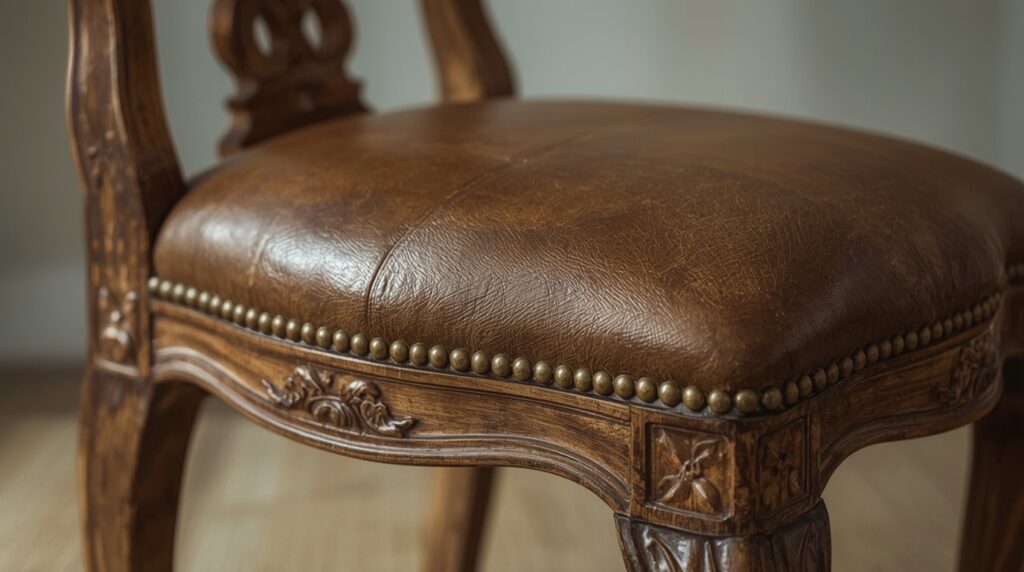
When done carefully, restoraion will not diminish the value though it must be honest and not unnecessary. If the seat cover is beyond any hope of repair, to replace it can also be appropriate as long as the process adheres to period methods and does not wipe away any evidence of originality. As the Metropolitan Museum of Art explains in its conservation of a seating element, they try to balance stability and respect for the original materials.
How to Evaluate Authenticity, Condition, and Value
Provenance matters because it links an object to a place, maker, or collection history. Look for documentation: old invoices, estate records, auction catalog entries, or dealer descriptions that specify origin and period. Even without paperwork, clues such as regional wood choice, construction methods, and stylistic details can narrow attribution. Cross-checking with museum examples—through online collections of the V&A, The Met, or the Louvre—helps you compare verified forms and decorative vocabulary.
Condition should be evaluated like a conservator would: structure first, surface second. Check if joints are tight, legs are not warped, and the chair sits evenly. Then examine the leather: is it brittle, powdery, or deeply torn? Small cracks and patina are normal; extensive losses may require conservation or replacement. The V&A’s furniture and leather conservation resources underscore that overly aggressive cleaning and conditioning can harm historic surfaces—less is often more.
Value combines rarity, maker, period desirability, and integrity. Sets of matching chairs (six, eight, or twelve) can command premiums, but mixed sets can still be valuable if they are period-correct and harmonious. Beware “marriages,” where an old frame is paired with an unrelated modern seat (or vice versa). Professional appraisal is recommended for high-value pieces, particularly if you suspect a chair is from a notable workshop or tied to an important historical context.
Key Characteristics at a Glance
| Feature | What to Look For | Common Period Associations | Red Flags |
|---|---|---|---|
| Frame wood | Oak, walnut, mahogany, beech; visible grain, oxidation in recesses | Georgian (walnut/mahogany), Regency (mahogany) | Uniform stain masking grain; overly fresh wood |
| Joinery | Mortise-and-tenon, pegs; consistent wear at joints | 17th–19th century | Modern brackets/screws as primary structure |
| Seat construction | Nailed leather, stitched upholstery, webbing; later sprung seats | Early nailed leather (17th–18th); springs (19th) | Staples, foam, synthetic webbing without disclosure |
| Leather surface | Patina, natural cracking, wear consistent with use | All periods | Plastic-like finish; artificial distress patterns |
| Decorative details | Hand-placed tacks, carving consistent with style | Baroque, Georgian, Empire | Machine-perfect tacks; mismatched motifs |
Care, Conservation, and Responsible Use Today
Leather and wood respond to environment. Stable humidity and moderate temperatures are essential; extremes cause leather to dry and crack and can loosen joints. The Smithsonian Institution’s conservation guidance consistently emphasizes preventive care—controlling light, handling, and climate—over frequent product use. Position chairs away from radiators, direct sunlight, and fireplaces, and use felt pads to reduce stress on legs.
Cleaning should be gentle and minimal. Dust wood with a soft cloth; avoid heavy silicone polishes. For leather, use a dry microfiber cloth first; if deeper cleaning is necessary, consult a conservator rather than applying modern conditioners indiscriminately. Many commercial leather products are designed for new, sealed upholstery and can darken or stain historic leather, or leave residues that attract dirt.
If you plan to use antique dining chairs regularly, consider a conservation-minded approach: rotate seating positions, avoid placing sharp objects (like belt buckles) against the leather, and consider discreet, reversible seat covers for daily use. A qualified upholsterer experienced in period furniture can stabilize webbing or stuffing without stripping the chair of its historical character.
Frequently Asked Questions
Are antique dining chairs with leather seats comfortable enough for daily use?
Many are, especially later 19th-century examples with sprung seats. Earlier nailed-leather seats can be firmer. Comfort depends on seat height, rake, and padding condition, so test stability and ergonomics before committing.
Does replacing the leather reduce value?
It can, particularly if the original leather survives and is historically significant. However, if the leather is beyond repair, a documented, period-appropriate replacement by a specialist may preserve usability while maintaining value more effectively than a poor DIY fix.
How can I tell if the leather is original?
Look for period-appropriate tack patterns, oxidation around nail heads, and wear consistent with the chair’s frame. Underside inspection helps: older seats often show traditional webbing, hand-stitching, or aged lining materials rather than modern staples and foam.
What styles are most sought-after?
Market demand varies, but Georgian, Regency, and well-proportioned French Empire or Louis-inspired dining chairs often attract collectors. Sets in good structural condition with consistent design and patina tend to be especially desirable.
Where can I compare my chairs to verified examples?
Use online museum collections and catalog entries from institutions such as The Metropolitan Museum of Art, the Victoria and Albert Museum, and the Louvre Museum. Their photographs and object descriptions provide reliable style and construction benchmarks.
This enduring appeal of antique dining chairs with leather seats stems from the fact that they answer one of life‘s oldest questions beautifully, making dining furniture durable and attractive, too. By mastering a few styles, closely examining the upholstery and construction, and adopting sensitive care, you can buy and enjoy chairs that tell a real story around your table. If more verification is required, look at museum examples and then see a professional if the chair seems important or is in poor condition.