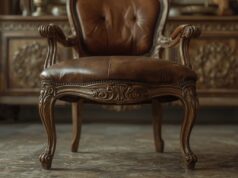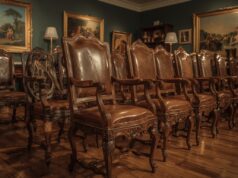
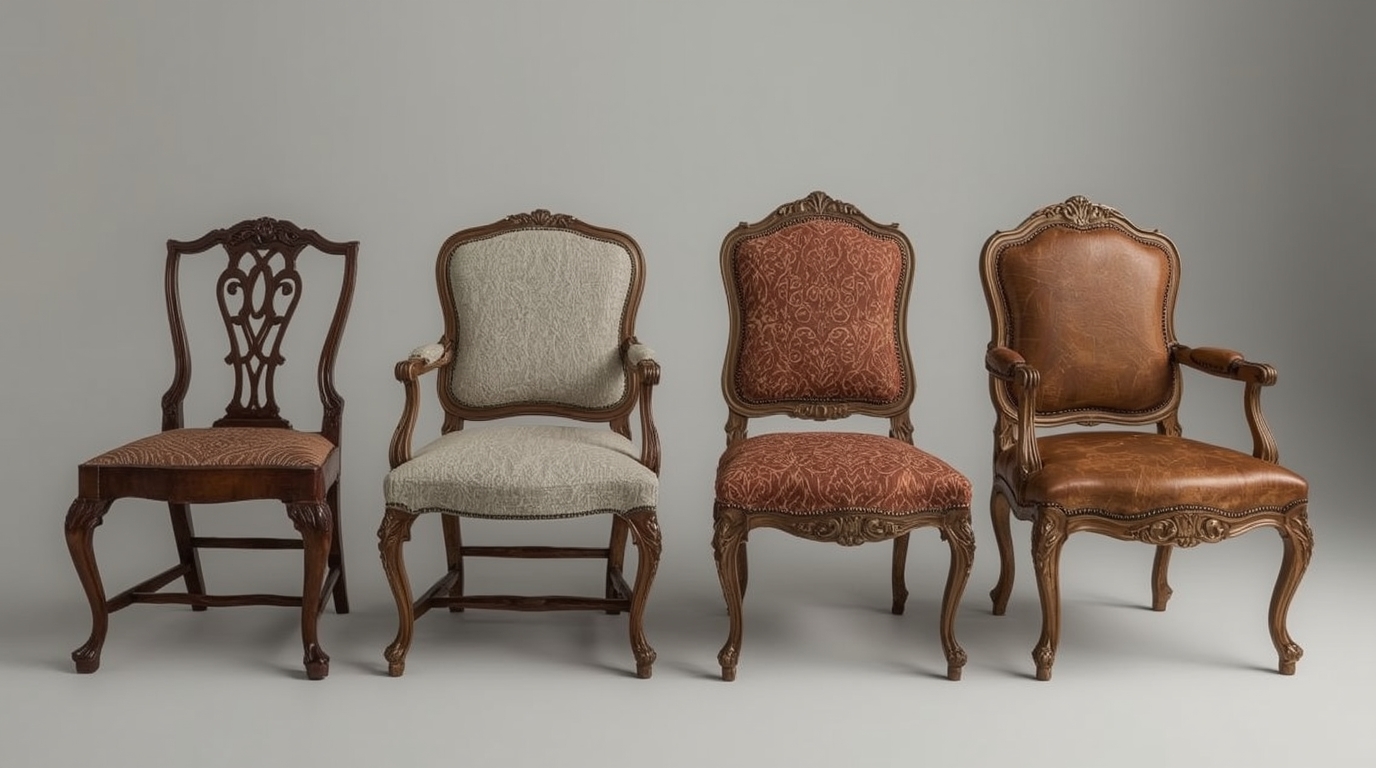
Antique dining chairs are more than seating: they are small, touchable pieces of social history. The curve of a crest rail, the choice of mahogany over oak, or the presence of gilded bronze mounts can reveal where a chair was made, which cultural ideals it served, and even how people wanted to be seen at the table. Understanding antique dining chair styles helps collectors buy wisely, helps homeowners furnish with integrity, and helps anyone appreciate why a seemingly “simple” chair can embody centuries of craft, trade, and taste.
Why Antique Dining Chair Styles Matter: Function, Status, and Craft
Dining chairs occupy a unique territory between everyday living and showing. For many cultures throughout history the dining room has been a public arena for performance, for showing off your status, for demonstrating good manners whether this was a Georgian townhouse in London, or a smart Parisian apartment during the Empire. Chairs were intended for sitting up, not for slouching.
The museum collections remind us how deeply art history and furniture history are intertwined. The Metropolitan Museum of Art and the Victoria and Albert Museum (V&A) trace the history of chair forms as designs reacted to the interiors of the time, to global trade, and to technology like new shipments of mahogany to Britain in the 18th century, or neoclassical influences from excavation in Herculaneum and Pompeii.
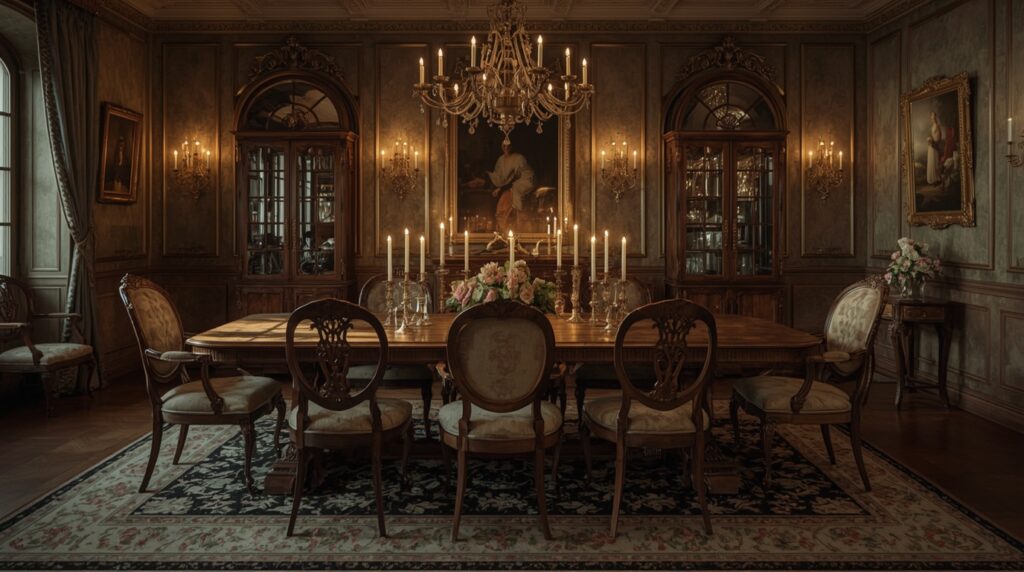
The V&A puts it best in their guide to furniture: style is not random. The way chairs are made, decorated and furnished can tell us both about craft traditions as well as fashion. So reading dining chair styles is not just a stylistic exercise, but a fact-based reading of chair construction, wood type, upholstery and decoration that can be verified with dated examples from places like the Smithsonian or The Louvre.
Major Antique Dining Chair Styles (17th–19th Century) and Their Hallmarks
William and Mary / Queen Anne (late 17th–early 18th century, Britain and colonies): Early dining chairs often show turning, stretchers, and expanding comfort. Queen Anne chairs are known for cabriole legs, pad or trifid feet, and vase-shaped splats—forms that spread widely to colonial America. Look for mortise-and-tenon joinery, early upholstery practices, and woods like walnut transitioning to mahogany.
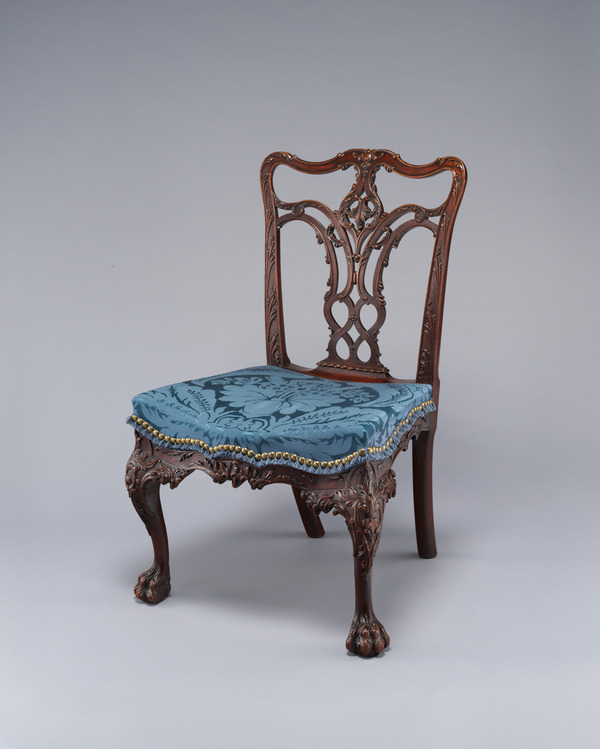
Georgian and Chippendale (mid-18th century, Britain and Atlantic world): Chippendale-style dining chairs commonly feature pierced splats (often Gothic, Chinese, or rococo-inspired), robust proportions, and rich mahogany. Thomas Chippendale’s influential pattern book shaped taste across Britain and beyond; many “Chippendale” chairs are later interpretations, so construction details and wear patterns matter. The Metropolitan Museum of Art holds important British and American furniture that illustrates these design languages in authenticated, dated contexts.
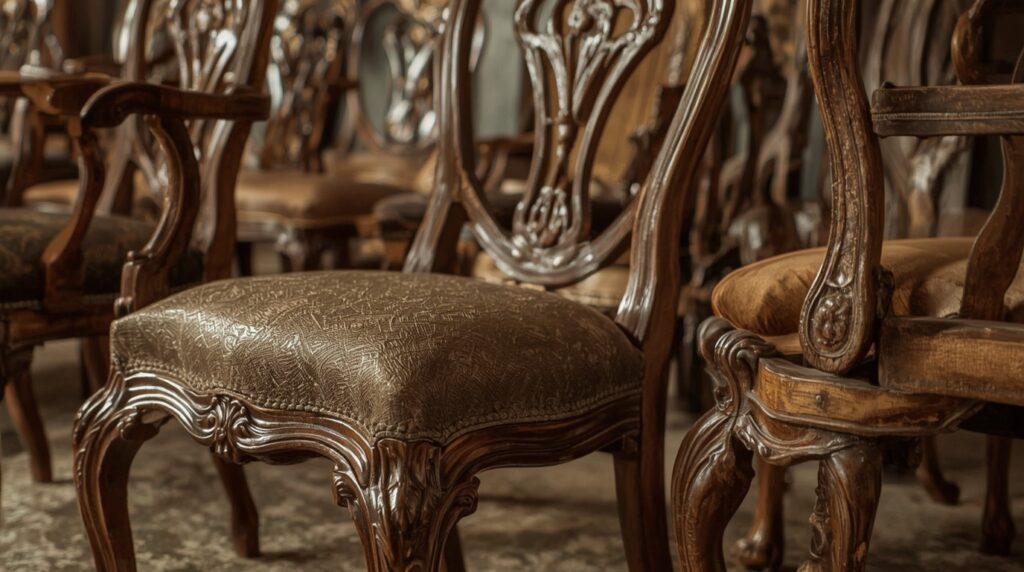
Hepplewhite / Sheraton (late 18th century, Neoclassical): These styles tend to look lighter and more architectural—think tapered legs, spade feet, and shield- or oval-back chairs with delicate inlay. Neoclassicism drew on ancient Greek and Roman motifs; its rise is closely associated with the Enlightenment and with archaeological scholarship that influenced European decorative arts. The V&A’s holdings and interpretive texts show how neoclassical design translated into furniture through refined line and restrained ornament.
French and Continental Influences: From Rococo Curves to Empire Grandeur
Louis XV (Rococo, mid-18th century France): In dining chairs (and other seating forms), you find asymmetrical scrolling carvings (shell, acanthus, scrolling profiles) with cabriole legs. The French guild system and Parisian workrooms (menuisiers and ebenistes) were held to high standards in carving and upholstering. The French decorative arts in the Louvre Museum fit into a social context of French court culture and patronage and the luxury signals in Rococo seating.
Louis XVI (Neoclassical, late 18th century)
With changing tastes, chair designs flattened out into more geometry: the chair has straight, fluted legs. Backs are oval or medallion-shaped and feature relief carvings of wreaths, ribbons and classical forms, mirroring the neoclassical Parisian architecture and antiquarian interests of the era. Beware of too much carving or recent staples often a later revival piece (which can be good, but don‘t pay top dollar).
Empire (c. Early 19th century, France and Europe): This period is all about muscle and imperial imagery laurel wreaths, eagles, sphinxes and strong veneers. It‘s tied directly to Napoleonic government iconography and grand interiors. Examples of Empire chairs found in the collection of The Met and other leading institutions illustrate how furniture ornamentation was used as political iconography, making it a favorite among those seeking dining chairs that look more architectural and less flimsy.
4) Quick Reference Table: Identifying Antique Dining Chair Styles at a Glance
| Style / Period | Typical Dates | Key Visual Traits | Common Materials | Tell-tale Construction Clues |
|---|---|---|---|---|
| Queen Anne | c. 1700–1725 | Cabriole legs, vase splat, restrained carving | Walnut, early mahogany | Pegged joints, early upholstery tacks, wear at stretchers/feet |
| Chippendale (Georgian) | c. 1750–1775 | Pierced splats (Gothic/Chinese/Rococo), heavier stance | Mahogany | Hand-cut tenons, consistent tool marks, old glue blocks |
| Hepplewhite / Sheraton | c. 1780–1810 | Shield/oval backs, tapered legs, lightness, inlay | Mahogany, satinwood (inlay) | Fine joinery, delicate proportions; inlay should show age patina |
| Louis XV (Rococo) | c. 1730–1760 | Curving lines, asymmetry, shell/acanthus carving | Beech (often), walnut | Carved frames, traditional webbing; later repairs often visible underneath |
| Louis XVI (Neoclassical) | c. 1760–1790 | Straight fluted legs, oval backs, wreath/ribbon motifs | Beech, gilding, painted finishes | Crisp classical carving; original gesso/gilding shows layered age |
| Empire | c. 1800–1820 | Bold silhouettes, classical/imperial motifs, strong geometry | Mahogany, veneer, gilt bronze mounts | Veneer aging, old fasteners; mounts should show consistent wear |
Authenticity, Provenance, and What Museums Teach Collectors
Museums depend on proof, from written provenance to technical analysis to comparison with known objects. You can use the object file and curatorial knowledge at the Smithsonian Institution to understand how particular pieces of furniture fit into American social history, for instance, when you‘re inspecting a Federal dining set or an American take on neo-classical style.
A good rule of thumb is to distinguish between style and age. So many dining chairs today are later reproductions: 19th-century Victorian “Louis XVI,” turn-of-the-20th-century Colonial Revival Chippendale, or early-post-war interpretations. It‘s possible to like these, even have them in your home, but they are not authentic period antiques. There are many tell-tale signs professionals look for: tool marks, oxidization in joinery, consistent shrinkage, and the evidence or absence of machine-cut screws and staples.
Expert advice also suggests we not be too wedded to labels. The Met, when discussing furniture materials and construction in its collection entries, states that attribution is based on an accumulation of evidence: the form, decoration, materials, and provenance. In the trade, the best dealers invite scrutiny, offer condition reports and reference similar pieces in prominent collections (the Met, V&A, Louvre).
Frequently Asked Questions (FAQs)
1) How can I tell if dining chairs are truly antique or just “antique style”?
Check construction first: hand-cut joinery, older fasteners, natural wear where feet meet the floor, and age-consistent patina in crevices. Compare the form to authenticated museum examples (Met, V&A, Smithsonian) and ask for provenance or a professional appraisal.
2) Are matching sets necessary for value?
Not always. Period sets are desirable, but assembled sets are common because chairs break and get separated. Value depends on quality, condition, and coherence—chairs can be “married” successfully if they share period, wood, and craftsmanship.
3) What upholstery is appropriate for antique dining chair styles?
Historically, upholstery methods varied by region and era—webbing, horsehair stuffing, and hand-tacked edges are common in earlier work. A well-done modern reupholstery can be acceptable, but it should respect the chair’s proportions and not obscure carved details or compromise the frame.
4) Which woods signal certain periods?
Mahogany is strongly associated with 18th-century British and American high-style furniture; walnut appears earlier in Britain; beech is common in French chair frames (often painted or gilded). Wood alone doesn’t date a chair, but it supports or contradicts an attribution.
5) What institutions are best for visual comparison?
The Metropolitan Museum of Art, Victoria and Albert Museum, Louvre Museum, and the Smithsonian Institution all provide online collection images and curatorial descriptions—excellent benchmarks for proportion, carving vocabulary, and period details.
Learning antique dining chair styles is ultimately about reading design as historical evidence: how people lived, what they admired, and how artisans solved problems of comfort and structure with the materials of their time. By grounding your eye in documented museum examples (Met, V&A, Louvre, Smithsonian), and by prioritizing construction details and provenance, you can choose dining chairs that are not only beautiful, but also credibly anchored in the past.