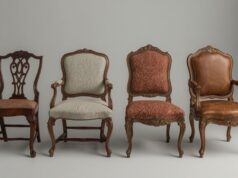
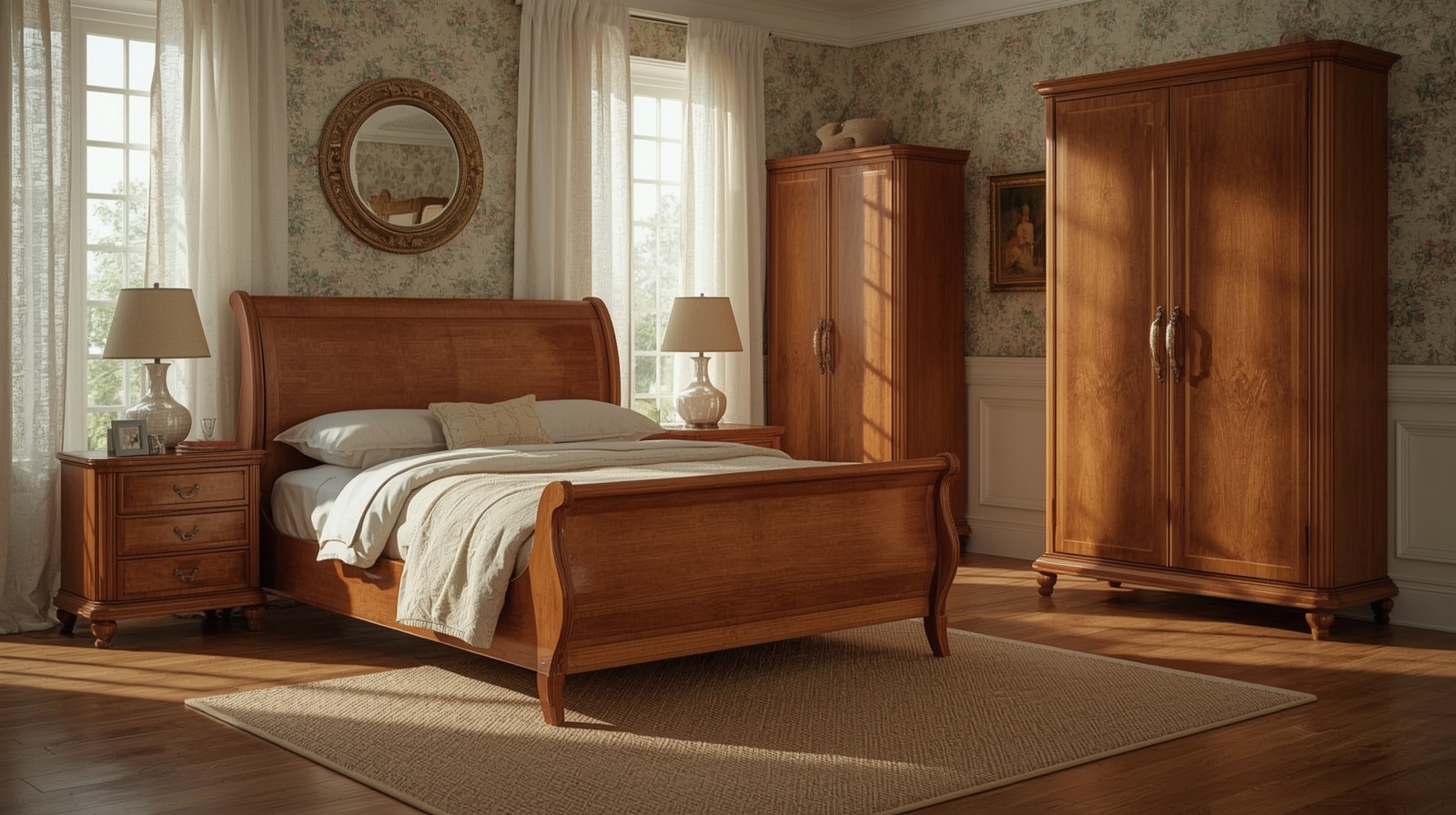
Antique bedroom sets from the 1940s are more than “old furniture”—they are artifacts from a decade shaped by war, rationing, postwar optimism, and rapid changes in design. Whether you’re restoring a period home, collecting American or European decorative arts, or simply hunting for durable craftsmanship, a 1940s bedroom suite can tell you exactly where design history pivoted: away from prewar glamour and toward streamlined practicality, then back again into postwar warmth and mass production.
Understanding 1940s Design: From Art Deco to Wartime Utility
These are the early 1940s, and some remnants of Art Deco, or Streamline Moderne (the design approach that held sway in the 1920s and 30s, characterized by smooth geometry, curved forms, and confident machine-age curves) linger: you can see it in the rounded corners of the dressing table drawers, the waterfall edges, the lack of fussy applied ornamentation. Often, a museum will frame this moment in time as part of a larger trajectory in modern design. In its summary of Art Deco, the Victoria & Albert Museum explains that the style represented an adoption of modern materials and a simplified aesthetic that was incorporated into domestic interiors across the class spectrum.
And then World War II (1939–1945) changed all of the rules for what was made and purchased. The War Production Board limited the use of vital resources in the US furniture industry. Designers came up with alternate materials or construction, and people simply lived with their existing belongings. In Britain, the wartime austerity and the government-controlled “Utility” scheme which became the emblem for shortages during the war prioritized simplicity and standardized design over embellishment.
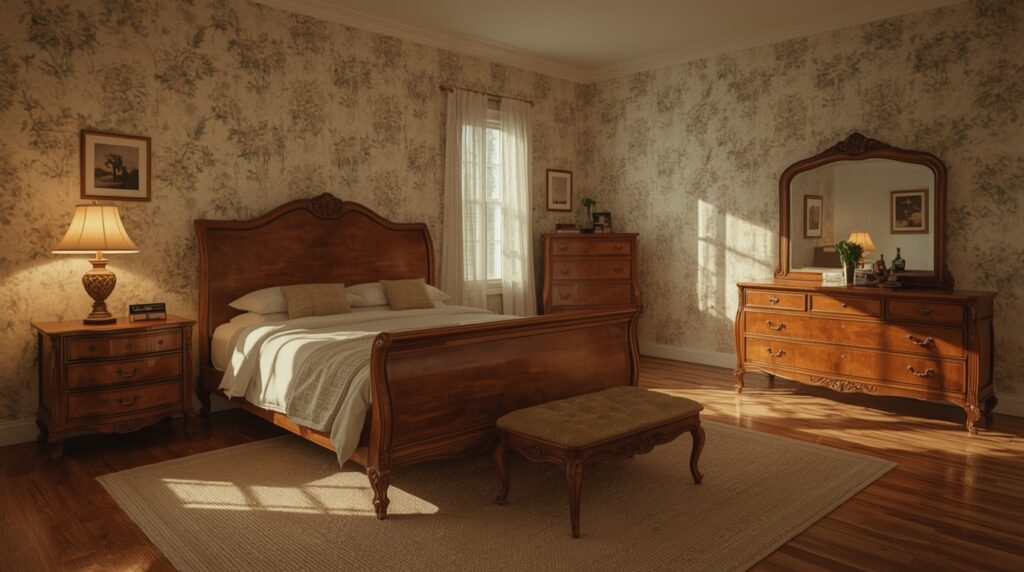
Around the late 1940s, however, things turned once again. Demand for furniture to replace older items in homes (which often survived and even “wore in” through the war) along with that returning population, consumer economy, and the increased production led to new lines being created. So the decade has an interesting split between more-prewar-like forms (Deco/Moderne), the spare nature of war-time, and the somewhat more traditional revival of the postwar. The Metropolitan Museum of Art and the Smithsonian Institution both make the case that design history can, and should, serve as a lens through which social conditions, technological and economic factors and experiences are studied rather than simply examining aesthetics alone; this is nowhere more true than when looking at furniture design in the 1940s.
What Defines Antique Bedroom Sets 1940: Materials, Forms, and Construction
In the 1940s, “bedroom set” generally meant a bed frame (usually a full size), dresser, and vanity or chest. These might or may not be accompanied by a nightstand or nightstands, and an attached mirror. North American bedroom sets from the 1940s are often walnut, mahogany, or birch veneers over hardwood or secondary woods. Book matching of the veneer and curved drawer fronts can be seen on pieces from the early 1940s. Hardware becomes less fussy. Simple pulls, sometimes in wood or Bakelite, with little or no stamping.
Look at the construction: real 1940s pieces are usually constructed with machine-cut dovetail joints in their drawers. The sides of the drawers should be made out of solid wood. Examine the finishes: real pieces should be lacquered with a patina of age. Some pieces from the war also show signs of material shortages: perhaps thinner veneers, different woods, and simpler outlines. Don‘t think that these qualities make a piece “less good” – it could mean it‘s even more collectible.
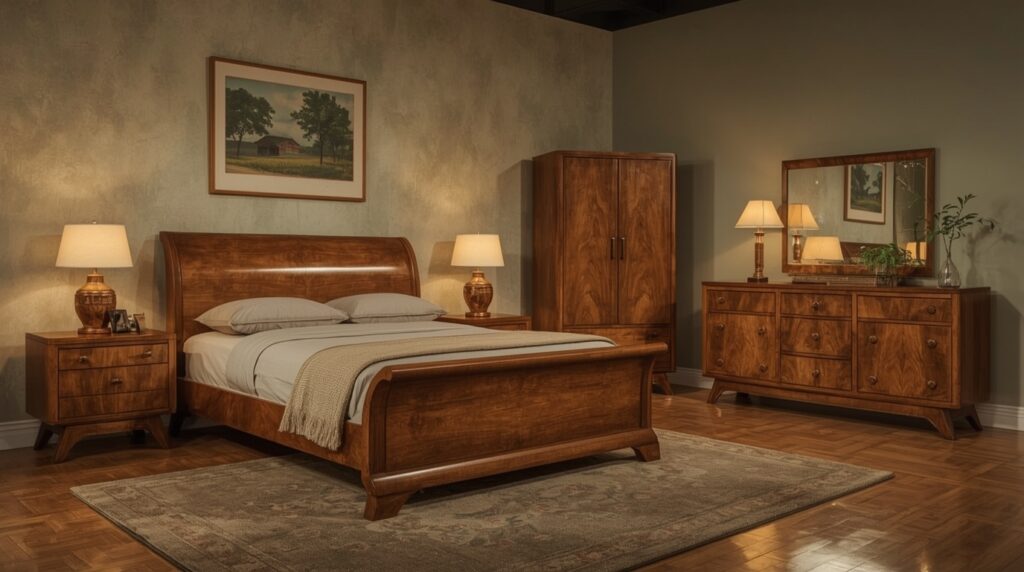
Provenance and record-keeping contribute to value. If you can identify the maker, look for manufacturer stamps (sometimes on legs, drawers, or hardware) or branded hardware; regional origin can help if the furniture predates ubiquitous national brands. The Grand Rapids, Michigan region, for example, has a history as a center for American furniture production. If in doubt, see an expert. The Smithsonian, as an example, emphasizes context when assessing historic artifacts: the same holds true for furniture in private collections.
Key characteristics at a glance
| Feature | Common in 1940s bedroom sets | What it suggests |
|---|---|---|
| Silhouette | Waterfall edges, rounded corners; later: simpler rectilinear forms | Early decade Moderne vs. wartime/postwar practicality |
| Materials | Walnut/mahogany/birch veneers, mixed secondary woods | Availability and cost; veneer artistry still valued |
| Hardware | Minimal metal pulls, sometimes Bakelite | Streamlined taste; wartime material constraints |
| Joinery | Machine-cut dovetails, solid drawer sides | Period-typical mass production with durability |
| Finish | Lacquer, patina, checking, worn high-touch areas | Age indicators; avoid overly “new” surfaces |
| Set composition | Bed + dresser + vanity/chest; nightstands optional | Standard mid-century consumer suite format |
Collecting and Buying: Authenticity, Condition, and Value
Authenticity begins with details that are hard to fake convincingly: consistent wear, construction methods, and period-appropriate proportions. Be cautious of “1940s style” listings that are actually later mid-century pieces or contemporary reproductions. A genuine set often shows uneven oxidation where pieces were exposed differently to light, and drawer bottoms may be thinner wood panels set into grooves. Mirrors in vanities may be original with subtle desilvering at edges—valuable as a sign of age, though not always desirable for daily use.
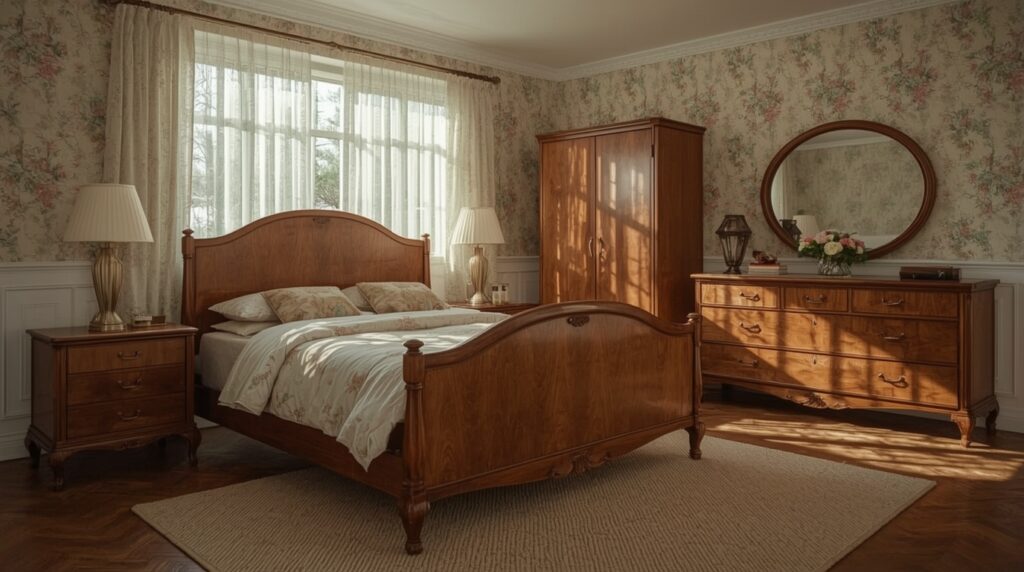
Condition should be assessed in tiers: structural, surface, and completeness. Structural issues—loose joints, warped drawer runners, broken bed rails—can be costly but fixable. Surface issues—scratches, cloudy lacquer, heat marks—are common and sometimes best preserved rather than aggressively refinished, especially for collectors who value originality. Completeness affects value: a matched set with original hardware and mirror generally commands more than a “married” group assembled from different sources.
For market reality, remember that value varies by region and taste. Sets from well-documented makers, with strong design coherence and original finish, tend to hold value best. When in doubt, lean on professional appraisal standards. As the Smithsonian’s collections and conservation work frequently demonstrate, restoration choices can permanently change an object’s historical integrity—so the most “beautiful” intervention is not always the most appropriate one.
Caring for 1940s Bedroom Furniture: Preservation and Restoration Ethics
Cleaning should start gently. Dust with a soft cloth; avoid soaking wood or using harsh degreasers that can strip lacquer. If you must use a product, choose one intended for historic finishes and test in an inconspicuous area. Small actions—felt pads under lamps, controlling humidity, keeping furniture out of direct sun—often do more for long-term preservation than any polish.
Restoration decisions benefit from museum-informed ethics: minimal intervention, reversibility when possible, and respect for original materials. The Metropolitan Museum of Art’s conservation approach emphasizes careful study of materials and techniques before treatment; applying that mindset at home means avoiding quick fixes like heavy sanding that removes veneer and edges. Stabilizing a loose joint or consolidating flaking finish is often preferable to total refinishing.
If refinishing is necessary (for example, after severe water damage), document what you change. Photograph labels, hardware placement, and finish layers before work begins. Retain original handles and hinges even if you replace them temporarily. Institutions such as the Victoria and Albert Museum and the Louvre Museum regularly underscore that an object’s history—its marks of use, repairs, and context—is part of its meaning. Your stewardship can preserve that history while still making the piece functional.
Authoritative Voices and Sources (Why They Matter)
Collections and research departments in museums offer a solid structure for styles and eras. (The Metropolitan Museum of Art‘s decorative arts and the Victoria and Albert Museum‘s design history resources, among others, can help untangle which decorative arts or modernistic elements went into homes and what objects of daily life were produced during each period.) They stabilize the lexicon and chronology–important when sellers are slinging the terms “Deco,” “Moderne,” and “mid-century” around.
These ideas also guide best practice in terms of curating and conservation. The holy grail of conservation, which is cited frequently, is for treatment to be conservative and to be recorded rigorously; in a museum setting, we‘re aiming to protect original material, to protect evidence of manufacture. And that‘s the basis that‘s guided museum conservation departments throughout the years, that‘s the guidance for the American Institute for Conservation.
Lastly, authenticity of provenance safeguards collectors. Instead of vague internet summaries, museum inventories, auction catalogs, or institution databases offer better assurance. For example, for a “1940 antique bedroom set,” we might compare stylistic elements to 1930s–1940s fine arts in museums and construction aspects to what period companies are known to have produced.
Frequently Asked Questions
Are 1940s bedroom sets considered “antique”?
In many markets, “antique” is commonly used for items around 100 years old, while “vintage” often covers younger pieces. A 1940s set is typically described as vintage, though some dealers use “antique” more loosely. Regardless of label, what matters is period authenticity and condition.
What woods are most common in antique bedroom sets 1940?
Walnut, mahogany, and birch veneers are common, often over secondary woods. Wartime and immediate postwar examples may show mixed materials due to shortages.
How can I tell if the finish is original?
Original lacquer often shows fine checking, uneven wear on edges and drawer fronts, and patina that doesn’t look uniformly “new.” A perfectly even sheen across all surfaces can indicate refinishing, though careful restorations exist.
Is refinishing always a mistake?
Not always. Severe damage may justify refinishing for usability. However, heavy sanding can destroy veneer and reduce historical integrity and value. When possible, choose conservation-minded repairs and document changes.
Where can I learn more from credible sources?
Start with institutional resources: The Metropolitan Museum of Art, the Victoria and Albert Museum, the Smithsonian Institution, and the Louvre Museum all publish collections, essays, and conservation perspectives that help anchor style identification and responsible care.
Antique bedroom sets 1940 capture a decade when design answered history—shifting from streamlined modern elegance to wartime restraint and then toward postwar renewal. By focusing on construction evidence, period materials, and conservation-minded care—supported by museum-grade reference points—you can buy, preserve, and live with these pieces in a way that honors both their craftsmanship and their time.