Albrecht Dürer (1471–1528) was a German painter, printmaker, and theorist whose sharp eye and restless intellect helped redefine art north of the Alps. Working in Nuremberg at the dawn of the sixteenth century, he blended late Gothic detail with the new ideas of the Italian Renaissance. Dürer was not only a virtuoso technician, but also a thinker obsessed with proportions, perspective, and the nature of artistic genius. His prints traveled widely, turning him into one of the first truly international art celebrities. Understanding Dürer means seeing how the Renaissance became a European, not just an Italian, phenomenon.
Early life and background
Albrecht Dürer was born in Nuremberg in 1471, the son of a Hungarian-born goldsmith, Albrecht Dürer the Elder, and Barbara Holper. Growing up in a busy commercial city filled with metalworkers, merchants, and publishers, he encountered at an early age the visual world of engravings, seals, and illustrated books. This environment, saturated with images and meticulous craft, shaped his sensibility long before he ever touched a painter’s brush. His childhood drawings—most famously a remarkable silverpoint self-portrait at thirteen—already reveal an almost unsettling intensity and precision.
Albrecht was sent to learn the goldsmith trade with his father, requiring absolute precision on the most minuscule of canvases, which would eventually become all the more evident in his incredible fine lines and control in printing. But Albrecht‘s ability to draw was a gift that could not be repressed. He became apprenticed to the most important painter and workshop owner in Nuremberg, Michael Wolgemut, the man responsible for huge altarpieces and the woodcuts for the landmark Nuremberg Chronicle. There, Durer was introduced to the world of panel painting and the business of mass communication.
Nuremberg itself played a role in shaping Dürer. As a free imperial city, a key point on trade routes, it provided access to imported Italian prints and texts by humanist scholars. The wealthy patricians and humanist intellectuals of Nuremberg made a market for art that was more than merely spiritual, but rather personal and intellectual. Dürer’s early life was spent in a city at the intersection of art, trade and learning, fitting him to emerge as an artist both regionally celebrated and of European importance.
Artistic training and influences
Dürer’s formal artistic training began in Wolgemut’s workshop, where he absorbed the late Gothic style of northern art: intricate drapery, expressive faces, and crowded narrative scenes. Workshop life taught him collaborative production: assistants prepared panels, transferred drawings, and even painted parts of commissions. Dürer’s earliest known works follow this vocabulary, but within a few years he was testing more sculptural forms and spatial depth, hinting at his ambition to go beyond regional conventions.
After completing his apprenticeship, Dürer embarked on the customary Wanderjahre, or journeyman years, across German-speaking territories. He likely visited Colmar and Basel, important centers of book production and print culture. In Basel, he contributed woodcuts to printed books, gaining firsthand experience in how images could circulate far beyond a single city. Although German masters like Martin Schongauer were formative for him—especially in engraving—Dürer’s imagination was increasingly drawn south, toward Italy.
His travels to Italy in the 1490s and again in 1505–07 were revelation. In Venice, he marveled at the luminous palette and calm disposition of Giovanni Bellini‘s paintings and became enamored of classical antiquity and its ideas of proportion. Italians had made of their exploration of perspective and anatomy a purely intellectual pursuit; Dürer embraced it with great gusto. He copied ancient statues, dissected human bodies, and amassed theoretical texts. But instead of copying what he found, he merged this ideal of harmonious balance with the north‘s penchant for detail, forging an innovative synthetic style both rational and closely observed.
In Nuremberg, Dürer engaged in a lifetime of conversation, worship and rivalry with Italian art and theory. Evidence is found throughout his correspondence and writing and even in his very name: “Albert Dürer” was a boast of authorship in a bold way not usually seen in the north of Europe. His prints argued that he was no mere technician, but a learned man, the equal of any poet or philosopher.
Signature style and techniques
Dürer’s style is often described as a synthesis: northern precision married to Italian classical ideals. The most immediately striking feature of his work is his command of line. In engravings and woodcuts, he uses lines not only to describe forms but to create light, shadow, and texture with astonishing subtlety. Fine parallel hatching, cross-hatching, and varied line weight allow him to model surfaces from shiny armor to soft fur, making his prints feel almost sculptural despite their two-dimensional medium.
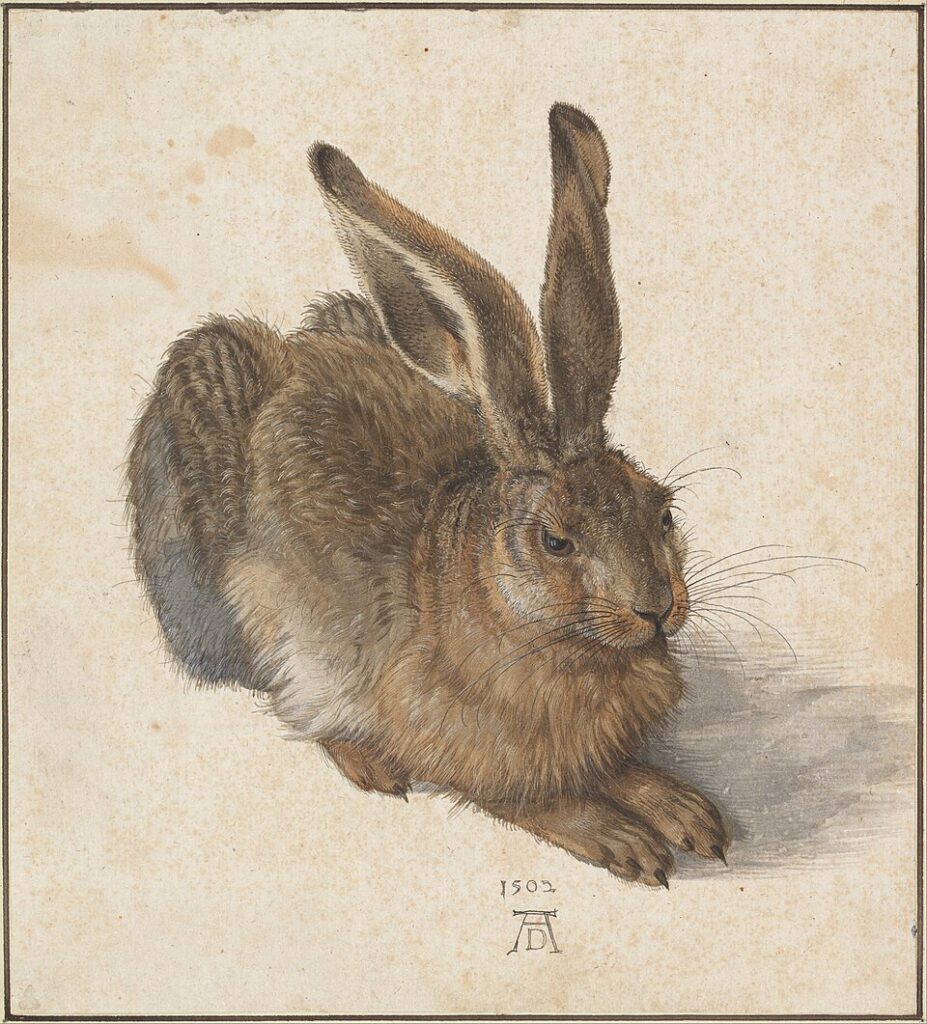
Equally distinctive is Dürer’s approach to realism. He was deeply interested in the visible world—landscapes, animals, aging faces, even tufts of grass. His famous watercolors of nature, such as “The Great Piece of Turf” and “Young Hare,” are not decorative studies but intense acts of observation. Dürer treats these subjects as worthy of the same attentiveness traditionally reserved for religious themes. This reflects a broader Renaissance shift: the belief that God’s presence could be found in the beauty and order of creation itself.
If you‘re painting in color, Durer‘s range extends from intricately described altarpieces to psychologically sharp portraits. His figures are placed in logical, mathematically structured spaces, but have a linear stiffness that comes from Gothic painting. His colors are refined, never as luxuriant as in Venice, but capable of conveying symbolic and emotional nuance. The gold of brocade, polished steel, and flushed skin are all there.
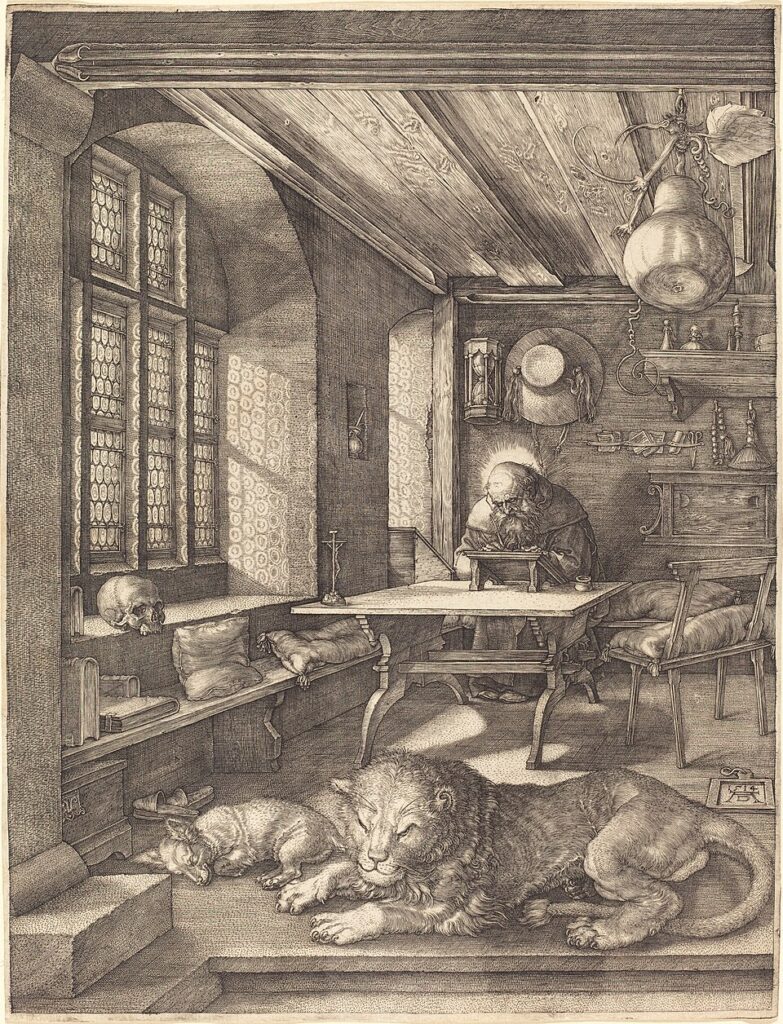
A different type of innovation from Durer was the use of the print: an artistic technique more than a way to look at it. He transformed the woodcut and the print from a minor craft form into high art; he made images complicated enough to be copied widely and easily through Europe. With an “AD” monogram on each print, he made his art a commodity and his visual brand immediately apparent.
Major works and masterpieces
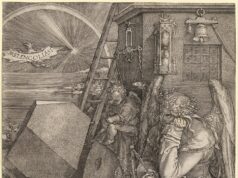
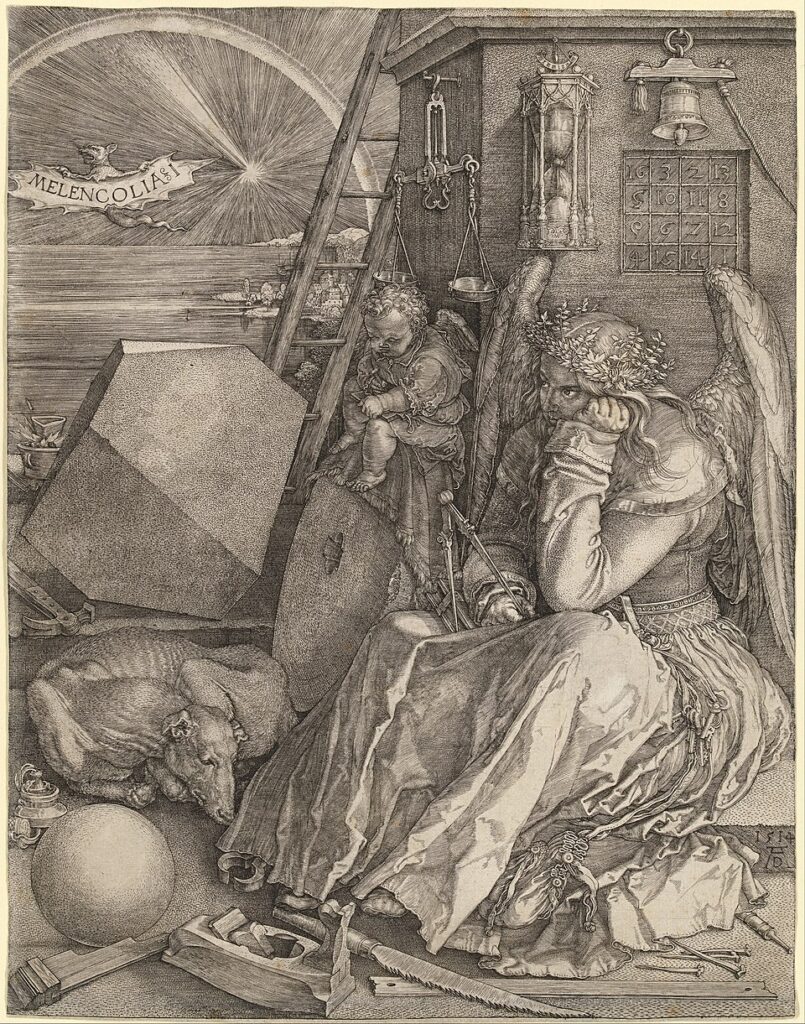
Among Dürer’s vast output, a handful of works have become emblematic of his genius. His engraving “Melencolia I” (1514) is often considered his intellectual masterpiece: a brooding winged figure sits amid a clutter of tools, a magic square, and geometric objects. The image resists simple explanation yet seems to crystallize the Renaissance artist’s anxious brilliance—surrounded by knowledge, but stalled by doubt. The same year, he produced “Saint Jerome in His Study” and “Knight, Death and the Devil,” forming a trio of prints that explore contemplation, faith, and moral courage.
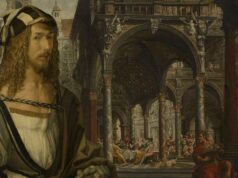
In painting, the “Adoration of the Magi” (1504, Uffizi) showcases his ability to integrate Italianate composition with northern detail. The richly dressed kings, crumbling architecture, and richly painted animals all draw the viewer into an elaborately observed world. His “Four Apostles” (1526), donated to the city of Nuremberg, presents monumental figures with an almost sculptural gravity, accompanied by text inscriptions warning against religious error. Created in the early Reformation era, it reflects both humanist admiration for the Bible and Dürer’s concern over spiritual turmoil.
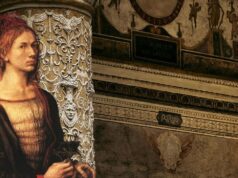
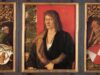
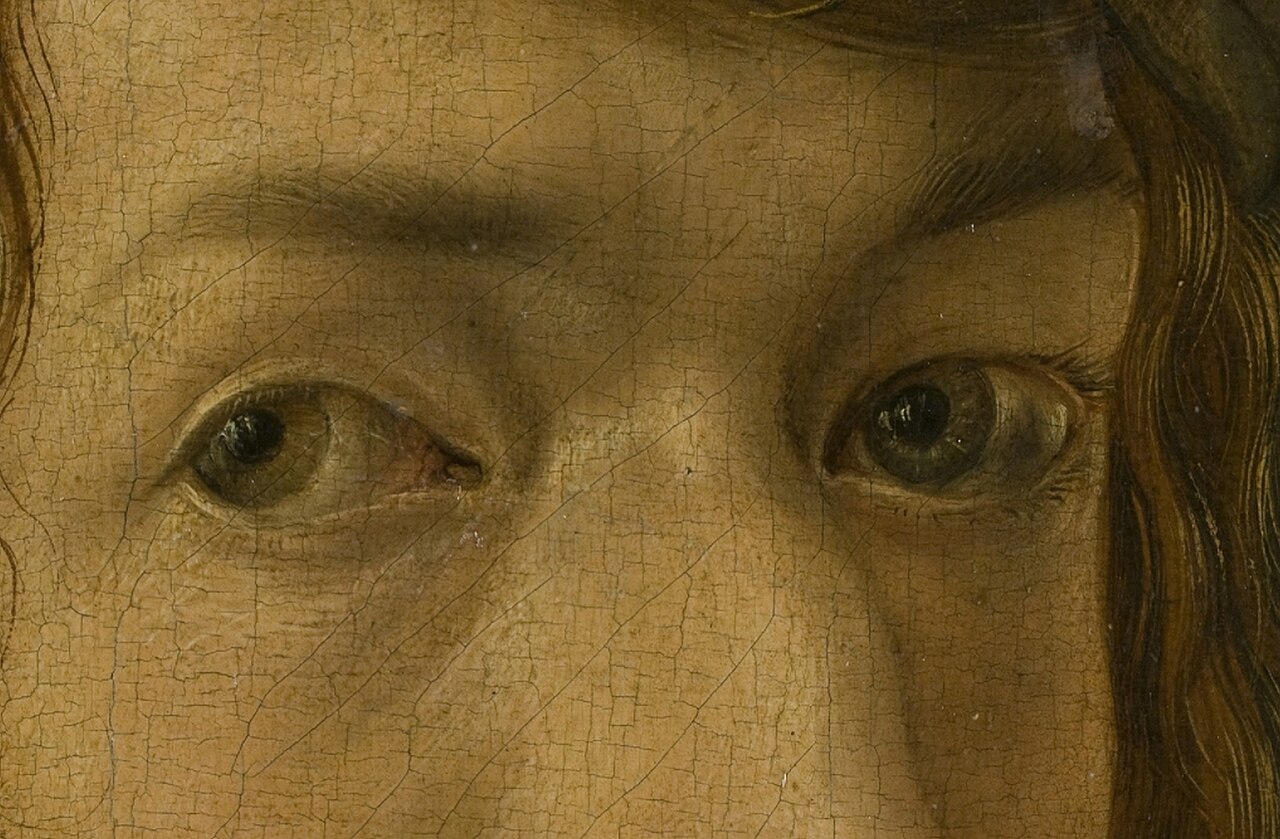
Dürer’s self-portraits are also masterpieces in their own right, functioning as statements about the status of the artist. The 1498 self-portrait in Madrid presents him as a cultivated gentleman in fashionable clothing, asserting social elevation beyond that of a traditional craftsman. Even more striking is the 1500 self-portrait in Munich, where he faces the viewer frontally, in a pose reminiscent of Christ. The sober gaze and central composition transform a likeness into a meditation on artistic creation and divine likeness.
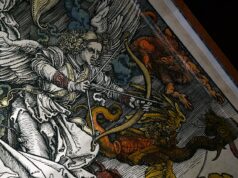
His woodcut series “The Apocalypse” (first published 1498) revolutionized religious illustration. The dynamic, almost cinematic depictions of the Book of Revelation—most famously “The Four Horsemen of the Apocalypse”—combine intense drama with intricate detail. These prints were not merely devotional aids; they were objects of aesthetic fascination that circulated across Europe, cementing Dürer’s reputation as a virtuoso of the graphic arts.
Meaning behind his work
Beneath Dürer’s technical brilliance lies a sustained inquiry into human existence, faith, and knowledge. Many of his religious works are not simply pious images but reflections on spiritual experience in a time of uncertainty. “Knight, Death and the Devil,” for example, can be read as an allegory of steadfast moral courage: the armored rider, eyes fixed ahead, presses forward undeterred by Death on a pale horse or the grotesque Devil at his side. The dense forest and narrow path intensify the sense that ethical life is a journey through danger and ambiguity.
“Melencolia I” delves into the darker side of Renaissance ambition. Traditionally, melancholy was associated with the frustrated genius: too thoughtful to be easily content. Dürer’s winged figure, surrounded by unused tools of measurement and creation, embodies the feeling that human intellect aspires to divine knowledge yet falls short. The magic square, hourglass, and comet overhead suggest both mathematical order and the passage of time, hinting that human achievements are bounded by mortality and limitation.
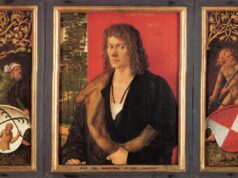
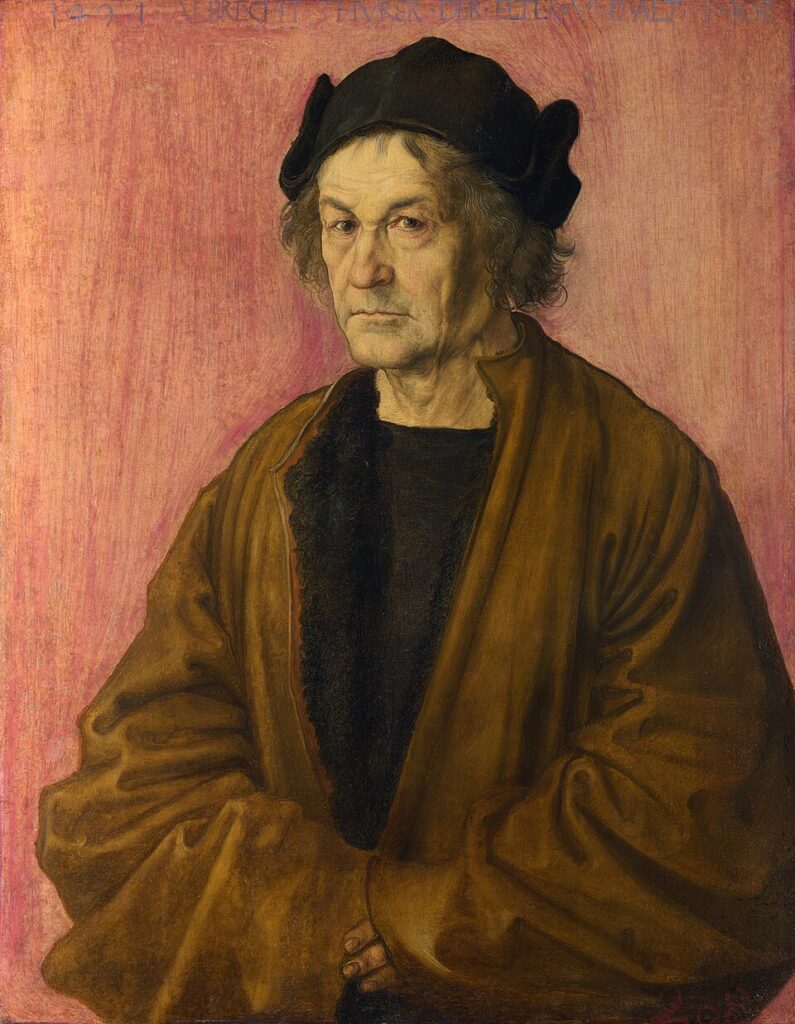
His portraits and self-portraits also carry layered meanings. By depicting himself with the gravity and frontal pose of Christ, Dürer was not claiming divinity but asserting that the artist participates in divine creativity—shaping images from raw matter, much as God shaped the world. Many of his sitters appear in moments of introspection rather than display, suggesting a concern with inner character rather than social rank alone. This psychological depth anticipates later northern masters like Rembrandt.
Even his studies of nature can be read symbolically. Works such as “The Great Piece of Turf” and “Young Hare” elevate humble subjects into central motifs. In an age fascinated by both theology and empirical observation, such images suggest that every blade of grass is worthy of attention, and that understanding the world visually is itself a form of knowledge. Throughout his oeuvre, Dürer’s art negotiates between the material and the spiritual, the measurable and the mysterious.
Dürer and the Northern Renaissance
Dürer stands at the heart of the Northern Renaissance, a movement that transformed late medieval visual culture into something more self-consciously classical, humanist, and observational. Unlike Italy, where the Renaissance grew in dialogue with ancient Roman ruins, the north had to import classical ideals through texts, prints, and travelers. Dürer was one of the major conduits for this transmission. His journeys to Italy and his intense study of proportion and perspective brought southern ideas into a northern visual language.
At the same time, he preserved key strengths of northern art: an almost forensic attention to texture, landscape, and everyday detail. Instead of abandoning Gothic complexity, he disciplined it with geometric rigor and classical anatomy. This fusion allowed northern patrons to embrace Renaissance innovation without feeling that their artistic identity had been swallowed by Italian models. Dürer proved that intellectualized, theory-driven art could thrive in German-speaking lands.
His close relationships with humanist scholars in Nuremberg further anchored him in the Northern Renaissance’s intellectual culture. Men like Willibald Pirckheimer exchanged books and ideas with him, reinforcing the notion that images could be vehicles for learned discourse, not merely decoration. Dürer’s inscriptions, monograms, and allegories show an artist practicing what humanists preached: the elevation of knowledge, individual achievement, and critical engagement with tradition.
Dürer’s role as a printmaker was especially significant for the Northern Renaissance. Because prints were relatively affordable and widely circulated, his images reached artists, patrons, and printers across the Low Countries, Germany, and even Spain. Younger northern artists absorbed his combination of realism, classical form, and symbolic depth, spreading a “Dürerian” visual language that helped define what Renaissance art meant north of the Alps.
Dürer as a printmaker and theorist
While Dürer was a superb painter, it was through printmaking that he achieved continental fame. He elevated the woodcut and engraving from supporting crafts to autonomous art forms capable of subtle expression. His woodcuts for “The Apocalypse,” the “Large Passion,” and the “Life of the Virgin” set new standards for complexity and drama. In engravings such as “Adam and Eve,” every line is calculated, the bodies idealized according to classical proportion yet rendered with tactile immediacy.
Dürer treated printmaking as both an artistic and a business enterprise. By controlling the design, production, and distribution of his prints, he reduced dependence on local commissions and built a brand that extended across Europe. His monogram functioned almost like a trademark, and he pursued legal protection against counterfeiters—a remarkably modern concern. This entrepreneurial approach changed how artists thought about authorship, reproduction, and the economics of art.
As a theorist, Dürer published pioneering treatises in German rather than Latin, making complex ideas accessible to a broader audience of craftsmen and educated laypeople. His “Four Books on Measurement” (Unterweisung der Messung, 1525) laid out principles of geometry, perspective, and proportion with practical diagrams and tools. His posthumously published “Four Books on Human Proportion” attempted to systematize the ideal human body through carefully derived canon systems, blending empirical observation with mathematical construction.
These writings reveal Dürer’s conviction that art rests on knowledge—especially mathematical knowledge—rather than on intuition alone. For him, proportion and perspective were not abstract games but ways to understand and emulate divine order. By casting the artist as a learned figure who grasps geometry and anatomy, Dürer helped elevate the social and intellectual status of art in the German-speaking world and beyond.
Why is Albrecht Dürer famous?
Dürer’s fame rests not merely on his technical skill, but on his role in reshaping what art could be and do. He was one of the first northern artists to be revered across Europe during his own lifetime, thanks largely to the wide circulation of his prints. Collectors prized his engravings as intellectual objects, filled with allegory and virtuoso detail, not just as illustrations. This created a new model of the artist as a pan-European figure whose influence transcended local patronage.
He also became famous as a bridge between northern and Italian art. His synthesis of classical proportion with northern realism provided a template that influenced generations of artists in Germany, the Low Countries, and beyond. Painters as diverse as Hans Holbein the Younger and later Netherlandish masters built on Dürer’s integration of psychological depth, meticulous observation, and structured compositions. In this sense, his fame is linked to his function as a cultural mediator.
Equally important is his impact on the concept of artistic authorship. By signing his works prominently, asserting legal rights over his images, and theorizing his craft in published books, Dürer helped construct the modern idea of the artist as an individual creator with intellectual property and a distinctive “brand.” His self-portraits demonstrate an acute awareness of personal image in a proto-modern sense, contributing to his enduring recognition.
Today, Dürer remains famous because his work still speaks to enduring concerns: the tension between faith and doubt, the ambitions and anxieties of creativity, and the beauty of observed nature. Museums consistently feature his prints and paintings as cornerstones of their Renaissance collections, and scholars continue to debate the meanings of his most enigmatic images. His legacy is not a static reputation, but a living conversation.
Interesting facts about Dürer
- Dürer was an early “art tourist”: during his 1505–1507 stay in Venice, he marveled at the works of Bellini and others, writing detailed letters that mix artistic analysis with wry observations about Italian life.
- He was fascinated by animals; his famous “Rhinoceros” woodcut (1515) depicts a creature he never saw in person, based instead on a written description and sketch, yet it shaped European images of rhinos for centuries.
- Dürer carefully tracked his finances and prices, leaving unusually detailed records that show him as a shrewd businessman as well as an artist.
- He was deeply interested in Martin Luther and the Reformation; though he died before aligning formally with Protestantism, his late works reveal sympathy with scriptural humanism.
- His monogram “AD” became so well known that contemporaries forged it on lesser works to boost sales, prompting Dürer to take legal action in Venice against counterfeiters.
He is relevant to us still, for he exemplifies the art that is both painstakingly made and boldly conceived. His paintings and engravings depict a moment when Europe was grappling with its beliefs, with what it could know, with what it meant to be a person living under the heavens, but the topics he wrestled with of faith and fact, ingenuity and error, of all we think we know and all that we are not continue to resonate with us. He combined Northern particularity with Renaissance learning and made prints worthy of intellectual discourse: he contributed to our modern conception of the artist as a thinking person and creator. His spirit still lingers on whatever page or canvas is marked by exactness and imagination and inquiry.