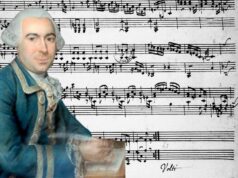

The figure commonly cited as Albinoni Tomaso—more precisely, Tomaso Albinoni (1671–1751)—stands at a revealing intersection of Venetian patrician culture, commercial publishing, and the evolving social role of music in late seventeenth- and early eighteenth-century Europe.
Born into a well-to-do paper merchant family in Venice, Albinoni did not work in the service of the court as a salaried employee nor did he need the patronage of church as many of his fellow musicians. His lack of dependency in both these matters reflected in the spread of his work much of it printed and sold in the international market and aimed at amateur and professional audiences who purchased Venetian commodities just as avidly as its glass and damask. And so, for those of us who are interested in decorative arts and collecting, the “objecthood” of music in paper, ink, binding, and publishers’ marks directly resonates with the material economy of Venice.
Albinoni composed through the twilight of Venice‘s Baroque, at a time when the city‘s image-generating industries print, engraving, luxury fabrics, decorative arts had a strong affiliation to cultural status. Like a carved console or a gilt-edged mirror, music traveled via a chain of makers, middlemen, and consumers. The printed music of this era, therefore, is less about transmitted sound than about the commodity object made in the same commercial, visual milieu that produced Venice‘s most famous luxuries. A “lost” manuscript by Albinoni must, for us, first be seen in relation to its printed counterpart, because they represent two technologies with very different social connotations. Manuscript suggested confidentiality, workshop production, and local use; print suggested broad distribution, the durability of celebrity, and commerce.
“the lost manuscript experts didn’t expect” is a certain sort of historiographic sigh. On the one hand, Albinoni is one of the better known composers in his period, on the other hand, his work is frustratingly incomplete (lost documents, wartime losses, attribution issues common to Baroque ensembles). The “discovery” is thus both exciting and to be questioned, requiring the conservator to examine fibers, ink, and stitches just as closely as the musicologist examines harmony and counterpoint. That is to say, the surprise is not in the music itself, but rather in its material history the history of the artifact, of where it was kept, how it was used and why it got lost.
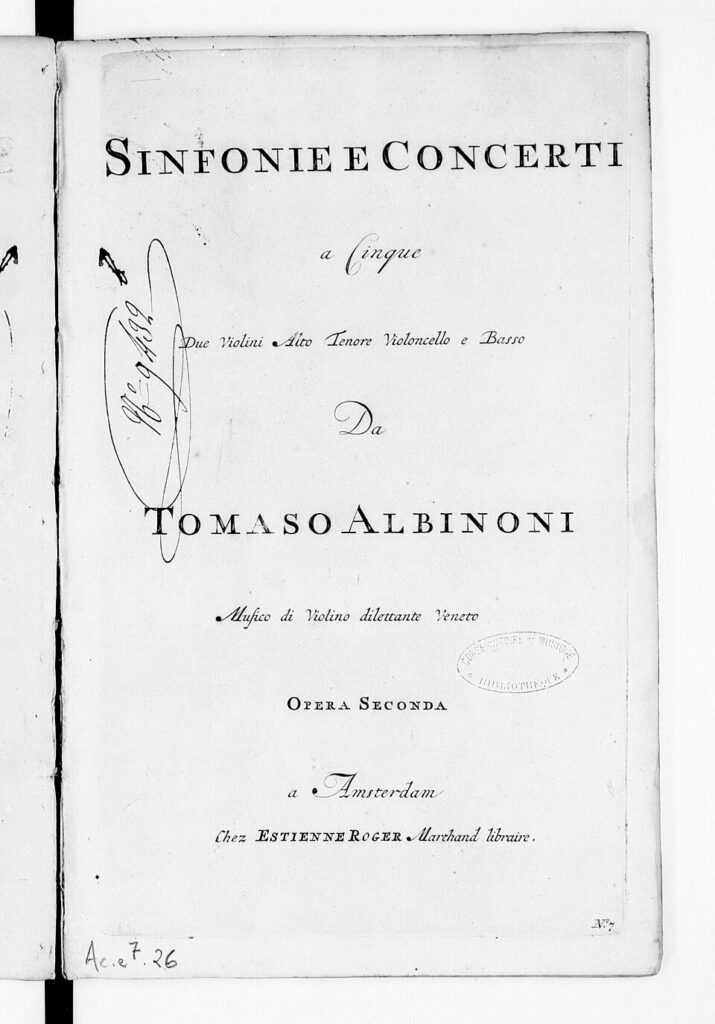
There are, in any case, numerous historical conditions that make it possible for such an item to exist. The music of Venice was extensively distributed via manuscript copies, particularly in places where no printed editions existed and where individual musicians would adapt parts to their own ensembles. In the eighteenth century, miscellaneous musical collections were made for private patrons and by institutional libraries. Often contained in volumes without a continuous title page or author attribution and rebound or re-cataloged at a later date, these miscellanies are the repositories where an item such as an Albinoni manuscript might lie unnoticed in plain sight. The unexpected nature is more a matter of the present-day desire for a tidily organized archive than an eighteenth-century reality for the working musician and librarian.
“The archive is not an abstract repository of truth, but a succession of decisions—what to bind together, what to label, what to copy, what to discard.”
—paraphrased from common archival theory as applied in music and book history
Cultural and symbolic meaning
To approach Albinoni as a subject in cultural history is to recognize how Venice used the arts to stage identity. The city’s ceremonial life—processions, festive seasons, and ecclesiastical calendars—created a constant demand for performative display. Music was one of Venice’s most exportable forms of splendor: it could be purchased, recopied, performed abroad, and credited back to the city’s prestige. Albinoni’s name, appearing in printed collections of sonatas and concertos, operated as a sign of “Venetian-ness” recognizable to distant consumers. In this way, the composer’s authorship functions similarly to a workshop mark on silver or the signature on a painted veduta: it anchors the object to a cultural center.
The symbolic meaning of an Albinoni manuscript differs subtly from that of a printed edition. Print implies public circulation and an intended broad audience; manuscript implies proximity—either to the composer’s workshop or to a practical performance context. When a manuscript surfaces in an unexpected location—say, in a Central European monastic library or within a private compilation of instrumental parts—the symbolic content includes the story of cultural transfer. Venice, the mercantile hub, appears not only as producer but as origin of a movable artifact that became integrated into another community’s ritual, pedagogy, or entertainment.

The “lost manuscript” narrative also participates in modern mythologies of authenticity. Baroque music is particularly susceptible to romanticized recovery tales because so much repertory survives only in partial form or in later copies. Yet authenticity, from an object-based perspective, is not a single threshold; it is a gradient of evidence. A manuscript can be authentic to a time and place—genuine eighteenth-century paper with credible watermarks—while still being uncertain in attribution. Conversely, a manuscript can be confidently attributed while still being a later copy. The cultural meaning, therefore, lies as much in the manuscript’s material truth as in its authorial truth.
Finally, Albinoni’s posthumous reputation has been shaped by modern reception as much as by eighteenth-century realities. Certain pieces linked to his name have traveled through arrangements, reconstructions, and editorial interventions, sometimes complicating public perception of what is genuinely his. From a museum-like standpoint, the lesson is not to dismiss popular afterlives, but to separate layers: original artifact, later restoration or reconstruction, and subsequent cultural use. Each layer is historically informative, and each leaves material traces—annotations, rebinding, paper repairs, and catalog entries—that become part of the manuscript’s meaning.
Craftsmanship and materials
A manuscript associated with Albinoni Tomaso invites the same forensic attention we bring to decorated surfaces and antique construction. The basic materials—rag paper, iron gall ink, and sometimes colored inks for headings—carry diagnostic information. Rag paper of the late seventeenth and early eighteenth centuries typically exhibits visible chain lines and laid lines, and often bears a watermark. Watermarks can indicate not only approximate dating but trade routes: Venetian printers and scribes used papers sourced through networks linking northern Italy with other European paper-making regions.
Ink analysis is equally revealing. Iron gall ink, common in the period, can range from rich brown-black to a faded sepia depending on formulation and exposure. Under magnification, one may see characteristic ink “burn” where acidity has eaten into fibers—an issue familiar to paper conservators and a central clue in assessing age and authenticity. The way the ink sits on the surface—whether it feathers, pools, or remains crisp—also suggests paper sizing and the scribe’s technique. Such features help determine whether the manuscript was made for quick practical use or for a more presentational purpose.
Bindings and sewing structures, when original, provide further context. Many music manuscripts were not luxuriously bound at the time of creation; they were folded gatherings stored loose, later stitched into wrappers, and only subsequently bound into volumes by libraries or collectors. A later binding can be historically meaningful in its own right, revealing the manuscript’s journey into an institution or collection. Decorative elements—marbled paper boards, calf tooling, shelf marks, and bookplates—are not mere adornment: they are evidence of ownership and intellectual framing.
The physical format of music manuscripts often reflects function. Performance parts may show page turns optimized for stand use; scores may reveal a more archival or compositional intent. One may find pricking marks, ruling lines, or evidence of scraping and correction. Such marks—like pentimenti in painting—signal a working document rather than a pristine presentation copy. In an “unexpected” find, these humble traces can be the very features that authenticate: they are difficult to counterfeit convincingly without deep knowledge of period practice.
Material indicators often examined in attribution and dating
| Feature | What is examined | What it can suggest |
|---|---|---|
| Watermark | Motif, dimensions, placement | Paper mill region; approximate date range |
| Chain/laid lines | Spacing and regularity | Paper type; hand-made production indicators |
| Ink chemistry (non-invasive) | Iron gall characteristics; corrosion | Period plausibility; conservation risks |
| Ruling/pricking | Methods of staff-line preparation | Workshop practice; intended use |
| Binding evidence | Sewing stations; pastedowns; labels | Later institutionalization; ownership history |
References to historical locations, museums, or archives
Any serious discussion of an Albinoni manuscript must be grounded in the ecology of European repositories. Venice itself, with its longstanding archival culture, remains foundational. The Archivio di Stato di Venezia documents the civic and commercial context in which Albinoni lived, while Venetian libraries preserve the print culture that helped define his reception. Although not every surviving musical source is housed in Venice, Venetian imprints and Venetian paper can serve as “material fingerprints” that connect a manuscript to the city’s production environment.
Outside Venice, major European libraries have long collected Italian music, often through eighteenth- and nineteenth-century acquisitions. The British Library and the Bibliothèque nationale de France provide instructive examples of how Italian repertory entered national collections, sometimes via diplomatic networks, aristocratic libraries, or antiquarian book markets. In German-speaking lands—where Italian music was admired and frequently recopied—library holdings can preserve unique witnesses to repertories otherwise lost. The mere presence of a Venetian manuscript in a non-Italian archive is not anomalous; it is characteristic of the period’s cultural circulation.
For Albinoni in particular, modern scholarship has relied on the careful cataloging of both prints and manuscript sources, and on the reconciliation of variant readings across copies. Many “surprising” finds occur not because the item was physically hidden, but because it was intellectually obscured—misattributed, described generically (“Italian concerto”), or buried within composite volumes. Museums and libraries increasingly digitize such materials, and digitization can itself catalyze rediscovery by enabling cross-institution comparison of handwriting, watermarks, and repertory concordances.
A credible “unexpected manuscript” story therefore unfolds in a chain of verifiable references: shelfmarks, accession registers, old catalog cards, binder’s tickets, estate inventory notes, and correspondence between collectors and librarians. This is where the disciplines of decorative arts and manuscript studies converge. Provenance research—standard in the study of furniture, silver, and painting—is equally essential in music manuscripts. The ethics and rigor of cultural property research apply: one must establish lawful custody, document transfers, and ensure that the excitement of discovery does not outrun the evidence.
Collector perspective
From the collector‘s point of view, an Albinoni manuscript is not just rare; it is layered. Where paintings or decorative arts might be assessed as the sum of their attribution, musical value and state of preservation, music manuscripts are often evaluated as a trifecta: is the attribution confident? Is the music particularly interesting or valuable? Is the paper clean and the music legible? If it‘s a first copy that is damaged but readable, that has a higher value than a clean copy that has only the second-copy music. Collectors individual and institutional look at the volume of information the manuscript contains, not just how shiny or crisp it is.
In music, the nineteenth-century cult of the “composer-autograph,” ideal object, has been an influential force on collecting practices for decades. However, many Baroque sources have only come down to us through copyists’ manuscripts, and sometimes these non-autograph copies are of the same, if not greater, historical significance to the music as any existing autograph: they may preserve an early version of the music, include ornamentation, or indicate the orchestration. The clever collector, however, knows that the musicological value of a manuscript may not always correspond with market value.
Provenance remains the collector‘s main protection. With a manuscript by a composer such as Albinoni, you want not a sensational provenance, but a quiet one: that it has been tucked away in a respectable library, passed through hands that you recognize, and bearing old shelf marks. Bookplates, stamps and antique inscriptions are to a manuscript what accession numbers are to sculpture or what “Beds” labels are to a French commode. They provide a grounding in history. An anonymous manuscript suddenly turning up out of the blue at an auction without any history requires scientific and paleographic analysis.
And collectors grapple with ethics, too. Since manuscripts are sometimes rebound in institutional bindings or collected into modern composites rather than kept in their original bindings and formats, ethical collecting means observing provenance and respecting historical assemblies. Museums generally prefer to retain context, even if that context is a damaged binding, a compiled volume, or an archival whole; but since Albinoni manuscripts are already so scattered in time and form, retaining original context is essential to scholarship.
Restoration insights
Paper conservation for Baroque music manuscripts confronts familiar challenges: ink corrosion, tears at fold lines, losses at edges, and the degradation caused by fluctuating humidity. A “lost manuscript” that evaded professional stewardship may show improvised repairs—pressure-sensitive tapes, acidic backing papers, or heavy-handed lamination—treatments now recognized as harmful. The conservator’s task is to stabilize while preserving evidence: erasures, corrections, finger smudges, and performance marks are often historically significant and must not be “cleaned away” in pursuit of an aesthetic ideal.
One of the most delicate issues is iron gall ink. Stabilizing ink corrosion can require controlled humidification, careful mending with compatible Japanese tissues, and, in some cases, specialized chemical treatments performed under strict protocols. Any intervention must be fully documented, reversible where possible, and proportionate. In museum terms, the goal is not to make the object look new but to prolong its readable life. Conservation reports become part of the manuscript’s archive, aiding future scholarship and providing transparency—an essential component of trustworthiness.
Bindings introduce additional choices. If a manuscript is found pasted into a later compilation, conservators must decide whether disbinding is justified. Removing an item can expose hidden features (watermarks, offsets, stub evidence), but it can also destroy a later historical layer. Decisions should be guided by research questions and by the significance of the composite volume. In some cases, the correct solution is to conserve the volume as a whole and improve access through digitization rather than physical separation.
Digitization itself is now a form of preventive conservation and scholarly access. High-resolution imaging—sometimes including raking light or multispectral techniques—can reveal faded notation, watermarks, and palimpsest-like undertexts without aggressive physical intervention. For an unexpected Albinoni manuscript, imaging can also support comparative study of hands and paper types across institutions, strengthening or challenging attribution. In this sense, modern conservation is not merely caretaking; it is an investigative discipline allied to art history and archival science.
Market interest and collector demand
Market interest in music manuscripts behaves differently from markets in decorative arts, yet it shares certain structural features: scarcity, authorship premiums, provenance effects, and condition sensitivity. Albinoni occupies an intriguing position. He is a recognized Baroque composer with a stable scholarly presence, but he does not occupy the same market tier as figures whose autograph materials are pursued as cultural relics. That relative position can create the conditions for “unexpected” rediscoveries: less continuous scrutiny can mean that items remain under-cataloged or undervalued until scholarship catches up.
Demand is strongest when three criteria converge: (1) secure attribution supported by handwriting study, concordances, and provenance; (2) research significance, such as a previously unknown work, an early state of a known piece, or evidence of performance practice; and (3) good material legibility enabling study and, if appropriate, performance editions. Institutional collectors—libraries, conservatories, and museums with music departments—often prioritize the second criterion even when the first remains probabilistic, provided the object is well documented and responsibly acquired.
The market also reflects the reality that many musical sources enter circulation through deaccessioning, estate dispersals, or the breaking up of composite collections. This is where scholarly caution must counterbalance commercial momentum. The same principles used to evaluate an attributed piece of furniture—construction analysis, tool marks, wood identification, finish stratigraphy—apply analogously here: paper, ink, ruling method, and binding evidence. Experts who “didn’t expect” the manuscript are often responding not to impossibility but to the rarity of encountering so many aligned indicators at once.
Finally, the growth of digital catalogs and open-access databases is reshaping demand. When a manuscript is newly described, imaged, and linked to related sources, its scholarly and cultural value becomes more legible, which can affect institutional priorities and private interest alike. Yet responsible discourse avoids conflating attention with worth. A manuscript’s primary significance lies in what it can teach—about Venetian production, European circulation, and the material life of music—rather than in its capacity to headline a sale.
The enduring significance of Albinoni Tomaso and the idea of a “lost manuscript experts didn’t expect” lies in the disciplined reuniting of sound with substance. Such a manuscript is not merely a container of notes; it is a crafted artifact shaped by paper economies, scribal labor, binding practices, and patterns of collecting that mirror those found across the decorative arts. It demonstrates how culture travels: from Venice’s commercial and aesthetic systems into distant libraries and private rooms, where it was recopied, performed, and reinterpreted.
In a moment when digital access can make cultural heritage feel weightless, the reappearance—or re-recognition—of a physical manuscript reminds us that history is preserved in material decisions: what was stitched, shelved, repaired, stamped, or forgotten. The “unexpected” nature of such finds is not simply romantic; it is methodological. It tests our standards of evidence, our ethics of stewardship, and our ability to read objects as layered witnesses. Albinoni’s manuscripts, whether autograph, copy, or fragment, therefore remain relevant not only to music history but to the broader humanistic project of understanding how artifacts survive—and what responsibilities arise when they do.