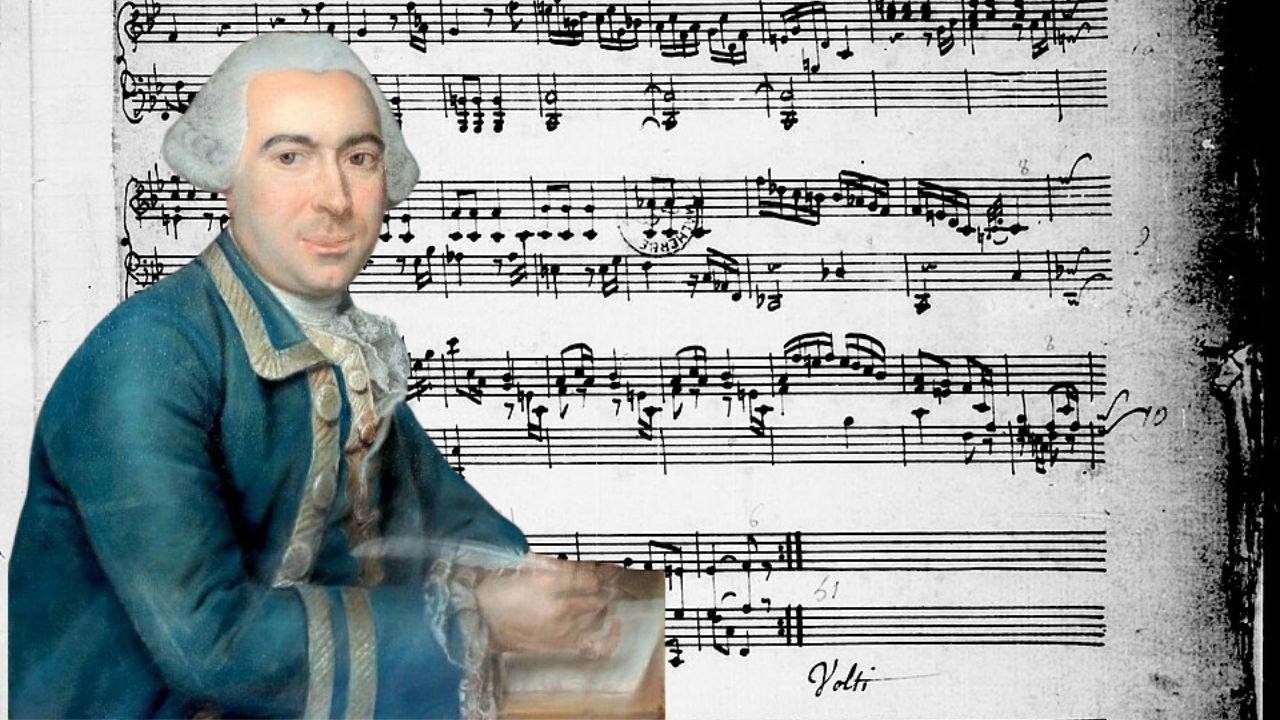
Louis Couperin (c. 1626–1661) is one of the most consequential names in the early history of French keyboard music—yet he remains, for many listeners, a shadow behind the later celebrity of his nephew François Couperin “le Grand.” In the span of a short life during the reign of Louis XIV, Louis Couperin helped define the sound-world of the French Baroque: the unmeasured prelude with its improvisatory freedom, the refined dance suite shaped by courtly culture, and the organ style that resonated through Parisian churches. To understand him is to stand at the moment when French keyboard writing began to look unmistakably French—ornamented, rhetorical, and architecturally poised.
Louis Couperin in the World of Seventeenth-Century France
Louis Couperin was born in the eastern Paris town of Chaumes-en-Brie during a troubled, but fertile century of Wars of Religion that gave way to consolidation of royal authority by Louis XIV (r. 1643–1715). Paris, the musical center of the time, contained the churches, salons, and the court that, among other things, gave rise to expectations of keyboard music: religious service, entertainment of royalty and its entourage, and promotion of status and prestige.
Can You Name the Masterpiece?
Ten masterpieces. Ten questions. How well do you know the history of art?
The most important of the influential musicians in Couperin‘s formative years was the legendary harpsichordist and organist Jacques Champion de Chambonnieres. While we have no definitive proof, contemporary sources credit Chambonnieres with being Couperin‘s patron and mentor, which is significant: it places Louis Couperin at the centre of the nascent French harpsichord school, focused on the elegance and embellishments derived from dance music. According to David Fuller (in ‘Louis Couperin’ entries in Grove Music Online), this group ‘formulated a French keyboard idiom that would characterize French taste throughout Europe’.
Louis Couperin was active as a musician in Paris from the early 1650s onward. Parisian society had a rich array of establishments that could afford to support organ and harpsichord performers of exceptional caliber, from parish churches and aristocratic hotels particuliers to chapels connected with the court. Louis worked as an organist at St-Gervais in Paris, a church that would become indelibly associated with the Couperin name for decades to come. This institutional succession is noteworthy for historical reasons: St-Gervais can be viewed as a dynastic, musical position, central to the Couperins’ pre-eminence in the capital‘s sacred-music life.
The Harpsichord Works: Unmeasured Preludes and Dance Suites
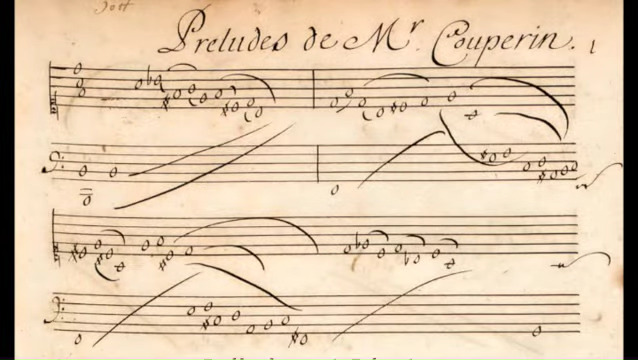
Louis Couperin is most celebrated for his harpsichord works, notably the “unmeasured” preludes. (French: preludes nonmesures) They are characterized by a nearly total lack of bar lines, giving the listener a sense that they are being improvised upon, spoken, breathed. This reflects the French Baroque interest in rhetoric and “declamation” in music. “The preludes,” as our modern analysts often declare, “are considered among the first and most remarkable of the genre”.
Can You Guess the Artist?
Three clues. One artist. How quickly can you identify the painter?
The individual dances of his suites allemandes, courantes, sarabandes, gigues are social music of the French court and its attendant dancing school scene. This wasn‘t “light music” in French court culture; this was an expression of class and decorum, and Frenchness. Couperin‘s suites demonstrate a composer concerned with scale and character, developing chains of dances that evolve from the most intimate to the most dazzling, with a logical key structure.
The acoustic and social environment of the harpsichord are central to appreciating him. The instruments and decorative arts of this world are on display in the great museums. Both the Met and the Victoria and Albert have fine harpsichords and other keyboard instruments from the general Baroque era, serving as touchstones for how the music sounded namely, in spaces where the visual and sonic cultures were joined. As the V&A‘s collection and scholarship document, keyboards were first and foremost utilitarian and showy objects to suit the tastes that Couperin addressed.
The Organ Legacy: Parisian Churches and Liturgical Craft
While Couperin‘s harpsichord pieces are more familiar, his organ music belongs to the parallel, essential, world of Paris‘s Catholic liturgy in the seventeenth century. Organists had to improvise, and had to offer alternatim verses alternating chanted verses with organ settings throughout the Mass and the Office. The underlying skill, in Couperin‘s unmeasured preludes, is that which characterized these liturgical improvisation: freedom, ornament, and resonance with great stone halls.
The Church of Saint-Gervais, in the Marais, was not just a parish church it was also a major musical stage. French organ culture at this time with its famous organs, fierce rivalry between musicians and an educated lay and religious audience provided context for this musical work. The context is important here: the organist is a public musical figure. He must protect and extend the tradition and at the same time be innovative.
The material culture associated with French sacred music paintings, ritual objects, architecture, and the way all those things influenced sonority are explored by larger institutions like The Louvre Museum and the Smithsonian Institution, providing a window into the visual and performative life of the French Baroque and the broader European tradition, respectively. Such institutions give readers a way to understand Couperin‘s music as part of a full sonic and sensory world, not as disembodied compositions: his pieces were lived in, accompanied, and sustained.
Influence, Sources, and Why Louis Couperin Still Matters
Louis Couperin’s surviving output is preserved largely through manuscripts rather than author-supervised prints, a common situation for mid-seventeenth-century keyboard composers. This has made source study central to Couperin scholarship: identifying scribal hands, reconstructing ornament signs, and comparing concordances. The very fragility of transmission—music carried by manuscript copying—underscores why his reputation depends on careful musicology.
His influence is both direct and stylistic. Directly, the Couperin family’s association with Saint-Gervais created a lineage culminating in François Couperin (1668–1733), who would publish widely and become internationally known. Stylistically, Louis Couperin helped establish the expressive vocabulary later refined by composers such as Jean-Henri d’Anglebert and, in a different national idiom, admired abroad by figures who sought “French taste.” In this sense, Louis Couperin stands at the fountainhead of a European conversation about elegance, ornament, and the art of timing.
Authoritative scholarship consistently positions him as foundational. Grove Music Online (Oxford University Press) describes him as a key figure in the development of the French harpsichord style and an early master of the unmeasured prelude tradition. Harpsichordist and scholar Gustav Leonhardt—one of the twentieth century’s most influential early music authorities—famously argued for the primacy of style and rhetoric in French keyboard performance; his recordings and writings (widely cited in conservatory contexts) reinforced the idea that Couperin’s music must be “spoken,” not merely executed. Such perspectives help explain why Couperin remains essential repertoire in historically informed performance programs today.
Table: Key Characteristics of Louis Couperin’s Keyboard Art
| Aspect | What it looks/sounds like | Why it matters historically |
|---|---|---|
| Unmeasured preludes | Free rhythm, few bar lines, improvisatory pacing | Early landmark of a distinctly French rhetorical keyboard style |
| Dance suites | Allemande, courante, sarabande, gigue; elegant ornamentation | Mirrors court culture under Louis XIV and codifies “French taste” |
| Ornamentation | Trills, mordents, agréments implied by style and signs | Sets performance expectations later formalized by François Couperin |
| Organ practice | Liturgical versatility, improvisatory craft | Connects French keyboard style to church institutions like Saint-Gervais |
| Manuscript transmission | Works preserved in copied sources | Makes scholarship and critical editions central to modern understanding |
Frequently Asked Questions (FAQ)
What period does Louis Couperin belong to?
He belongs to the mid-seventeenth century, at the start of the mature French Baroque, overlapping with the early reign of Louis XIV and the flourishing of French court culture in and around Paris and Versailles.
Is Louis Couperin related to François Couperin?
Yes. Louis Couperin was the uncle of François Couperin “le Grand.” Louis helped establish the family’s Parisian reputation, particularly through the Saint-Gervais organist post.
What is an “unmeasured prelude,” and why is Couperin important for it?
An unmeasured prelude is a keyboard piece notated with minimal rhythmic prescription, inviting flexible timing. Louis Couperin is among the earliest major composers to write masterpieces in this genre, shaping how later French composers approached improvisatory notation.
Where can I study the instruments and art culture connected to his music?
Major museums provide relevant context: the Metropolitan Museum of Art and the Victoria and Albert Museum hold important keyboard instruments and decorative arts; the Louvre Museum preserves visual culture of the French Baroque; the Smithsonian Institution offers educational resources on instruments and historical performance contexts.
What are the best authoritative sources on Louis Couperin?
Start with Grove Music Online (Oxford University Press) for vetted scholarship and bibliographies. For performance practice, consult reputable critical editions and writings by leading early music scholars and performers (often housed in conservatory libraries and university music departments).
Conclusion
But Louis Couperin‘s success was not just as the composer of some charming pieces; it was in being an inventor of a language, which would bring together the Parisian churches, the aristocratic balls, and the French sensitivity for stylistic finery in one keyboard tradition. Even with the accustomed ear, his preludes and suites continue to have an edge. It‘s the tension between form and freedom, privacy and performance, that gives him lasting power in Baroque history.
Authoritative sources referenced: Grove Music Online (Oxford University Press); collection and research resources from The Metropolitan Museum of Art, the Victoria and Albert Museum, the Louvre Museum, and the Smithsonian Institution.
AI Notice: Some visual content in this article may have been created or enhanced using artificial intelligence (AI) for artistic, editorial or illustrative purposes. Learn more about our approach in our AI & Editorial Principles.