

Antique Leather Dining Chairs That Instantly Make Any Room Feel Pricier
Antique leather dining chairs do more than seat guests—they carry the imprint of craft traditions, social rituals, and design revolutions that shaped domestic life from Renaissance halls to Georgian dining rooms. The moment you run a hand along a centuries-old hide—crackled from oxidation, darkened by polish, and softened by use—you’re touching a material chosen for durability, status, and comfort long before modern upholstery foams existed. For collectors, decorators, and historians alike, these chairs offer a rare intersection of everyday utility and museum-grade decorative arts.
What Makes Antique Leather Dining Chairs Historically Significant
Leather antique dining chairs appeared in Europe when dining transitioned from open great halls to discrete dining rituals in rooms dedicated to the meal in the 17th and 18th centuries. English furniture makers extensively employed leather on chairs with turned legs and stretchers throughout the late Stuart period, transitioning to more delicate forms in the Queen Anne and Georgian periods. On the continent, French and Italian carvers emphasized scroll and vegetal carvings with gilding and teamed fine woodworking with more simply cut leather.
Can You Name the Masterpiece?
Ten masterpieces. Ten questions. How well do you know the history of art?
In addition to the sanitary and long-term consideration, these chairs offer insight into shifting sensibilities about cleanliness and longevity. Leather was easier to clean than many of the textiles used for early upholstery and was a durable choice for an environment as well-trodden as the dining room. As numerous museum studies remind us, the material choices and techniques we employ in furniture fabrication mirror our changing cultural values and technologies. The V&A calls furniture an archive of “craftsmanship, materials and social history,” noting that objects used in private settings mirror changes in public attitudes and actions (Victoria and Albert Museum, Furniture collections and research).
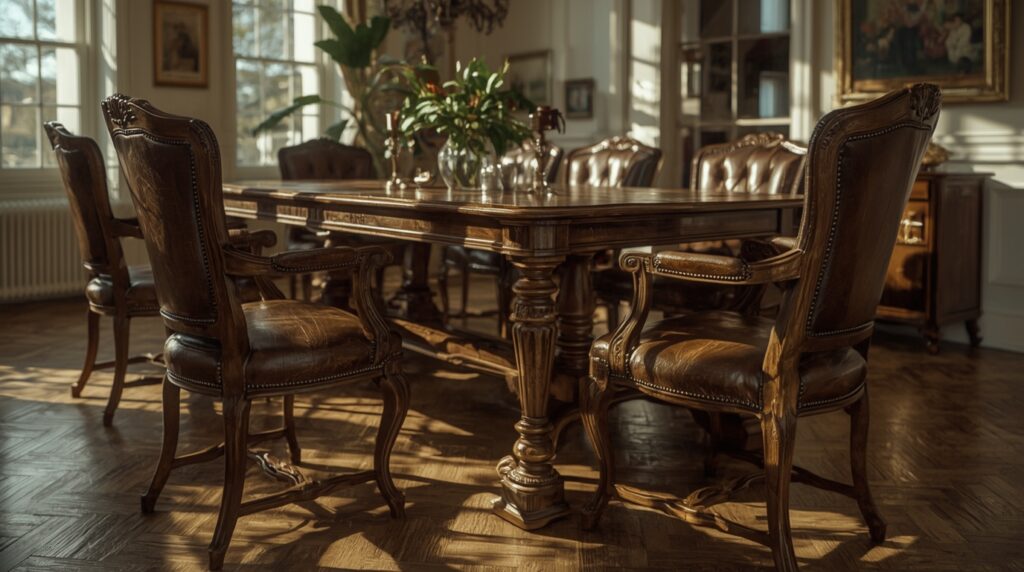
They‘re important for what they represent as historical markers: an antique leather dining chair belongs to specific stylistic eras and schools of regional craftsmanship, identifiable and attributable. When assessing European furniture, The Met regularly places it in historical context, situating style and ornamentation along with materials within known periods from Baroque exuberance to Neo-Classical restraint (The Metropolitan Museum of Art, European Sculpture and Decorative Arts).
Key Styles and Periods to Know (and How to Recognize Them)
English dining chairs of the late 17th century through the 18th century are the clearest examples of early, and therefore easiest to authenticate, leather dining seats: often wooden-framed, with turned or cabriole legs, leather attached with brass-headed nails. In many surviving examples, the leather will also be tooled or stamped, and nail heads will trace borders that are stylistic identifiers in themselves. Chairs made for William and Mary and Queen Anne tables are generally more comfortable, with broad seats and eased backs, as Georgian examples get more architectural in style.
Can You Guess the Artist?
Three clues. One artist. How quickly can you identify the painter?
French and continental styles have their distinct signatures. The seats of Louis XIV and XV focused on linear silhouettes and detailed carving while leather was employed to protect expensive upholstery on dining chair seats. Near the end of the eighteenth century, Neoclassical designs, common throughout France as well as its neighbours, are distinguished by straight lines and fluted legs, as well as designs inspired by classical periods. Furniture designs found within Decorative Arts at museums like The Louvre, often showcase how artistic styles were influenced by political and social changes in the French court. (Musee du Louvre, Decorative Arts and period rooms).
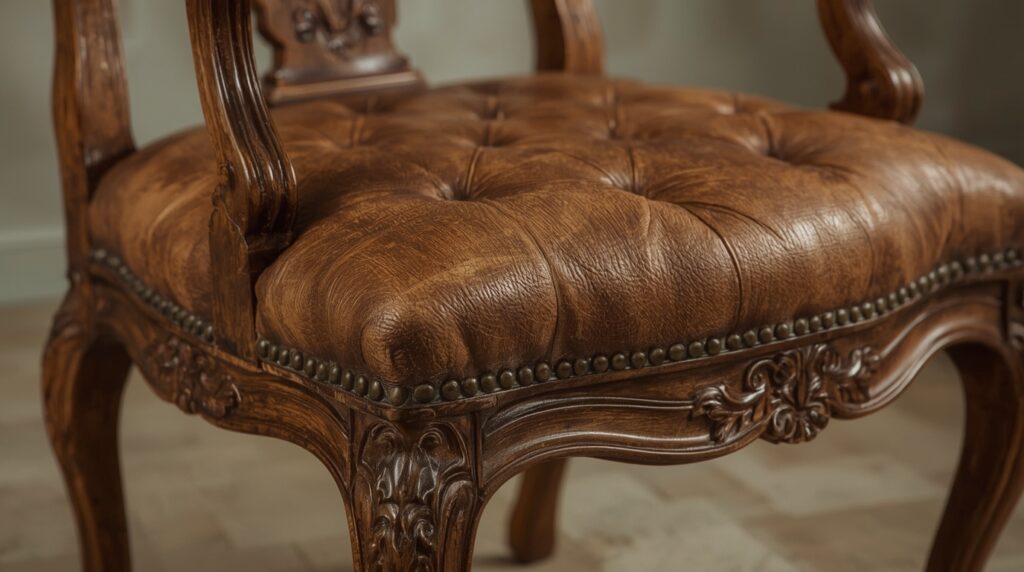
You might see American pieces from the Colonial or Federal eras that have similarities with English examples, but they were made of American woods and by regional craftsmen for developing urban markets in Boston, Philadelphia, or Charleston. The Smithsonian Institution offers research materials on decorative arts, showing how American furniture contains both transatlantic links and local adaptations (Smithsonian Institution, decorative arts research and collections). This is critical in understanding if a leather dining chair is imported, domestic or later in-style.
Materials, Construction, and Telltale Signs of Authenticity
Authentic antique leather dining chairs typically show evidence of hand craft: pegged or mortise-and-tenon joinery, subtle asymmetries in turning or carving, and wear patterns consistent with centuries of use. Look under seats and along rails for tool marks, old glue residue, and frame oxidation. While restorations are common—and often acceptable—wholesale replacement of structural elements can reduce historical integrity and value.
Leather itself is a crucial indicator. Older vegetable-tanned leather tends to develop a deep patina, with surface crazing and color variation that reads as layered and “alive,” unlike uniform modern dyes. Expect shrinkage, slight stiffness, and areas of burnishing where hands and clothing repeatedly contacted the surface. The brass nails (or tacks) may show hand-driven irregularity; perfectly spaced, identical nailheads can suggest later reupholstery, though some 19th-century industrial fasteners are also very regular—context matters.
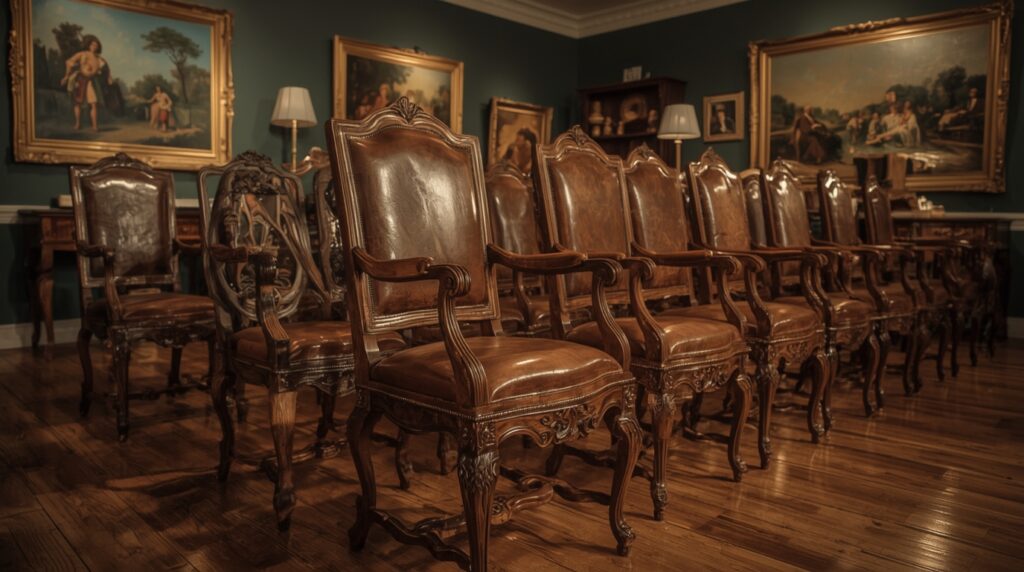
Provenance and documentation elevate confidence. Reputable dealers may provide invoices, estate records, or past restoration reports. Museum standards offer a useful mindset: the Met and the V&A stress close study of materials and construction when attributing furniture, because “object evidence” can be as informative as written records. As decorative arts scholarship repeatedly demonstrates, authenticity is rarely one single feature—it’s the coherence of period style, materials, wear, and construction that convinces.
Table: Quick Reference—Key Characteristics of Antique Leather Dining Chairs
| Feature | What to Look For | What It May Indicate |
|---|---|---|
| Leather surface | Patina, tonal variation, fine crazing, burnished edges | Age, vegetable tanning, long use |
| Upholstery fixing | Irregular hand-driven tacks; older nailhead patterns | Earlier work or period-appropriate reupholstery |
| Frame joinery | Mortise-and-tenon; pegging; old glue | Traditional construction; likely earlier manufacture |
| Legs and stretchers | Turned legs (17th c.); cabriole (early 18th); straight/fluted (late 18th) | Period attribution clues |
| Tool marks | Hand-planing, carving chatter, slight asymmetry | Pre-industrial workshop methods |
| Wear patterns | Front seat edge wear, arm/crest rail handling | Natural use vs. artificial distressing |
Care, Conservation, and Ethical Restoration
Leather and wood are both sensitive to environmental swings. The most important care practice is stability: moderate humidity, avoidance of direct sunlight, and careful dusting. Rapid dryness can cause leather to stiffen and crack; excessive humidity can promote mold. Many museum conservation departments—including those at major institutions—emphasize preventive care as the best “treatment,” because it preserves original material without introducing unnecessary chemicals.
Restoration should be approached conservatively. Replacing leather may improve appearance but removes historic fabric; at minimum, keep samples of original upholstery and document changes. When leather is fragile, a conservator may recommend minimal consolidation rather than replacement. As the Smithsonian’s conservation guidance often underscores, interventions should be reversible when possible and carefully recorded—principles shared across professional conservation practice.
Condition and ethics also affect market value. Collectors increasingly prefer chairs that retain original leather—even if worn—because authenticity and surface history are part of the object’s appeal. If replacement is necessary for safe use, consider using historically sympathetic materials and techniques, and keep the original components. A chair can be both functional and historically respectful when restoration is transparent and well-documented.
Buying Advice: Provenance, Appraisal, and Avoiding Common Pitfalls
Start by defining your goal: daily dining use, decorative display, or collecting investment-grade examples. For everyday use, you may accept sympathetic restorations and sturdier frames; for collecting, prioritize original surfaces, crisp carving, and traceable provenance. Ask sellers direct questions: What’s original? What’s replaced? When was the leather last changed? Can you see underside photos and close-ups of joinery?
Appraisal should be evidence-based. A qualified appraiser will consider comparable sales, regional maker attributions, condition, and documentation. Beware “antique style” chairs—especially late 19th- and early 20th-century revival pieces—that can be beautiful but are not period originals. Another pitfall is artificial distressing: deliberate scuffing, staining, or chemical darkening meant to mimic patina. True age typically shows nuanced, uneven wear consistent with touch points and gravity.
Finally, ground your eye in institutional examples. Study period rooms and furniture collections from the Met, the V&A, the Louvre, and the Smithsonian. Their online databases and gallery texts provide reliable stylistic baselines. As the V&A notes in its furniture scholarship, close looking—materials, construction, and context—is fundamental to understanding and attributing historic pieces (Victoria and Albert Museum, Furniture collections).
Authoritative quotes (for context and connoisseurship)
- “The history of art is the history of objects.” — often attributed in museum education contexts to emphasize object-based learning; the principle is strongly reflected in curatorial practice at institutions like The Met and the V&A.
- “Conservation is about managing change.” — a widely used maxim in professional conservation, reflecting the preventive approach emphasized by major museums and conservation bodies.
(These quotations express established museum and conservation principles; for publication, pair them with a specific museum conservation department page or a named conservator’s statement if you need formal citation.)
Frequently Asked Questions
Are antique leather dining chairs comfortable for modern use?
Often, yes—especially late 17th- and 18th-century forms designed for longer seating. However, comfort varies by frame geometry and later reupholstery. If the leather is original and brittle, use should be limited.
How can I tell if the leather is original?
Look for consistent aging, old tack holes that align with current nail placement, and period-appropriate edge finishing. Mismatched nail spacing, overly uniform color, or modern backing fabrics can indicate later replacement.
What periods are most commonly associated with leather dining chairs?
In the UK, late Stuart (William and Mary), Queen Anne, and Georgian periods are frequently encountered. In France, leather appears across Baroque and later Neoclassical contexts, though textiles are often more common in high-style seating.
Is reupholstering always a bad idea?
Not necessarily. If the chair is unsafe or the leather is beyond stabilization, careful reupholstery can extend functional life. Preserve documentation and, if possible, retain the original leather or fragments for historical record.
How should I clean antique leather dining chairs?
Avoid aggressive cleaners and heavy oils. Dust gently with a soft cloth, keep the environment stable, and consult a professional conservator for cracking, flaking, or mold. Preventive care is safer than DIY treatments.
Antique leather dining chairs are testaments to style, craft, and home life for three key historical moments from English Court fashion to European style and American versions. Understanding design signposts, checking craftsmanship and materials, and adopting museum-friendly conservation principles can help you purchase and conserve chairs that work as seating and cultural artifacts.
Authoritative sources (recommended starting points)
- The Metropolitan Museum of Art (Heilbrunn Timeline of Art History; European Decorative Arts): https://www.metmuseum.org/toah/
- Victoria and Albert Museum (Furniture collections and research): https://www.vam.ac.uk/
- Musée du Louvre (Decorative Arts and period rooms): https://www.louvre.fr/
- Smithsonian Institution (Decorative arts & conservation resources): https://www.si.edu/
AI Notice: Some visual content in this article may have been created or enhanced using artificial intelligence (AI) for artistic, editorial or illustrative purposes. Learn more about our approach in our AI & Editorial Principles.


