

This Antique Oak Console Table Trick Makes Any Entryway Look Expensive
An antique oak console table can transform a room in a way few furnishings can: it adds architectural presence, historical depth, and a tactile reminder of pre-industrial craftsmanship. Unlike trend-driven pieces, an authentic antique console table carries the marks of time—tool traces, subtle shrinkage, softened edges, and a patina that cannot be manufactured convincingly. For collectors and practical homeowners alike, oak consoles sit at a compelling intersection of durability, decorative artistry, and cultural history, echoing centuries of European and Anglo-American interior design.
What Defines an Antique Oak Console Table?
An antique oak console table is one of the kind of narrow, wall-hugging display tables, once intended for a grand entry hall or the rooms of a salon or gallery, that made a statement and was furnished to produce a designated “arrival” space (with mirror, busts, clock and light). Console tables gained importance as rooms in European houses became more formalized and defined in space particularly from the late 17th century and furniture took a greater role in the performance of hospitality.
Can You Name the Masterpiece?
Ten masterpieces. Ten questions. How well do you know the history of art?
According to strict trade definitions, “antique” really means 100 or older, but the value of an antique piece is measured by much more than its age. Proportions, wood, joinery techniques, surfaces, and provenance all come into play. Oak is one of the best woods to judge by age, because the ways it develops over time (its coloring, the heightened grain patterns visible beneath old finishes, and the use of historical construction methods like peg mortise and tenon) are quite specific.
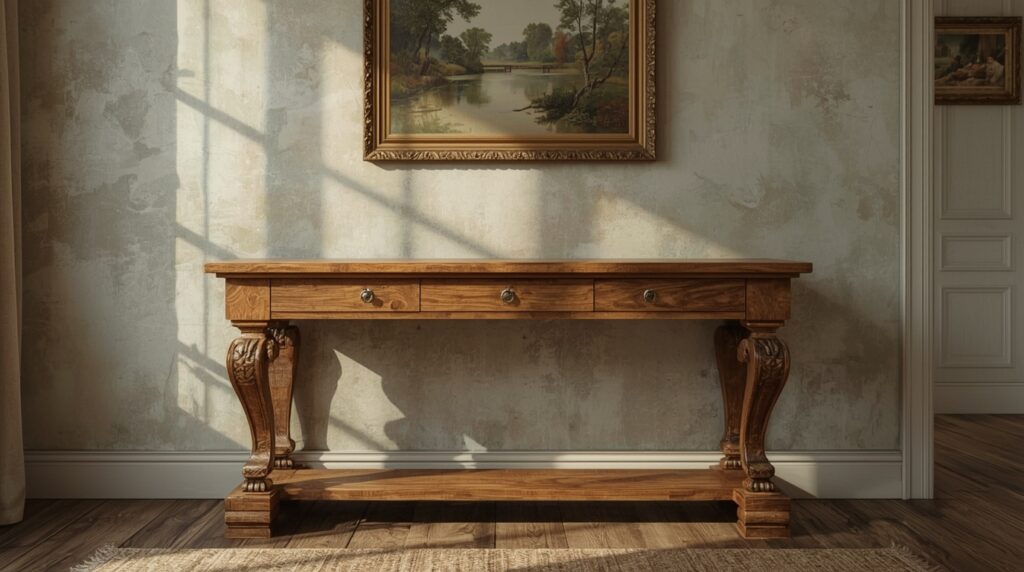
Consoles in museums collections remind us consoles were never simple utility pieces. They were artifacts of culture. Consoles were decorative pieces with status significance that made their way into aristocratic residences as showcased in collections at The Metropolitan Museum of Art and the Victoria and Albert Museum (V&A). The V&A writes in its furniture literature that “furniture reflects changing fashions, technologies and social habits” which is helpful when thinking about changes in console form and ornament over centuries.
References: V&A Collections & Furniture research; The Met Collection (European furniture).
Historical Periods and Styles: Where Oak Console Tables Come From
Can You Guess the Artist?
Three clues. One artist. How quickly can you identify the painter?
French consoles would most often occupy the space beneath mirrors, set against ornate gilded boiserie panels. Some of the more prominent types of consoles, in fact, were developed in France in the age of Louis XIV (1643–1715), and through the Regence and Louis XV eras. French furniture in particular in the court favored walnut and giltwood. Oak was also commonly used, particularly in Northern Europe and for structural use, as it was durable and relatively abundant.
As for Britain, oak has a lengthy history associated with the country‘s construction practices and timber availability. Oak furniture was quite prevalent from the Tudor and Elizabethian periods up through various revivals. Initially oak examples mostly consisted of tables and chests but evolved with the Georgian period (1714–1830) as hall furniture became fashionable and designers emphasized symmetry in room layout. British oak examples may incorporate limited carving, turned legs, or neoclassical ornamentation.
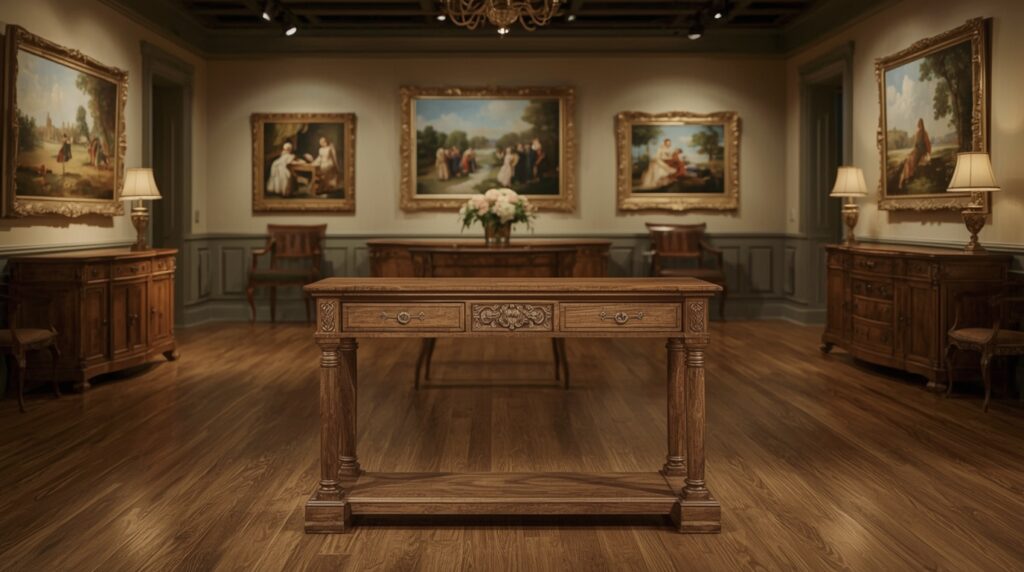
In the United States, the narrative typically centers on the late 18th and 19th centuries, when American artisans reinterpreted European designs. By the Federal period (c. 1780–1830) and later Victorian eras, pier and hall tables, consoles in style, were increasingly seen, occasionally made of oak in the late-19th-century oak revival. Museums like the Smithsonian Institution place the furniture in a broader historical context, charting how design trends were shaped by an influx of people to cities and shifting notions of home life: entryways became performance spaces that proclaimed social standing and taste.
Collections and studies of decorative arts; The Met Collection; V&A Collections; Smithsonian Collections
Craftsmanship and Materials: How to Recognize Quality Oak
The best antique oak console tables reveal craft in both what you see and what you don’t. Look underneath: authentic antiques often show hand-planed surfaces, uneven saw marks, older screw types, or pegged joints. Drawers (if present) may use dovetail joinery that varies slightly from corner to corner—precision without modern uniformity. In contrast, perfectly identical machine-cut dovetails and uniformly milled boards can suggest later manufacture or heavy restoration.
Oak itself offers clues. Mature European oak tends to have prominent medullary rays (flecking) visible on quarter-sawn surfaces—an effect prized in certain periods and later in Arts and Crafts furniture. Patina should read as layered and coherent: wear at edges and touchpoints, darker coloration around handles, and subtle oxidation in recesses. Over-sanded surfaces, overly sharp edges, or an aggressively “antiqued” finish may indicate refinishing intended to simulate age.
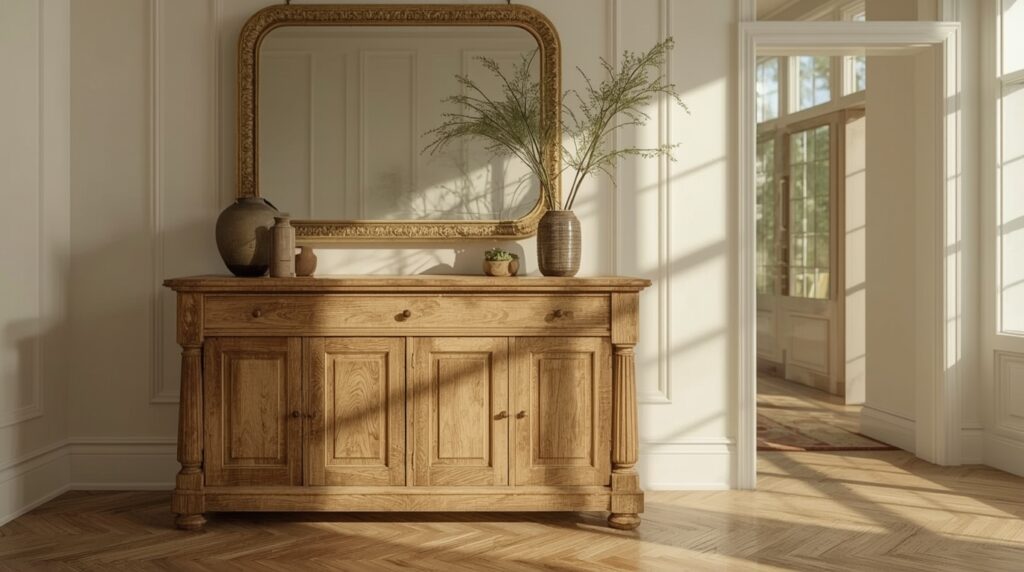
Museum guidance supports this material-focused approach. As furniture curators often emphasize, construction and surface are core evidence. The Metropolitan Museum of Art and the Louvre Museum both present period furniture where toolwork, joinery, and finish are integral to attribution and dating—reminding buyers that “style” alone is not proof. In the words of the Smithsonian (in its public-facing decorative arts interpretation), objects are best understood through “materials, making, and meaning”—a framework that applies directly to evaluating antique oak.
Sources: The Met and Louvre collections databases; Smithsonian decorative arts interpretation materials.
Buying and Caring for an Antique Oak Console Table
Before purchasing, prioritize provenance and documentation. Reputable dealers provide condition reports, detailed photos of joints and underside, and clear statements about restorations. If possible, seek pieces with a paper trail: prior auction records, collection labels, or references to known workshops. When spending significantly, consider an appraisal by an accredited professional (for example, those affiliated with major professional appraisal organizations), especially for insurance.
Condition assessment should be practical and honest. Old repairs are normal; what matters is whether they are stable and disclosed. Check for woodworm evidence (historic exit holes are not uncommon in old oak), splits from movement, and wobble in the frame. A console table is often a “working” piece—keys, lamps, ceramics—so stability is essential. Also confirm whether a marble top (if present) is original to the base; mismatched tops are common.
For care, keep oak away from radiators and intense sunlight, and maintain steady humidity when possible. Clean gently with a soft cloth; avoid silicone sprays that complicate future conservation. If the piece is historically significant, consult a conservator rather than a general refinisher—museums such as the V&A and the Met follow conservation principles that favor minimal intervention and respect for original surfaces. As the conservation field commonly stresses, original surface is historical evidence, not just “finish.”
Sources: V&A conservation approach (public materials); Met conservation department resources (public materials).
Key Characteristics at a Glance
| Feature | What to Look For | Why It Matters |
|---|---|---|
| Wood & grain | European/English oak with visible ray fleck (often on quarter-sawn boards) | Supports period-appropriate material and quality |
| Joinery | Pegged mortise-and-tenon, variable hand-cut dovetails | Indicates pre-industrial or early workshop methods |
| Surface/patina | Layered wear at touchpoints, oxidation in recesses | Hard to fake convincingly; helps confirm age |
| Style markers | Legs, carving, frieze design aligned to Georgian, Louis XIV/XV, Victorian, Arts & Crafts | Helps date and place the piece culturally |
| Provenance | Dealer documentation, labels, auction references | Strengthens authenticity and value |
| Restoration | Disclosed repairs, stable structure, non-invasive conservation | Impacts longevity, value, and historical integrity |
Frequently Asked Questions
1) How old does a console table need to be to count as “antique”?
In many markets, 100 years is the common threshold, though some dealers use “antique” more loosely. Serious evaluation considers construction, surface, and provenance—not just an age claim.
2) Are antique oak console tables always European?
No. While many are European (French, British, Flemish), American and other regional traditions produced oak hall and pier tables, particularly in the 19th century and later revival movements.
3) Is refinishing always a bad idea?
Not always, but it can reduce value—especially if it removes original patina. For higher-value pieces, follow a conservation mindset: minimal intervention, reversible treatments when possible, and professional advice.
4) How can I tell if parts were replaced?
Look for mismatched wood color, inconsistent tool marks, modern screws, or joints that don’t match the rest of the construction. A blacklight inspection can sometimes reveal finish discrepancies, but expert assessment is best for expensive purchases.
5) What is the best placement for a console table at home?
Traditionally: entry halls, landings, and dining room walls. Use felt under decor, avoid direct heat, and keep heavy items centered over strong supports.
When we talk about choosing a vintage oak console table we are talking about something else. Something far more than an object you can set down on we are talking about something with a history to own. To own a part of design history dictated by the manners of European courts, Georgian hallways and the domestic life that evolved through time. From studying the grain, patina, construction and warmth of the timber, anchoring your home to the taste and time scales laid down by The V&A, The Met, the LOUVRE and The Smithsonian your console table will have a story to tell that never fades.
AI Notice: Some visual content in this article may have been created or enhanced using artificial intelligence (AI) for artistic, editorial or illustrative purposes. Learn more about our approach in our AI & Editorial Principles.


