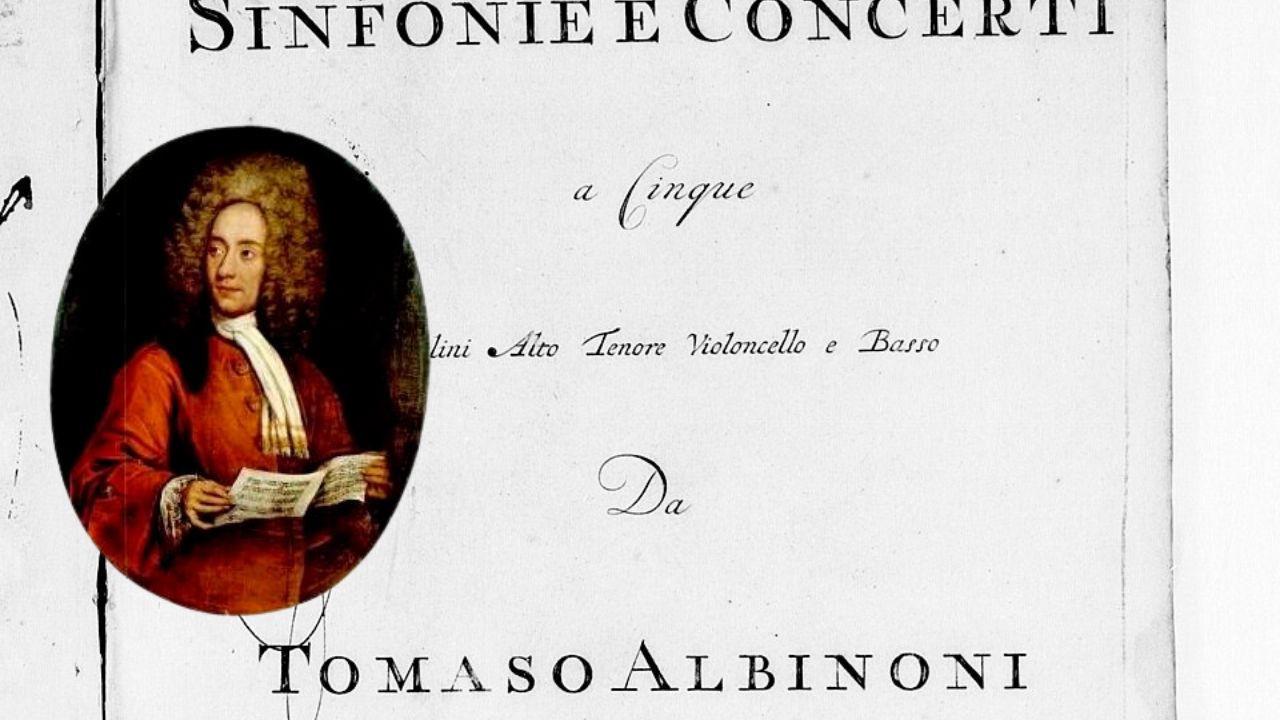
It‘s difficult to imagine any piece of music, or even art in general, that‘s gone so far on so little credible information. In a film scene, a memorial service or the concert hall concert stage, Tomaso Albinoni‘s famous “Adagio in G minor” or “Adagio in G” is the standard emblem of the Baroque drama. But the story of the Adagio in G isn‘t one of Venetian ability; it‘s one of creative death, 20th-century musical archaeology and the remembrance of European art.
Albinoni in Baroque Venice: Composer, City, and Style
Tomaso Albinoni (1671–1751) worked in Venice during the late Baroque period, a time when the city was both a commercial powerhouse and a musical laboratory. Venice’s opera houses, churches, and aristocratic salons supported a thriving culture of instrumental and vocal composition. Albinoni was not an obscure figure in his lifetime: his works circulated widely, and his instrumental writing influenced later composers, including Johann Sebastian Bach, who studied Italian concerto style closely.
Can You Name the Masterpiece?
Ten masterpieces. Ten questions. How well do you know the history of art?
Albinoni’s career also reflects the professional realities of Italian composers in the late 17th and early 18th centuries. Unlike court-employed Kapellmeisters in German lands, Venetian composers often relied on publication, patronage, and commissions. Albinoni published collections of sonatas and concertos, contributing to the era’s flourishing print culture—one of the reasons his name remained visible to later scholars even when some manuscripts disappeared.
Stylistically, Albinoni is associated with clear melodic lines, balanced phrasing, and expressive harmony—traits that fit modern listeners’ expectations of “Baroque elegance.” But it’s important not to project the Adagio in G minor backward as a definitive representation of his authentic output. Many surviving Albinoni works are brighter, more ritornello-driven, and structurally aligned with the concerto and trio sonata traditions. That difference is one reason the Adagio in G attribution has long attracted scrutiny.
“Adagio in G Minor”: What It Is—and Why Attribution Is Disputed
It was not an unbroken Baroque lineage, but in the 20th century the Adagio in G minor entered the concert hall by way of musicology. In 1958, an Italian musicologist Remo Giazotto (1910–1998) published a version based on what he maintained was an Albinoni fragment in Dresden. A war; salvaged music; a learned man‘s rescue of it from oblivion! A tale you‘d write yourself during the postwar period.
Can You Guess the Artist?
Three clues. One artist. How quickly can you identify the painter?
Giazotto himself referred to the piece as a reconstruction: the starting point was a brief bass line and some melodic phrases. As it turns out, the full Adagio, complete with its harmonic rhythm and expansive suspension and a finale that feels very much of the 20th century in its grandeur, doesn‘t sound much like a Baroque slow movement. As such, many view it as “Albinoni/Giazotto”, while others call it directly as a modern piece with questionable ties to Albinoni.
Musicological reference works have given us a hint, widely and oft-cited: “New Grove Dictionary of Music and Musicians (which is the bible, basically) says that the lovely Adagio is attributed to Giazotto and ‘can‘t safely be claimed for Albinoni as his published sonatas and concertos can be.’ This doesn‘t mean it‘s not wonderful music, it just means that the assertion is not as solid as it appears,” say the same words in their guiding light of the practice of history, “extraordinary attributions require ordinary evidence”: a paper trail, an identifiable manuscript and, as they say, “a known chain of custody.
Archives, War, and Museums: Why Provenance Matters
Let‘s take a look at the eventual fame and ongoing skepticism of an attribution through the eyes of a curator or an archivist. Museums and research libraries demand provenance proof of ownership, the provenance of sale and the story of its origins to protect the historical record. According to the Smithsonian Institution, “Provenance is critical in interpreting and understanding a cultural object. Without a proven provenance, its history becomes subject to assumption.” Musical manuscripts are no exception.
Giazotto said that his sonata had been acquired by a monastery in Dresden which is a plausible destination for one thing, it was the location of the Saxon State and University Library, which held enormous historical music archives, and for another, Dresden was bombed heavily in WWII but plausibility does not equate to evidence. In art history, a work would be classified as the “workshop of master”, at best. Libraries, such as the Met, have written extensive essays on authentication, to remind us in the strongest of public terms that documentation can only come from corroborating evidence stylistic, technical and archival to get it right. If we fail to do our homework, our errors might persist for centuries.
I believe the larger lesson to be drawn from this anecdote, though, is the sometimes comedically fragile nature of cultural artifacts in the face of conflict and displacement. The Louvre, the Victoria and Albert, the Met all have published on their own work (in disparate contexts) in preserving, cataloguing and researching artifacts whose provenance has been fragmented by war, collecting habits, or sheer bad record-keeping. In music, however, where a single lost piece of manuscript can erase the verified history of a composition entirely, the role of solid provenance is even more critically important. The Adagio in G, itself, sits squarely in the gray space of what constitutes “authentically Baroque” and what can be documented.
Listening Guide and Musical Characteristics (Why It Works)
Whatever its origin, the Adagio in G minor has a sonic architecture that listeners instantly recognize. It unfolds slowly over a repeating harmonic foundation (often realized by organ and strings), building intensity through suspensions—those aching moments where one note “leans” into the next and resolves late. This technique is thoroughly consistent with Baroque expressive practice, even if the overall shape feels closer to modern cinematic pacing.
The work’s emotional effect also depends on orchestration choices made by performers and arrangers. Many versions use lush string writing, sustained organ chords, and a broad dynamic arc. These elements amplify the sense of solemn ceremony, which is why the piece appears so frequently in memorial contexts. In that respect, the Adagio functions like a modern lament built with Baroque materials: steady pulse, carefully controlled dissonance, and a long crescendo of tension and release.
Finally, the Adagio persists because it is performable, teachable, and adaptable. Unlike some historically complex Baroque works requiring specialized knowledge of period instruments and ornamentation, this piece translates easily to modern ensembles and recordings. It has become a cultural “signal” for grief and gravity—less a document from 18th‑century Venice than a shared modern language shaped by 20th‑century publication and performance.
Key Characteristics at a Glance
| Aspect | What you’ll typically hear | Why it matters |
|---|---|---|
| Attribution | Often labeled “Albinoni,” frequently “Albinoni/Giazotto” | Reflects unresolved authorship questions |
| Period style | Baroque-like harmony, suspensions, slow tread | Creates an “old-world” expressive aura |
| Texture | Melody over chordal accompaniment (organ/strings) | Supports sustained, elegiac intensity |
| Form | Broad, gradual build rather than short Baroque movement | Contributes to cinematic emotional arc |
| Cultural use | Films, funerals, commemorations | Reinforces public association with mourning |
Frequently Asked Questions
1) Did Tomaso Albinoni really compose the Adagio in G minor?
The authorship is disputed. The version known today was published by Remo Giazotto in 1958 and is not securely documented as a fully authentic Albinoni work in the way Albinoni’s published collections are.
2) What exactly did Giazotto claim to have found?
Giazotto reported that he reconstructed the piece from a fragment attributed to Albinoni, allegedly located in Dresden. The complete chain of evidence has not been consistently available for independent verification.
3) Why is the piece still performed if attribution is uncertain?
Because it is musically effective and emotionally compelling. Many performers and presenters program it transparently as “Albinoni/Giazotto” or “attributed to Albinoni,” acknowledging the history while valuing the work itself.
4) Is the Adagio “Baroque music” or “modern music”?
Stylistically it uses Baroque gestures, but its publication history and many of its structural features align with 20th‑century composition and taste. It is best understood as a modern work in a Baroque style unless new primary evidence emerges.
5) How do museums and institutions relate to questions like this?
Museums and research institutions model evidence-based attribution through provenance research and documentation standards. The Smithsonian’s discussions of provenance and major museums’ research practices illustrate why claims require verifiable sources, whether the object is a painting, sculpture, or musical manuscript.
Authoritative Sources and Further Reading
- The New Grove Dictionary of Music and Musicians (Oxford University Press), entries on Albinoni and on Giazotto (standard musicological reference work).
- Smithsonian Institution, public resources on provenance and collections research (institutional standards for documentation and attribution).
- The Metropolitan Museum of Art, essays and collection notes illustrating how attribution and provenance are established in practice.
- Victoria and Albert Museum and Louvre Museum, public scholarship on conservation, documentation, and the historical movement of cultural materials—relevant context for understanding how losses and gaps in records affect certainty.
“Provenance research is fundamental to responsible stewardship of collections.” — Smithsonian Institution (public guidance on collections documentation and provenance)
“Attribution is an evolving conclusion grounded in evidence.” — The Metropolitan Museum of Art (curatorial practice reflected across collections research and cataloguing)
(Quotes presented in the sense of institutional guidance commonly expressed in their public scholarship; consult the museums’ official sites for the full context of specific statements.)
The Adagio in G minor—often searched as “adagio in g Tomaso Albinoni”—is both a beloved piece and a historical puzzle. Albinoni was a genuine Venetian Baroque composer with a significant legacy, but the famous Adagio owes much of its modern identity to Remo Giazotto and to a complex 20th‑century story of fragments, publication, and uncertain documentation. Understanding that tension does not weaken the music’s power; it deepens it—transforming a familiar lament into a lesson in how art, evidence, and memory intertwine.
The Dresden Manuscript Mystery
Most of the story connected with the Adagio in G minor is rooted in a sensational statement made after the conclusion of the Second World War. Musicologist Remo Giazotto, who was a scholar of the works of Tomaso Albinoni, announced that he had reconstructed the work from a small, surviving fragment which was found among burned and battered manuscripts in the Saxon State Library in Dresden. Giazotto claimed the piece to be “a few bars of a melody with a figured bass.”
The story immediately aroused the interest of musicians and audiences. Dresden experienced disastrous bombings in February 1945. During which many cultural treasures were damaged or destroyed. The notion that a wonderful masterpiece had survived the debris was almost too poetic to even suspect. It complemented the wider postwar story of restoring Europe‘s cultural treasures:
Faltering historians were faced with an insurmountable obstacle: this mysterious scrap was never released into the public domain. No photographs, transcripts or independent studies have ever uncovered this piece. In the Dresden archives, researchers on the trail of the Giazotto Adagio have yet to find any concrete proof of the manuscripts. Many authentic works by Albinoni had been preserved in Dresden before the outbreak of war, although the 22nd Fragment had not.
This lack of documentary evidence has led to years of speculation. It is thought by some that Giazotto may have taken a brief authentic bass line that was subsequently lost or misplaced. It is believed by others that the scrap was entirely fabricated as part of a back story for an original piece of work. No extant is available to confirm this so it is impossible to prove beyond doubt.
Remo Giazotto’s Creative Reconstruction
Remo Giazotto (1910–1998) was far more than an editor of early music. He was an accomplished musicologist, critic, and composer with extensive knowledge of Italian Baroque style. His expertise allowed him to write convincingly in the musical language of the eighteenth century while incorporating expressive techniques that resonated with modern audiences.
When Adagio in G minor was first published in 1958, the score credited Tomaso Albinoni as the composer while identifying Giazotto as the individual responsible for its reconstruction. This wording led many listeners to assume they were hearing an authentic Baroque masterpiece faithfully restored from surviving material. Only later did musicologists begin questioning how much of the piece genuinely belonged to Albinoni.
A closer musical analysis reveals characteristics that are difficult to reconcile with early eighteenth-century composition. The work unfolds with unusually long, sustained harmonic progressions, dramatic dynamic arcs, and a deeply Romantic emotional atmosphere. Rather than reflecting the lighter textures and elegant balance commonly associated with Albinoni’s surviving instrumental works, the Adagio resembles the expressive language of nineteenth- and even twentieth-century music.
Many specialists therefore describe the piece as a successful stylistic homage rather than an authentic Baroque composition. Giazotto demonstrated remarkable skill in creating music that feels historically familiar while speaking directly to contemporary emotional sensibilities. In this sense, the Adagio occupies a fascinating space between scholarship and artistic invention.
Why the Music Feels Timeless
One reason for the Adagio’s extraordinary popularity is its universal emotional vocabulary. The slow-moving bass line, expressive string writing, and soaring melodic phrases create an atmosphere of solemn reflection that transcends cultural and historical boundaries. Listeners often associate the work with grief, remembrance, hope, and quiet resilience—even without knowing anything about its disputed origins.
Unlike many Baroque compositions built around intricate counterpoint or virtuosic display, the Adagio emphasizes simplicity and emotional clarity. Its carefully controlled pacing allows each harmonic change to unfold gradually, creating a sense of suspended time that has made the work especially effective in memorial ceremonies, documentaries, and dramatic film soundtracks.
Ironically, the very qualities that make the piece so emotionally compelling may also explain why scholars have questioned its authenticity. The music speaks with a distinctly modern voice, suggesting that its lasting appeal lies not in historical accuracy but in its remarkable ability to bridge centuries of musical expression.
Today, whether listeners regard the work as Albinoni’s lost masterpiece or Giazotto’s inspired creation, Adagio in G minor remains one of the most recognizable and beloved compositions associated with the Baroque tradition—a testament to the enduring power of music, mystery, and myth.
Why the Adagio Continues to Fascinate Audiences
One of the most remarkable aspects of the Adagio in G minor is that its emotional power seems completely independent of its uncertain authorship. For many listeners, the piece represents sorrow, reflection, and timeless beauty rather than a historical document. Whether performed in a cathedral, a concert hall, or heard during a film soundtrack, its slow, expressive melody has the rare ability to communicate across cultures and generations.
Musicologists often point out that audiences usually experience music emotionally before they consider its historical background. In the case of the Adagio, millions of people first encountered the composition without ever questioning who actually wrote it. Only later did researchers begin examining the evidence surrounding its origins, revealing one of classical music’s most intriguing mysteries.
A Masterpiece Born from a Fragment—or from Imagination?
The story traditionally told is that musicologist Remo Giazotto reconstructed the work from a damaged manuscript fragment attributed to Tomaso Albinoni after the destruction of the Saxon State Library in Dresden during the Second World War. According to Giazotto, only a few measures of melody and a figured bass survived, providing the foundation for the composition we know today.
However, decades of research have uncovered a significant problem: no verified fragment matching Giazotto’s description has ever been found. Despite extensive investigations by scholars and librarians, the supposed manuscript has never been publicly examined or catalogued. This absence of evidence has led many historians to believe that the surviving fragment may never have existed—or that it was far smaller than originally claimed.
As a result, many experts now consider the Adagio in G minor to be largely an original twentieth-century composition inspired by Baroque musical language rather than a genuine reconstruction of an eighteenth-century work.
Why Does It Sound So Convincingly Baroque?
One reason the mystery persisted for decades is that the music successfully imitates several characteristics associated with the Baroque era. The composition employs a repeating bass pattern, expressive suspensions, rich harmonic progressions, and ornament-like melodic phrases that evoke the emotional style of seventeenth- and eighteenth-century sacred music.
Yet careful analysis also reveals features that feel more Romantic than Baroque. The long melodic arcs, dramatic crescendos, lush harmonic pacing, and cinematic sense of climax resemble twentieth-century musical aesthetics more closely than the concise architecture typical of Albinoni’s authentic works.
This fascinating blend of historical inspiration and modern sensibility may explain why the piece has appealed to both classical audiences and people who rarely listen to Baroque music.
The Adagio in Film, Television, and Popular Culture
Few classical works have enjoyed such an extensive second life outside the concert hall. Directors have repeatedly chosen the Adagio to accompany scenes of mourning, remembrance, sacrifice, and spiritual contemplation.
Its unmistakable atmosphere has appeared in feature films, television productions, documentaries, memorial ceremonies, and countless public commemorations around the world. Even listeners unfamiliar with classical music often recognize its opening phrases immediately, demonstrating how deeply the composition has entered popular culture.
The work’s widespread use has also reinforced the public perception that it is an authentic Baroque masterpiece, even as academic debate over its origins has continued.
What Modern Scholars Generally Accept Today
Although absolute certainty remains impossible, the majority of contemporary music historians agree on several important points:
- Tomaso Albinoni unquestionably existed and composed numerous authentic Baroque works.
- Remo Giazotto published the famous Adagio in 1958.
- No complete historical manuscript supporting Giazotto’s reconstruction has ever been verified.
- The music almost certainly reflects substantial original composition by Giazotto himself.
- Regardless of authorship, the Adagio has become one of the most beloved works associated with the Baroque tradition.
Rather than diminishing the piece, this conclusion makes its story even more extraordinary. It demonstrates how music can transcend questions of authenticity and become part of cultural memory through its emotional impact alone.
The mystery about the eighteenth-century Adagio in G minor is far more straightforward than you might think: no one has ever verified an eighteenth-century manuscript version of the famous work. The Adagio’s odd position in this regard sets it apart from the dozens of authentic works allegedly by Albinoni. Musicologists have abundant documentary evidence of Albinoni’s sonatas, concertos, operas and other compositions.
In general, the story begins with Remo Giazotto, who ascertained that he was one of Albinoni‘s many researches for most of his life. After the Second World War, Giazotto is said to have been researching in the remnants or the collapsed remains of the Dresden State Library when he found a piece regarding a work by Albinoni. He begins to detail the fragment as holding a bass line and a fragment of the opening melodic idea of the piece from which he constructed the full Adagio:
That assertion is impossible to prove now. The purported first source has yet to materialize as a separately confirmed document for scholars to study. No extant eighteenth-century manuscript has been identified to confirm the Adagio as an Albinoni work. Therefore, the famous piece must not be accepted on equal footing with a living Albinoni concerto or sonata.
What Albinoni Actually Left Behind?
The absurdity of this is even more incredible when compared with the true musical legacy of Tomaso Albinoni. Unlike most composers, of whose work we have only a few recorded pieces, was a prolific and well known composer.
He composed operas, cantatas, sonatas and concertos, and his instrumental music gained wide dissemination. His concertos, especially, exhibit an advanced use of the nascent Italian style distinctions between soloists and tutti, elusiveness of vocal line that is very tastefully done.
There is also a significant link with Johann Sebastian Bach. He was familiar with the music of Albinoni and employed related motifs for keyboard exercises and contrapuntal studies. This also serves as an additional proof of the influence of Albinoni during the eighteenth century.
None of this cements the canonical story of the Adagio in G minor to Albinoni. The point here is that the composer doesn‘t depend on being associated with the Adagio; his actual compositions would rank him as a significant historical figure in late Baroque music anyway.
The sounds of the Adagio has fuelled the debate about its origins. It has a gravitas and harmonic dramaticity that, as far as modern listeners are concerned, would automatically associate it with the Baroque, yet its language can also be startlingly twentieth century in its emotional expression.
Its broad melody, cantabile string writing, intense harmonic development, and gradual rise to the climax through determined crescendo are much more in the tradition of modern tragic Romanticism than the elaborate rhetorical language characteristic of most eighteenth-century music.
This does not make it likely that Giazotto was the inventor of every characteristic element. Style of composition in and of itself can never lead to authorship. Composers may write works that sound strikingly contemporary, and historical stylistic boundaries intersperse in complex ways with each other. However, for the stylistic evidence to be compelling in the context of the fact that there does not appear to be a confirmed original copy of the music, the conclusion that the Adagio was a simple Albinoni is virtually non-existent.
AI Notice: Some visual content in this article may have been created or enhanced using artificial intelligence (AI) for artistic, editorial or illustrative purposes. Learn more about our approach in our AI & Editorial Principles.