

Why Everyone Wants an Antique Writing Desk With Drawers Right Now
Nothing makes you feel the past more palpably than furniture. And nothing makes history feel so real as an antique desk, with drawers. These pieces were simultaneously architected and intimist. Here, people penned love letters and balanced books; drawers held ink pots, ledgers, and sensitive correspondence. Antique desks were not solely designed for display; they were meant for use, and thus, the wear on most surviving pieces authentically indicates their age, often better than any official mark. Desk-with-drawers antique pieces hold immense appeal, therefore, to homeowners, collectors and history aficionados alike.
Why Antique Writing Desks with Drawers Matter
A 17th/18th-century writing desk with drawers is a time capsule for a different kind of office life. Writing desks, of various forms, existed to facilitate a Europe-wide boom in letters, commerce and paperwork (particularly in the trading nations of Britain, France and the Netherlands), the desk an emblem of literacy and social standing. Drawers weren‘t an add on: in the 1700s, they were the security system for a world of bills of exchange, deeds, seals and the occasional stash of cash.
Can You Name the Masterpiece?
Ten masterpieces. Ten questions. How well do you know the history of art?
Writing furniture is considered within the wider history of decorative arts by the Metropolitan Museum of Art or the V&A, for instance. Both Museums acquire desks not simply for their appeal, but as evidence of cabinet-making techniques, trade routes and supply of materials. Looking at period desks, you can discover how joinery, veneers and Hardware are connected to the supply of wood, to colonial resources and local skills.
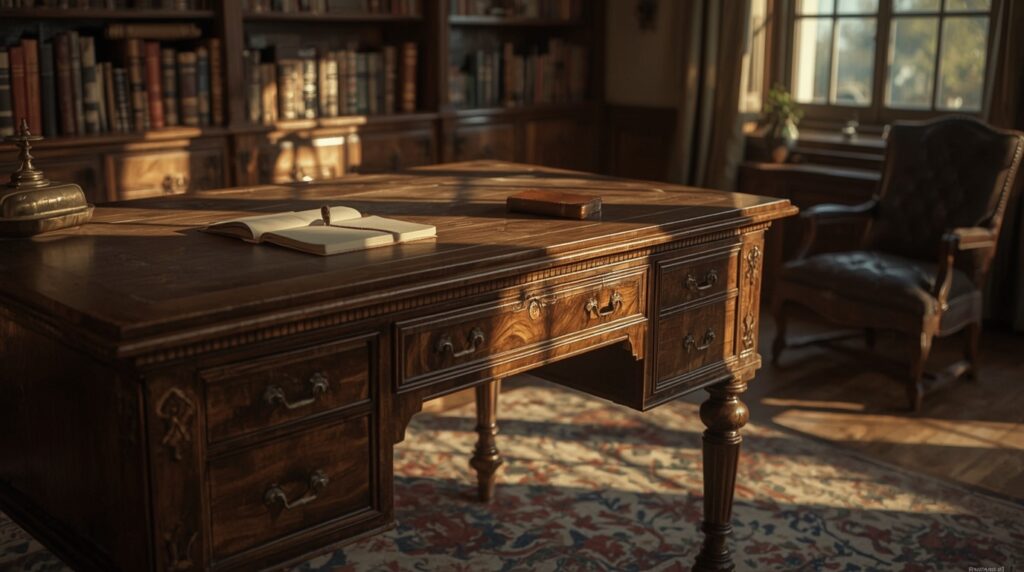
The writing desk, on a cultural level, also traces changing domesticity. In the 18th century, writing began to occupy more private spaces, moving into studies, libraries, and drawing rooms, part of a changing concept of selfhood and privacy. The common availability of multiple drawers and pigeonholes on a writing desk hints at this: more paper, more keepsakes, more bits and pieces to sort through (and hide).
Defining Features of an Antique Writing Desk with Drawers
Generally, an antique writing desk will have at least three components: a work surface (sometimes flat, slant-topped, or fall front), an enclosure or frame, and drawers (either a whole pedestal on one or both sides, or smaller drawers underneath the writing area). High quality antique writing desks may also feature secret compartments, pigeon holes, or hidden drawers. The sides of the drawers are also a giveaway and should be made of solid wood and dovetail-jointed, not stapled together.
Can You Guess the Artist?
Three clues. One artist. How quickly can you identify the painter?
Materials can tell you as much about a piece as construction, as can the finishes used. Mahogany would become very popular in British furniture in the 18th century but this sort of work was made from walnut up to the 17th century in England and in France. French pieces might well be veneered with intricate marquetry (inlaid work) and is indicative of the work of the Parisian guilds and their 18th century output. Luxury desks sometimes came with brass fittings, inlay and sometimes leather tops for writing, but more simple, country pieces were not unusual but no less well made.
Hardware warrants scrutiny, too. Escutcheons and locks, drawer pulls, all moved in and out of favor with style and changing technology, and replacement is not unheard of. A desk with later pulls can still be “good”, but the best desks are usually those where the original patina is consistent and the hardware has some period provenance. A drawer‘s pull is not as revealing as the smooth scrape of the runner, the grain of the wood inside and its wear patterns.
Historical Styles and Periods to Know
Several major periods define the antique writing desk landscape. In Britain, Georgian (1714–1830) desks often emphasize proportion and restrained elegance; later Regency (1811–1820, broadly early 19th century) pieces may appear sleeker and more architectural. In France, Louis XV (rococo curves) and Louis XVI (neoclassical geometry) created distinct desk silhouettes, often paired with refined marquetry and gilt-bronze mounts. In America, desks influenced by English forms evolved through colonial and Federal eras, with regional differences from New England to the Mid-Atlantic.
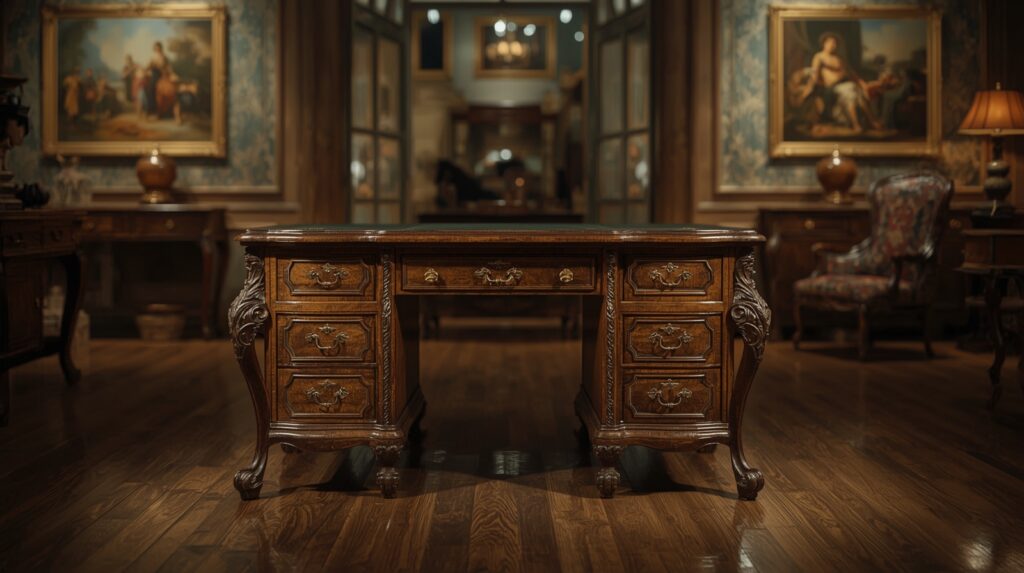
Institutional collections help anchor these styles in real objects. The V&A is particularly strong for British and European furniture histories, while the Metropolitan Museum of Art contextualizes desks within global material culture and trade. The Louvre Museum connects desks to French courtly taste and the elite workshops that served it. In the United States, the Smithsonian Institution provides a lens on American domestic life and craftsmanship, showing how European desk forms were adapted to local tastes and resources.
It’s also important to recognize that “antique” spans many subtypes: the bureau (slant-front), the secretaire (often with a drop front and internal drawers), the partners’ desk (designed for use from both sides, popular in 19th-century offices), and smaller ladies’ writing desks intended for domestic correspondence. Each of these types tends to organize drawers differently, reflecting intended use and social context.
How to Evaluate Authenticity, Condition, and Value
The authentication of an antique writing desk (with drawers) involves equal amounts of connoisseurship and apprehension. If a desk is claimed to be, say, 18th century, then you‘ll want to see tool marks they can be uneven but should make sense (as should hand-cut dovetails). A finish patina in corners and in the back of drawers should be present and also make sense while a mirror-perfect smooth surface or uncanny symmetry can hint at a recent origin. (That said, the late 19th century was a time of increasingly refined woodworking techniques even at a mass-production level, so not all symmetry equals a recent origin).
A piece in good condition is not only worth more but is also usable. Often, you will find problems such as veneer lifting, warping, drawers with replaced bases or evidence of old woodworm. A desk that is repairable is not out. Many museum grade antiques have been conserved at some stage or other. The crucial questions are whether the repairs are honest, sound and sympathetic. If a desk is to be put to work as a desk for current use it has got to have drawers that open smoothly and will hold writing weight without strain.
This is when a purchase ceases to be “decorative antique” and becomes “piece of history.” If there is a provenance or a documented chain of ownership (old bills of sale, estate inventories, etc.), this will bring a sense of conviction. As the Smithsonian Institution collects, they have said “provenance” is key in giving an object its historical meaning. If there isn‘t any, get it appraised and then compare it with objects in museum collections.
Key Characteristics at a Glance
| Feature | What to Look For | Why It Matters |
|---|---|---|
| Drawer construction | Solid sides, dovetail joinery, aged drawer runners | Indicates period-appropriate craftsmanship |
| Materials | Mahogany, walnut, oak; quality veneers/marquetry | Ties to era, region, and value tier |
| Hardware | Period-appropriate locks/pulls; consistent patina | Replacements affect originality and price |
| Writing surface | Leather insert, fall-front, or flat top with wear | Wear patterns can support authenticity |
| Proportions & style | Georgian restraint, Louis XV curves, Louis XVI geometry | Helps date and place the piece |
| Condition | Stable frame, manageable veneer loss, sound drawers | Determines longevity and restoration cost |
Caring for an Antique Writing Desk with Drawers
Preservation starts with environment. Stable humidity and temperature reduce warping and veneer lifting; direct sunlight can bleach wood and dry finishes. Museums such as the Metropolitan Museum of Art and the V&A routinely emphasize preventive conservation—controlling light and climate is often more effective than aggressive restoration. At home, avoid placing desks near radiators, fireplaces, or air-conditioning vents.
Daily use should be gentle and intentional. Use blotters or desk pads to protect surfaces; avoid adhesive desk mats that can react with old finishes. When opening drawers, pull from the center rather than one side to reduce strain on runners. If a drawer sticks, resist forcing it—seasonal wood movement is normal, and forcing can crack runners or loosen joints.
Cleaning should be minimal and reversible. Dust with a soft, dry cloth; if needed, use a slightly damp cloth and dry immediately—never soak. Polishes can build up and obscure original finishes, and some oils can darken wood unevenly over time. For valuable desks, consult a professional conservator rather than relying on household products, especially if the piece has veneer, marquetry, or fragile inlays.
Frequently Asked Questions
How can I tell if a writing desk with drawers is truly antique?
Check for period construction (hand-cut dovetails, aged drawer runners), consistent wear, and wood movement that looks natural. Compare the form with documented examples in museum collections such as the Metropolitan Museum of Art and V&A online databases, and consider an appraisal by a qualified specialist.
Are replaced drawer pulls or locks a dealbreaker?
Not always. Replacements are common due to centuries of use. Value is highest when hardware is original and consistent, but a well-matched period replacement may be acceptable—especially if disclosed and priced accordingly.
Which periods are most sought after?
Demand varies, but 18th-century Georgian (UK) and Louis XV/Louis XVI (France) desks are widely collected for craftsmanship and design. Certain American Federal-era desks are also highly collectible, particularly with strong provenance.
Is it safe to use an antique writing desk every day?
Yes—if the structure is sound and you use protective coverings and gentle handling. If drawers stick or joints feel loose, have the desk assessed to prevent small issues from becoming major repairs.
What’s the best way to research my desk’s style and origin?
Start with the desk’s form, materials, and construction details, then compare against credible references. Museum collections from the Louvre, the Smithsonian Institution, the Met, and the V&A are excellent benchmarks, and specialist furniture reference books or a reputable antiques dealer can help narrow attribution.
A vintage writing desk with drawers is not just a beautiful piece of furniture it‘s a live history of art, of class, and of work. By teaching yourself about the major styles of the past, the principles of antique construction, and how to care for them appropriately, you too can own and use a genuinely antique writing desk that is as functional as it is historical. When in doubt, consult museum collections and research, truly great desks invite research as much as they do work.
AI Notice: Some visual content in this article may have been created or enhanced using artificial intelligence (AI) for artistic, editorial or illustrative purposes. Learn more about our approach in our AI & Editorial Principles.


