The Hidden Stories in Art by Johannes Vermeer That Most People Miss
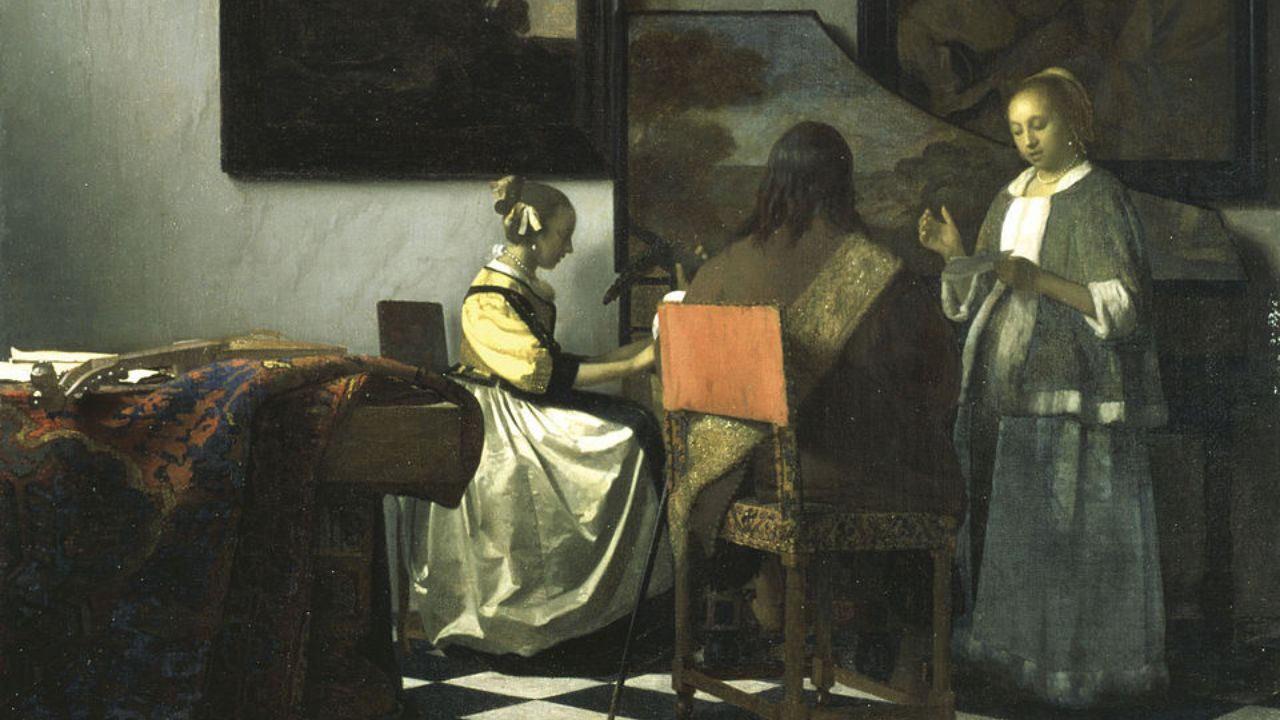
It is rare that an artist can make the experience of silence as palpable as sound, but the work of Johannes Vermeer achieves just that, again and again. In quiet, confined spaces, a woman reading a letter, a maid pouring a pitcher of milk, a person halted by a window, Vermeer escalates the mundane into the sublime. The paintings of his subjects don‘t so much cry for attention, as they command it; the shine of a pearl, the angles of a tiled floor, the still space that separates two people who might never speak.
What keeps Vermeer modern is how much of his work is an act of looking, not of performing. He worked at a remove, completed a small output over time, and had no taste for the grandiosity of European court life. Instead, he staged these quiet dramas in which light acts as the central star.
Can You Name the Masterpiece?
Ten masterpieces. Ten questions. How well do you know the history of art?
It‘s that pairing the mundane subject, the astonishing eye that has made Vermeer a touchstone for realism, intimacy, and pictorial intelligence. Museums from Amsterdam to New York regard his canvases as cornerstones for grasping the Dutch Golden Age, and, as an extension, what painting is capable of.
Vermeer in the Dutch Golden Age: Delft, Markets, and Meaning
Johannes Vermeer (1632–1675) worked during the Dutch Golden Age, a period of intense prosperity and cultural production in the Dutch Republic. Delft, his home city, was a thriving center of trade and craft. The art market there differed from the courtly systems of France or Spain: prosperous merchants and civic institutions bought paintings for homes and guild halls, creating demand for scenes of domestic life, urban views, and still lifes as well as religious and mythological works.
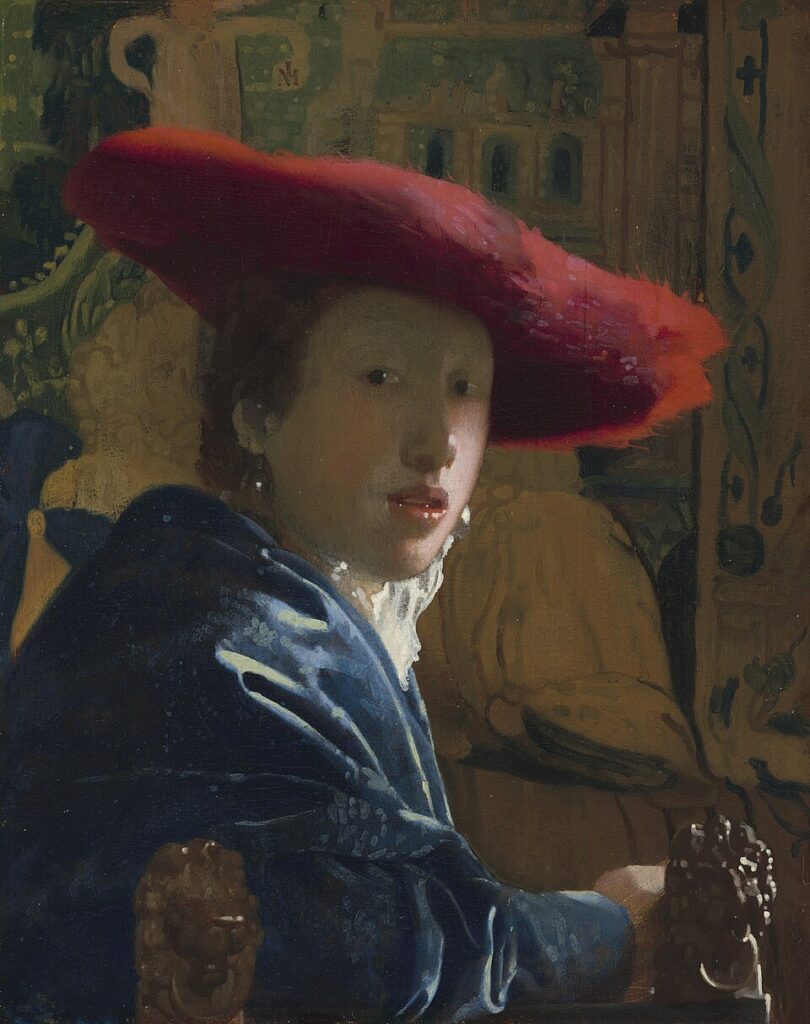
Vermeer was associated with Delft’s professional art world through the Guild of Saint Luke, the institution that regulated painters, art dealers, and related trades in many Dutch cities. He served as headman of the guild, a sign of professional standing even if his finances were often precarious. His career unfolded alongside artists such as Pieter de Hooch and Carel Fabritius, who also explored perspective, interior spaces, and quiet narrative.
Can You Guess the Artist?
Three clues. One artist. How quickly can you identify the painter?
Museums and scholars frequently frame Vermeer as both emblematic and unusual within his era. His themes—music-making, letter-writing, household tasks—fit the period’s taste for genre painting. Yet his extreme refinement of light, color, and structure makes him exceptional. As the Metropolitan Museum of Art notes regarding Young Woman with a Water Pitcher, Vermeer’s work can transform a simple domestic act into a scene of remarkable clarity and stillness, where compositional balance and illumination carry much of the meaning.
Light as Structure: Technique, Optics, and Vermeer’s Signature Look
Vermeer‘s art isn‘t so much “realism” as a carefully modulated realism not too real, not too artful. He creates spaces, as meticulously as a stage designer would, and then he lets light, usually from a left-handed window, create faces, fabrics, walls and objects with consistent form. The whites aren‘t bland. The shadows aren‘t gray or brown, or green smears.
Vermeer‘s methods have been analyzed in numerous technical papers and reveal his highly effective pigment and layering strategies. He used the best available materials, such as ultramarine (ground from lapis lazuli) for his bright blues, and glazes to add depth and tone. Magnifying the painting even further shows the pointillé, or dots of light, on highlights like pearls or brass, adding to the sharp sheen of the works. Museum conservation departments (including the Metropolitan Museum of Art‘s) regularly extol his strategic decisions, which add to the works’ sense of optical realism.
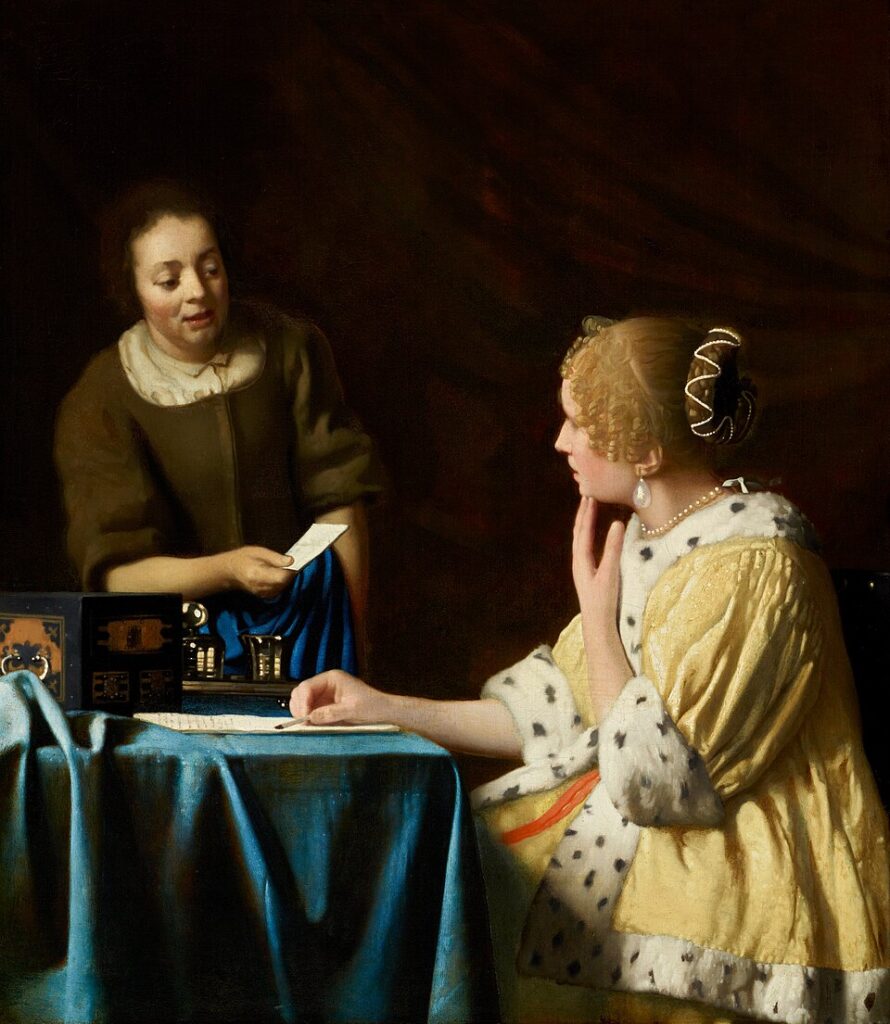
Questions are also raised as to whether or not Vermeer used the camera obscura. Though there is no direct evidence for a single artwork of his being so created, I believe many writers suggest that such optical devices might account for the blurriness in parts of the painting or the scintillating glints of light that may suggest lens use. Yet, even when optical devices are thought to have influenced a painting, that does not make Vermeer disappear. They just add an optical clue; Vermeer “solves” the painting when he decides what to include and what to leave out, when he renders light in paint. In his book, The Story of Art, E. H. Gombrich writes, “There really is no such thing as Art. There are only artists.”
Interiors, Women, and the Ethics of Attention
Many of Vermeer’s greatest paintings center on women in domestic interiors. These are not mere illustrations of household life; they are meditations on attention—on reading, listening, weighing, waiting. Works such as Woman Holding a Balance (often discussed in museum contexts for its moral and spiritual undertones) suggest that daily actions can carry ethical weight. A single gesture, held in time, becomes the subject.
Modern viewers sometimes debate how to interpret these images: Are they celebrations of domestic virtue, reflections on private desire, or critiques of social roles? The Dutch Republic was shaped by Protestant culture, mercantile wealth, and a strong market for images intended for private homes. Within that context, Vermeer’s interiors can be read as carefully calibrated worlds, where maps, instruments, pearls, and letters function as signs of knowledge, commerce, temptation, or global reach.
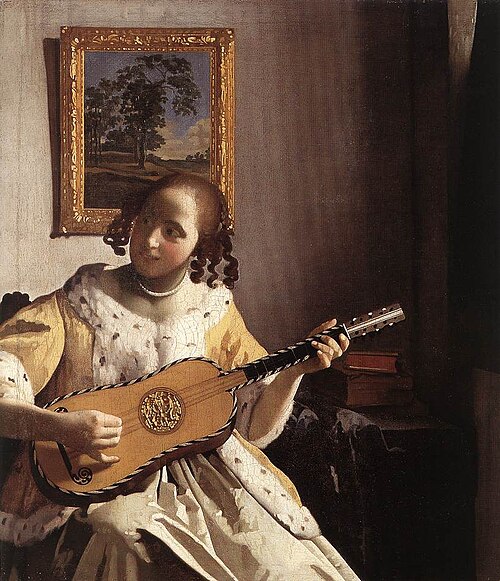
Institutions such as the Victoria and Albert Museum (which contextualizes decorative arts and domestic culture) help illuminate the material world Vermeer painted: textiles, instruments, furniture, and the social meanings they carried. His scenes are not only about people; they are about the built environment of the seventeenth-century Netherlands—how rooms were used, what objects signaled status, and how light itself could confer dignity on ordinary life.
Landmark Works and What They Reveal
Certain paintings have become essential reference points for understanding Vermeer. Girl with a Pearl Earring (Mauritshuis, The Hague) is not a portrait in the strict sense but a tronie—a character study—built from minimal means: a face, a blue-and-yellow turban, a luminous earring, and a dark void. The result is intimate yet enigmatic, proving how Vermeer could achieve psychological impact without narrative.
Two works show his range beyond interiors. View of Delft (Mauritshuis) anchors Vermeer in a civic and geographic reality, using atmosphere and reflections to dignify a real place. Meanwhile, The Art of Painting (Kunsthistorisches Museum, Vienna) is a self-conscious statement about the painter’s craft and the status of art—part studio scene, part allegory—suggesting Vermeer understood painting as both skilled labor and intellectual enterprise.
Major museums continue to deepen knowledge of these works through conservation science, provenance research, and historical interpretation. The Louvre Museum, for example, situates seventeenth-century Dutch painting within a broader European context, helping viewers compare Dutch domestic realism with contemporaneous French classicism or Spanish court portraiture. In the United States, the Smithsonian Institution provides accessible scholarship on art history and material culture that supports public understanding of how artworks are made, traded, and preserved—exactly the ecosystem in which Vermeer’s reputation has been reassessed over centuries.
Key Characteristics of Art by Johannes Vermeer (Summary Table)
| Characteristic | What it looks like in Vermeer | Why it matters |
|---|---|---|
| Controlled natural light | Window-lit interiors; soft shadows; luminous highlights | Creates realism plus emotional calm |
| Geometric composition | Strong horizontals/verticals; tiled floors; balanced spacing | Gives stillness and authority to simple scenes |
| Material precision | Satin, pearls, brass, bread, maps rendered with care | Conveys the sensory world of Delft’s middle class |
| Limited, rich palette | Ultramarine blues, warm ochres, lead whites | Produces depth and coherence |
| Quiet narrative | Minimal action; moments of reading, music, work | Encourages contemplation and interpretation |
| Optical effects | Sparkling highlights, gentle blur in places | Enhances immediacy; suggests sophisticated observation |
Frequently Asked Questions
1) How many paintings by Johannes Vermeer survive?
Most scholars attribute roughly 34–37 paintings to Vermeer, depending on attribution debates. The small number is partly due to his slow, meticulous working method and limited production over his lifetime.
2) What is Vermeer best known for?
He is best known for intimate interior scenes with exceptional light handling—works that turn ordinary domestic moments into enduring images of calm concentration.
3) Did Vermeer use a camera obscura?
It is plausible he used optical aids, but the question remains debated. Even if he did, it would not diminish his achievement; composition, color, and meaning are painterly decisions that devices cannot supply.
4) Where can I see Vermeer’s art in major museums?
Key works are held in European museums such as the Mauritshuis (The Hague) and the Rijksmuseum (Amsterdam), and in major international collections including the Metropolitan Museum of Art (New York). Broader context for Dutch and European painting can be studied through resources from the Louvre Museum, the Victoria and Albert Museum, and educational materials from the Smithsonian Institution.
5) Why does Vermeer’s work feel so modern?
Because he prioritizes perception and attention: his paintings are about how we see—light, focus, texture, and time—rather than about grand events. That makes them resonate with modern sensibilities shaped by photography and cinema, even though they are firmly rooted in the seventeenth century.
Authoritative Sources and Further Reading
- The Metropolitan Museum of Art (Heilbrunn Timeline of Art History) – Scholarly essays and object entries on Dutch Golden Age painting and Vermeer-related works.
- Victoria and Albert Museum – Context on domestic interiors, materials, textiles, and objects that align with Vermeer’s world.
- Louvre Museum – Collection research and European art-historical framing for seventeenth-century painting.
- Smithsonian Institution – Public scholarship on art, conservation, and material culture that supports understanding of how artworks are made and studied.
- Ernst H. Gombrich, The Story of Art – Influential art-historical synthesis (useful for conceptual framing and the cited remark on artists).
“There really is no such thing as Art. There are only artists.” — E. H. Gombrich, The Story of Art
Vermeer is still with us because he made the commonplace inexhaustible. Connected to the city of Delft and the Dutch Golden Age but now investigated and displayed by some of our most prestigious museums and universities, his works are studies in spatial lighting, stillness, and the kind of observation that is the closest we can come to truth. In Vermeer‘s care, a room quietly becomes a universe.
AI Notice: Some visual content in this article may have been created or enhanced using artificial intelligence (AI) for artistic, editorial or illustrative purposes. Learn more about our approach in our AI & Editorial Principles.