Johannes Vermeer‘s paintings seem to halt time with an uncanny effect. In an age of large-scale, flamboyant Baroque, he was the master of small rooms, diffused light and everyday life. But the effects are astonishing: surfaces that shimmer, silence you can almost hear and ordinary lives that achieve a historical scale. For this powerful intersection of intimacy and technical brilliance, Vermeer‘s meager oeuvre of about three dozen paintings is one of the greatest achievements of the Dutch Golden Age.
Vermeer in the Dutch Golden Age: Delft, Patronage, and a Small Oeuvre
Johannes Vermeer (1632–1675) worked in Delft in the Dutch Republic during the Dutch Golden Age, a period shaped by global trade, scientific curiosity, and a thriving art market. Delft was not Amsterdam’s commercial powerhouse nor Haarlem’s artistic hub, but it fostered a prosperous bourgeois culture that valued domestic virtue and refined material life—precisely the environment reflected in Vermeer’s interiors. His paintings often depict tiled floors, plastered walls, maps, musical instruments, and pearls: the everyday prestige objects of a rising urban society.
Can You Name the Masterpiece?
Ten masterpieces. Ten questions. How well do you know the history of art?
Unlike prolific contemporaries such as Rembrandt van Rijn or Frans Hals, Vermeer left a remarkably small oeuvre. Scholars generally attribute roughly 34–36 paintings to him, a number that has intensified both his mystique and the scrutiny applied to each canvas. The limited output likely reflects his methodical working process, the demands of a large family, and reliance on a narrower circle of patrons. One central figure was Pieter van Ruijven, a Delft collector believed to have acquired many Vermeers directly, helping explain why the artist could work slowly and still sustain a career.
Vermeer’s institutional footprint today is international: his paintings are held in major museums and collections across Europe and the United States, including the Mauritshuis (The Hague), the Rijksmuseum (Amsterdam), and the National Gallery of Art (Washington, D.C.). The continuing prominence of these institutions in Vermeer scholarship reinforces how deeply his art is embedded in both Dutch history and the global canon of museum culture.
What Makes Johannes Vermeer Paintings Distinct: Light, Space, and Materials
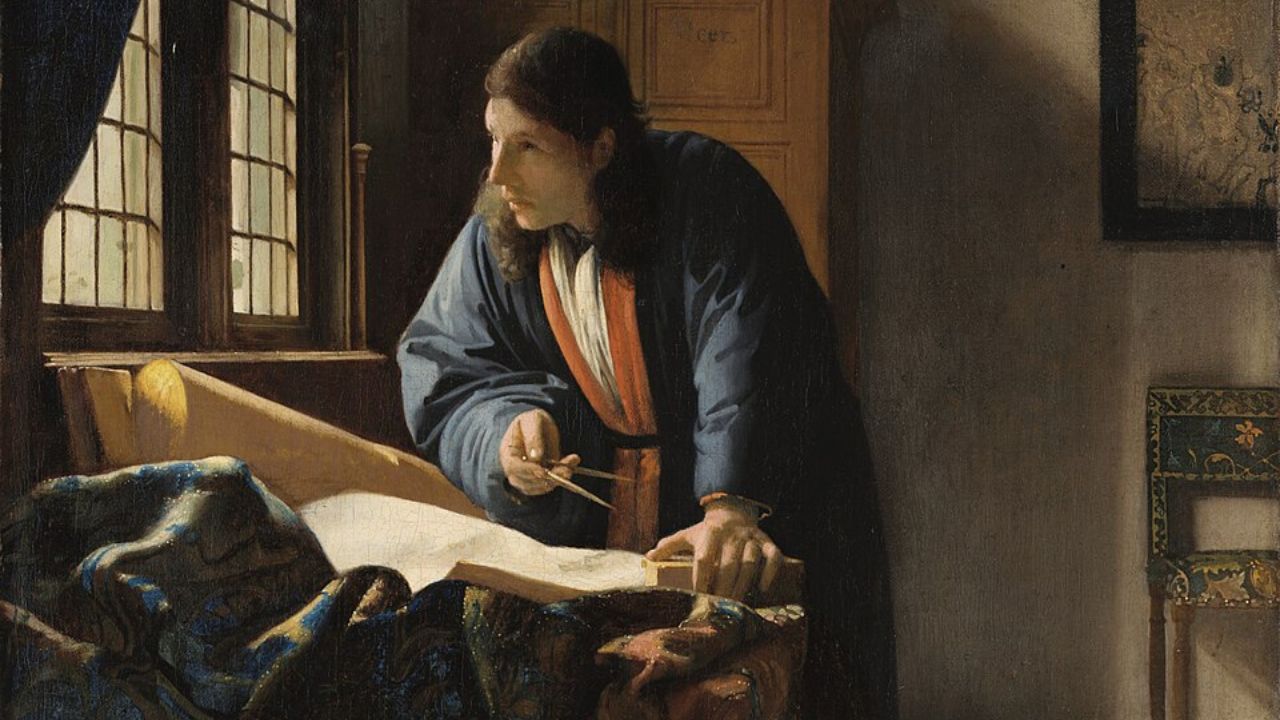
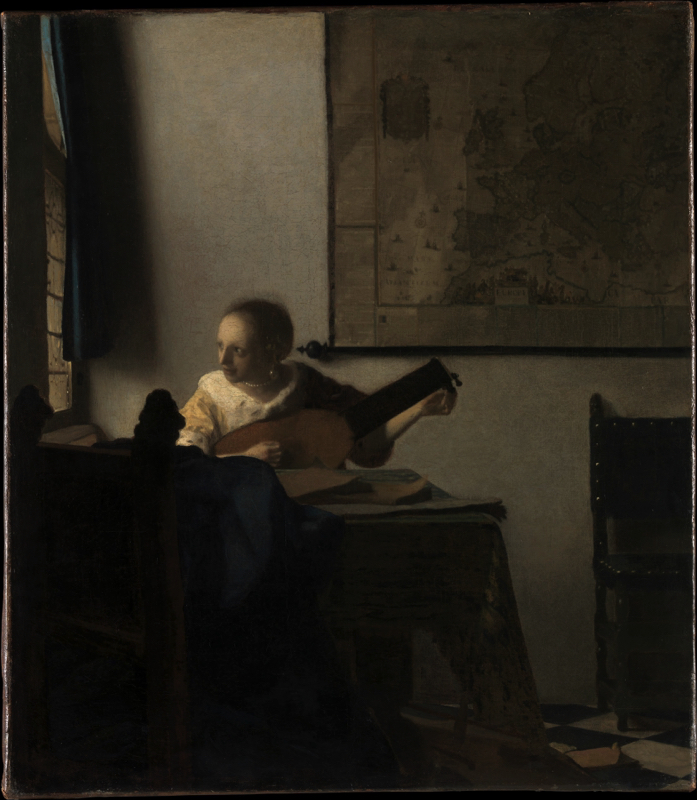
The defining feature of Johannes Vermeer paintings is light—specifically, the cool, directional daylight that enters from a left-hand window in many scenes. This is not merely illumination; it is structure. Light models faces and fabric, measures distance, and unifies a composition so that objects feel anchored in real space. The Metropolitan Museum of Art describes Vermeer’s “subtle light” and “quiet mood” as central to his achievement, emphasizing how he transformed ordinary domesticity into a stage for perception itself (The Met, Heilbrunn Timeline of Art History).
Can You Guess the Artist?
Three clues. One artist. How quickly can you identify the painter?
Vermeer‘s use of materials is no less characteristic. The ability to translate satin as satin, bread as bread, pearls as pearls, often with a few well-placed strokes and highlights. He makes use of some very expensive pigments; lapis lazuli for ultramarine which he used to color not just blue but shadows too, or the air within a room, a feature of what people refer to as ‘optical truth’ although his arrangements were very far from documentary photographs.
And finally there is Vermeer‘s sense of space. The rooms are lived-in but still orderly. His view is restrained. His silence is architectural. We don‘t have to take my word for this. The Louvre, custodian of The Lacemaker, comments on his uncanny ability to distill stillness and attention: “The extreme carefulness of Vermeer‘s observation and the delicacy of his technique give concentration and stillness to his scenes” (Musee du Louvre collection notes). But this stillness isn‘t static. It‘s the psychic architecture of where focus itself resides.
Major Works and Where to See Them: Museums, Masterpieces, and Viewing Context
Vermeer’s fame rests on a handful of masterpieces that anchor museum collections and public imagination. Girl with a Pearl Earring (c. 1665) at the Mauritshuis has become an emblem of Dutch art, though it is technically a tronie (a study of character or expression) rather than a portrait. View of Delft (c. 1660–61), also at the Mauritshuis, shows how Vermeer could apply his sensitivity to atmosphere and light to an urban landscape—one of the most celebrated cityscapes in European painting.
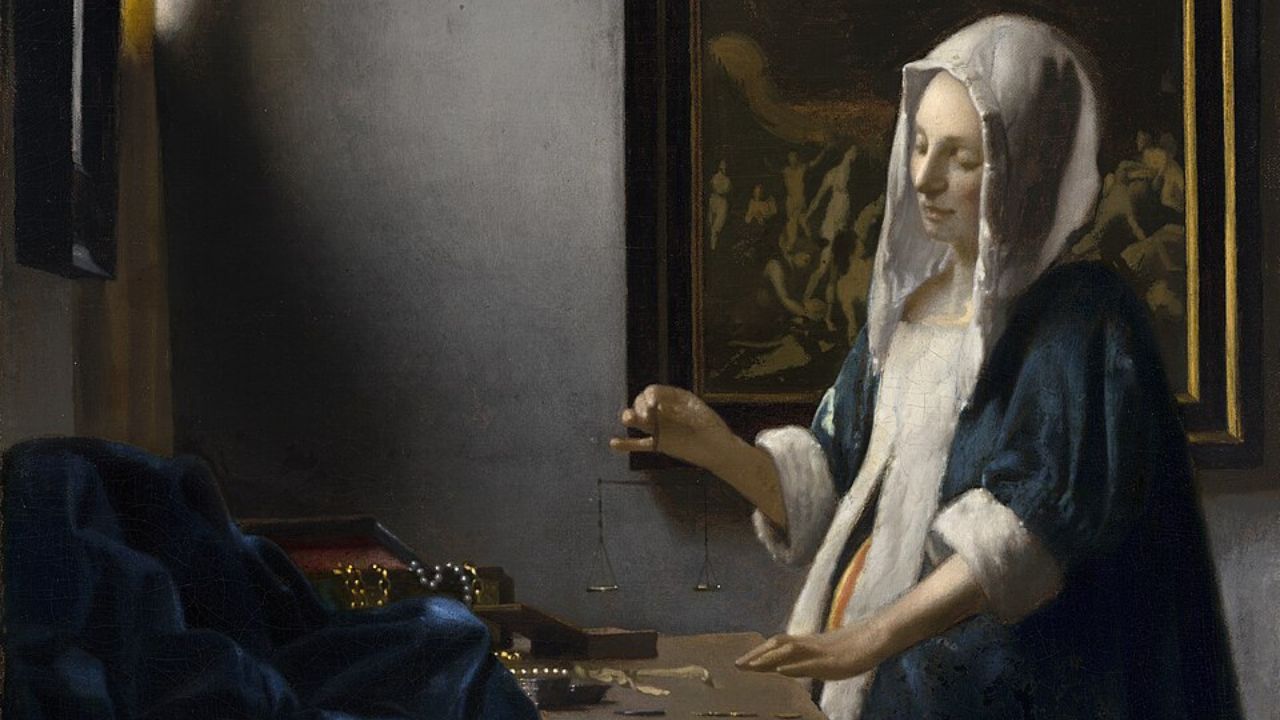
In France, the Louvre Museum holds The Lacemaker (c. 1669–70), a small painting revered for its intimacy and astonishing depiction of thread, fabric, and absorbed attention. In the United States, the National Gallery of Art in Washington, D.C., houses works such as Woman Holding a Balance (c. 1664) and A Lady Writing (c. 1665), offering close comparisons between Vermeer’s compositional restraint and his moral undercurrents (National Gallery of Art, collection entries). These museum contexts matter: Vermeer’s scale is often smaller than people expect, and viewing in person reveals how his paint surface—tiny highlights, soft edges, and layered glazes—creates the sense of luminous air.
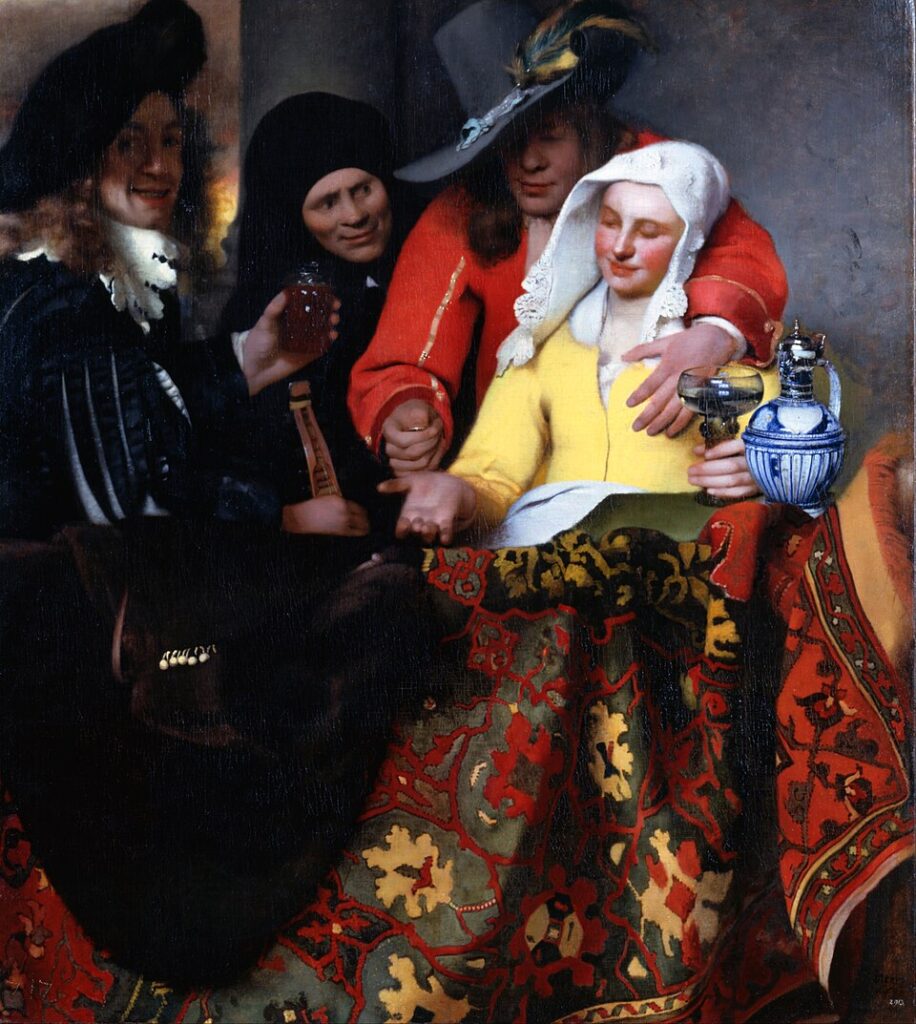
British institutions also contribute essential scholarship and public interpretation. The Victoria and Albert Museum (V&A) is a leading center for decorative arts and material culture of the early modern period, providing critical context for the textiles, maps, furnishings, and domestic objects that appear throughout Dutch Golden Age interiors. Understanding those objects—how they were made, traded, and valued—deepens what we see in Vermeer: not generic “old rooms,” but a specific 17th-century world of craftsmanship and commerce (Victoria and Albert Museum, collections and research resources).
Key Characteristics of Johannes Vermeer Paintings (Summary Table)
| Characteristic | What it looks like | Why it matters |
|---|---|---|
| Directional daylight | Usually from a left window; soft but precise | Structures the scene; creates calm realism |
| Quiet domestic subjects | Reading, writing, music-making, household tasks | Elevates everyday life into profound moments |
| Controlled composition | Balanced geometry; clear focal points | Produces visual clarity and psychological stillness |
| Refined texture | Pearls, satin, bread, plaster rendered convincingly | Demonstrates technical mastery and material culture |
| Selective detail (“optical”) | Soft edges and bright highlights | Creates lifelike perception rather than hard outlines |
| Costly pigments | Frequent use of ultramarine | Signals ambition, patronage, and visual richness |
Interpretation, Technique, and Scholarly Debates: Meaning Beyond the Quiet
Vermeer’s calm scenes have long invited interpretation. Many works include objects that suggest moral reflection: scales, mirrors, maps, letters, and musical instruments can point toward themes of temperance, fidelity, transience, and self-knowledge—ideas common in Dutch Republic culture and Calvinist-inflected ethics. Yet Vermeer rarely turns symbolism into a blunt lesson; he lets meaning remain poised, as if the viewer is catching a private moment mid-thought.
Technique is another center of debate, particularly the possibility that Vermeer used optical aids such as a camera obscura. Some scholars argue that his soft focus, luminous highlights, and heightened sense of light resemble effects produced by lenses. Others caution that such tools—if used—would not replace artistic intelligence; they would be part of a broader practice of observation in a period fascinated by optics and science. The Smithsonian Institution, through its art-historical and conservation-oriented programming, frequently emphasizes how scientific analysis (pigment study, microscopy, imaging) helps clarify artists’ methods without reducing them to mere technology (Smithsonian research and conservation resources).

What remains beyond dispute is Vermeer’s authority as a painter of perception. As the Metropolitan Museum of Art summarizes, his achievement lies in “the serene beauty of his paintings” and their exceptional handling of light and atmosphere (The Met, Heilbrunn Timeline). That serenity is not a lack of drama; it is a different kind of drama—one that unfolds in attention, restraint, and the slow realization that seeing itself can be profound.
Frequently Asked Questions (FAQ)
How many Johannes Vermeer paintings exist?
Most scholars attribute roughly 34–36 paintings to Vermeer. The exact number varies because attributions can change with new research, conservation findings, and technical analysis.
What are the most famous Johannes Vermeer paintings?
Among the best known are Girl with a Pearl Earring and View of Delft (Mauritshuis, The Hague), The Lacemaker (Louvre, Paris), and Woman Holding a Balance (National Gallery of Art, Washington, D.C.).
Where can I see Vermeer paintings in the United States?
Major U.S. holdings include the National Gallery of Art (Washington, D.C.) and The Metropolitan Museum of Art (New York), both of which provide authoritative collection information and art-historical essays.
Did Vermeer use a camera obscura?
It is possible, but not definitively proven. Some visual features align with optical effects, yet Vermeer’s composition, color, and paint handling show deliberate artistic choices that go beyond any device.
Why do Vermeer’s paintings feel so modern?
Their cropped compositions, emphasis on everyday moments, and attention to light resemble later visual sensibilities—almost photographic in mood—while remaining deeply rooted in 17th-century Delft.
Authoritative Sources (Selected)
- The Metropolitan Museum of Art (Heilbrunn Timeline of Art History; Vermeer essays and collection resources)
- Musée du Louvre (collection entry and curatorial notes for The Lacemaker)
- Victoria and Albert Museum (research resources on Dutch material culture and decorative arts context)
- Smithsonian Institution (conservation science and art research resources relevant to technique and materials)
- National Gallery of Art, Washington, D.C. (collection entries and interpretive essays on Vermeer)
Vermeer‘s paintings have a timeless quality because they juxtapose opposites grandeur with intimacy; complexity with simplicity; quietude with emotion and in Doing so he makes them relevant once again. His art, that once decorated the homes of 17th-century Delft and has since found a home in venues such as The Louvre, The Met and The National Gallery of Art, has set a precedent for the art that followed.
AI Notice: Some visual content in this article may have been created or enhanced using artificial intelligence (AI) for artistic, editorial or illustrative purposes. Learn more about our approach in our AI & Editorial Principles.