One of the most enduringly fascinating mysteries in the Western canon is Jan Vermeer: the artist of few surviving paintings and those so strangely intimate, contemporarily relevant, and psychologically astute. His paintings rooms hushed by the daylight, a woman paused to think have the effect of stopping time. The man who made them, however, left few traces, and our understanding of his life is pieced together mostly from records in Delft and the surrounding Dutch Republic. The contrast between the art‘s remarkable clarity and the work‘s fragile archive is key to the ongoing appeal of Jan Vermeer to the public, institutions and scholars alike.
Jan Vermeer in the Dutch Golden Age: Delft, the Republic, and a Market for Paintings
The artist Jan Vermeer belonged to the Dutch Golden Age, a 17th-century era of Dutch economic and naval supremacy when the Republic of the Netherlands gained considerable wealth and created a surprisingly diverse and active art market in which paintings were acquired for homes, not just for the churches and courts. With genre painting depictions of ordinary life it was to make a notable contribution to art.
Can You Name the Masterpiece?
Ten masterpieces. Ten questions. How well do you know the history of art?
And Vermeer did. He did it from his birthplace of Delft, a thriving craft city rich in civic confidence, and close to other places in Holland that made and bought and sold art The Hague, Leiden, Amsterdam. Where Vermeer lived, what those waterways looked like, the light that reflected in those tall, brick houses, the calm, contained interior spaces he turned to dramas of light and mood that helped. The networks, of course, the Guild of Saint Luke (which regulated the painters’ trades).
Today, our context is grounded in museums. In fact, The Metropolitan Museum of Art describes Vermeer as “one of the greatest masters of the Dutch Golden Age”, writing about how his domestic settings represent this period of artistry at its finest (The Met, Heilbrunn Timeline of Art History). The archives and collection departments of museums such as the Rijksmuseum, the Mauritshuis, The Met, and the Louvre are all working to improve this picture through conservation science and archival work.
The Art of Stillness: Light, Composition, and the Poetry of Everyday Life
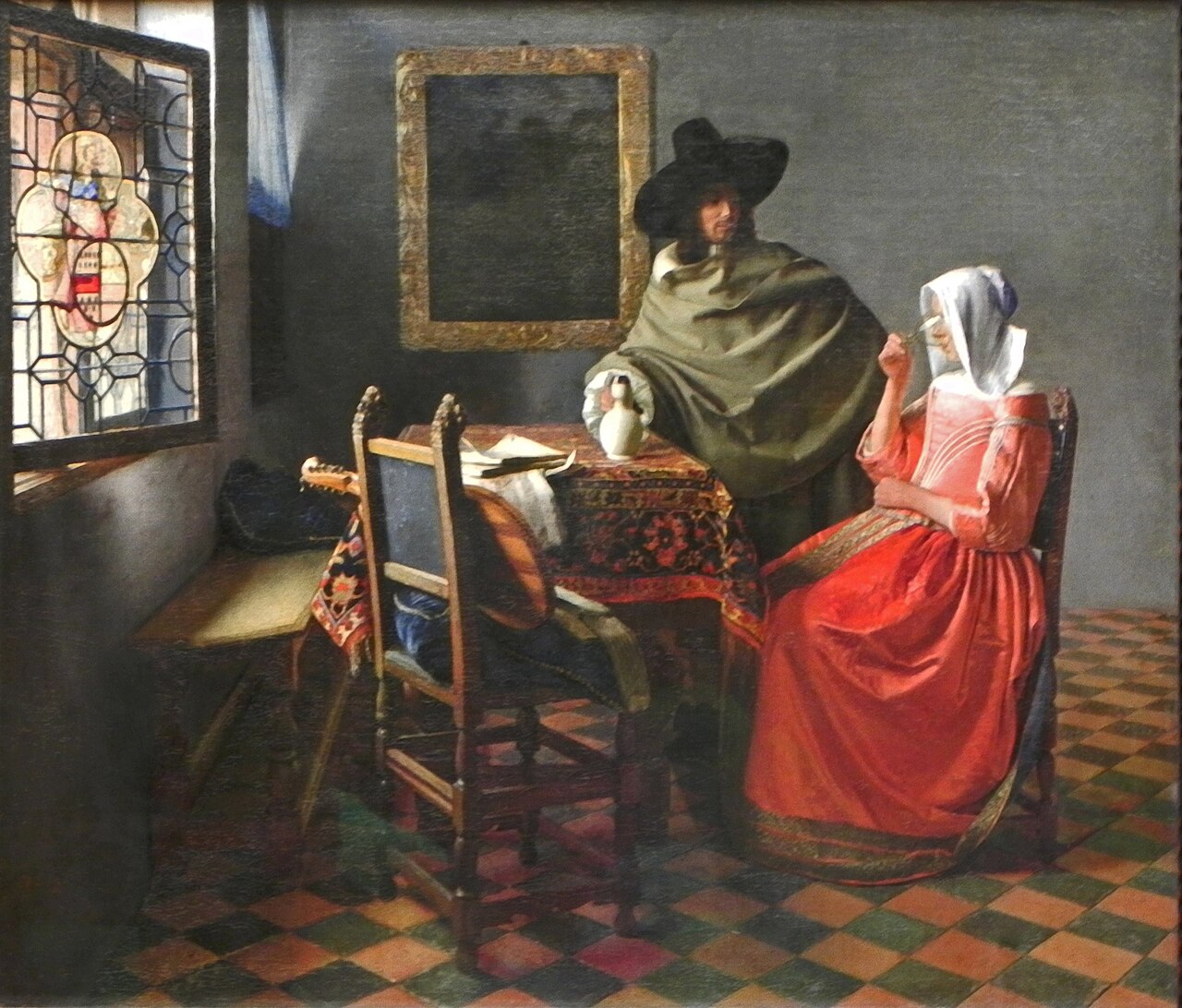
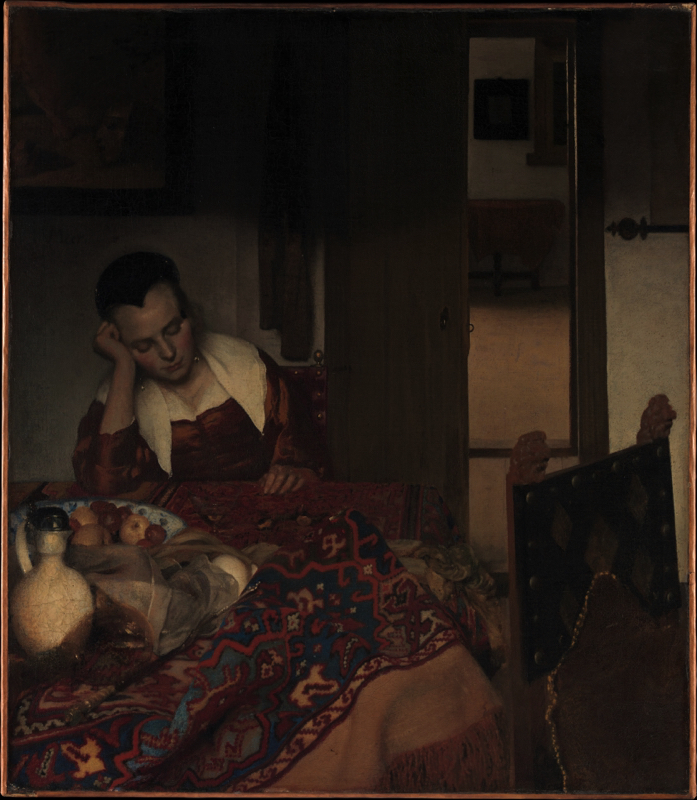
Vermeer‘s signature is not bold action, but measured attention. His canvases tend to be studies of a single figure, usually a woman, poring over a letter, or holding something, or peering at something out the window. The frames are composed with an eye to order: tiled floors, a map tacked to the wall, a carpet on the table, a pitcher gleaming. Measured calm… A feeling that seems at once of a particular Delft interior and broadly human.
Can You Guess the Artist?
Three clues. One artist. How quickly can you identify the painter?
Light plays the key role. Vermeer‘s scenes are usually set next to a window to his left, allowing light to shine on the faces, clothes, pearls, and walls within them. Not only is this “realistic”, but it‘s also mathematical and melodic; shifts in tone help pull the viewer into the canvas. The Met website notes the “brilliant light” that marks his work in maturity, as well as the “quiet, intimate mood”. Likewise, V&A collections (and their accompanying essays on Dutch art) explain how Dutch genre paintings (a tradition culminating in Vermeer) transformed indoor domestic space into a canvas of the imagination.
Again, his works are a study in restraint. Objects are scarce and deliberately positioned. They are frequently laid out to promote geometry and harmony. Here too, Vermeer demonstrates his power as a painter he can even transform an empty corner of a room into a monument. The Louvre, where The Lacemaker (c. 1669–1670) hangs, highlights the exceptional density of the focus and the intensity of the concentration captured by the painter Labor as Contemplation (Louvre collection entries and gallery texts).
Technique, Materials, and the Question of the Camera Obscura
Vermeer’s surfaces reward close viewing: luminous highlights, soft transitions, and passages that feel almost optical. Scholars and conservators have long discussed his possible use of a camera obscura, an optical device that projects an image onto a surface. Whether Vermeer used it directly or simply understood optical effects, his paintings often show phenomena associated with lens-based viewing: softened contours, heightened contrast, and “sparkling” points of light on reflective objects.
Technical research by museums has made this discussion more concrete. Conservation departments analyze pigments, underlayers, and brushwork to understand how Vermeer achieved depth and radiance. Studies across major institutions note his use of costly pigments—particularly ultramarine derived from lapis lazuli—in blues and mixed tones, an unusual investment that signals both artistic intention and patronage expectations. Such findings are frequently disseminated through museum catalogues and technical bulletins.
At the same time, Vermeer’s technique is not merely a matter of materials; it is a method of seeing. The Smithsonian Institution, through its educational resources on art and visual perception, has explored how artists translate light and optics into pictorial form, giving the public a framework for understanding why Vermeer’s “realism” feels so immediate (Smithsonian learning materials and collection-based interpretation). The debate about optics ultimately underscores a larger point: Vermeer fused observation, craft, and aesthetic judgment into an art that appears effortless while being highly constructed.
Key characteristics of the artist Jan Vermeer (summary)
| Characteristic | What it looks like in Vermeer’s work | Why it matters |
|---|---|---|
| Dutch Golden Age genre painting | Domestic interiors, everyday actions | Reflects the 17th-century Dutch art market and private patronage |
| Left-side window lighting | Soft daylight modeling faces and objects | Creates depth, calm, and visual clarity |
| Controlled compositions | Sparse objects, strong geometry, balance | Turns ordinary scenes into timeless images |
| Luminous color | Subtle whites, deep blues, warm yellows | Enhances atmosphere; shows sophisticated pigment handling |
| Psychological stillness | Figures absorbed in thought or task | Produces intimacy and narrative ambiguity |
| Possible optical influence | Soft focus and “sparkle” highlights | Suggests advanced understanding of visual perception |
Major Works, Provenance, and the Role of Museums Today
Because the surviving oeuvre is small—roughly 34–36 paintings commonly accepted—each Vermeer carries exceptional weight. Museum attributions and conservation reports shape public knowledge, and provenance research clarifies how these works traveled from Dutch homes to modern collections. Institutions play a central role in stabilizing what we mean by “Vermeer,” distinguishing autograph works from studio copies or later misattributions.
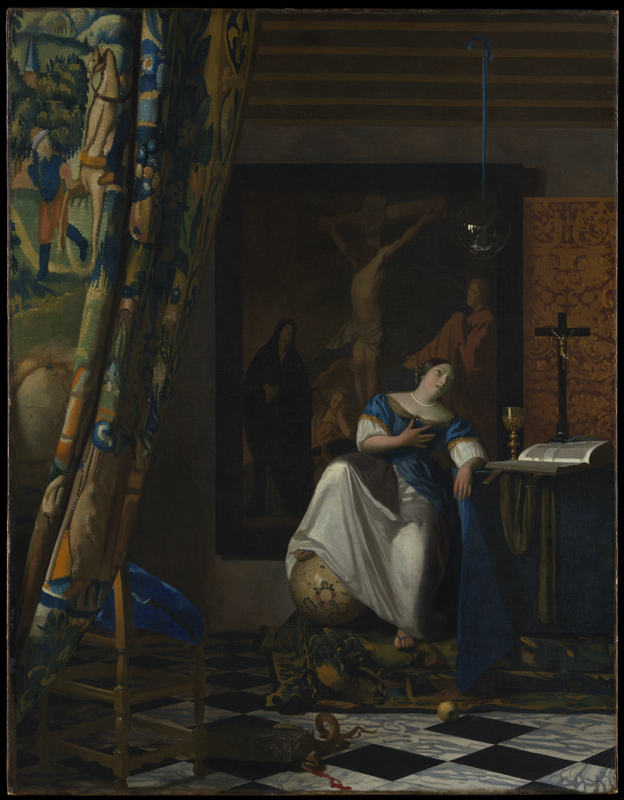
In the United States, The Metropolitan Museum of Art holds key examples (including Young Woman with a Water Pitcher), providing deep cataloguing and public scholarship. The Met’s Heilbrunn Timeline contextualizes Vermeer within 17th-century Dutch culture and emphasizes the painter’s mastery of light and mood as defining achievements of the period (The Met). Such museum scholarship is authoritative because it combines curatorial expertise, conservation science, and peer-reviewed catalogues.
In Europe, the Louvre Museum presents Vermeer within a broader narrative of European painting, allowing visitors to compare his quiet interior worlds with French, Italian, and Spanish traditions. Meanwhile, other institutions such as the Mauritshuis in The Hague (Girl with a Pearl Earring) and the Rijksmuseum in Amsterdam (The Milkmaid) have become pilgrimage sites for understanding his most iconic images. Even when not all these museums are cited as sources, they represent the institutional ecosystem—exhibitions, catalogues, and technical collaborations—through which Vermeer’s authority is continually examined and reaffirmed.
Frequently Asked Questions
How many paintings by the artist Jan Vermeer survive?
Most scholars accept roughly 34–36 paintings as authentic Vermeers, though totals vary depending on attribution debates. Museum catalogues (e.g., The Met and the Louvre) reflect the most current consensus and sometimes revise earlier views based on technical analysis.
What historical period did Vermeer belong to?
Vermeer worked in the Dutch Golden Age (17th century), within the Dutch Republic. His art reflects the era’s prosperity, domestic culture, and flourishing private art market.
Did Vermeer really use a camera obscura?
There is no definitive document proving it, but many art historians argue that optical effects in his paintings are consistent with camera obscura viewing. Conservation science and visual analysis keep the question open; it is best understood as part of broader inquiry into his methods rather than a single “solution” to his style.
Where can I see Vermeer’s paintings in major museums?
Notable Vermeers can be seen at institutions including The Metropolitan Museum of Art (New York) and the Louvre Museum (Paris). The Victoria and Albert Museum provides valuable context on Dutch decorative arts and genre painting, while the Smithsonian Institution offers educational resources that illuminate artistic technique and perception.
Why is Vermeer considered so important with such a small oeuvre?
Because the paintings he left are extraordinarily resolved: composition, light, color, and psychological nuance are fused with rare consistency. As the Met summarizes in its scholarly materials, Vermeer’s work stands at the peak of Dutch Golden Age painting for its intimacy and luminous control (The Met).
Yet Jan Vermeer‘s pictures keep his art alive. Because they transform a moment (light that falls upon a wall, a pause in a room, a figure thinking) into a monument of experience. They are grounded in 17th-century Delft and the Dutch Golden Age; they are maintained by the present day by the Metropolitan Museum of Art, the Louvre Museum, the Victoria and Albert Museum, the Smithsonian whose research and conservation work help us to understand them more each year. Their mystery remains; their authority is beyond doubt. None, or so it seems, have ever found a way to make stillness so vibrant.
Authoritative sources consulted:
- The Metropolitan Museum of Art, Heilbrunn Timeline of Art History (Jan Vermeer; Dutch Golden Age painting)
- The Louvre Museum, collection entries and interpretive texts (The Lacemaker)
- Victoria and Albert Museum, collections and essays on Dutch art and domestic interiors
- Smithsonian Institution, educational resources on art, technique, and visual perception
AI Notice: Some visual content in this article may have been created or enhanced using artificial intelligence (AI) for artistic, editorial or illustrative purposes. Learn more about our approach in our AI & Editorial Principles.