

This Vintage Wood and Glass Coffee Table Makes Any Room Look Expensive
Vintage wood and glass coffee tables have a particular kind of gravity: they can make a room feel instantly “collected,” as if it has a past worth paying attention to. Look for the sweet spot of rich, sensuous wood with clean, pure glass a dialogue that came into its own in the 20th century, as furniture makers began to rethink their work in terms of the micro-architecture of a room. From the opulence of Art Deco to the pared-down sleekness of mid-century modern or the Scandinavian obsession with craft, the right vintage wood and glass coffee table is a great piece to read between the lines with.
Why Wood and Glass Became a Classic Pair
Wood-and-glass tables gained prominence as modern interiors evolved in the early-to-mid 20th century, when designers sought lighter visual footprints without sacrificing structure. Glass offered “air” and transparency; wood offered warmth and tradition. In combination, they answered a modern need: furniture that supported new patterns of living—open-plan rooms, low seating, and a growing emphasis on social, casual gathering rather than formal drawing-room rituals.
Can You Name the Masterpiece?
Ten masterpieces. Ten questions. How well do you know the history of art?
Historically, this pairing aligns with the broader movement toward modern materials and clean forms that emerged between World War I and the post–World War II decades. Art Deco (1920s–1930s) embraced polished surfaces, geometric profiles, and luxurious contrasts; later mid-century design (roughly 1945–1965) pushed toward clarity of line and honest construction. Museums such as the Victoria and Albert Museum (V&A) in London and The Metropolitan Museum of Art in New York preserve furniture and decorative arts from these periods, underscoring how materially inventive this era was across Europe and the United States.
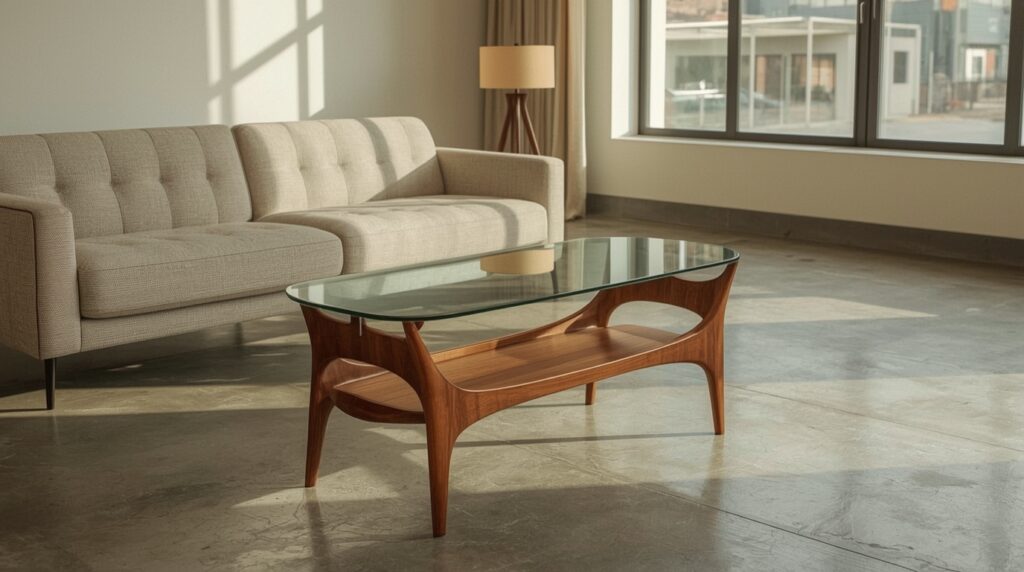
The appeal is not only aesthetic but also legible: wood tells you about species, joinery, and craft traditions, while glass signals technological capability (tempering, precision cutting, and later, mass production). As the Smithsonian notes in its design-related collections and scholarship, modern design often reflects the intersection of industry, domestic life, and material innovation—exactly the story a vintage wood-and-glass coffee table can tell in one object.
Key Design Eras and What to Look For
Art Deco (1920s–1930s, Paris, London, New York): Expect strong geometry—stepped forms, arcs, and symmetry—often with darker woods (walnut, mahogany) and glamorous finishes. Glass tops might be thicker, sometimes with beveled edges. This period’s visual language echoes what you’ll see in decorative arts departments of major institutions like The Metropolitan Museum of Art and the V&A, where interwar design is contextualized alongside architecture, fashion, and graphic arts.
Can You Guess the Artist?
Three clues. One artist. How quickly can you identify the painter?
Mid-Century Modern (c. 1945–1965, U.S. and Europe): Look for tapering legs, light-to-medium woods (teak, oak), and a structural clarity that foregrounds proportion. Glass often appears as an unobtrusive plane—allowing sculptural bases to remain visible. This “less, but better” attitude is frequently associated with influential European design thinking; a widely cited expression of this principle comes from designer Dieter Rams: “Good design is as little design as possible.” While not limited to coffee tables, that ethos explains why many mid-century wood-and-glass pieces feel calm, logical, and enduring.
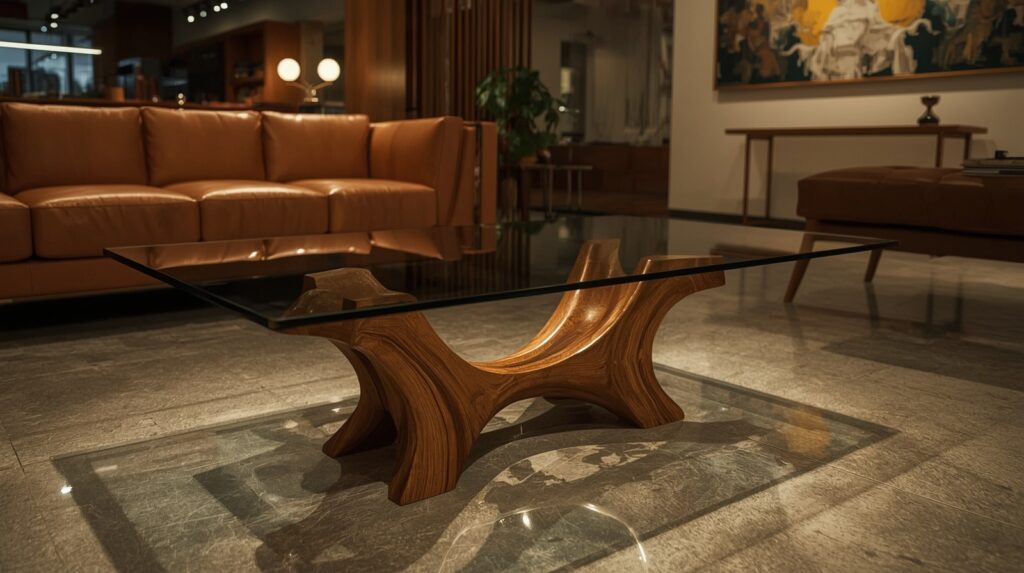
Scandinavian Modern (1940s–1970s, Denmark, Sweden, Finland): Similar to mid-century in restraint, but often softer in line and more explicit about craft. Joinery may be more visible, curves more organic, and proportions more human-scaled. Teak and rosewood appear frequently, with glass used to reduce visual mass. Institutions across Europe have documented this period’s emphasis on democratic design and domestic comfort; the V&A’s design collections provide helpful context for how Scandinavian modernism influenced global interiors.
Materials, Construction, and Authenticity Markers
A truly exceptional vintage piece will give itself away in the details what kind of wood used, the type of joinery used, and how glass fits in. Look for solid wood or fine quality veneer work, which indicated the best work was done. Cheaper items will be made with thin veneers, uneven or wobbly frames, or cheap hardware. Inspect under corners and edges.
Glass can also shed some light on the tale of the base. Early glass tops may have some undulation or minor imperfections from use. In contrast, glass replacements may look too “perfect” or even be ill-proportioned relative to the size and width of the base. Tempered glass, in particular, often has an etch or stamp and became more standard as safety practices changed, but older tables were likely to have plate glass. For regular use, you‘ll probably want a custom tempered top so you can protect the original.
Provenance. Documentation breeds confidence. Dealer invoices, maker’s marks, and maker‘s marks, or catalogs from the era all assist in authentication of your table‘s period and place of origin. From the records for object details in The Louvre Museum and other great houses of the world, the what and where and when of the object contribute to its value. Whether or not your table has museum-quality standards, apply museum-quality treatment to your materials, condition, and documentation.
Summary Table: Key Characteristics of Vintage Wood and Glass Coffee Tables
| Feature | What to Look For | Why It Matters |
|---|---|---|
| Wood species | Walnut, teak, oak, mahogany; quality veneer | Species and veneer quality signal era and craftsmanship |
| Joinery | Mortise-and-tenon, dowels, tight miters | Strong joinery correlates with longevity and value |
| Glass type | Thickness, beveled edge, tempered stamp | Safety, authenticity, and visual correctness |
| Proportions | Low profile (mid-century), geometric mass (Deco) | Helps date the piece and match interior style |
| Hardware/fasteners | Period-correct screws, brackets, finish | Replacements can indicate repairs or altered originality |
| Patina | Even wear, honest marks, stable finish | Natural aging supports authenticity; damage lowers utility |
Styling, Care, and Long-Term Value
The art of styling the wood and glass coffee table is respecting the transparency of the piece the clutter beneath the glass really shows. So as with curating pieces for museum displays, two or three items of varying height are more of a statement (a stack of books, a ceramic bowl, one sculptural element). The overall effect is more thought out than multiple small elements.
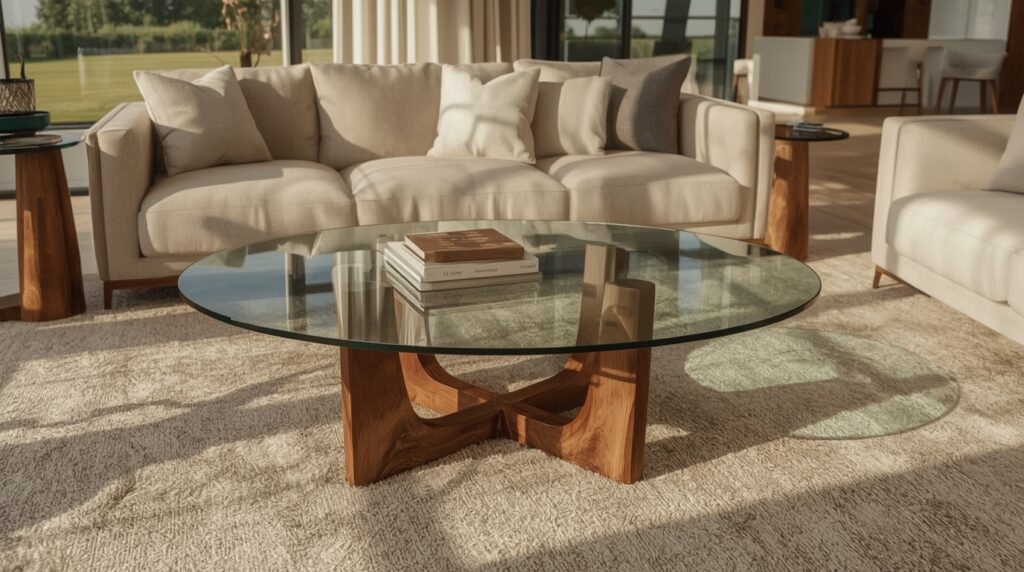
Cleaning is simple with patience. For a glass surface, clean with non-ammonia glass cleaner (if you are concerned about damage to surrounding materials). For polishing, avoid microfiber cloths to prevent scratching and apply the product on a soft cloth. Wood furniture should not be polished with silicone-rich polishes, as they can create a residue. Use a quality wax, or a conservator-safe polish with moderation. If the top is a veneer, be careful with moisture and heat.
Long-term value goes to those pieces with a clearly recognizable style (Deco, mid-century, Scandinavian), in great condition (especially a solid table structure and unbroken glass panels around the top and sides) and with clear attribution. As you see the decorative arts collections at The Metropolitan Museum of Art and at the V&A, you realize that objects gain value when the story of their creation is apparent: who made it, where, when, and of what. As long as the table is structurally sound and clearly made in the 1970s, its value will hold better than a contemporary imitation by an unknown designer.
Frequently Asked Questions
How can I tell if the glass is original?
Check fit and finish: original glass typically matches the base’s intended proportions and hardware. Look for period-consistent thickness, beveling, and edge wear. If the glass seems too new or sits imperfectly, it may be a replacement.
Is tempered glass necessary for a vintage coffee table?
Not strictly, but it is safer—especially in homes with children or heavy daily use. Many owners keep the original glass stored and use a custom-cut tempered top that matches the original dimensions.
What wood types are most common in mid-century wood-and-glass tables?
Teak and walnut are common, with oak also appearing frequently. Teak often signals Scandinavian or broadly European modern production, while walnut is common in American mid-century furniture.
Does refinishing reduce value?
Aggressive refinishing can, especially if it removes original veneer, alters edges, or changes color beyond period norms. Conservation-minded restoration—stabilizing structure, cleaning carefully, and preserving patina—typically protects value better.
Where should I research design context before buying?
Start with museum collection resources and essays from institutions such as The Metropolitan Museum of Art, the Victoria and Albert Museum, and the Smithsonian Institution. Their object records and curatorial writing help you learn period cues, materials, and maker information.
Conclusion
A well-chosen mid-century wooden and glass coffee table is a winner if it does the job that the best design always does: simplifying daily life, with a whisper of history thrown in. Know how to spot the hallmarks of key decades, examine the craftsmanship and origin, and trust your museum-quality instincts when it comes to attribution and conservation to choose a coffee table that is perfectly in tune with your home, built to stand the test of time, and in direct lineage with the design traditions that shape our modern lives.
Bibliography: The Met. The V&A. The Louvre. The Smithsonian. (Collection and Curatorial Resources). Famous design mantra of Dieter Rams.
AI Notice: Some visual content in this article may have been created or enhanced using artificial intelligence (AI) for artistic, editorial or illustrative purposes. Learn more about our approach in our AI & Editorial Principles.


