
These Queen Vintage Bed Frames Are Making Modern Bedrooms Feel Magical
Queen vintage bed frames sit at a rare intersection of daily comfort and cultural history: they are functional furniture pieces that also carry the design DNA of entire eras. A good vintage bed frame can do more than bring architectural personality to a room it can create a lived-in look in a modern bedroom by layering on the appropriate scale, material, and ornament that make a house feel like a home. However, vintage is a broad term, and buying a queen frame has the additional challenge that traditional beds were usually designed for smaller mattress sizes than what is standard now. Here‘s a look at what makes a queen vintage bed frame, and how to find one.
What Makes a Queen Bed Frame “Vintage” (and Why That Matters)
In the furniture trade, vintage typically refers to pieces made in the mid-20th century (often 1930s–1980s), while antique is usually 100+ years old. The distinction matters because many “vintage-style” frames are new reproductions that borrow historic motifs without the construction methods or materials of the period. If you want authenticity, learn the hallmarks of real manufacture: joinery, patina, hardware, and maker’s marks.

Can You Name the Masterpiece?
Ten masterpieces. Ten questions. How well do you know the history of art?
The second important consideration is queen size. The contemporary queen mattress (which is often considered 60” x 80” in the U. S. today) wasn‘t so much of a fixture on the bed scene until much after many more antique bed designs were developed. Antique Victorian, Edwardian and even some antique French beds were built with mattresses that were sometimes narrower or shorter. You need to make sure a truly antique bed will accommodate a modern queen mattress, or possibly needs to be altered.
So, why are our period details so important? The Metropolitan Museum of Art and the Victoria and Albert Museum (V&A) tell the story of beds, in particular, being very important pieces and symbols of status. If the room had only one statement piece, it was the bed! Throughout European courts and large townhouses, the bed would show a family‘s wealth with intricate carving, gilding, textiles, and elaborate headboards. These were concerns that later “filtered down” to mass-market designs of the 19th and 20th centuries.
Major Styles and Historical Periods Found in Vintage Queen Bed Frames
Many queen vintage bed frames you’ll encounter today are later interpretations of older European styles, or products of 20th-century movements. Victorian-inspired frames often feature ornate cast iron, scrolling, and finials; these echo the 19th-century industrial boom in Britain and the United States, when iron casting made decorative beds accessible beyond aristocratic households. If you see heavy iron with crisp repeating motifs, it may be a 20th-century revival rather than an 1800s original—still vintage, but not antique.
Can You Guess the Artist?
Three clues. One artist. How quickly can you identify the painter?
Art Deco (1920s–1930s) and Mid-Century Modern (roughly 1945–1965) are especially common in true vintage queen frames. Deco emphasizes geometry, symmetry, and luxurious materials; Mid-Century favors clean lines, warm woods (like walnut or teak), and tapered legs. These styles track major historical shifts—interwar optimism, postwar housing growth, and the rise of modernist design education and manufacturing.
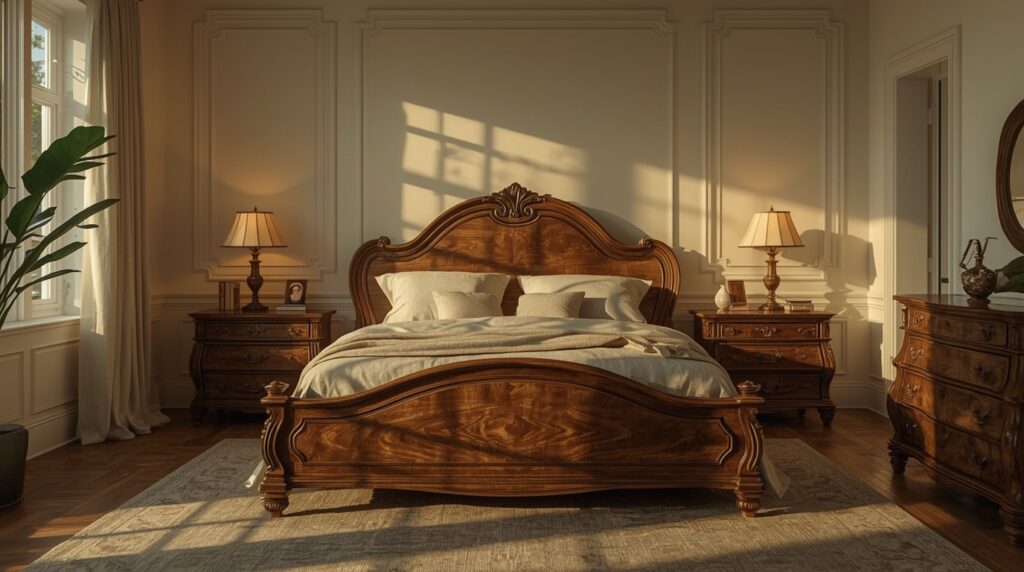
For deeper context, collections and scholarship from institutions such as the V&A (London), The Metropolitan Museum of Art (New York), the Louvre Museum (Paris), and the Smithsonian Institution (Washington, D.C.) provide reliable reference points for ornament, materials, and construction traditions. These museums show how forms evolved—from carved and gilded court furniture to later industrial and modern designs—helping buyers distinguish genuine period cues from vague “retro” styling.
Materials and Construction: How to Judge Quality Like an Expert
Top-notch vintage headboards (iron, brass or wood) are identified more by their structure than their finish. With wooden beds, you want to see solid rails, snug joins, and signs of joinery, like mortise-and-tenon construction on the headboard‘s posts and rails, well-made dovetails on any storage drawers or cabinets it might have, or well-fitted corner blocks. Veneer is also fine (particularly in Art Deco and Mid-century pieces), but make sure it is undamaged, without excessive bubbled areas or chipped edges.
Metal frames are another story. A cast iron and steel bed should feel sturdy, with tight welding or bolt assembly. Brass beds (or brass-plated beds) should also be checked for plating damage, especially around contact points, and any cracks from stress around the joints. If you buy a vintage metal frame and it racks or twists when you assemble it, you may want some new parts.

Authenticity is even in the details: old screws, manufacture marks, wear commensurate with age. As the Smithsonian explains in its conservation articles, “dirt” isn‘t just dirt it‘s the surface trace of an object‘s life. Heavy refinishing can destroy evidence of its history. In other words, refinishing might improve shine, but diminish substance and value.
Table: Key Characteristics to Compare
| Type of vintage queen bed frame | Typical eras | Common materials | Visual cues | Practical considerations |
|---|---|---|---|---|
| Victorian/Revival metal | late 19th motifs; many 20th-century revivals | cast iron, steel, sometimes brass | scrollwork, finials, repeating patterns | ensure rail hardware fits queen; check for wobble and missing connectors |
| Art Deco | 1920s–1930s | walnut/mahogany veneers, lacquer, chrome accents | stepped forms, geometry, bold symmetry | veneer condition is crucial; may need custom slats |
| Mid-Century Modern | 1945–1965 | walnut, teak, oak; some metal | low profiles, tapered legs, minimal ornament | center support often needed for modern mattresses |
| French/European-inspired vintage | 20th-century interpretations of earlier court styles | carved wood, painted finishes, sometimes gilding | curved headboards, cabriole legs, decorative crests | measure carefully; ornate parts can be fragile in moves |
Buying, Sizing, and Restoring a Queen Vintage Bed Frame
Start with measurements, not photos. Confirm the interior dimensions between side rails and the length from headboard to footboard. Ask whether the frame was built for a box spring, platform slats, or a rope/metal support system. Many vintage beds need an added center beam and legs to support today’s heavier mattresses—especially foam and hybrid models.
When evaluating sellers, prioritize those who provide provenance details: where the piece was found, any known maker, approximate decade, and what has been replaced. Replaced hardware is not inherently bad, but it should be disclosed. If you’re buying a dismantled bed, ensure all rails, bolts, brackets, and slats (if original) are present; missing proprietary fittings can be time-consuming to source.
Restoration should be conservative. Museum conservation practice generally favors minimal intervention and reversibility—an approach echoed across major institutions. As the V&A has stated about conservation philosophy, the goal is to “preserve as much original material as possible” (V&A Conservation guidance). In practical terms: clean gently, stabilize loose joints, and refinish only when necessary—and preferably in ways that do not erase tool marks, aged surfaces, or original finishes.
Frequently Asked Questions
1) Can a true vintage bed frame fit a modern queen mattress?
Sometimes yes, but not always without adaptation. Many older frames were made for smaller standards. Measure the interior opening and plan for a modern support system (slats plus center support) if rails and brackets allow.
2) How can I tell if a bed is vintage or just “vintage-style”?
Look for construction clues: period-appropriate hardware, consistent wear, older joinery methods, and maker marks. New reproductions often use modern screws, uniform “distressed” finishes, and lightweight components.
3) Are metal vintage queen frames noisy or unstable?
They can be if hardware is worn or incomplete. Tighten connections, replace missing bolts with correct sizes, add rubber washers where appropriate, and ensure the frame sits level. Quality metal frames are typically very durable.
4) What’s the safest way to clean a vintage wood or metal bed?
Start dry (soft brush/vacuum with brush attachment), then use a lightly damp cloth with mild soap only if needed. Avoid harsh solvents. If the finish is flaking, consult a professional conservator or experienced restorer.
5) Does refinishing reduce value?
Often, yes—especially for historically significant pieces. Heavy sanding can remove patina and original surfaces. Many collectors prefer an honest aged finish, stabilized and cleaned, rather than made to look new.
Authoritative Sources and References
- The Metropolitan Museum of Art (Heilbrunn Timeline of Art History and furniture collections), New York: https://www.metmuseum.org
- Victoria and Albert Museum (Furniture collections and Conservation resources), London: https://www.vam.ac.uk
- Louvre Museum (Decorative Arts collections), Paris: https://www.louvre.fr
- Smithsonian Institution (Collections and conservation perspectives), Washington, D.C.: https://www.si.edu
“Conservation is the profession devoted to the preservation of cultural property for the future.” — American Institute for Conservation (AIC), a leading professional body guiding best practice: https://www.culturalheritage.org
“The aim of conservation is to preserve as much original material as possible.” — Victoria and Albert Museum conservation guidance (V&A): https://www.vam.ac.uk
Conclusion
If you can treat a queen vintage bed frame as something more than just something your bedding lies on, you can ensure this furniture piece will be an historically based design statement providing balance, craftsmanship, and story to your bedroom. Combine period styling with your room, double and triple check to confirm the bed frame is queen sized and use a soft hand to maintain original materials. Shop like the best museums shop; verify, document and conserve. It pays.
AI Notice: Some visual content in this article may have been created or enhanced using artificial intelligence (AI) for artistic, editorial or illustrative purposes. Learn more about our approach in our AI & Editorial Principles.