Cézanne Still Life Paintings: The Apple Secret That Made Modern Art
Paul Cézanne still life paintings occupy a paradoxical place in nineteenth-century art: modest in subject, radical in consequence. In the hierarchy of genres inherited from the French Academy, still life (nature morte) sat low—beneath history painting, portraiture, even landscape. Yet it was precisely the genre’s supposed humility—its apples, bottles, plates, and folded linen—that offered Cézanne a controlled arena for experimentation. In these carefully staged arrangements, he tested how painting could convey the weight of objects, the pressure of space, and the logic of perception without relying on inherited formulas of illusionism.
Can You Name the Masterpiece?
Ten masterpieces. Ten questions. How well do you know the history of art?
Seen from the perspective of decorative arts and material culture, Cézanne’s still lifes are also inventories of domestic life in late nineteenth-century Provence and Paris: ceramic dishes, utilitarian glassware, patterned tablecloths, baskets, and sturdy wooden tables. These are not incidental props. They are artifacts with tactile presence, bearing the marks of use and the aesthetics of everyday interiors. Cézanne treated them as seriously as a sculptor treats stone—probing their contours, resisting easy finish, and allowing their forms to “assert” themselves within the pictorial field.
The “apple secret” often invoked in discussions of Cézanne is not merely that he painted apples repeatedly. It is that he used the apple—stable, symmetrical, familiar—as a laboratory instrument. An apple can be rotated, re-seen, re-colored; it catches light without becoming theatrical; it can be stacked, balanced, or allowed to roll into compositional tension. By returning to the same motifs, Cézanne transformed the still life into a sustained inquiry into structure: how a painting holds together, how objects occupy space, and how the act of looking unfolds over time.
Art historians describe these works as a hinge between classical representation and modern abstraction because Cézanne did not abandon the visible world—he rebuilt it. His tables tilt; perspectives disagree; contours tighten and loosen; color becomes constructive rather than merely descriptive. The result is not a whimsical distortion but a new pictorial ethics: to paint not what one “knows” an object should look like, but what one experiences in the act of sustained seeing.
“Cézanne is the father of us all.” — often attributed to Pablo Picasso, reflecting the foundational status later modernists granted Cézanne’s method.
Origins and Time Period: Still Life in Cézanne’s Career (1870s–1906)
Can You Guess the Artist?
Three clues. One artist. How quickly can you identify the painter?
To understand why still life became central to Cézanne, it helps to place his work against both academic tradition and Impressionist rupture. Still life painting in France had prestigious precedents—Chardin in the eighteenth century foremost among them—yet by the mid-nineteenth century it was frequently associated with technical exercise or bourgeois decoration. Cézanne’s early years in Paris exposed him to the Louvre’s lessons in Old Master composition and material description, while his friendships with Impressionists encouraged direct engagement with color and optical sensation. Still life offered a space to reconcile these competing imperatives: solidity and sensation, permanence and flux.
Cézanne’s commitment to still life intensified in the 1870s and 1880s, a period marked by his uneasy relationship with Parisian exhibitions and critical reception. Unlike landscape—dependent on weather and shifting light—still life could be arranged and revisited in the studio, allowing him to work slowly, revising relationships across days or weeks. The studio still life also suited a temperament that sought order amid doubt. Apples did not demand conversation; bottles did not fatigue; a folded cloth could be adjusted until the composition “held.” In this sense, still life was not a retreat from modernity but a disciplined method for confronting painting’s foundational problems.
Culturally, Cézanne’s objects reflect the domestic environments of the Third Republic: modest tablewares, locally available fruit, and textiles whose patterns register both rural Provençal life and middle-class interiors. The presence of baskets, earthenware, and simple glass suggests a world where craftsmanship and utility overlap—objects made to be used rather than displayed. Cézanne’s art historian’s eye did not romanticize these items as quaint; he treated them as forms with dignity, capable of carrying the same compositional weight as classical architecture.
The time period also matters because Cézanne’s still lifes coincide with broader shifts in visual culture: the rise of photography, debates about realism, and a growing suspicion toward academic illusion. Cézanne’s response was neither photographic imitation nor purely decorative surface. Instead, he pursued what he called a more enduring “realization” of nature—something constructed, reasoned, and felt. Still life became the genre where this ambition could be tested most rigorously.
Beyond Realism: Geometry, Spatial Tension, and the Tilted Table
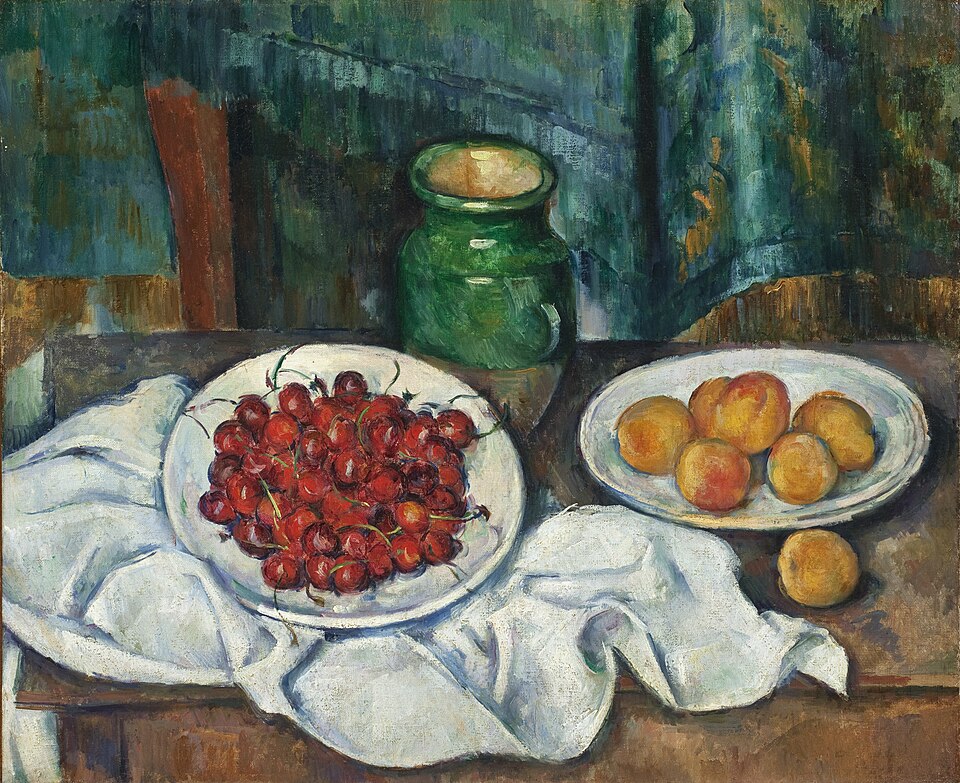
Cézanne did not paint still life as a window onto a stable world. He painted it as a field of forces. Traditional still life realism often aims to persuade: the viewer should believe the grapes are cool, the glass transparent, the table plane level. Cézanne’s paintings frequently refuse this comfort. Tabletops tip forward; plates seem to slide; edges fail to converge; objects appear seen from slightly different vantage points at once. These are not “mistakes” in perspective but deliberate acknowledgments that perception is mobile and time-based.
From an art-historical standpoint, Cézanne’s innovation lies in how he shifted the purpose of perspective. Renaissance perspective had promised a coherent space anchored to a single eye. Cézanne, working in the aftermath of Impressionism, treated space as something negotiated—built through color relations and structural adjustments rather than deduced from geometry alone. The still life’s enclosed setting—table, wall, corner—amplified these negotiations. A bowl becomes a compressed ellipse; a bottle stands upright like a measured axis; a cloth becomes a terrain of folds that both supports and destabilizes the objects.
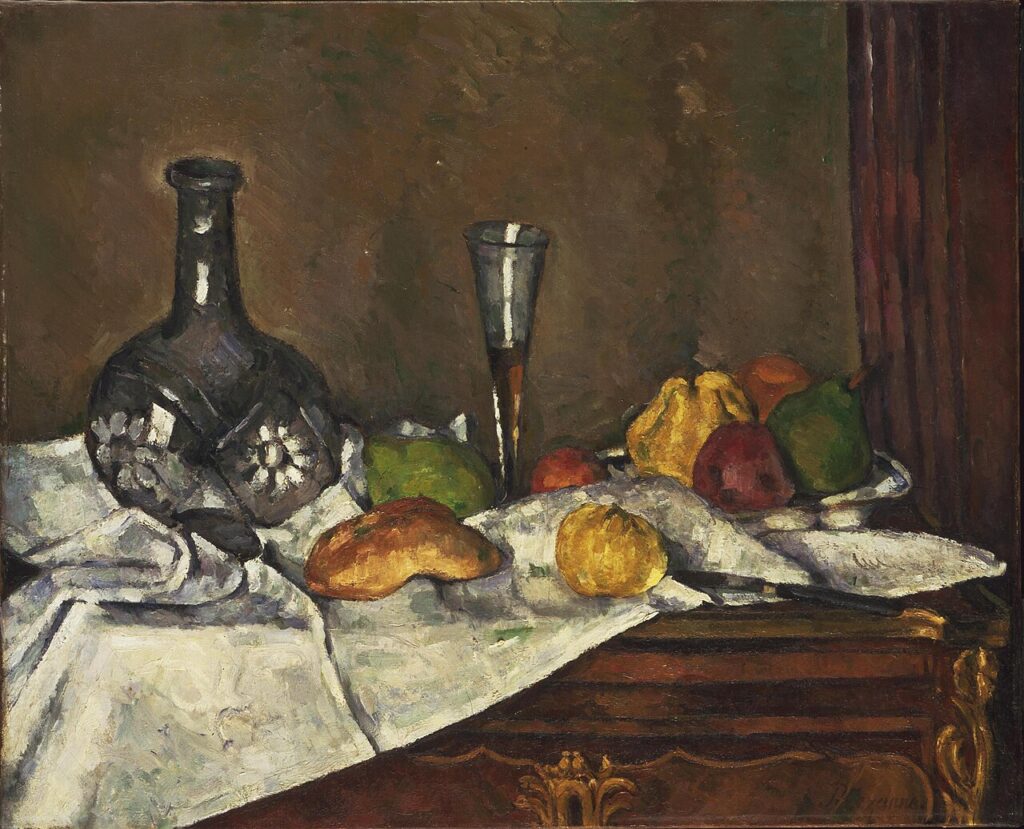
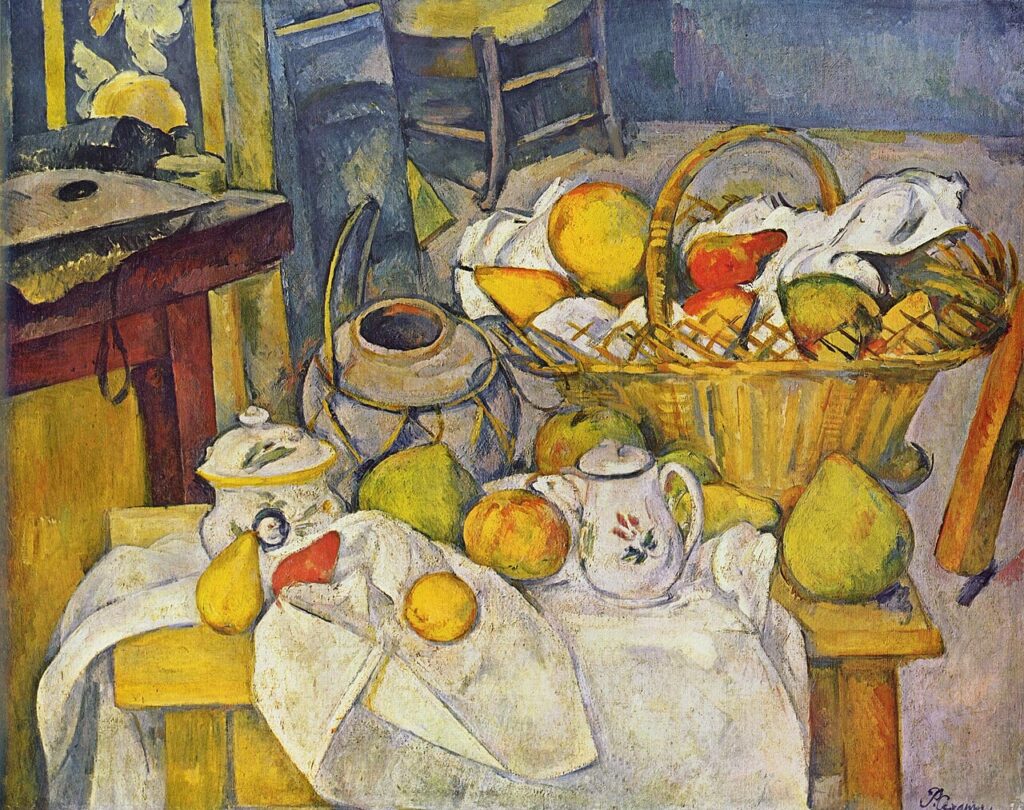
The “tilted tabletop” is among the most distinctive visual characteristics of Paul Cézanne still life paintings. In decorative-arts terms, the table is not merely furniture; it is a stage whose plane and edges define the painting’s architecture. Cézanne often exaggerates the table’s inclination to bring objects toward the viewer, intensifying the sense that composition is an arrangement under pressure. The effect is subtle but profound: the scene becomes less a depiction of a meal’s aftermath and more an inquiry into how forms maintain equilibrium.
Spatial tension also emerges from Cézanne’s balancing of masses. Apples cluster, separate, and re-cluster; bottles and jugs serve as vertical counters to horizontal plates; cloth folds create diagonal vectors. The entire scene is orchestrated like a stillness that is not inert but held—like a carefully tuned instrument. What looks calm is structurally alive.
Objects as Cultural Actors: Apples, Bottles, Cloth, and Ceramic Dishes
The everyday objects in Cézanne’s still lifes are often discussed formally—as spheres, cylinders, cones—echoing the well-known formulation (reported by later writers) that nature can be treated through these basic solids. Yet from a decorative-arts perspective, these items also carry cultural and symbolic resonance. Fruit—especially apples and pears—evokes abundance and transience, recalling the long European vanitas tradition in which ripeness implies decay. Cézanne rarely moralizes in the overt seventeenth-century manner, but the quiet awareness of perishability remains: fruit bruises, skins dimple, stems curl.
Table textiles are particularly revealing. Cézanne’s cloths are not neutral backdrops; they are complex, often white or patterned fabrics with heavy folds that create miniature landscapes. Their materiality suggests domestic laundering, linen cupboards, the tactile culture of the household. In the late nineteenth century, such linens signaled respectability and routine; in Cézanne, they also become vehicles for painterly construction—planes that tilt, catch color, and knit forms together.
Ceramic dishes and bowls in Cézanne’s compositions invite a connoisseur’s attention. Their rims, glazes, and profiles function as tests of curvature and reflection, but they also anchor the scene in ordinary dining habits. A simple plate is an emblem of use; a bowl is a container that frames and presents fruit like a curator’s plinth. Bottles—often wine bottles—hint at Provençal sociability and local agriculture, yet Cézanne treats them with near-architectural gravity, as if they were columns stabilizing the painting.
Even the basket—most famously in The Basket of Apples—has cultural weight. A woven basket is a vernacular object, tied to rural economies and craft traditions. Its weave is an index of handwork, and in Cézanne it becomes a challenge of depiction: an object defined by pattern, voids, and tension. That Cézanne sometimes allows such items to appear slightly “wrong” in perspective is telling: he privileges the painting’s structural truth over literal transcription.
Craftsmanship and Materials: Color Patches, Constructive Brushwork, and “Built” Volume
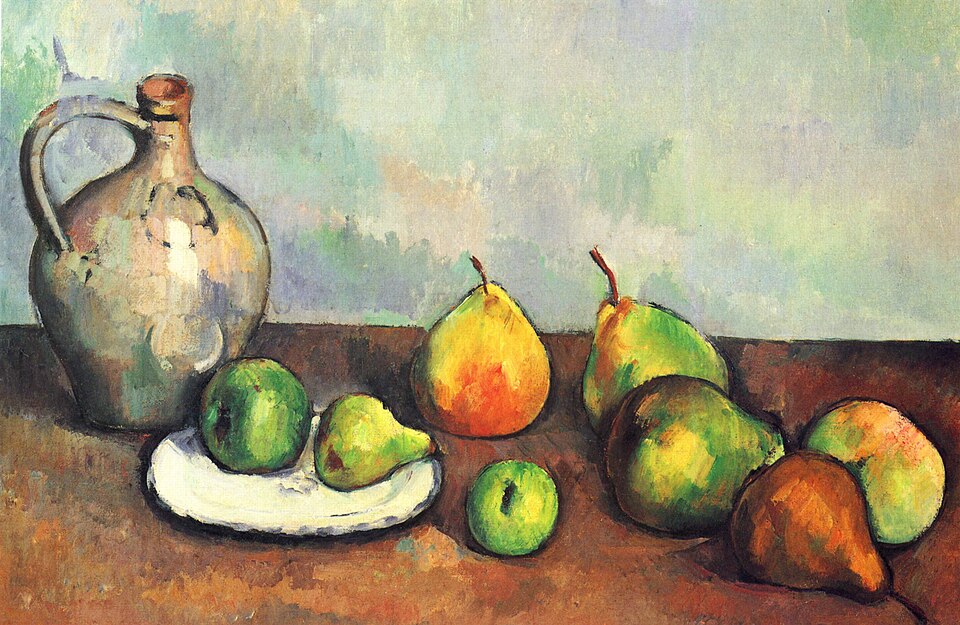
Cézanne’s still lifes are often described as a bridge from Impressionist color to modernist structure. Technically, his method depends on what might be called constructive brushwork: small, deliberate strokes or patches of color laid side by side to build volume. Instead of modeling an apple with smooth chiaroscuro, he constructs it through warm and cool shifts—greens into reds, ochres into blues—creating form by chromatic relation rather than by darkness alone.
This approach has implications for conservation and for our understanding of his craft. Cézanne frequently worked wet-over-dry, returning to passages to adjust relationships. Paint layers can be thin in places, more worked in others, leaving a surface that records decision-making. Under close examination (as one might in a museum study room), edges often reveal subtle corrections—outlines tightened, contours reiterated. The “unfinished” quality sometimes noted by early critics is, in fact, an index of process: the painting does not hide its construction.
The materials—oil paint on canvas—are traditional, but the handling is not. Cézanne’s color is not merely local (red for apple, white for cloth); it is relational. Shadows contain color; whites carry blues and violets; tabletops become fields of modulated tones. This is why reproductions can mislead: the true experience often lies in the minute calibrations between adjacent strokes, best seen in person under museum lighting.
From the standpoint of decorative arts, Cézanne’s craft resembles a form of “pictorial joinery.” Just as a cabinetmaker uses joints to hold a piece together, Cézanne uses color transitions to bind forms into a coherent structure. His still lifes are not illusions laid atop canvas; they are assemblies, built piece by piece.
Case Studies in Revolution: The Basket of Apples and Other Canonical Works
Among the most discussed Paul Cézanne still life paintings, The Basket of Apples (c. 1893) has become almost a textbook of modern pictorial tension. The bottle stands as a central vertical, yet the table edges do not agree; the basket tilts improbably; the plate at left seems to occupy its own perspective. And still, the composition holds—indeed, it holds more intensely because of these disjunctions. The painting dramatizes the act of arranging and seeing, making stability something achieved rather than given. Today it is closely associated with the Art Institute of Chicago, where viewers can study its subtle spatial “errors” as purposeful inventions.
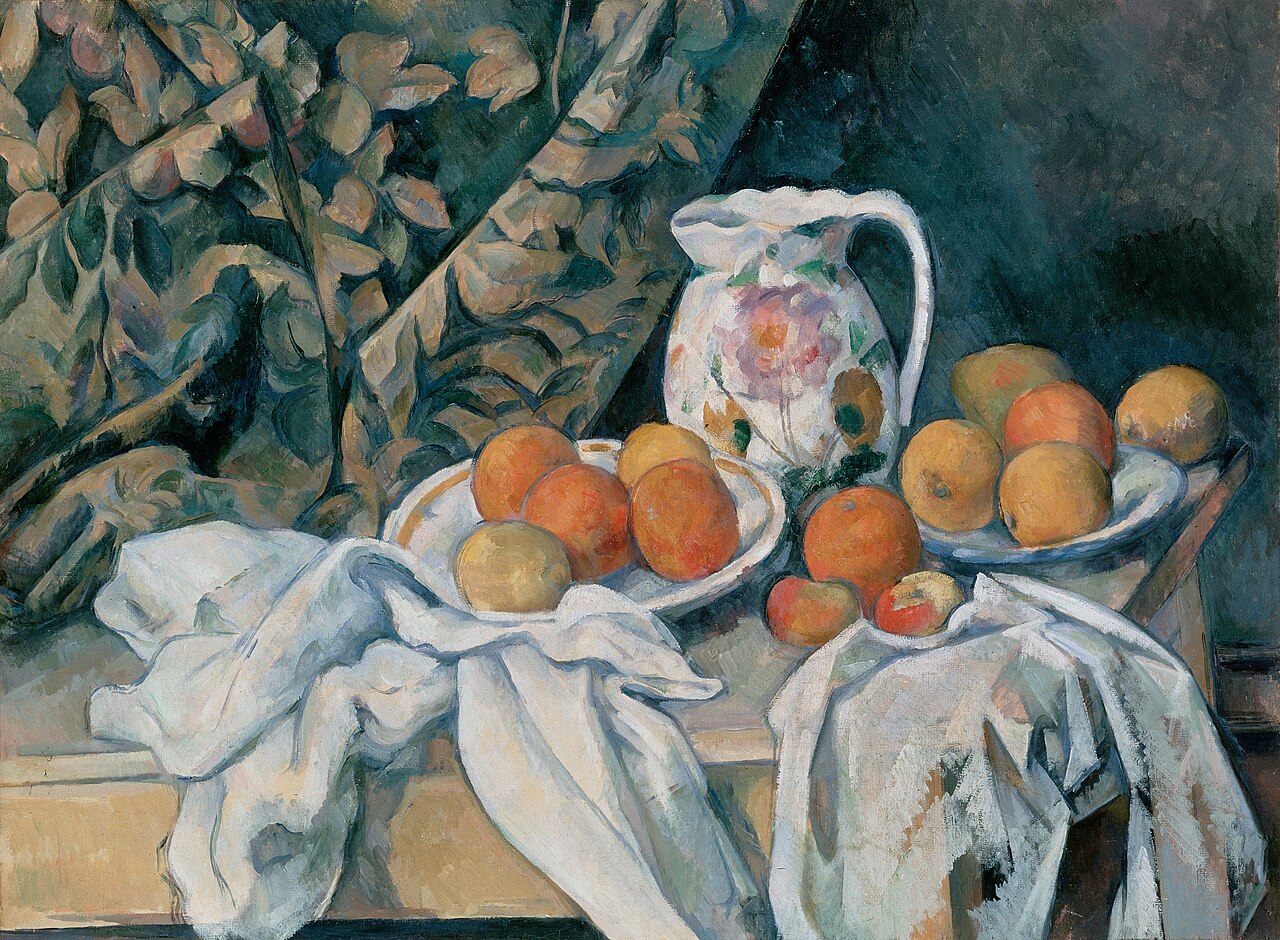
Still Life with Apples and a Pot of Primroses (c. 1890) offers a different register: the floral element introduces a fragile verticality and an organic irregularity that contrasts with the fruit’s weight. Here the domestic pot—an object of humble craft—becomes a focal point, and the cloth’s folds create a cascade of planes. The painting’s quiet drama emerges from how Cézanne orchestrates competing textures: matte fruit skins, reflective ceramics, absorbent cloth. The effect is less about depicting a tabletop scene than about staging a dialogue between materials.
Other fruit compositions—apples piled on plates, pears arranged near jugs, bottles flanked by folded linens—repeat motifs without repeating solutions. That repetition is historically significant. It suggests Cézanne’s still life practice was iterative, akin to a series of laboratory trials. He was not “illustrating” still life; he was investigating the conditions under which painting can organize sensation into structure.
For the art historian, these canonical works also demonstrate how Cézanne reactivated still life’s long lineage. One can sense echoes of Chardin’s gravity and Dutch still life’s attention to objects, yet the outcome is neither eighteenth-century intimacy nor seventeenth-century virtuosity. Cézanne’s achievement is a new kind of seriousness: a painting that admits the instability of perception while insisting on the permanence of form.
Influence on Cubism and Modern Art: From Apples to Picasso and Braque
The influence of Cézanne’s still lifes on later artists is not a vague claim of inspiration; it is visible in the mechanics of modern painting. When Pablo Picasso and Georges Braque developed Cubism in the early twentieth century, they intensified Cézanne’s spatial renegotiations into overt fragmentation. Cézanne’s multiple viewpoints—subtle in a tilted plate or a skewed table edge—became, in Cubism, a principle. His insistence that a painting’s structure could supersede optical correctness gave later artists permission to reimagine objects as sets of relationships rather than as single-view appearances.
Cézanne’s still life was especially fertile for Cubism because it already treated objects as durable forms in a confined space. A bottle is an axis; a guitar (later for Cubists) is a volume; a table is a plane. Cézanne provided not only motifs but methods: constructing form through planar shifts, using color to articulate structure, and treating composition as an engineered balance. One could say that the Cubists took Cézanne’s quiet tensions and made them explicit.
Art historians often note that Cézanne’s work was pivotal for modernism because it offered an alternative to both academic finish and Impressionist immediacy. His still lifes demonstrated that modern painting could be rigorous—analytical, even architectural—without returning to classical illusion. This is why museum narratives frequently position Cézanne as a bridge figure: not the end of tradition, but tradition remade as inquiry.
The cultural significance extends beyond formal influence. By elevating ordinary domestic objects into sites of philosophical and perceptual experimentation, Cézanne helped redefine what counts as a serious subject in art. In a modern world increasingly shaped by commodities and interiors, Cézanne’s apples and tablecloths quietly forecast the twentieth century’s attention to everyday life as a locus of meaning.
Museums, Archives, Restoration, and the Collector’s Perspective
Cézanne’s still lifes occupy prominent positions in major museum collections, where they function both as masterpieces and as teaching objects for the history of modern art. Institutions such as the Art Institute of Chicago (The Basket of Apples), the Musée d’Orsay (key works from the late nineteenth century), the Metropolitan Museum of Art, and others present these paintings as essential to understanding the shift from representation to modern pictorial construction. In study rooms and conservation departments, they also serve as technical documents—records of how an artist built form through color and revision.
From an archival standpoint, Cézanne’s correspondence—preserved and published in various scholarly editions—reinforces the sense of a methodical, questioning painter, concerned with “realization” rather than anecdote. While still life objects may seem mute, the historical record suggests an artist intensely verbal about his aims and doubts. Catalogues raisonnés and museum technical notes, often accessible through institutional libraries, form the backbone of trustworthy scholarship on these works, allowing provenance, dating, and technique to be evaluated with rigor.
Restoration insights are crucial for understanding both appearance and market perception. Cézanne’s surfaces can be sensitive: thinly painted passages may reveal canvas texture; varnish layers (sometimes added later) can alter the intended chromatic balance; old restorations may have filled cracks or adjusted tonalities in ways now considered intrusive. Modern conservation tends to favor minimal intervention, careful cleaning tests, and reversible materials, aiming to preserve the painter’s nuanced color relationships. For scholars and collectors alike, technical reports—when available—are invaluable, because Cézanne’s meaning often resides in precisely those subtle chromatic transitions most vulnerable to overcleaning or discoloration.
From a collector’s perspective, Cézanne still lifes occupy a rarefied tier of the art market. Demand is driven not by decorative appeal alone—though these works are undeniably compelling—but by their canonical status as foundations of modern art. Provenance becomes paramount: works with clear exhibition histories, early critical attention, and unbroken ownership lines carry scholarly and financial weight. Yet the market’s intensity also underscores a cultural reality: these paintings have become, in effect, shared reference points—objects through which museums and collectors participate in the custodianship of modernism’s origins.
Reference Table: Key Features of Cézanne’s Still Life Method
| Aspect | Traditional Still Life Aim | Cézanne’s Innovation | Why It Mattered for Modern Art |
|---|---|---|---|
| Perspective | Coherent single viewpoint | Multiple, subtly shifting viewpoints | Opened the door to Cubist space |
| Modeling | Chiaroscuro shading | Color modulation builds volume | Color becomes structural |
| Composition | Stable tabletop realism | Tilted planes, tension, recalibration | Painting as constructed object |
| Surface | Smooth finish, hidden labor | Visible strokes, revisions | Emphasized process and perception |
| Objects | Symbolic/virtuosic display | Everyday items as formal problems | Elevated the ordinary as serious |
Paul Cézanne still life paintings endure because they changed the terms of what a painting could be without abandoning the world it depicts. Apples, bottles, and folded cloth are not merely motifs; they are instruments through which Cézanne investigated how form emerges from looking, how color can carry weight, and how a composition can hold together under the stress of competing viewpoints. The quietness of the subject is part of the revolution: the smaller the drama of narrative, the more visible the drama of structure.
For cultural historians, these works preserve a material record of domestic life—objects of craft and use transformed into enduring forms. For conservators, they present surfaces where meaning is embedded in delicate chromatic calibrations and revisions. For museums and collectors, they remain touchstones—rare paintings that are at once historical artifacts, technical innovations, and foundational texts of modern visual language.
Cézanne’s still lifes still matter today because they teach a mode of attention that modern life often erodes: sustained looking, patient revision, and respect for the ordinary as a site of profound inquiry. In a world saturated with images, Cézanne’s apples remind us that the deepest innovations can occur on a tabletop, in silence, through the slow labor of seeing.
AI Notice: Some visual content in this article may have been created or enhanced using artificial intelligence (AI) for artistic, editorial or illustrative purposes. Learn more about our approach in our AI & Editorial Principles.