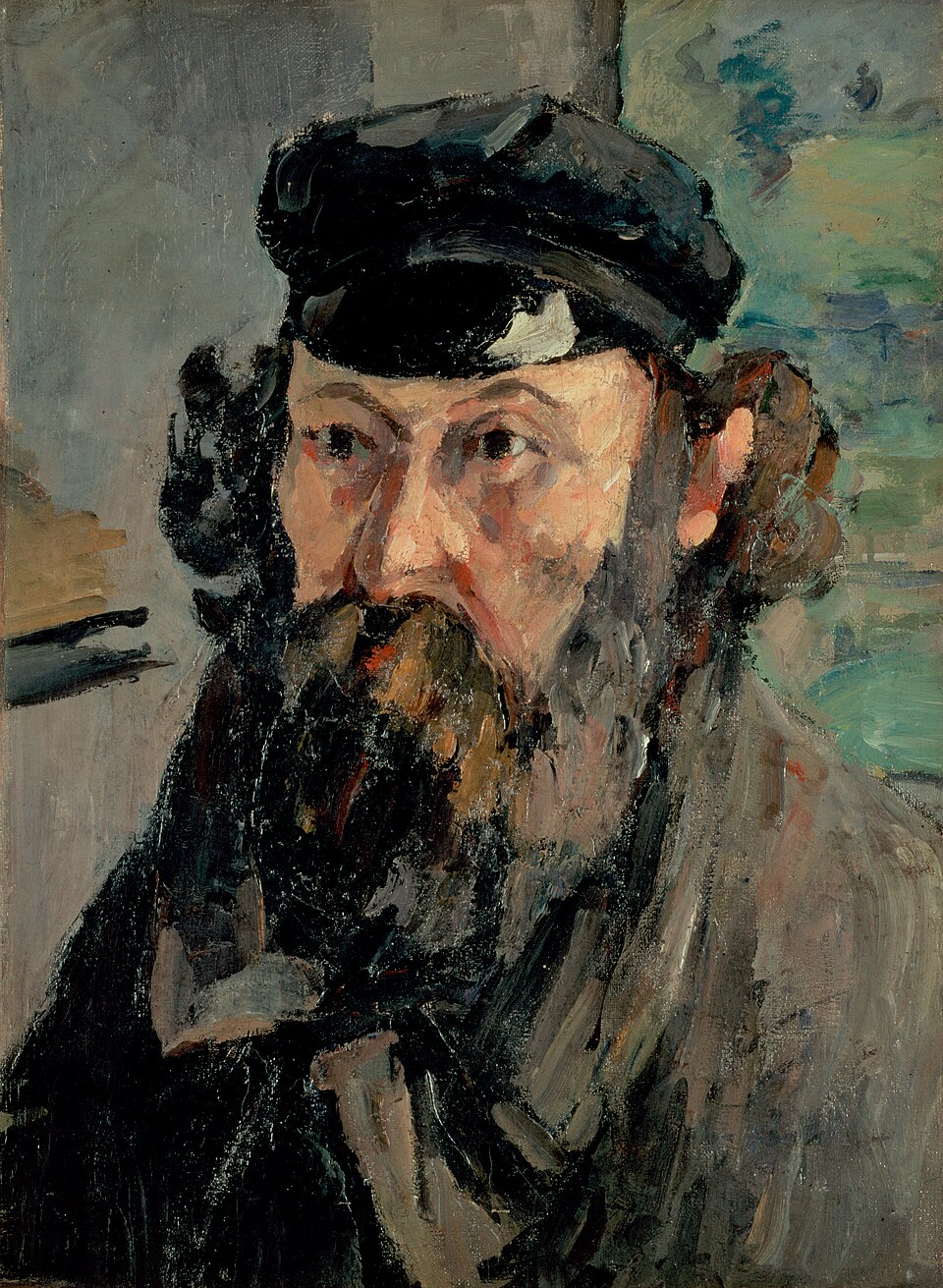
Paul Cézanne: The Quiet Geometry Behind Modern Art
Paul Cézanne (1839–1906) belongs to a precise historical hinge: born under the July Monarchy, maturing during the Second Empire, and working through the Third Republic’s upheavals, he painted across decades in which France remade itself politically and culturally. His native Aix-en-Provence—an administrative town ringed by orchards, quarries, and the limestone mass of Mont Sainte-Victoire—offered both provincial continuity and a distinct Mediterranean light that differed from Parisian atmosphere. This double condition, of distance from the capital yet constant awareness of it, shaped Cézanne’s temperament: an artist pulled between tradition and experiment, between a private, almost stubborn craft ethic and a modernizing art world increasingly organized by salons, dealers, and critics.
Cézanne’s early education was conventional and bourgeois. He studied at the Collège Bourbon (now Lycée Mignet) in Aix, where he formed a lifelong friendship with Émile Zola. His father, a successful hatmaker turned banker, expected a respectable profession; Cézanne briefly enrolled in law. Yet the local Musée Granet—still essential to Cézanne scholarship for its holdings and regional context—offered him an alternative education through Old Master painting and drawing. This matters historically: Cézanne’s “modernity” was never a rejection of the museum so much as a re-argument with it, a desire to re-found pictorial form on more stable terms than optical impression alone.
Can You Name the Masterpiece?
Ten masterpieces. Ten questions. How well do you know the history of art?
The crucial geographical turn came with his repeated moves to Paris in the early 1860s, where he confronted the city’s institutions and its avant-garde. At the Académie Suisse he met painters who would define the next decades, and he studied in the Louvre with the intensity of a craftsman: copying, comparing, and absorbing solutions of composition and weight from artists as different as Poussin and Rubens. Those hours in front of museum canvases—recorded in anecdotes and implied by the structure of his own work—help explain why his paintings often feel built rather than merely seen. Even at his most “Impressionist,” Cézanne’s attention returns to construction, to the anchoring of objects in pictorial space.
From a decorative-arts perspective, Cézanne’s Provence is not incidental scenery; it is a material culture of earthenware, patterned textiles, plain wooden tables, and sturdy household vessels. His later still lifes repeatedly stage humble ceramics and mass-produced tableware alongside fruit, suggesting a quiet archaeology of everyday objects. In these paintings, the domestic interior of late-19th-century France becomes a site where modern painting tests its grammar: how a plate tilts, how a bottle’s glass catches light, how cloth folds into a landscape of planes.
Between Impressionism and Its Discontents: Pissarro, Monet, and the Problem of Seeing
Cézanne’s relationship to Impressionism was intimate yet uneasy, and that tension is central to understanding his historical role. In the 1870s he worked closely with Camille Pissarro, particularly in Pontoise and Auvers-sur-Oise, where a more luminous palette and a steadier attention to outdoor light entered his practice. Pissarro’s example was not simply technical; it was ethical. He modeled a sustained discipline of looking, a commitment to painting directly from nature, and a confidence in the legitimacy of the new art outside the Salon. Cézanne absorbed these lessons but transformed them: he wanted the truth of sensation without forfeiting the permanence of form.
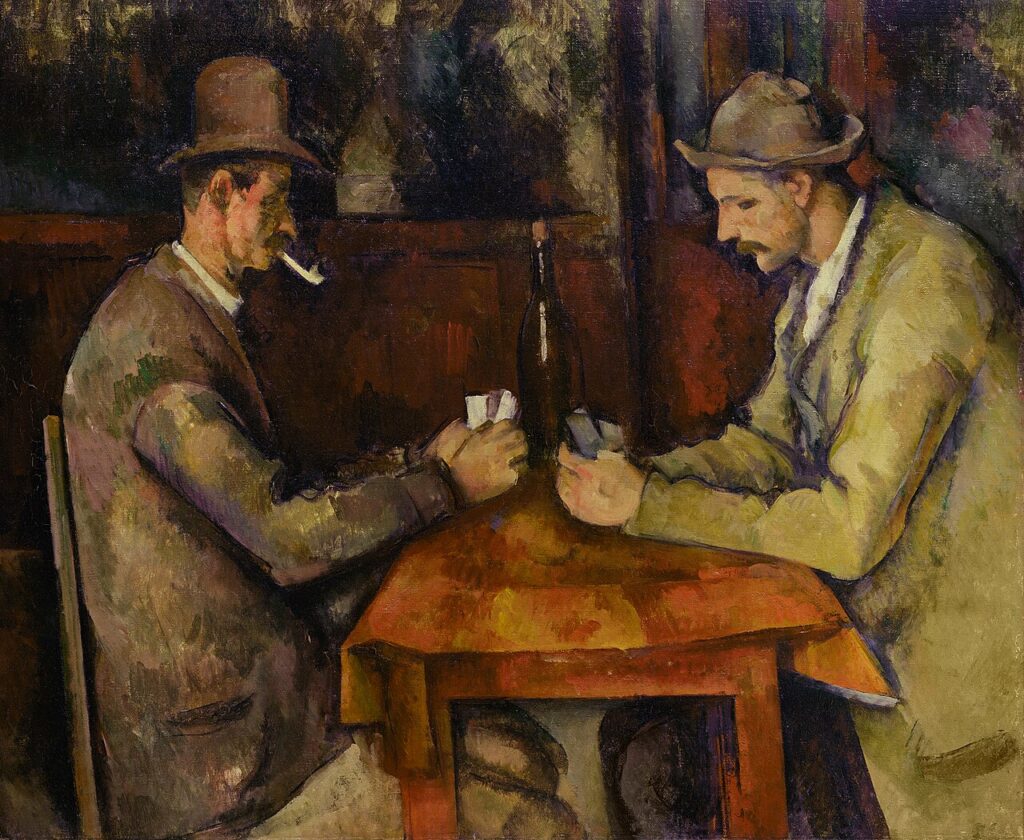
Can You Guess the Artist?
Three clues. One artist. How quickly can you identify the painter?
This is the point at which Cézanne separates from Claude Monet and several other Impressionists. Monet’s method pushed toward the instantaneous, the serial, and the atmospheric, emphasizing the fugitive effect and the dissolution of contour. Cézanne, by contrast, pursued duration—how perception accumulates and stabilizes. He repeatedly returned to the same motif not to capture varying weather alone, but to test whether painting could reconcile changeable sensation with structural coherence. His canvases can feel like slow arguments: brushstroke laid against brushstroke until a motif becomes inevitable rather than fleeting.
The social history of this period is equally important. Cézanne exhibited with the Impressionists in 1874 and 1877, and the critical reception was often derisive, treating his paint handling as clumsy or willfully crude. The hostility was not merely aesthetic; it reflected anxieties about class, taste, and the perceived threat posed by artists who refused academic finish. Cézanne’s work seemed to many viewers neither properly “drawn” nor properly “painted,” because it declined the smooth, hierarchical separation between line and color that academic practice taught.
Cézanne’s retreat from Paris—partial, never absolute—was therefore not simply a personal quirk but a strategic response to a hostile interpretive environment. By working in Provence, he placed himself at a remove from the critical theater, allowing a more private and methodical investigation. In modern art history this is often narrated as the myth of the solitary genius; an art-historical reading is more precise: Cézanne cultivated conditions under which a new pictorial language could be developed without immediate pressure to conform to existing categories.
The Quiet Geometry: Technique, Color Modulation, and the Craft of Construction
Cézanne’s innovations are often summarized by his reported aim to “treat nature through the cylinder, the sphere, the cone.” Whether phrased exactly so or transmitted through studio lore, the idea captures his reorientation of painting toward structure. He did not reduce nature to mere shapes; rather, he sought underlying volumetric coherence—how objects occupy space, how they turn, how they bear weight. This is why his trees, mountains, and apples feel simultaneously observed and built: he models their presence through a grammar of planes and directional strokes.
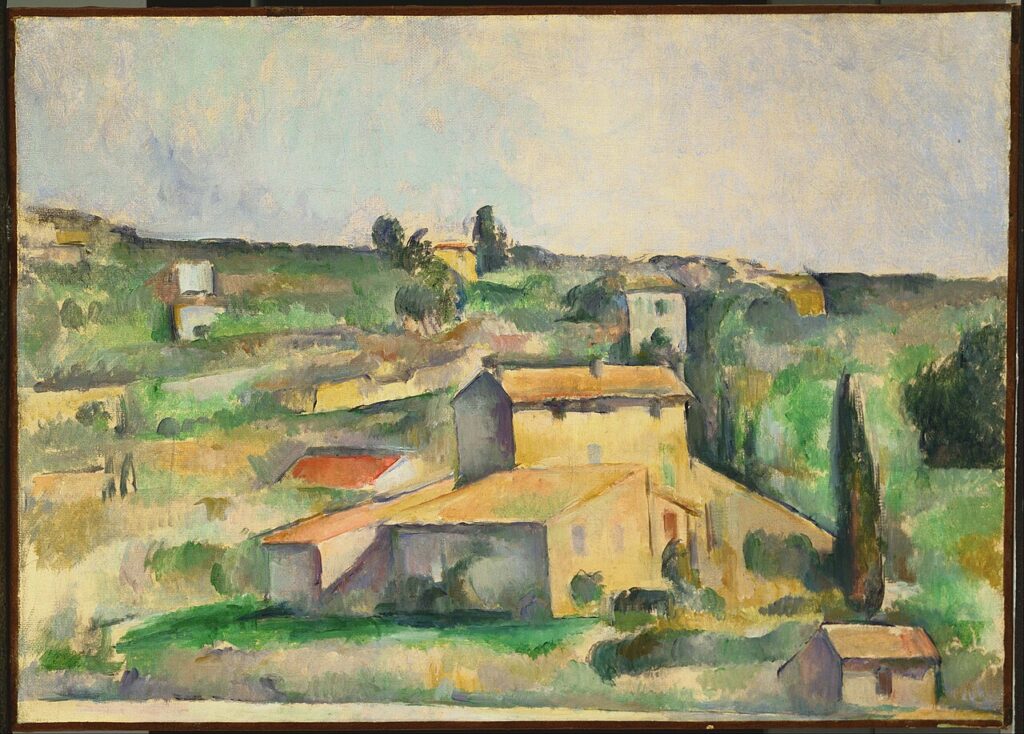
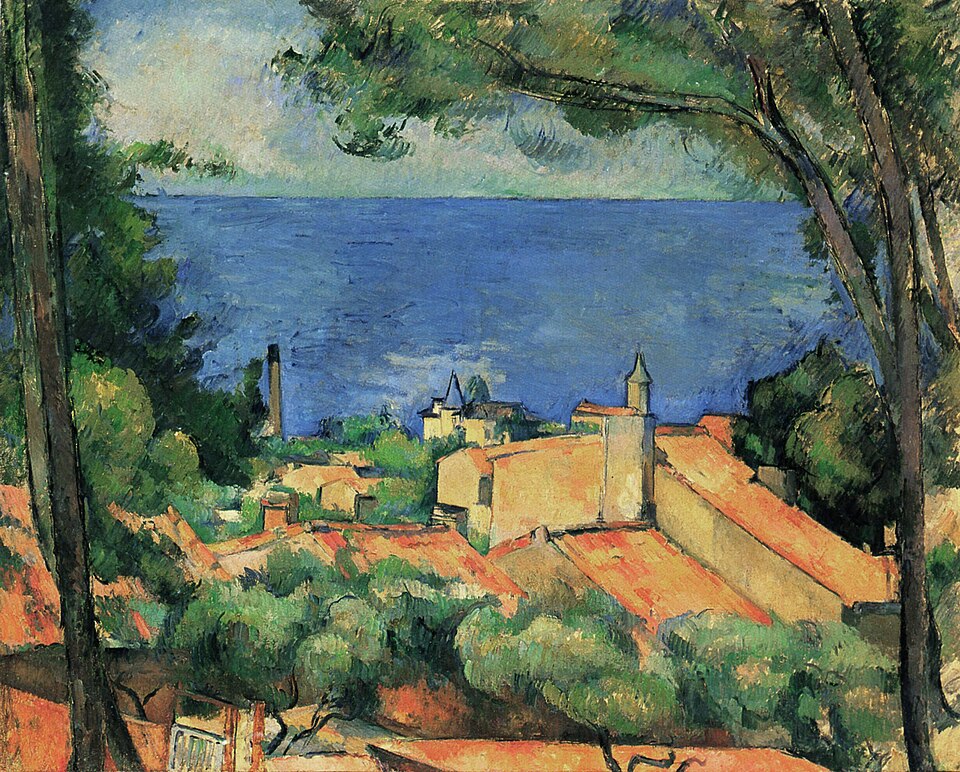
Technically, Cézanne’s layered brushwork—his “constructive stroke”—is a form of craftsmanship in pigment. He often placed adjacent touches of color that modulate slowly from warm to cool, light to shadow, without relying on black for depth. This modulation is not Impressionist shimmer for its own sake; it is an engineering of volume through chromatic relationships. A cheek, an apple, or a hillside becomes readable because color steps around form like masonry. The viewer senses a stability that does not depend on traditional chiaroscuro, but on calibrated shifts in hue and value.
Materials matter here, especially from the perspective of conservation and decorative-arts scholarship. Cézanne generally worked in oil on canvas, sometimes with commercially prepared grounds typical of late-19th-century suppliers, though his surfaces vary. His paint can be thin and aqueous in passages, then dense and reworked elsewhere. He sometimes left areas of canvas or ground visible, integrating the support into the image’s light. Such decisions affect how the work ages: thin passages are more susceptible to abrasion; heavily worked zones may show complex cracking patterns. Museums such as the Musée d’Orsay and the National Gallery of Art (Washington) have published technical studies that reveal revisions, shifts in contour, and occasional pentimenti that testify to an unusually prolonged, problem-solving process.
Cézanne’s compositions also complicate the inherited rules of perspective. In still lifes, tabletops tilt, plates seem to slide forward, and multiple viewpoints coexist. Rather than errors, these are deliberate structural negotiations—attempts to present a more comprehensive experience of looking, where the mind assembles a coherent object from successive perceptions. The resulting “instability” is, paradoxically, a higher order of pictorial stability: the painting declares its own construction, insisting that representation is an act of making, not a transparent window.
Motifs as Cultural Meaning: Mont Sainte-Victoire, Apples, Bathers, and Provence as Archive
Cézanne’s recurrent motifs are not merely personal obsessions; they are the laboratories in which modern form was tested. Mont Sainte-Victoire, visible from Aix and its environs, becomes in his hands a kind of secular monument—an emblem of permanence seen through shifting weather and vantage points. In canvases now dispersed among major collections (including the Courtauld Gallery in London and the Philadelphia Museum of Art), the mountain is less a picturesque landmark than an armature for investigating how architecture, geology, and atmosphere interlock. The motif’s repetition is methodological: each version recalibrates the relationship between contour and plane, between near and far, between the “readability” of a place and the autonomy of paint.
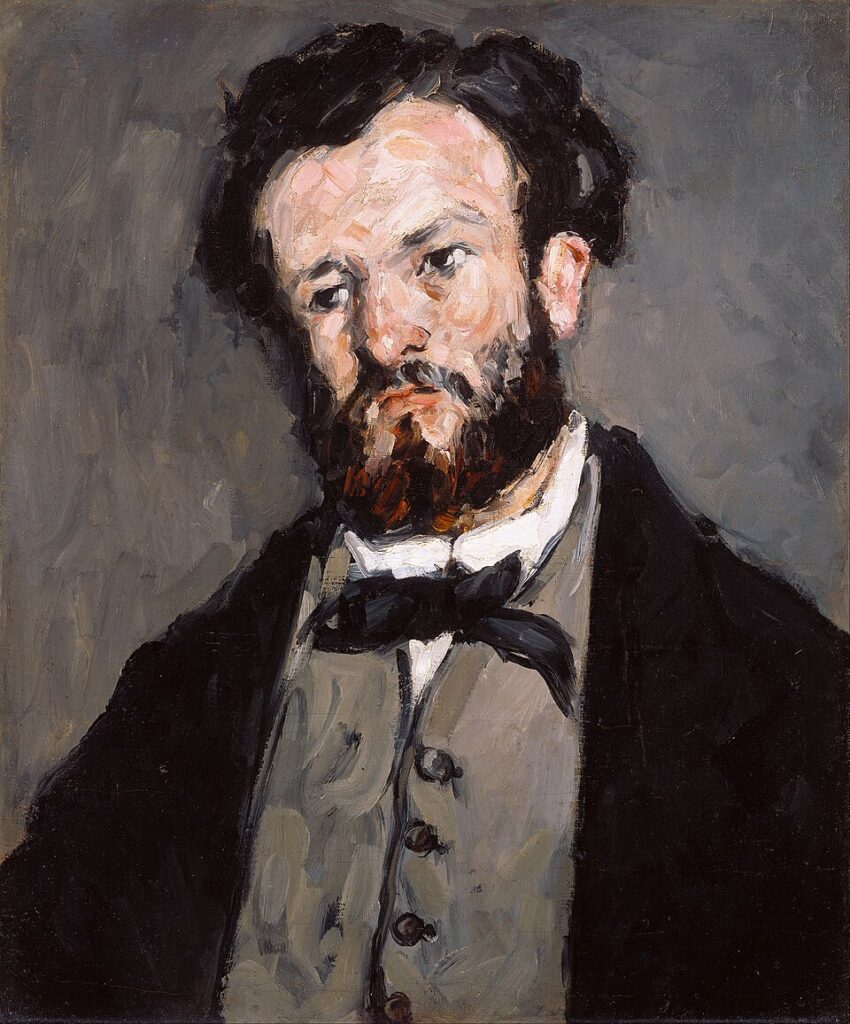
His still lifes—especially those with apples—are often discussed for formal reasons, yet they also contain cultural and symbolic undertones rooted in 19th-century domestic life. Fruit, table linen, and ceramic vessels evoke the bourgeois interior, but Cézanne suspends that world in an uncanny stillness. The apples are not merely edible; they are weights, volumes, and color-events. They suggest abundance without narrative, a material plenitude stripped of anecdote. As in the decorative arts, where the arrangement of objects signals taste and order, Cézanne’s arrangements are acts of placement and balance, yet they refuse the polished rhetoric of display. They are, instead, meditations on how objects “stand” in the world.
The bathers—culminating in large, late compositions—extend Cézanne’s structural inquiry to the human figure and to the inherited genre of Arcadia. But his Arcadia is tense. Bodies are simplified into interlocking forms, sometimes awkwardly, as if the classical ideal had to be rebuilt from raw perception. The cultural meaning here is double: Cézanne invokes the authority of the classical nude while quietly undermining academic finish. In the history of French art, this is a pivotal gesture—one that turns the figure into an arena for modern abstraction without announcing itself as a break.
Provence itself functions as an archive of modernity’s unevenness. While Paris proclaimed progress, the Provençal countryside preserved older rhythms of labor and landscape. Cézanne’s paintings do not sentimentalize this; they make the region a site where nature, settlement, and material culture can be studied with near-scientific patience. The quarry at Bibémus, for example, becomes an essay in ochres and planes, its cut stone echoing the faceted logic that would later resonate with Cubism.
Misunderstanding, Posthumous Recognition, and the Museum after 1906
During Cézanne’s lifetime, critical opinion lagged behind his achievement. He had supporters—dealers like Ambroise Vollard, and a growing circle of younger painters who sensed his importance—but broad acclaim was slow. The difficulty lay partly in the paintings themselves: they demanded a viewer willing to accept that “finish” could mean structural resolution rather than smoothness. They also demanded time, a kind of looking that 19th-century exhibition culture, with its crowded walls and rapid judgments, discouraged.
After Cézanne’s death in 1906, the acceleration of his reputation was rapid and historically consequential. The 1907 retrospective at the Salon d’Automne in Paris is frequently cited as a catalytic moment for the European avant-garde. In the museum-like space of the Salon, Cézanne’s canvases could be read as a coherent project rather than as eccentric outliers. This is a reminder that modernism was not only made in studios but also in exhibitions—through the framing power of institutions that teach audiences how to see.
Museums soon became central to Cézanne’s canonization. Today his works anchor narratives of modern art at institutions such as the Musée d’Orsay, the Metropolitan Museum of Art, the Art Institute of Chicago, and the Hermitage. Archival holdings—letters, dealer records, and early criticism—distributed across French repositories and international collections, have allowed art historians to reconstruct not only his stylistic evolution but also the networks that shaped his market and reception. Cézanne becomes, in this sense, a case study in how modern artistic value is produced through a triangulation of scholarship, institutional acquisition, and collector confidence.
Yet even as his fame rose, the interpretive problem remained: was Cézanne the last great painter of tradition or the first architect of modern abstraction? The most convincing historical answer is that he was both, and that his significance lies precisely in his refusal to choose. He made paintings that look backward in their seriousness about the museum and forward in their reengineering of pictorial space.
Influence, Collecting, and Conservation: From Picasso to the Contemporary Market
Cézanne’s influence on Pablo Picasso and Georges Braque is not a matter of vague inspiration but of specific pictorial lessons. Cubism’s fragmentation and reassembly of form can be read as an intensification of Cézanne’s multiple viewpoints and planar construction. When Picasso reportedly called Cézanne “the father of us all,” the phrase captures an art-historical genealogy: Cézanne offered a way to dismantle Renaissance perspective without abandoning the physicality of objects. Henri Matisse, too, learned from Cézanne’s color—its capacity to build form rather than merely decorate it—while pursuing a different emotional register.
From the collector’s perspective, Cézanne occupies a rare position: essential to the story of modern art, relatively limited in supply, and strongly represented in public museums, which both stabilizes and intensifies private demand. Works with secure provenance—especially those traceable through Vollard or early 20th-century collections—command particular scholarly and market attention because they anchor authenticity and exhibition history. The market’s interest is not simply monetary; Cézanne is collected as a foundational text, a work that legitimizes a collection’s narrative of modernism’s origins.
Conservation and restoration present their own insights into Cézanne’s working method. Technical imaging frequently reveals revisions: a shifted contour of a bottle, a rethought edge of a mountain ridge, a table line adjusted to re-balance the entire pictorial architecture. Such findings matter culturally because they counter the myth of effortless genius. Cézanne’s “quiet geometry” is a labor geometry, achieved through re-seeing and re-making. Restorers must also navigate the ethics of surface: removing discolored varnish can clarify Cézanne’s chromatic relationships, yet over-cleaning risks flattening the delicate transitions that carry his form. Conservation reports—often accessible through museum conservation departments and published case studies—become, in effect, auxiliary art history, documenting how the material object embodies the artist’s intentions and the passage of time.
In contemporary art history, Cézanne’s continuing importance lies in his model of painting as a system of relationships: between color patches, between object and ground, between motif and structure, between seeing and knowing. Even artists who do not paint—working in installation, digital media, or conceptual forms—inherit a Cézannian problem: how to construct meaning through the arrangement of elements in space, how to make an experience that is both immediate and intellectually legible. The “modern” in Cézanne is therefore not a style but a discipline of attention.
Conclusion: Why Cézanne’s Quiet Geometry Still Matters
Paul Cézanne matters today because he demonstrates how revolutions in art can occur without spectacle. His achievement was not the invention of a brand-new subject matter, but the retooling of painting’s internal logic: how color can build volume, how structure can arise from sensation, how a picture can admit its own making and still persuade. In an age that often equates innovation with rupture, Cézanne offers a different historical lesson—modernity as continuity under pressure, tradition reworked from within.
His landscapes, still lifes, and figures remain inexhaustible because they are both objects and arguments. They invite the viewer into the slow construction of form, into the subtle negotiations that hold a world together on canvas. Museums preserve them not as relics but as active propositions about how we see. Collectors pursue them not merely for prestige, but because Cézanne’s paintings are unusually complete documents of thought made material—craftsmanship that carries philosophy in pigment.
To study Cézanne is to encounter modern art at its point of quiet origin: not in a manifesto, but in a brushstroke that insists a mountain has weight, an apple has volume, and a painted surface can become a new kind of truth. In that insistence, the course of modern art did not simply change; it acquired a structure capable of holding the 20th century’s experiments—and still supporting our own.
AI Notice: Some visual content in this article may have been created or enhanced using artificial intelligence (AI) for artistic, editorial or illustrative purposes. Learn more about our approach in our AI & Editorial Principles.