
Vintage Glass Coffee Table Origins: Clues From Modernism
The vintage glass coffee table is best understood as the 20th-century answer to an older European tradition: low tables designed for sociable rituals—tea, aperitifs, cigarettes, books—performed in the shared interior. Even before “coffee table” was a catch-all term, occasional tables, nest tables, or tea tables in Western houses tended to be “busy” in their appearance carved wood, ornate veneers, or upholstered skirted legs. In the modern interior, however, openness, movement, and a clear sightline were at a premium, and the coffee table was one of the key tools in their creation. Once a decorative accessory, it became a deliberately flat, architectural form.
It started, with glass, as a supporting player. A protective layer over the inlaid wood of a table‘s top, or a display surface across some folded fabric. Glass‘s progression to center stage had something to do with the rational forces of modern design itself. If modernism aimed to foreground architecture and space, glass was an ideal and contradictory material for this purpose. It was there, and yet not there. It could create the appearance of a “there” in this abstract void without actually seeming substantial or bulky.
Can You Name the Masterpiece?
Ten masterpieces. Ten questions. How well do you know the history of art?
The Bauhaus, along with their European modernist counterparts, offered precedents. Marcel Breuer‘s furniture in tubular steel and the industrial push more generally opened up the possibility of domestic goods and engineering concepts feeding one another: chrome-like surfaces, modular frames, flat, clean facets. Though not all the classic early coffee tables were in glass, this era set the groundwork for glass as a modern surface an evolution of the window, the vitrine, the display case.
With the postwar era, from the 1950s and 60s until the 80s, the coffee table became another mass domestic living room centerpiece, and the material itself, glass, increasingly became the main event rather than an accessory. The modern coffee table was less a vehicle for drinks and magazines than it was a stage for contemporary living its surfaces reflecting the era’s enthusiastic belief in new materials, consumer choice, and the possibilities of the open plan home.
Mid-Century Modern and the Postwar Appetite for Lightness
For better or worse, the postwar home (at least in North America and Western Europe) favored light, clean surfaces, and casual layouts. It was both practical and philosophical. The newly-built housing and new patterns of family life demanded furniture designed for small rooms, for open-plan living spaces, for homes that were increasingly viewed through images: magazine photographs, catalog shoots, later, television. A vintage glass coffee table fit right into this mix, “disappearing” into magazine photos and yet conveying a sense of being modern and chic.
Can You Guess the Artist?
Three clues. One artist. How quickly can you identify the painter?
And in America, the living room served this same role: of recreation but also of display. The glass-topped coffee table presented an updated iteration of respectability: smart, sleek, simple to wipe off, and in sync with mid-century preoccupation with modern materials. The shiny surface, see-through, reflected car paint, washing machines and all the other glass and polished chrome accoutrements of the postwar age of abundance. The table could absorb the everyday practices of postwar life drinks, board games, album covers while also representing the optimism of the age.
In Europe, this meant the revival of glass furniture under influences specific to certain countries like Italy. The post-war boom of reconstruction and industrial innovation, combined with an Italian appetite for craftsmanship, created a fertile tension between the two in Italian design culture. Glass, with its long association with Venetian glass blowing, could be both ancient and modern, high culture but also, crucially, stylish. In Scandinavia, glass was a rare luxury, its purpose often to clarify rather than to add drama, with wood and texture dominating.
The spread of modernism through galleries, department stores, and exhibitions was crucial for glass‘s rise to prominence. MoMA in New York, to name just one example, used design exhibitions and acquisitions to sway public tastes, legitimizing modern furniture as part of a significant aesthetic tradition rather than a passing trend. Exposure to modern design in organized settings allowed consumers to interpret glass-topped tables as signifiers of a fully-realized modern interior as part of a language rather than an isolated product.
By the late 60s and early 70s, glass coffee tables were part of an expanded vision of modern domestic space large open interiors, the flexible comfort of low modular upholstery, and blurring lines between private life and public show. The modernist ideal of transparency in some homes veered into the decorative bronze, smoked glass, or mirror would often add a touch of glamour but the basic proposition held: a table to maximize perceived space and design.
International Influences: Italian, American, and Scandinavian Clues
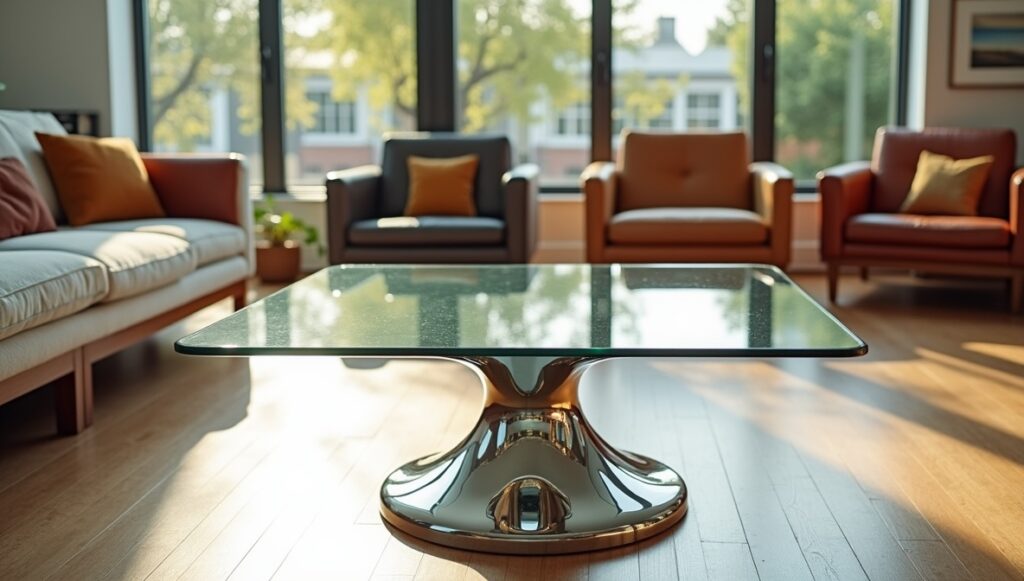
The other big influence on the vintage glass table came from modernism most notably from the Italian experiments with structure and silhouette. In the hands of Italian manufacturers, the table base is often Architectural Sculpture. A pediment, a stack of cubes or cylinders, interlocking chrome or steel shapes… holding the glass like a hovering disc. This is part of the grand story of Italian design from the postwar era captured in exhibitions and the archives of institutions like the Triennale di Milano, where furniture, architecture, and industry were presented as one cultural endeavor. There is a compositional flair, even theatricality, to Italian glass tables.
American modern furniture, born from mass production and the proliferation of sub-urban development, added another characteristic thread in the form of the glass top as a rational, reproducible element matched with a standardized metal or wood base. Brands and designers of the mid-century mode leaned into ratio and efficiency and mix-and-match logic for interiors. In the American home, glass topped coffee tables were often neutralizers that bridged seating and architecture bringing order to a room without making it feel too weighty. Glass “lightness” harmonized with mid-century low slung sofas and the increasing value of continuity from room to room.
By contrast, Scandinavian modernism made glass‘s meaning sharper. For the Danes, Swedes, and Finns, the ethic and the aesthetic was all about truthful materials, above all wood. And when glass entered the scene, it was used with extreme moderation: a narrow window over elegant joinery, or a simple top that made the glory of a wooden base readable. Less of an eye-popper, more of a clear view of how things join up, how weight is supported.
In all these zones, the vintage glass coffee table served as a locus for brokering the abstract visions of modernism against the mundane exigencies of everyday life. The glass‘s transparency implied openness, but it also afforded vigilance the capacity to inspect the particles, smears, and dust. A glass surface mediated the interior, it seemed to train good tidiness while showing that you were living a modern, design-conscious life.
To today‘s historian or collector, those foreign inspirations become “modernist clues” found on each object: the slant of a support, the plating of a brass fitting, the weight and edgework of the glass, how a base meets the floor. These are far from insignificant. They were the language by which modernism spoke of its ideals and remain intelligible today.
Craftsmanship and Materials: Chrome, Brass, Steel, Wood, and Acrylic
The vintage glass coffee table is rarely only glass. Its identity emerges from a conversation between a transparent top and an expressive support system. Chrome-plated steel and tubular frameworks, visually referencing modernist furniture before eventually aligning with all things postwar consumer chic, provided a gleamy, engineered shine. Brass added warmth and a richer register, particularly in interiors tinged with Hollywood Regency and the glam-modernist interiors of the 70s.
Wood bases complicate the story in interesting ways. A glass top might be like a lens, revealing the grain and joinery of the wood. In thoughtful execution, the wood elements are proportioned and balanced, sometimes even sharing the elongated and architectural flair common in the era of mid-century craft. The glass enables us to understand the base from above. Structure becomes the decoration instead of hidden underneath an opaque top.
Acrylic and Lucite bases that became ubiquitous from the 1960s onwards added a second transparency element. When both the tabletop and base were optically ‘light’, the table became almost visually dematerialised; a piece of furniture as ‘idea’ as much as a solid mass. This coincided with the plastics’ boom, the public‘s enchantment with the potential of new materials and interiors aiming to be uncluttered, hyper-modern. Now acrylic introduced its own peculiar ageing processes to the collector‘s assessment: yellowing, crazing and haze.
Inherent in craftsmanship are how the different parts join together the way glass butts against metal, where nuts and spacers go, how the weight is engineered to keep it from wobbling, the feet that protect the floor and steady it. Mid-century furniture can be found on a spectrum, from the highly thought out to the readily reproduced, a piece meant to approximate an appearance without having had the engineering to support it. To work on such furniture is to learn to look at the underside as closely as the top to look at the nuts and bolts, welds, screws and signs of wear.
The glass varied in color and treatment from clear, to smoked, to bronze-tinged, to sometimes textured. The material treatments and edge finishes beveled, polished, pencil rounded may signify age or quality. These material considerations were more than just stylistic, they often reflected the broader cultural taste the clarity and logic of the 50s, geometric expressiveness of the 60s, darker glasses and warm metallics of the 70s, to more geometrically sharp and postmodern designs of the 80s.
Styles in Form: Minimalist Modern, Sculptural Bases, and Geometric Language
So most minimalist modern glass coffee tables are based on the most straightforward proposition. A shallow rectangle or circle of glass held up by a modest armature. Such tables draw their force from balance and a controlled dialectic between line and void. This is furniture as building, with the modern, architectonic impulse to build for clarity rather than overwhelming the space: you see more of the room and the ‘style’ of the table is practically an ethical position: nothing gratuitous or obscured.
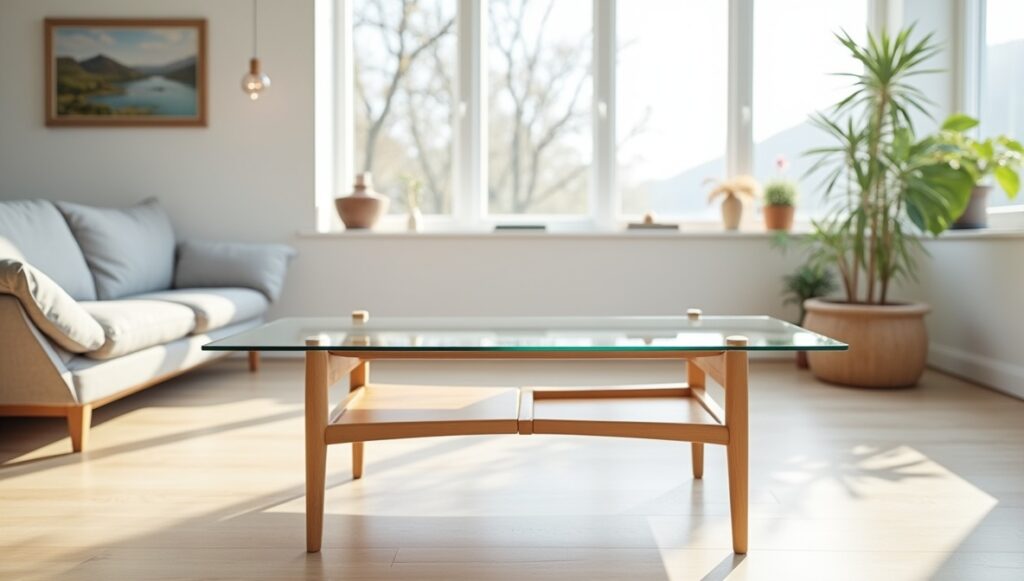
Sculptural bases is yet another direction. I like the kind of table that acts like a centerpiece in the living room a small monument. Its glass top becomes a vitrine, letting the base be examined from all sides. This was consistent with the post-war emphasis on biomorphism and abstraction and also reflects the living room being a stage-set. The object feels theatrical even in clear glass, because the base is inviting: interlocking wooden shapes, twisting metal, an abstract column of a pedestal.
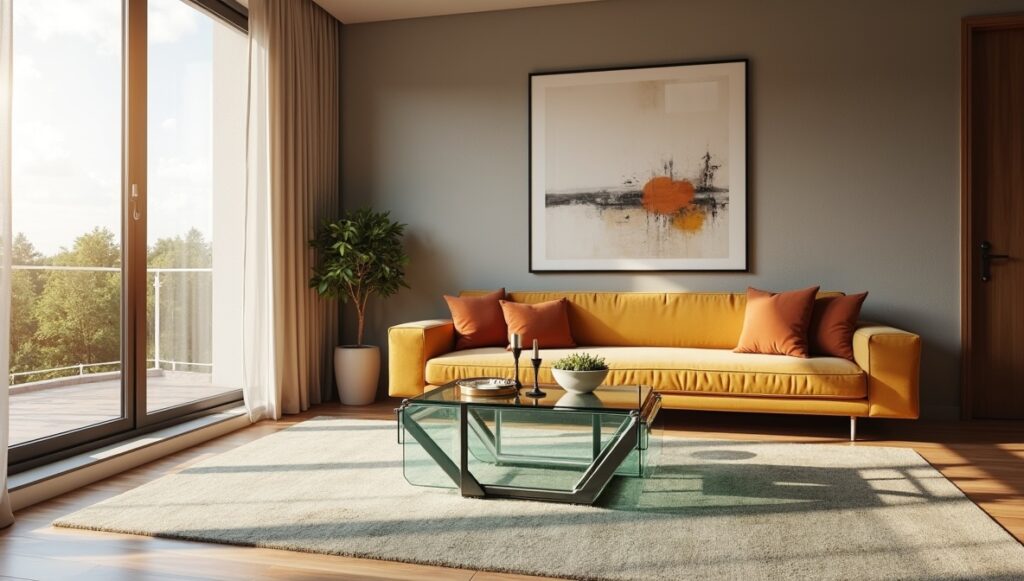
Shapes, always there, took on a new legibility in the postwar decades triangle, hexagon, layered planes, nested rectangles absorbing graphic design, architecture and eventually the Op Art-adjacent culture of visuals. Clear glass tops further emphasized the forms’ linear clarity and intersections with another visible layer. And in the ‘70s, smoked glass really came into its own, helping to imbue a table with all the atmospheric, moody vibes you crave in a smoky, darker world.
Those categories weren‘t rigid boxes they blended and overlapped with each other depending on interior design, production capacity and cultural wish-fulfillment. You could have a sleek chrome and glass table as part of a corporate modern milieu; a brass and smoked glass piece would say metropolitan lounging. Both qualify as “modern,” but they index different subcultures of modernity: one bureaucratic, the other aesthetic.
As a historian, style is evidence. It can contextualize something in time, its relation to a progression in taste from the confident simplicity of the ‘50s to the luxurious modernism of the ‘70s, to the geometry-led style of the late modern/early postmodern. This retro glass coffee table reads as a cultural signifier, as a snapshot of our expanding comfort zone and new ideas about the way we live.
Tempered Glass and the Engineering of Domestic Safety
And tempered glass really did let designers get greedy about what they could ask of a coffee table. For a while, a glass-topped table would need to be smaller to avoid being too precarious to edge against, and a large piece was really a luxury you didn‘t throw daily confidence at. But tempering adjusted that social contract you could get a big slab and use it without the existential dread of a catastrophic shattering, making it more of a central architectural feature.
The gain in robustness also opened up possibilities in terms of styling. Furniture could have thinner profile without compromising stability to create a more ‘floating’, contemporary plane. Edges were sharper, corners sharper. The glass top could be disproportionately large for the base to give the illusion of hover. The fact that the classic glass coffee table is still stylish is due to precisely such technical wizardry, which older furniture so rarely took chances on.
These changes in how glass was produced transformed public attitudes to the material. It no longer functioned solely as a fragile, ornamental surface but was perceived instead as an everyday material to be trusted as much a part of the postwar story of technological development as everything else in the modern home. With the increasing standardization, safety, and predictability of home furnishings (from more child-friendly materials and standardized parts to a greater reliance on engineered goods), the coffee table became the test case for these attitudes.
As a collector or restorer, tempered glass can be both blessing and bane. Most pieces can be found, or remade, with new glass. But will that new glass have the original thickness, tint, edge shape and corner radius? Some mid-century glass is also tinted, either greenish edges in clear glass, or particular bronze-smoky tones. Often, an accurate reproduction is educated guess rather than a faithful copy.
So technology isn‘t a postscript, it‘s a source of form. In fact, the mid-century glass coffee table is a perfect case study in how material science can make the principles of modernism airy, rational, and unburdened the norm instead of the unusual.
Identifying Authentic Vintage Glass Coffee Tables: A Collector’s Method
Authenticating a vintage glass coffee table begins with disciplined looking. Labels, brands, maker‘s signatures are nice, when they‘re found, and when they‘re actually original, as many high-quality mid-century pieces were originally left unmarked, and trademarks disappear after refinishing and reupholstery of surrounding furniture. So collectors have to trust the construction methods themselves. How is the table welded? What‘s used for fasteners, how precise is the machining, how does it all fit together?
Glass details are one of the most useful pieces of evidence available. The thickness of the glass can give you hints about its quality and age the quality of the edge finishing can give you insight into how a table was manufactured. A sharp, finely polished bevel suggests a high-quality example; crudely finished edges and asymmetrical corner rounding can hint at a replacement or later table. Glass color can also inform.
Similarly, the base demands attention. Chrome in the middle of the century generally has a predictable wear pattern micro-pitting, dull spots in areas touched and worn, and rust at tension points. Brass typically tarnishes, and its patina tends to be hard to replicate in an authentic way. Look at the wood bases to check grain and joinery: during mid-century production wood was often used with veneers, understanding where the veneer should be (and where solid wood is still a possibility) can help identify a false signature. Acrylic bases have their own pitfalls: there should be stress cracks where bolts hold things together, and the acrylic should develop a patina similar to how you would expect a base to develop from decades of wiping and light exposure.
A table‘s provenance how it was acquired, if it belonged to an original family, and whether or not there are original photographs can bolster an attribution, but it seldom supplants proof from the object itself. A good habit is for dealers to line up and cross-reference tables with known examples found in archives, old ads, museum holdings, MoMA and Vitra Design Museum collections, catalogs of exhibitions, and design journals; libraries and design school libraries often keep files of ads and journals.
In the end, for this category, authenticity means “believable period manufacture” and not usually a famous designer, although the market tends to inflate designer-ship. Often the best examples for documenting the history of the modern interior can be factory pieces that were created by talented mid-century factories in an anonymous way.
Condition and Conservation: Scratches, Replacement Glass, and Stability
Issues of condition come with the terrain of glass as a material for a surface. Use scratches – mug, grit from magazines, metal ashtray will start to appear under raking light as a dulling of the clarity of the surface. Scratches on glass are unlike, say, patina on wood or brass; it seldom reads as character, but instead suggests damage. Good dealers will show you the table in sidelight. Good collectors should ask to see it.
Replacement glass is fine don‘t discard something on that basis alone but it needs to be evaluated fairly. A replacement pane of the same dimensions but a different thickness, tint, or edge profile can change the whole aesthetic of the table. In terms of conservation, good replacements are those that simulate era qualities but are not presented as originals. Keep records, such as receipts, notes from a glazier, or photographs of the pre-replaced state, for potential future buyers.
The secret problem may be structural. The joints of the metal base might be loose; the welds could be failing. The wood may have dried out and shrunk, ever so slightly altering the geometry in such a way that your glass is not perfectly level. Acrylic can become stressed and form cracks especially when screws pass through it and where the base carries weight unevenly. Glass tabletops bear weight differently than wooden ones, so even minor instability can become significant, leading to wobble, rattling, and dangerous pressure points along the edge.
A restoration should be done with all the care of a conservator. If you aggressively polish glass, you can deform its optics or change the way the edges were originally made, if you buff a piece of metal too hard, you can take off the plating; if you resurface wood, you can eliminate all evidence of the original shaping tool and the surface finish it imparted. For most experts, the ethos is minimal intervention: stabilize if needed, clean gently, and leave traces of its origin. When you do have to alter a piece to make it safer add a pad or a new rubber separator, for example make sure it‘s reversible and document everything.
A vintage glass coffee table that has been properly restored is still functional, and can still be read historically. That means making it look not fresh off the factory floor, but as physically intact and conceptually whole as possible while honoring the material reality of its patina.
Styling Vintage Glass Coffee Table Today: Continuity Rather Than Revival
Today, a vintage glass coffee table is a bridge between ages. In minimalist interiors, it continues the modernist experiment in “transparency”: it leaves the view open and does not clutter the center of the room with solid objects. In eclectic, densely layered spaces, it acts as a flat neutral field, on the background of which fabrics, books and objects can be perceived without extra color and textural conflicts.
These days, collectors and designers opt for glass tables to help pack more density into the same space. You can create a more airy environment with lots of seating, like in a room with plenty of seating plush sofas, busy patterns, thick curtains if the coffee table is transparent. It‘s not simply a matter of trompe l‘oeil. The piece is functioning the same way it did that day to make a crowded, modern existence look light.
And meanwhile, the antique glass coffee table has developed a second connotation. The implication of its presence is that the homeowner is ‘aware of history.’ That‘s if it‘s a particular table the home is related to those mid-century and postwar design stories. Even if its designer isn‘t known, it still refers to those stories. It‘s like quoting modernism; you know it when you see it.
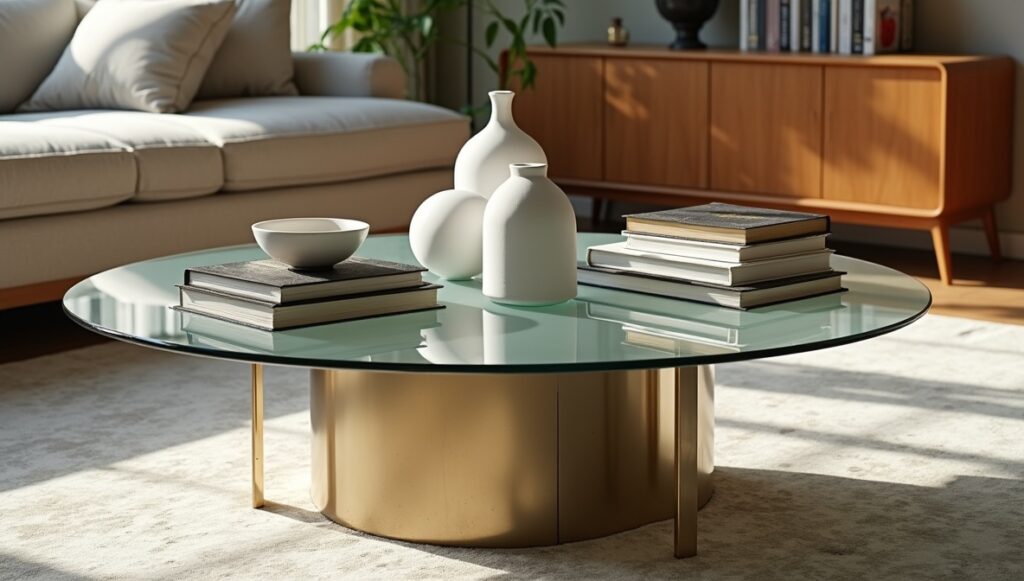
This is where most people‘s styling skills get involved: styling with an awareness for the materiality. For example, glass is unforgiving, so you‘ll want to be deliberate with what you place: a petite stack of books, a ceramic bowl, a single tray. Historically, coffee tables once held magazines and ashtrays. Today, you might see more art books and sculptural objects, but the function remains a curated representation of home life.
And what‘s amazing is how much of the reasoning behind it is the same. This old glass coffee table is still an instrument for composition: an object by which we can see the room, make visible our daily habits, and which transforms the void into something substantial by being empty.
Market Interest, Demand, and Price Ranges for Well-Preserved Examples
Collector demand for the vintage glass coffee table is shaped by a combination of aesthetics, condition, and attribution. While signed designer-makers and marked manufacturers tend to fetch top dollar, many collectors (particular interior designers interested more in “right” than in “by whom”) prize quality of construction, good proportions, and authentic materials from the period. And “right-looking” anonymity is “what the market has been trained to appreciate,” says Schipper.
Generally speaking, table prices fluctuate wildly from region to region, and from object to object. Anonymous, unmarked mid-century tables of glass and metal in sound, original condition, can be found in the low hundreds to low thousands range (USD equivalency), whereas very special examples, especially those with carved or sculptural bases, unusual dimensions, or a provable history, can command a much higher price. Condition can play as important a role as designer; a stunning table with the original glass deeply scratched, or featuring the wrong replacement glass, may fetch less than a plainer one, if the glass remains in place.
These are things that have the most reliable market: balanced tops, good working of the metal elements and the quality of the edges and the stability of the base. Smoked glass and brass have their moments (when interiors favor warmer, moodier aesthetics). Clear glass with chrome or steel will always be a winner because it works with almost any style. It‘s modern, but not retro-mod.
Owners must also consider the tangible ownership expenses. Moving such pieces carefully, packing them professionally, replacing glass that has chipped or broken (which can be more than for plain glass, in the case of tempered pieces) are all real expenses. Pieces that are unusually large or have complex tops can be more difficult to insure, ship, and, consequently, have more limited markets.
For any historian, what interests the market is itself a cultural document. The focus of renewed interest on the vintage glass coffee table tells us something about modern obsessions with authenticity, reuse and the material flow of household life. Collecting, then, offers itself up as a kind of vernacular preservation of modern design history.
Why Vintage Glass Coffee Tables Still Matter
The vintage glass coffee table endures because it materializes a central modernist ambition: to make space feel freer without abandoning comfort or everyday use. In homes, glass topped tables translated the architectural philosophies into spaces that were relatable, if elevated. Suddenly the household was part of a larger culture of modernity and good taste.
As well, these artifacts provide interesting documentation of change. Technology (tempered glass), industry (post-war fabrication) and sensibility (from spare to sculptural) can all be tracked through them. They can show us how global languages of design (Italian exuberance, American common-sense, Scandinavian restraint) could converge around the same piece of furniture, each leaving its subtle signature in shape, finish, and method of construction.
To collectors and keepers, the allure is tied to responsibility. Glass tables, after all, invite a sober self-appraisal of condition and a conservative attitude to repair. Well cared for, they will preserve their design intelligence, the intricate interplay of plane and pedestal, the precise thickness of material, the delicate way they choreograph light within a space.
In the end, vintage glass coffee tables matter today for the timeless truth they have to teach us about the nature of contemporary design that often the biggest, most unsettling shifts in our everyday routines are not heralded by monuments, but by common, everyday things clear flat things at the center of the room which sustain everyday rituals and make the rest of our surroundings new again.
AI Notice: Some visual content in this article may have been created or enhanced using artificial intelligence (AI) for artistic, editorial or illustrative purposes. Learn more about our approach in our AI & Editorial Principles.