
Vintage Lexington Furniture: Tracing a Collector’s Clues
Vintage Lexington furniture has a very American story, in the long history of industrial craft in the Piedmont South, a place where raw wood, railroads, and a pool of able-bodied workers all aligned to make North Carolina the epicenter of furniture production in the United States. The place-name Lexington, North Carolina which became shorthand for the factories and showrooms spread across the region took on a certain symbolic weight in the national American home-furnishings imagination, its identity constructed around a thick network of mills, finishing shops, pattern shops, and upholstery workrooms that catered to a national craving for “quality furniture” as America‘s middle class grew in the early and mid-20th century.
It‘s from this ecosystem that Lexington Furniture emerged as a corporate enterprise and rose to widespread status in those mid-century years when domestic life shifted into the home around a fresh regime of cleanliness, comfort and show. A period of consolidation that witnessed furniture makers grow through mergers, acquisitions and a wide mix of products, Lexington‘s public persona was predicated on a sense of endurance: that tradition of regional crafting and expert finishing could endure in an ever-nationalized market. It‘s this tension between local production and widespread distribution that makes vintage Lexington pieces at once particular (materials, joinery) yet all-American (a certain stylistic compromise.)
Can You Name the Masterpiece?
Ten masterpieces. Ten questions. How well do you know the history of art?
The 1940s–1980s is the main hunting ground for the collector for the simple reason that it covers the wartime rationing and subsequent boom, the suburban house, and then the advent of decorating for lifestyle. Post–WWII furniture producers enjoyed the backlog of pent-up consumer demand, plus increased suburban housing and expanding retail options. Lexington‘s product planning during this time charted a back and forth between periods referencing history typically presented as “proper” and comfortingly familiar and then more “modern” designs suggesting the efficient and lightweight feel of looking ahead. It‘s less a contradiction, more a timeline of how American taste wrestled with modernity.
For those interested in getting documentary footing, knowledge about Southern furniture manufacturing generally is readily available in collections such as the High Point Market and from regional collections that interpret North Carolina‘s industrial design history. Museums such as the Thomasville History Center and the North Carolina Museum of History (Raleigh) also can provide material culture context on how furniture manufacturing in North Carolina fit with labor history and consumer culture. Although the archives of a particular brand might not be available, the state‘s museum and research infrastructure is useful in contextualizing Lexington‘s production within American decorative arts in the 20th century.
Craftsmanship, Materials, and the Reputation for Durability
When talking about quality craftsmanship in vintage Lexington furniture, we‘re talking about these inter-locking mechanisms that lead to sustainability: dried woods, secure case joinery, durable joins, and glazes and finishes designed for a working life. Mid-century American furniture was by no means “handmade” as understood in the pre-industrial era, but it wasn‘t disposable either. It often lived in that in-between place where machinery offered precision and repeatable assembly, but artisans still provided human insight at crucial moments: fitting drawers and doors, sanding, toning, rubbing out finishes and installing hardware. Collectors often mistake this in-between nature for a lack of craft; this was, in fact, a very modern conception of craft, and that of precision.
Can You Guess the Artist?
Three clues. One artist. How quickly can you identify the painter?
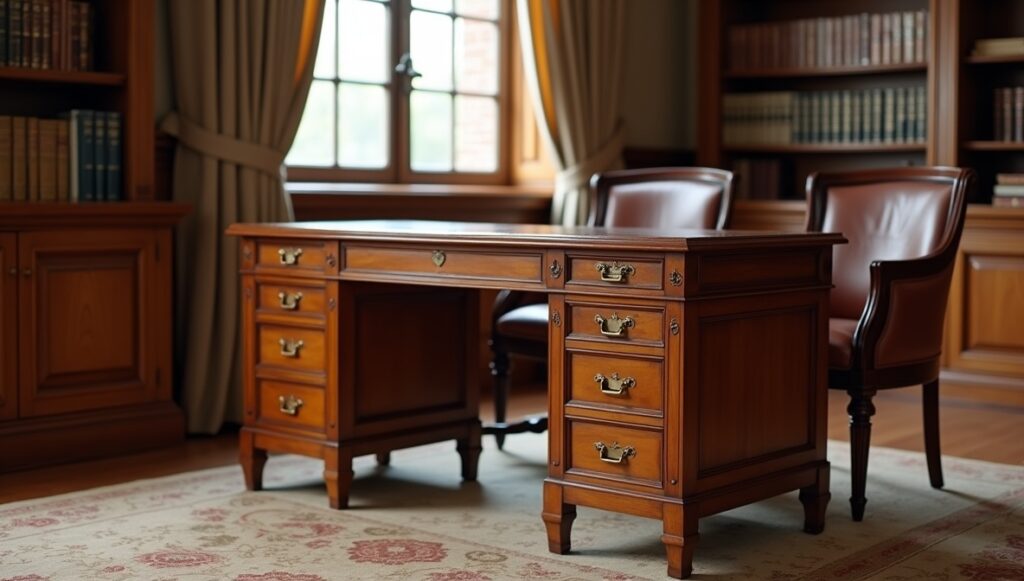
There is a signature hardwood-and-veneer mark left on a lot of Lexington furniture. Solid wood is present (oak, walnut, cherry), as are veneers, often in tandem. A solid oak top with a walnut veneered skirt and drawer fronts, for example. Solid at edges and stress points; veneer for a smooth, stable, attractive surface. No, veneer is not lesser quality. Good mid-century veneering made it possible for makers to display figured wood (a walnut crotch, cathedral oak, ribbon mahogany) over wide areas without issues of cupping and warping which can affect wide solid-wood planks. The hidden engineering why case pieces last longer.
Also, we need to consider the construction. Drawer boxes might have thicker sides, joinery that is identical on every drawer (whether finger joint, dovetailed, or otherwise mechanically connected, depending on the line and period) and dust panels or frames that suggest thought went into building for substance, not style. Even as newer decades brought more cost-conscious practices, any surviving object that boasts features such as drawers with smooth glides, doors hung with consistent alignment, and casework that doesn‘t easily rack should suggest careful engineering. It‘s worth judging such things, not on brand mythology, but on the visual evidence underneath the piece, on the backs, and inner architecture that we‘re unlikely to see at a distance.
The finishes often lacquer in mid-century American production are as much a part of the look as of the accumulation of wear that collectors learn to read as stratigraphy. Toners and shading were added to even out grain and enhance color, to lend a patina of age or formality to new pieces. Lexington, you will note, has a number of pieces that look “worn-in” from day one; a patina of taste, not use. Sunlight, polishing regimes and daily life add further layers of meaning over time: rings, fading and softened corners mark not just damage, but a history of use.
Collections and Style Currents, 1940s–1980s: Tradition Negotiates Modern Life
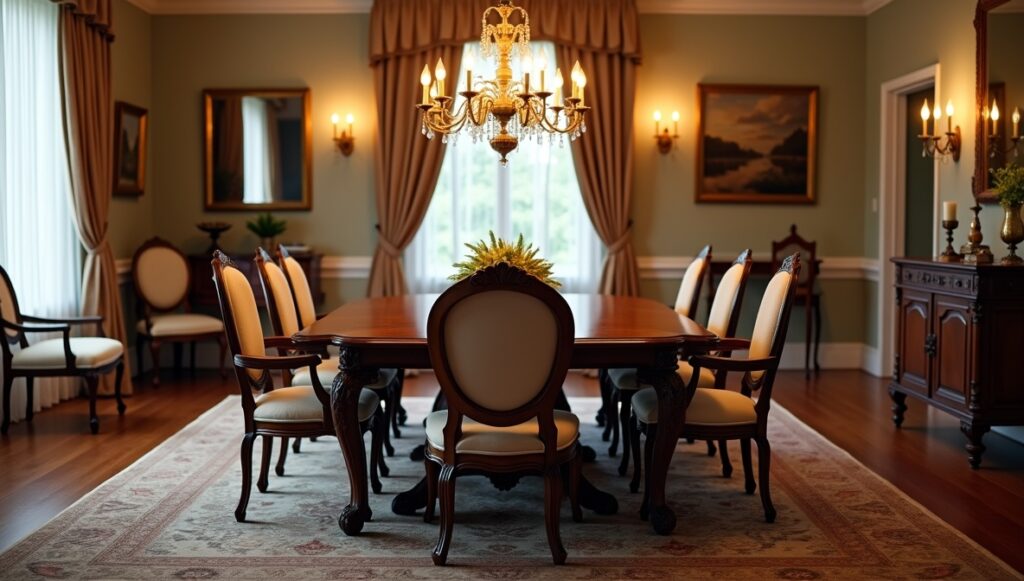
When vintage Lexington shoppers speak of what‘s so captivating about the brand‘s old pieces, they usually mean less a singular style and more a vernacular with variations spoken fluidly throughout the mid-century. The 1940s and early 50s were still under the spell of revival-style and American traditional pieces furniture with the look and feel that “belonged” in a formal dining room and master bedroom, with case fronts that were symmetrical, the moldings shapely, the decoration contained. It was the type of furniture for hosting, holiday dinners, and projecting stability in a domestic world just exiting the wartime years.
As the late ‘50s and ‘60s rolled in, Lexington‘s interiors took on some of those new-fangled traits less carving, more proportionality, clean lines, lighter visual weight, a consideration of how furniture would live along with new devices and lifestyles. It‘s not that they necessarily played in the strictest avant-garde mode, but their pieces of this period are streamlined compared to earlier works, with integrated hardware and more celebration of wood grain. It could be seen as a compromise if one insists on such demarcations. American style had always embraced an “updated traditional” spirit to some extent, and Lexington‘s appeal lies in skillfully meeting that demand.
The 1970s and early 1980s witnessed yet more changes: earthen colors, darker wood stains, and a return to richness and texture. Dining and bedroom sets from those decades often had a heavy and warm presence, echoing the cultural emphasis on comfort and an almost architectural gravitas. However, shifts in the design of our living spaces (such as open-plan living rooms and multipurpose family rooms) also favored furniture that could create a sense of presence. Lexington case goods from these years are often characterized by solid silhouettes and striking hardware, a hint of stability during decades of uncertainty.
There is value in understanding these styles not as fads, but as historical artifacts. Furniture is among the most intimate historians (our body shapes are held in chair heights and arm curves, our homes are expressed in china cabinets, dressers, and nightstands, our identities are performed through formal dining suites or casual living room sets). In museums like the Museum of Early Southern Decorative Arts (MESDA) in Winston-Salem, one can discover a baseline for “Southern furniture” as a continuous tradition. Against the longue durée of MESDA, Lexington‘s mid-20th-century furniture should be understood as modern iterations less an aristocratic statement, more a middle-class affirmation of enduring quality and poise.
Distinguishing Features: Carving, Hardware, Finish, and Proportion
That restrained but present decoration is a distinctive aspect of vintage Lexington furniture, and it partially accounts for its collector status. The Lexington design often is built from elements of restrained decoration, or controlled ornament, which is carving or incising that functions as punctuation marks rather than over-decoration. There are many vintage Lexington pieces where rather than full sculptural carving all the way through, they use punctuation marks on the ends of apron rails or the tops of crest rails, on the face of drawers, pilasters, etc. a very controlled pattern.
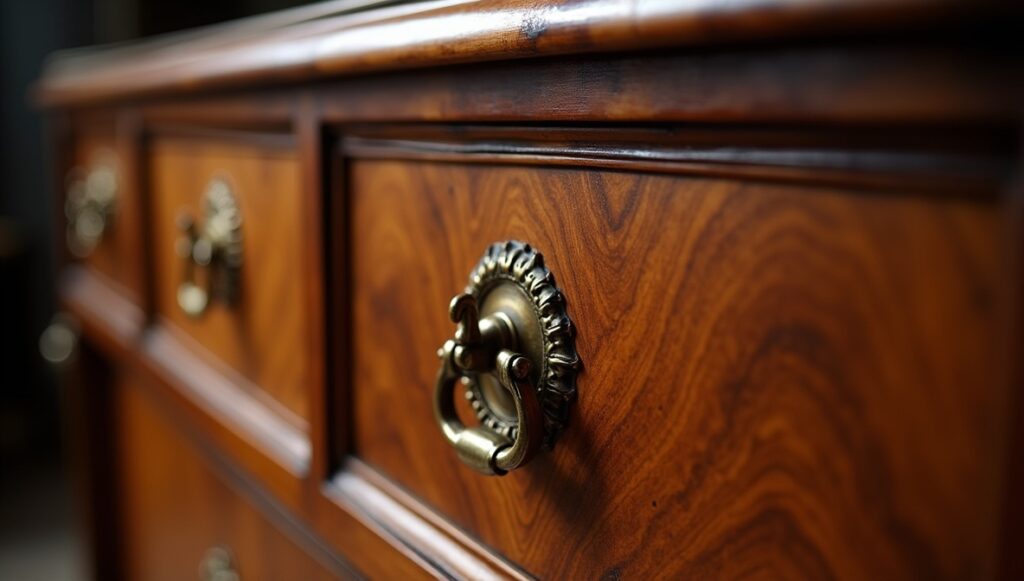
Hardware can be a final diagnostic and interpretive marker. Hardware, like pulls, escutcheons, and handles, can be perceived as jewelry for case pieces, and in its various styles can date a piece by broad decades. Curvilinear bail pulls and more elaborate plates are more indicative of earlier midcentury traditional lines; rectilinear pulls or less ornate forms are more indicative of later midcentury and 1970s sensibilities. Collectors need to examine hardware for not only style but installation original hardware is usually properly seated, aged as the piece itself, without extra holes or mismatching screws. Replacement hardware is normal and doesn‘t discount an object, but it compromises its history.
Is also probably the most subjective; it‘s where the object is at its closest engagement with its contemporary viewer. Lexington finishes are more often beautiful deep, glowing, richly controlled. We have examples of objects that were double-toned deeper in the corners or at the edges, hotter in the light. The surface was not just an aesthetic it was a way of signaling. A finished dining suite meant that you were ready for serious guests you were ready for adult life. You were connecting to the old ways of “doing” even if you were in a new house.
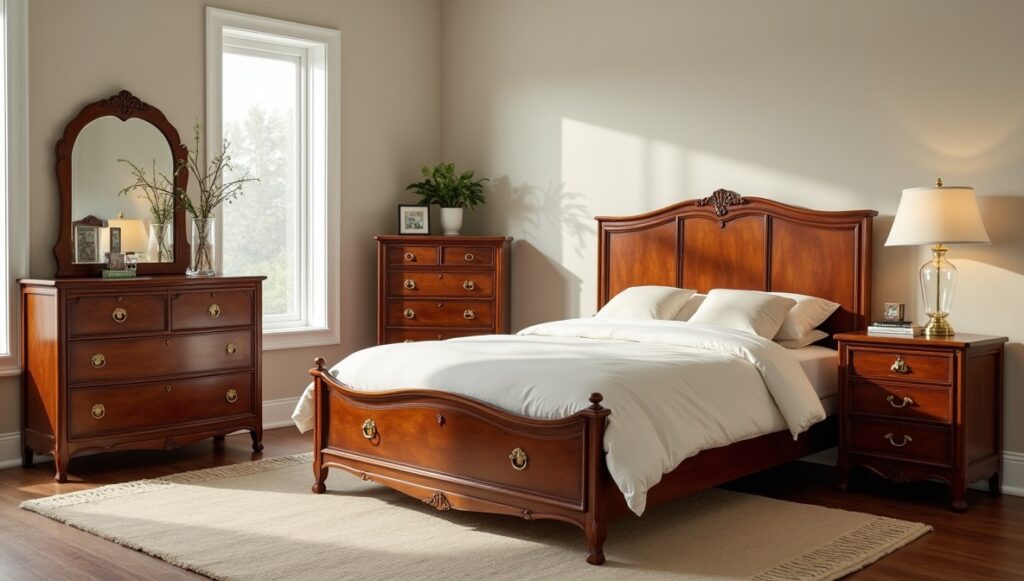
And finally, proportion and utility: this is where design becomes enacted history. Bedroom suites show the aspiration to coordinated living rooms in the postwar era; dressers, mirrors, nightstands, and beds are the components of a singular visual schema. Dining sets show the endurance of ritual: buffet and china cabinet to serve and store, tables the size of family and festive gatherings. If most furniture today seems impermanent, the proportions of old Lexington pieces their heft, the way they are built to store, the “flow” of the system speak to an older world that assumed furniture was permanent.
A Collector’s Clues: Identifying Authentic Vintage Lexington Furniture
But the sure way to recognize genuine vintage Lexington furniture isn‘t by one simple identifier but by putting together a picture from several clues. The easiest proof is a maker‘s mark a paper label, a foil sticker, a burn-in mark, or printed mark inside a drawer or on the back panel or underside of a case piece. Labels can be lost or gone because of cleaning or moisture or plain age, so don‘t assume a lack of label means it‘s fake. The smart collector is familiar with the common places to find them and the clues to their former existence faint shadows of labels, staple holes, or protected areas of finish.
A second level of evidence is found in construction. Drawer construction that is the same throughout a suite, the same secondary wood, and hardware that is aged in the same way throughout an item support original creation. An errant drawer joint, a newer back panel, mismatched screws, and other inconsistencies are cues to repairs or a marriage of pieces. It was common to assemble bedrooms and dining rooms from sets over years. Married pieces aren‘t problematic; they just need to be recognized as such for attribution and pricing.
Dating an item in the 1940s–1980s range depends more upon triangulation of style, and lack of a singular date stamp. A collector might triangulate hardware profiles, styles of the legs, the profile of a edge molding, or the color of a finish. In this case, institutional help is beneficial. Decorative arts library survey books, trade catalogs (when available), or study collections of regional museums can be utilized. The research department of major American decorative arts museums are good examples of trade literature locations. In addition to brand catalogs there may be product literature that documents what a given piece fits into in the overall mid-century manufacturing picture.
Last but perhaps least regarded as a means of identification is provenance, the history of ownership. Estate records, receipts from new purchases, memories passed down through generations can all lend support to claims of age and originality. And though it lends itself to romantic storytelling (who knows why the suite remained together all these years, why the finish looks almost perfectly maintained, or why we see this particular style in this part of the country?) the stories are also utilitarian. For the antiques collector they are, at some level, documentary. They help map where the furniture has traveled with a family through marriage, inheritance and the sentimental topography of house.
Condition Issues and Restoration: What Time Does to Mid-Century Case Goods
Veneer lift at the edges and bubbled tops that experienced a heat and moisture influx is among the most frequent problems we see in Lexington antiques due to the wood, veneer, and finish not holding up to years in a home environment (most commonly caused by plant pots, drink rings, and humidifiers sitting on the furniture). However, these are often fixable, and depending on who fixes them (sanding veneer through the top and using the wrong glue result in bad repairs), a qualified restoration can restore many pieces.
Sometimes problems show up as graying (from dampness), alligatoring or crazing (from age and climatic changes), and differing sheen (from spottiness, cleanings or polishes). Here the historian‘s point of view overrides the restorer‘s instinct: not all degradation is ruin. Some wear on the surface and softening of tone are the legitimate patina, the physical biography of use. Aggressive refinishing obliterates that biography and, more palpably, erodes sharp details, flattens moldings, and eliminates proof of original color treatment. The gentlest technique is the one that tends to conserve rather than replace, when the surface has been rendered beyond functional or decorative possibility.
The damage is usually simple but critical wobbly drawers, racked cabinets, drawer runners worn by grit, and hardware pulled away over decades. Always approach the repair with an understanding of original construction. Trying to stabilize a racked cabinet by clamping on a new angle bracket will add stress to the wood and might split it further in time. It is better to re-glue the joints, replace the worn drawer runners, and utilize the original, complementary materials. The aim is not to make the cabinet look new, but to allow it to function again.
Upholstered Lexington examples (when they surface) present a whole new set of issues, including the failure of foam, wear to fabric, and deterioration of springs and webbing. While reupholstery is often built into the expected lifecycle of an piece that might be with a family for centuries, one must consider textile choices as well as cushion fullness, to retain the historical profile and integrity of a piece. Modern, puffy cushions and “period-neutral” fabric are not always ideal for a vintage piece that needs its historical character to remain in tact. The finest examples treat a piece of furniture like a museum artifact that has a design purpose and origin. This philosophy can work equally well at home as it does on display.
Vintage Lexington Furniture in Modern Interiors: Continuity, Contrast, and Reinterpretation
Within the architecture of many contemporary interiors, Lexington can act as a kind of anchor, both visually and philosophically, to spaces otherwise eclectic and spare. A vintage Lexington sideboard may serve as an architectural ground in an otherwise decidedly art-filled home because its weightiness reads as a counterpoint to the lightness of our era. More than a stylistic choice, it‘s evidence of a cultural longing for duration in effect, for living with objects that have implied time.
The bedroom and dining suite presents another dilemma: is the suite best preserved, or disassembled and divided up? At the very least, the notion behind an ensemble was that the household was a deliberate, unified creation for example, created at marriage or the purchase of a house. Many people nowadays desire assembled groupings rather than matched pieces. But a well-preserved Lexington suite, particularly if it‘s appropriate in scale for the room, can be read as subtly subversive in an era that is largely anti-form. In that respect, keeping a suite is a form of historical commentary.
Lighting and wall paint also offer new ways to interpret these artifacts. What may have looked dense in middle-century incandescent light now looks more subtle beneath warmer L ED lights, near natural light. Carved elements and brass hardware, signs of buttoned-up respectability before, can add sculptural texture to a minimalist room. The object hasn‘t changed; its reception has, and the piece of furniture is taking part in the phenomenon that cultural historians call “the changing reception” of artifacts.
Vintage furniture has its own ethical component now too. Decorating with vintage is a kind of conservation-by-use, giving a second life to materials already collected and shaped. The mid-century furniture boom never had a basis in today‘s green conversation, but vintage possession can fit in with the modern discourse about obsolescence and disposal. And vintage Lexington furniture here doesn‘t just sell the past, it sells an argument against planned obsolescence.
Market Interest, Collector Demand, and Price Ranges
Demand for vintage Lexington pieces is generally higher when design authenticity, fine condition (or carefully restored condition), and functional fit with modern life occur simultaneously. Case goods (dressers, bedside tables, sideboards, dining tables, china cabinets) typically sell better than big, formal pieces the modern buyer has a harder time placing things like an enormous armoire or a giant dining suite. And so the market‘s tastes decide what from Lexington‘s past you still see most often.
The cost of most of these categories is highly dependent on region, style, condition, and size, but you start to see some trends. Pristine single case furniture is often found in the low hundreds to low thousands (USD), with the price higher with excellent condition, preferable wood (especially walnut or mahogany veneer with nice figure), or form factor suitable to modern-day homes. Bedroom sets or dining tables sets don‘t necessarily cost more simply because it is an ensemble. Moving and storage will make a complete large set impossible to sell for more than a single fantastic dresser.
Collectors recognize decorator versus historical value. A piece that has been refinished might make a perfectly lovely chair, but can become less desirable by the discerning eye if a refinisher has softened crisp details or stripped away patination. A piece with some wear that hasn‘t been refinished can be more enticing to collectors who prize an original surface over a fresh one, a trend that parallels the way art collectors and buyers of prints and even architectural salvaged goods now appreciate authenticity
The market is also informed. As collectors learn to examine veneers, hardware and construction, demand will naturally grow for furniture that merits scrutiny collecting American vintage Lexingtons, then, is also an education in American decorative art: the collector is educated not just to commodify objects but to read them as so many sources of evidence about American manufacturing, about cultural mediation between the old and the new, about the staging of the American interior over time.
Conclusion: Why Vintage Lexington Furniture Still Matters
Mid-century Lexington furniture matters not because it‘s “just old furniture,” but because it‘s a lasting testament to the mid-century American conception of the home, captured in wood, veneer, brass, and finish. Over four decades-the 1940s to the 1980s-Lexington‘s pieces helped furnish a nation working through war, post-war abundance, suburbia, and subsequent retreat. Its forms tell a story of how American design didn‘t simply adhere to, or abandon, tradition, but rather reinvented it as the American home was remade for new sorts of space, space use, and space expression.
For collectors, the temptation of these objects is the narratives: the chipped label, the dovetails on a drawer, a brass pull whose curves are characteristic of a particular decade, a patina that hints at both the factory finish and generations of wear. For historians, the draw is the grander design: how local, North Carolina manufacturing, may have had something to do with national tastes, how hands-on craftsmanship remained within the framework of mass production. In a world of planned obsolescence, Lexington‘s pre-WWII vintage furniture serves as a powerful reminder that material objects continue to hold meaning. In other words, it provides a means of sustaining a conversation with the past, not just for decoration, but as an ongoing, tangible engagement with making and with meaning.
AI Notice: Some visual content in this article may have been created or enhanced using artificial intelligence (AI) for artistic, editorial or illustrative purposes. Learn more about our approach in our AI & Editorial Principles.