Unlocking the Drawer: The Hidden History of Antique Tables
In fact, the rather silent integration of the drawer into the table has been perhaps the most informal but active of ways of change in European domestic life. With the exception of the medieval and Renaissance chests and coffers, serving generously as the main repository for all domestic stuff, the table has remained a trestled, open surface, not only an object in which to contain, but more than this, which could be adapted.. By the late sixteenth and early seventeenth centuries, however, the stabilization of domestic interiors- espe cially in Italy, France, the Low Countries, and England-began to demand a surface that could comfortably serve as both workspace and display surface and storage space, and this in turn spurred the development of the still evolving category of “tables with drawers”, which traced their origins to joined tables or side tables incorporating a slab of cabinetry [which could be atraced or decorated], suspended beneath the table surface (usually flush with the frieze or stile boards). As these early prototypes, which tended to be somewhat ornate, continued to be produced at all, they were rarely found outside of the homes of the wealthy, and they mark the emergence of a new class of object: the table as work space.
Dating is less certain by region, but documentary and surviving evidence from the 17 th century demonstrates a continuous spread of tables with drawers within domestic and record-keeping contexts. English probate inventories by c.1650s increasingly indicate that “table with drawers” or “joyned table with a drawer” became delineated as something to be specifically identified, implying a growing ubiquity. Continental examples also sometimes crop up in bourgeois interior paintings, often in pairs, replete with a single or two drawers, placed beside windows, loaded down with books and writing implements and blankets. Such representations reveal how drawers changed the table from a collectively used surface to something much more possessed and individual, somehow more literate, numerate, and business-minded.
Can You Name the Masterpiece?
Ten masterpieces. Ten questions. How well do you know the history of art?
Significantly, the presence of drawers was directly linked to changes in both domestic space and domestic sociology. As European domestic architecture came to define separate and different types of rooms (study, boudoir, dressing room, cabinet of curiosity, etc.), suitable ‘fitted’ so-called ‘fixed’ furniture which could be permanently located in a specific room or corner and dedicated to specific tasks also flourished. Table drawers became common in these newly recognised space-types, the contents of these ‘concealed’ storage were more comfortably stashed away, well away from the public eye, with the table and the contents of the drawers functioning both practically and discreetly. Drawers enabled papers, cosmetics, sewing paraphernalia or prayer books to be gesturally hidden away from view, further facilitating a culture of concealment and privacy in the early modern household. By the 18th century the drawer was no longer just ‘adorably new’, but an inevitable feature of an elegant table.
Beginning also indicated a new conceptual direction in furniture, an idea that a piece could be a complete unit for living: Whereas chests remained storage containers and tables were simply surfaces, the drawer-table was an articulation of meaning. The move toward multifunctionality, as it coincided with the rise of bureaucratic states, commercial expansion, and authorizing form of literate civilization, was oriented toward the deepening complexity of individual paper lives. The physical motion of pulling out a drawer, of revealing a discrete, curated interior, dovetailed neatly with this modern sense of the authenticated “individual,” whose letters and records and possessions all necessitated a discrete and secure home. In this way, the drawer traces a subtle but important trajectory in the material history of home and individual subjectivity.
Drawers and Domestic Life: Changing the Function of Furniture
The development of the drawer fundamentally altered the patterns of domestic labor. Earlier on, writing, sewing, dressing, bookkeeping—all of these were activities that effectively required one to figure out how to do the circling of objects from trapezes, to trunks, to cupboards. Once a drawer was incorporated into the table, these implements could be tied down to a particular surface—inkstands to writing tables, brushes and perfumes to dressing tables, pincushions to small work tables. By having everything you needed to “hand,” a new micro-environment of work was established that reflected 18th and 19th century increases in the efficiency and routine of life.
Can You Guess the Artist?
Three clues. One artist. How quickly can you identify the painter?
It also mediated a compromise between display and concealment. Porcelain, candlesticks, books, writing gear could all be displayed on a tabletop to demonstrate good taste and social standing, but only inside drawers could the less glamorous and more personal realities of domestic life be kept out of view: unpaid bills, unfinished embroidery, love letters, medicine bottles. The dual purpose of drawers is clearest in the development of console and pier tables, which often feature shallow drawers. These tables, which could be pushed up against a wall and were frequently topped with a slab of marble, frames around a mirror on which objects could be displayed, even if its drawers might hide bottles of perfume, spare keys, or the contents of various cabinets and closets.
Gendered distinctions in the use of termainedrawn chests, too, emerged in the mid-eighteenth century. As an element of writing tables and bureauplat: s, themangedains came to represent a masculine domain of administration and intellectualization: in studies and libraries. However, as part of marriage wardrobes and boudoirs, as well as the Victorian bedroom suite, the diminutive, fragile dressing and work tables with their drawers came to imply-indeed, to visually furnish-a woman‘s space and interior life, where they held hairpins, cosmetics, scented bottles, and correspondence in a manner that mirrored newer notions of women as private, interior creatures. Such sex distinctions are well-documented in inventories and visual culture, in which the fixture and placement of a termainedamight suggest the gendered uses even of a piece of furniture.
In the context of institutional and commercial use, tables with drawers supported new models of administration and trade. Shop counters with drawers to the front, writing tables for clerks in counting-houses and library tables with fitted compartments are all proofs of the prominence of the drawer as an organizational device. These ‘working-class’ contemporaries of their more elegant domestic cousins show how progressively across a range of spheres, the drawer remained a practical tool, not merely an aesthetic device; the same principle– a readily accessible space beneath a working surface– was appropriated for a variety of institutions. To collectors and historians alike, therefore, this width of use even in its most mundane looks demonstrates that the drawer was no mere visual perk but a development in function that contributed to the development of the modern bureaucratic and domestic state.
Styles and Periods: From Georgian Rationality to Victorian Opulence
By the Georgian period in Britain (c. 1714-1830), tables with drawers had become highly codified within the system of Italianate modes of furniture categorization used by cabinetmakers. During early Georges, the relaxation of rule seen in the high forms of the Mid-Georgian period was tempered by clear adherence to the styling of Palladian classicism, with rectilinear shapes, restrained decoration, and light application of columns, pilasters, and asymmetric pediments. Writing tables, side tables, and dressing tables tend to have simple straight or slightly cabriole legs and the drawers are often set into a standard continous frieze. This is also the period when research evidence shows the impact of Thomas Chippendale and other London-based cabinetmakers was felt, as more derived and refined proportions and arrangements of drawers appeared (for example, a number of small drawers reaching out from either side of a central kneehole in dressing tables, or a symmetrical pairing of double drawers on mid-Georgian library tables). Compositional interests lead to well-considered drawer fronts, sometimes with restrained classical moldings, gilt-bronze escutcheons, or selection of veneers.
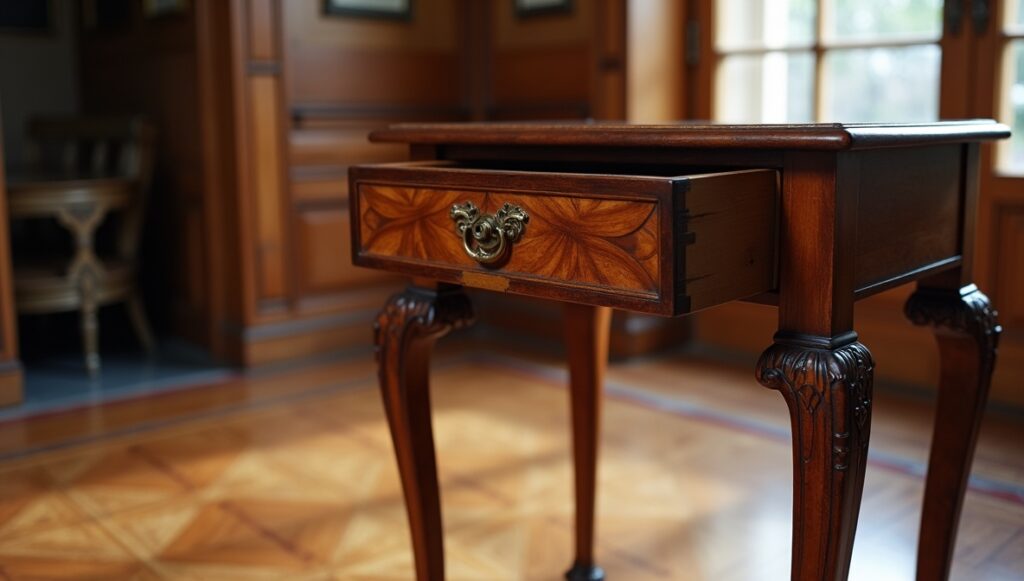
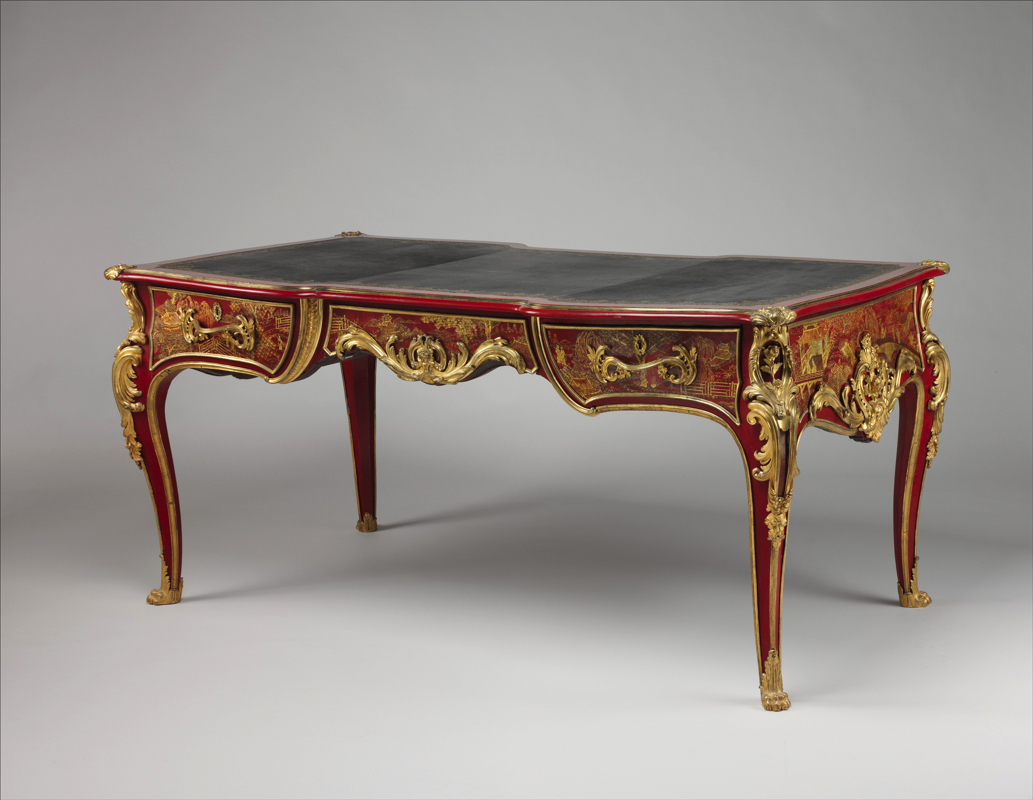
Later, the Georgian and Regency (c. 1790-1830) period saw the increased focus on the writing table as a separate specie, a manifestation of the cult of sensibility and burgeoning print culture. The bureau-plat and partner‘s desk, as seen in the grand scale, balanced with more modest writing tables with one or two long drawers (sometimes a drawer in the guise of an apron). Style was consistent and evolved as early in the century as the tapered legs, brass castors and crossbanded tops in mahogany or satinwood. The Regency love of classical is seen in reeded legs, lion‘s-paw feet and brass inlay, and the use of brass line inlay in the front of the drawer to emphasize its geometrical shape. The writing table was lined with green paper or baize to contain the world within the writing box of letters, legal papers and confidential notes.
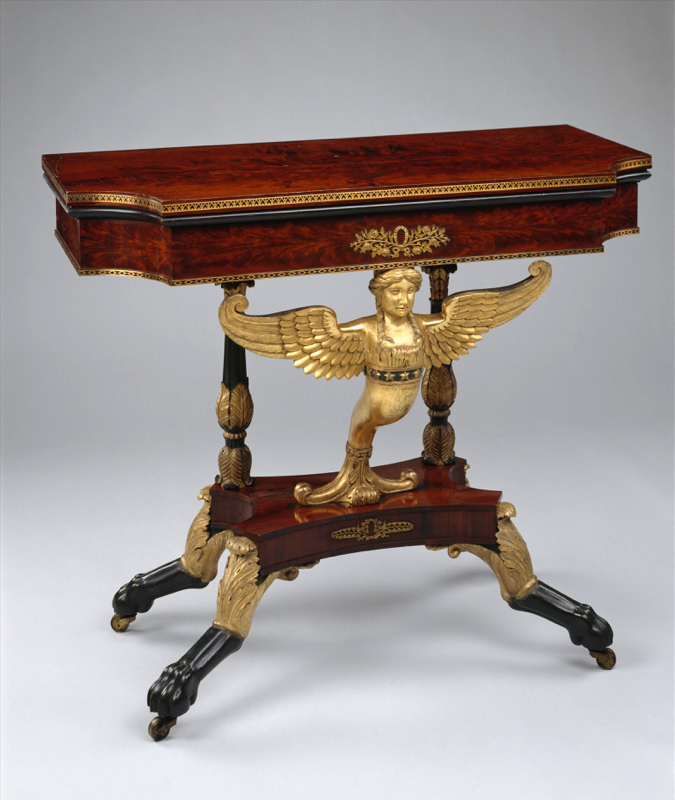
In the Channel, the French Empire style (c. 1800-1815) was more concerned with going monumental in the depiction of tables with drawers. The bulk of the short Empire bureau-plat (shown here as the article‘s epigraph) – veneered in sumptuous mahogany and ornamented in gilded-bronze – usually depicted one central long drawer flanked by short ones subtly united by an exaggerated thickening of the apron. In comparison, console tables with a single shallow drawer and a mirror-back panel in the same room and form as the bureau-plat adopted a more ceremonious image of the same storage principle – an individually delicate structural element that was nevertheless loaded with everything imaginable: the gilded keyhole and ormolu handle as symbols of political, symbolic, and visual economy.
Biedermeier furniture (ca. 1815-1848) from the German-speaking lands and Austria provides another as well as a radically different model of the table-with-drawer: the Biedermeier table. Biedermeier tables display a restrained preference for uncluttered forms and transparent, luminous veneers (usually cherry, birch, or walnut veneer) over several layers of tooth-aching gilt ornament. Writing, side and work tables often feature one or two uncluttered, flush-fronted drawers which are evanescent, in terms of their surface and grain, and in terms of surrounding trim and stringing, and if they are not veneered they may well have a one-inch-wide, overhanging lid rather than a display of fancy carving or climbing devices. The quiet flat-about-the-edges fronts to the drawers, with their indiscernible keyholes and tiny knobs, resonate thoughtfully with the middle-class taste for conservative respectability, cozy domestic regulation, and a hermetic escape from aristocratism. Under many different circumstances, the Biedermeier table-with-drawers expresses the nineteenth-century glorification of the cradled home as bourgeois temple of order and sentimental emotion.
Victorian furniture (c. 1837-1901) added even greater diversity of type and decoration to the mix. Writing tables (first explored at the end of the 17th century) gained multiple mini-drawers, multi-tiered etageres with expertly fitted drawers, sewing and writing tables with sliding or drop-down doors, and dressing tables with dramatic mirror frameworks. All of these reflected a culture hungry for grouping and organization. Victorian tables (side, and center tables, desk tops, etc.) may show unassuming looking niches and pointy, over-elevated, and transom-feathered carved aprons hiding drawers larger than their portals; or they may incorporate them as dramatic flush drawers introduced amid Gothic, leaf, scroll, and filligree tropes on a form that, in the 18th century, avoided drawers. In other words, the drawrobust Victorian furniture offer collectors the possibility of studying a variety of historicist dialects (Gothic Revival, Renaissance Revival, Aesthetic Movement) which used the drawer in subtly different ways.
Materials and Craftsmanship: Woods, Joinery, and Drawer Construction
Materiality of the antique table with drawer is therefore fundamental to understanding its function. European cabinetmakers of the 18 th and 19 th centuries drew on a hierarchy of woods. Reflecting the price one was prepared to pay for the furniture, its status, and one‘s taste, knots and figure were desirable. As early as the 16 th century, burled elm formed the basis for grand country furniture. A range of timbers was used for paneling, executing intricate marquetry inlays and for turning fine, reeded legs. But the older, slow growing and dense tropical hardwoods such as the Caribbean (or American) and West African mahogany, and the older European, or Black, oak–originally the sorts of brown oaks that grew on the continent–became the currency by which furniture could be measured. From the mid-18 th century, these were the material of the finest writing and library tables; their smooth surfaces able to show off the depth of color, and the perfection of grain in a substantial top, or the finely shaved drawer front or finely turned or reeded leg.
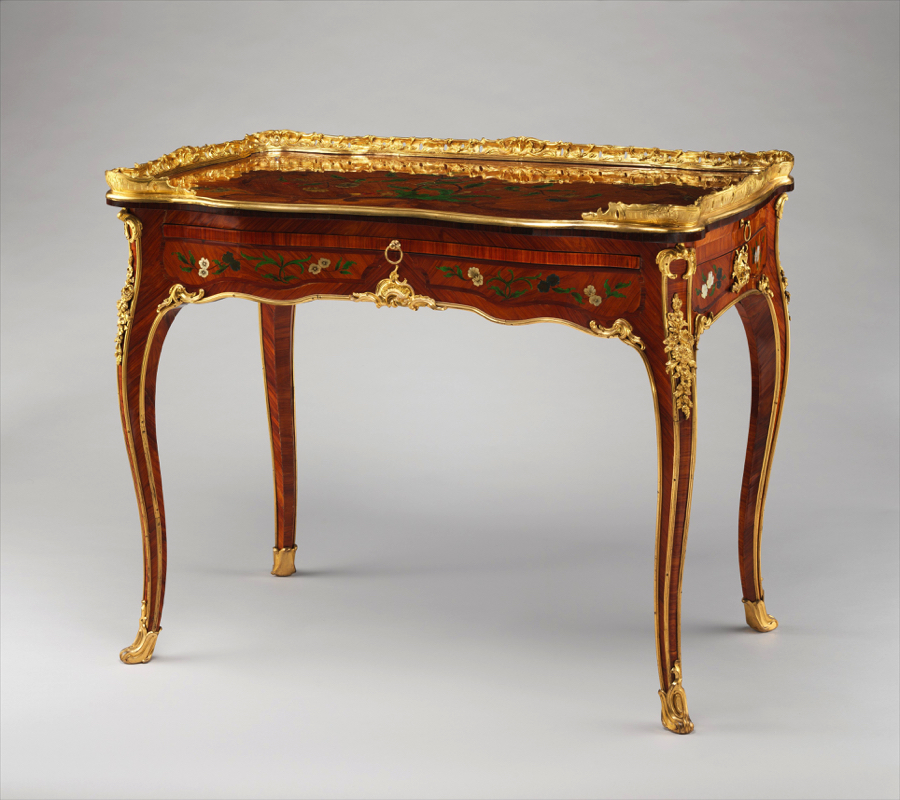
Rosewood in the 19 th century was handled for the luxury veneer associated with fine writing and occasional tables. Much darker in color, with a strong grain pattern, it was well suited to slicing thin (sometimes to bandings on drawer fronts and the edges of tables). Other traditions ( Biedermeier and central European styles ). exhibited an attraction to local or indigenous woods—cherry, oak, maple, birch, that were used in nature as veneered surfaces in lieu of more costly substitution with a fine-grained african species. Veneer was deliberately selected for a bookmatched pattern (or a radiating symmetrical pattern), in the case of drawer fronts and aprons, so that the interrupted nature of the work was camouflaged by a change of grain. In the more rustic or provincial table, other locally available species such as fruitwoods or oak were used in the form of a flat board.
Drawing construction is an important indication of the quality and skill involved. Many fine mid-18th to early 19th century drawers have lighter, plain-grained side panels, often oak, pine or deal, which are joined to the drawer front with hand-cut dovetailed joints, which can be uneven, producing narrow pins at different points. The Drawer bottom is normally a solid panel set into grooves cut into the sides and rear, and nailed, or left floating so that expansion in the woods can take place. Drawer bottoms are sometimes protected by a coat of hand-plane marks, and the runners which the drawers sit on can be little separate strips applied to the interior of the carcass. Long use causes these to become polished by contact. small ridges can also form in the runners, and the color of the wood can darken with the oxidation which occurs on the exposed areas.
As the centuries move into the 19 th century, one can begin to see the touch of mechanization. By the mid-to-late Victorian era, machine-cut dovetails (more even and regular) are found on the drawer joints of mass-produced furniture. Particle- and composite-woods, as well as lower-quality secondary woods, start to be found more frequently on sides and bottoms of drawers. For lower- and middle- market furniture, veneers are sometimes applied to less attractive cores, and sometimes covers multi-part drawer fronts that are hidden beneath a veneer “skin”. For the modern specialist, woodworking/ joinery variations, tool-marks, oxidation groups, and aged consistency are some of the most trustworthy indicators for date and the authentication of table drawers.
The relationship between form and decoration is also notable in the design of the drawers themselves. Most eighteenth-century tables are tray-like and the fronts of the drawers are often contained within framing or cockbeading applied in the same way as the carcase. Cockbeading is a narrow molded strip which acts as a “border” and is intended to prevent damage to the veneer. The brass handles, backplates and escutcheons lend presence and draw the eye forward to the keypoint of the piece; as well as being practical, they are indicative of date depending on their method of attachment; some are fixed by threaded posts while others are attached using a screw later in the century. In sumptuous tables, particularly those made in France and Central Europe, the lines of the drawers are sometimes ignored altogether with the fronts being covered in a much larger pattern of inlay and marquetry. Image is everything; this techniques emphasizes the fact that table storage can be both hidden and open to the viewer.
Decoration and Detail: Legs, Hardware, and Marquetry
The form of the ‘legs’ of antique tables with drawers (as opposed to supports oriented in a plane parallel to the top) provides among the most style-rich information about the conception of the piece and frequently provides the visual link between form and function. Visually and structurally the earliest 1700s tables generally have either turned or cabriole-formed legs, with the period‘s characteristic curves and the pad- or claw-and-ball feet placing the piece squarely within the larger taste of baroque and rococo design. Although these forms are infrequently the most stable type for supporting a top and drawers, they do provide an elegance that is suitable to the formal formal reception room or well-equipped library. With the arrival of the Neoclassical mode in the later 1700s, tapered, reeded, or fluted legs begin to predominate, especially in writing or side tables; the proportionally taller and straighter columnar leg echoes the rectilinear form of the drawer fronts and reveals the period fascination with architectural vocabulary.
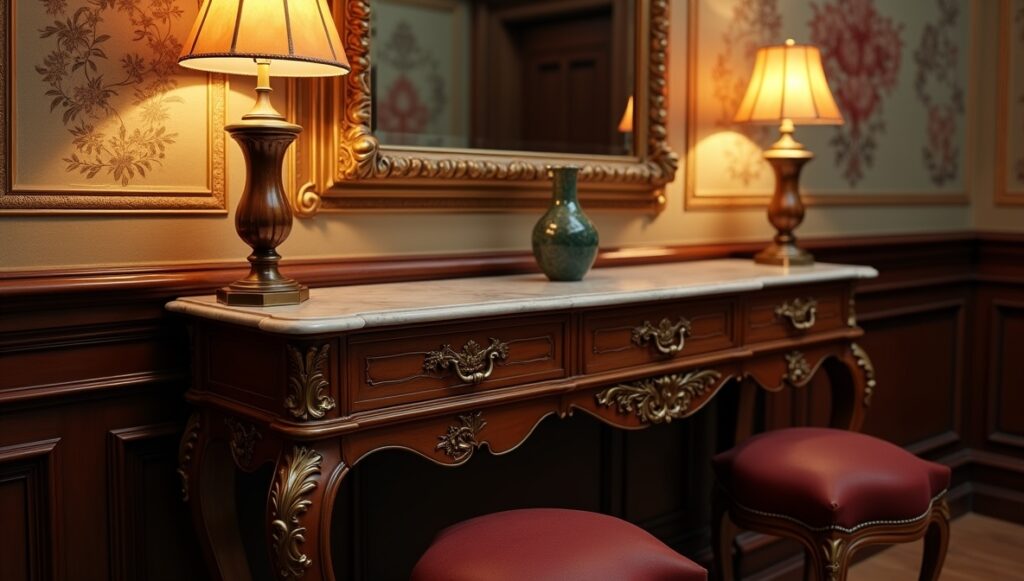
Leg styles are often more sculptural on console and pier tables with drawers. Empire tables may show huge lyre-shaped supports or pilaster-like supports (sometimes carved with anthemion or palmette decoration) on big plinths or ‘pawfoot’ type supports. Biedermeier tables tend to be plainer, with relatively simple columns or tapering legs or supports shaped like restrained lyres, as the emphasis is on veneers and proportions rather than carving and ornament. Victorian furniture shows a proliferation of leg types, with big turned, baluster-shaped supports, twisted barley sugars, massive square-section supports, or bulbous, turned motifs. The collector soon learns to be able to interpret the leg together with the apron shape and arrangement of drawers and fittings.
Handles and escutcheons should be studied as expressions of style as well as a functional element. Early 18 th century tables may be equipped with basic drop handles on backplates, all, regardless of their period or style, showing evidence of the decorative vocabulary of the age. Later Georgian and Regency tables tend to show oval or round stamped brass backplates, often decorated with individual urns, classical masks or sunbursts; Mid-century tables often show more forceful gilt-bronze mounts-ring handles in lion‘s mouths, for example-which become part of a larger Rhetoric of power and luxury. In Biedermeier or Central-European tables, handles and escutcheons tend to be less intrusive, as their location on a veneered surface precluded unnecessary decoration; the occasional small round knob, tinyturned piece of wood, or modest oval key-hole escutcheon avoid interference with the veneer‘s formal unity. Variation in form, attachment, and patination offer an important series of clues in dating a piece: original hardware will typically display oxidation, years of heavy fingers or light taps, and is in keeping with the physical and formal vocabulary of the period.
Marquetry and inlay are especially significant in raising tables with drawers above their costor function. In late Baroque and rococo furniture, particularly for France and the Low Countries, elaborate floral marquetry–tulips, roses, scrolling leaves and tendrils worked in a variety of dyed and natural woods–could continue at a flourish across the top and into the drawer fronts. Balancing and disguising joints and joins was another testament to the skill of the cabinetmaker. With Neoclassical and Directoire furniture, the marquetry may be more geometric: Greek keys, urns, vases, arabesques in light and dark woods delineate the sections of the drawers. Empire and Biedermeier tables often favor a more Spartan use of inlay, leaning on the rhythm of a veneered surface, though the occasional star medallion or banding across the drawer fronts alludes to order and balance.
The carved ornament on tables with drawers fluctuates greatly by type and function. Writing and dressing tables, frequently associated with sober, literate activity, generally have a restrained decorative scheme, with decoration directed mainly at veneers, moldings, and the faintest suggestion of carving around aprons and legs. Console tables, more frequently found in reception rooms, many of which are exhibited by the Victoria and Albert Museum, can be more exuberant in their approach; acanthus leaves on knees, festoons, masks, scrolls, and other nudges towards grandiosity may be deployed, and Victorian side and center tables are often densely and confusingly decorated with foliage, grotesque heads, Gothic arches, and other symbols of culturally current obsession, putting aside the known utility of the drawers in an excess that constitutes its own kind of commentary.
Writing, Side, Console, and Dressing Tables with Drawers
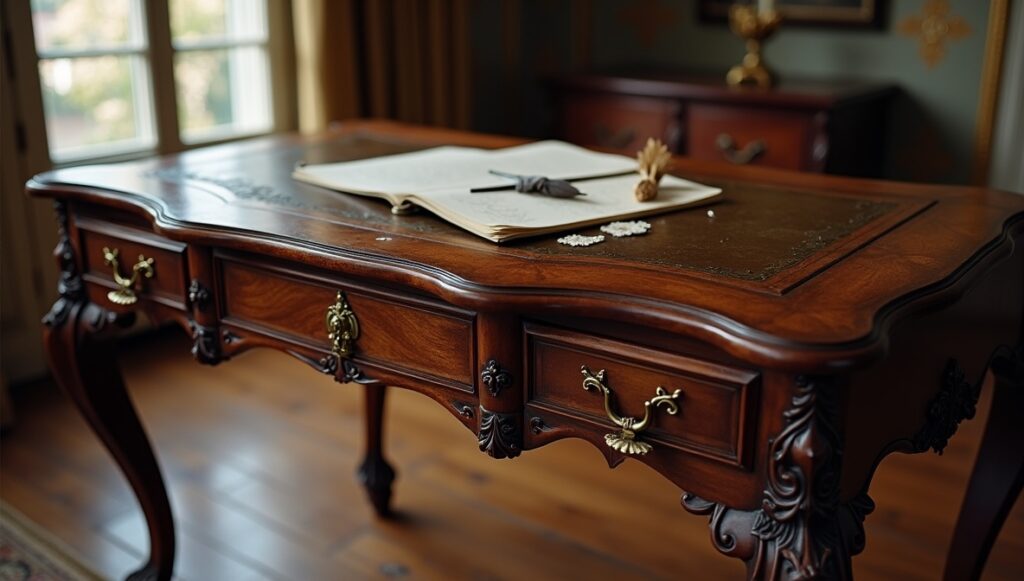
Writing tables with drawers are also among the most intellectually provocative furniture categories, in the simplest form (as exemplified by Georgian and Regency examples). A rectangle top, one or more drawers in the apron, four plain or slightly tapered legs. More complex examples (especial in French and Victorian examples) may have multiple tiny drawers in the apron/sides of the top of the table, the so-called ‘Bonheur-du-jour’, or double-sided drawers for two users in a partner‘s desk. The internal layout of the writing table is according to the proliferation of letter-writing offices, compartments, ink-bottle recesses and pen trays. It turns the writing table into a physical archive and a symbolic site of obligation.
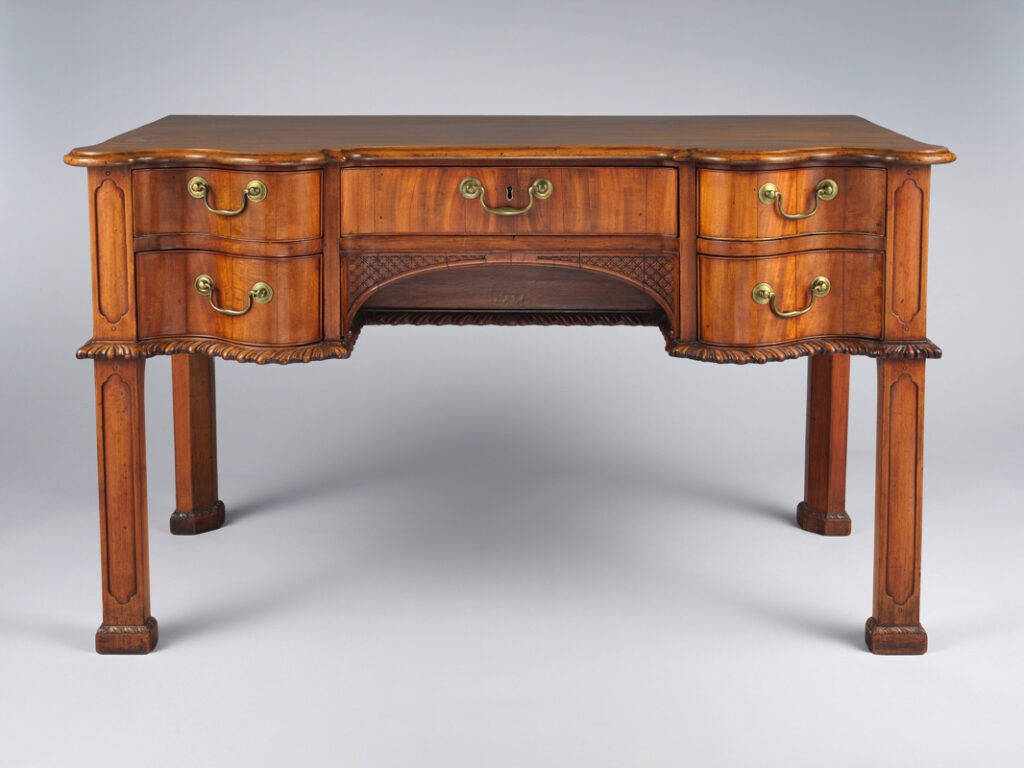
Side tables (with drawers) are more likely to be flexible pieces used throughout the house, including hall tables, serving tables, and occasional tables placed against the wall or in between windows. Their drawers may serve as storage spaces for keys, candles, cutlery, account books, or sewing materials, depending on their placement and the number of members in a household. Unlike writing tables, they tend to follow the stylistic program of their rooms, rather than providing a function particular to a certain kind of table: a Gothic Revival hall table, for example, might have most tracery and pointed arches on the drawer fronts, while a neoclassical side table placed in a drawing room might prefer fluting and dainty brass mounts. The varying amount and size of drawers may contribute to the distinction between a side table and the generally shallower console table, which favors display over storage.
Consoles with drawers seem to represent an in-between species, a meeting-point of decorative display and humble utility. Against walls, beneath looking-glasses, or between windows, consoles frequently have marble tops, supported by magnificent supports and/or false supports. Their drawers are often narrow, and may even be glided over, by frieze or applied ornament. In many aristocratic interiors of the eighteenth and early nineteenth centuries, the drawers of console-tables might contain visiting cards and small coins, sealing wax and keys, articles used in the social rituals of place- and person-appearance, and circulation. Console and pier tables with drawers are also found in corridors and ante-rooms of some empire and Biedermeier house interiors.
Dressing tables with drawers inhabit an even more explicitly intimate domain. In Georgian and Regency England, the dressing or toilet table—usually sold with a matching, separate mirror—will most often resemble the classical design of a simple table with a symmetrical arrangement of drawers, possibly with a kneehole in the center. By the Victorian moment, the dressing table will have grown into a more elaborate structure—more drawers, no separate mirror, in the central mirrors aware above the table, with banks of small drawers on the table‘s surface joined by one or more large, central drawers below. Drawers stored combs, brushes, hairpads, scent bottles, gloves, fans, and other personal tools. The distribution of drawers reflect ideas concerning bodily regulation and presentation, especially in relation to gender and gendered presentation. Speaking to another paradox, some small dressing tables with fitted interiors and usefully hidden drawers threatened to become the safekeeping vessel for personal secrets and private rituals, in danger of turning into a type of casket.
Larger side and work tables with drawers—desk, dressing tables—pointed up the range of more general functions drawers could accommodate. The occasional tables with drawers—such as the unobtrusive little table of 1802 (RMN), or one with a combination of both shallow and deep drawers—may have been used to hold sewing or writing equipment or to display a few embellishments. Some varied their function; others were specifically designed to hold spectacles, books, or pipes. For the collector of furniture, it is important to understand the original function of these pieces as an item intended for work, writing, dressing, or display, can become a confused mix by alteration or misidentification of their intended use.
Identifying Authentic Pieces: A Collector‘s Framework
For thecollector, the complex task of authenticating antique tables with drawers derives from a comprehensive analysis of structure, materials, surface, and style. The process does not always start with the decoration but often begins on the underside or inside. An assessor looks at the jointing of the drawers, the quality and consistency of secondary woods, the furniture‘s wear patterns on guides and runners, the way period handles have beveled profiles. Hand-cut dovetails, unequally spaced saw cuts, and plane tracks are classic indicators of pre-industrial manufacture but must be viewed in context. A provincial piece from the end of the nineteenth century may still have been hand-made; an urban table from the 1820s may already display signs of early mechanization. No single characteristic determines legitimacy; rather it is the consistent application of techniques, materials, and aesthetic principles in conjunction with what is understood about local-market workshops and period practices.
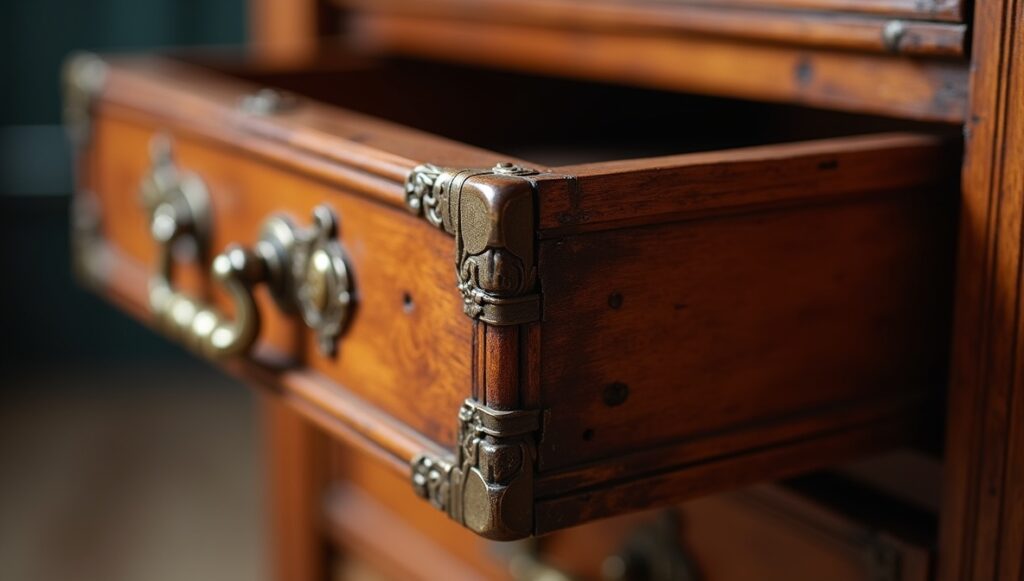
Checking the surface is also essential. Authentic patina on a hard wood such as mahogany, Walnut or oak takes on several different shades, shows signs of minor scratches and a soft sheen where the most contact has been made (most notably around draw pulls, keyholes and edges). A table with a pristine expanse on the draw fronts but with a weathered surface on the top or vice versa should be inspected thoroughly, inconsistencies in aging times indicate the possibility of replaced sections or the marriage of a new top to an original table. Draw fronts using veneer should be inspected for thickness, cracking or veneer lifting. Very thin, very bright veneers across the whole surface are a likely sign of re-veneering. Similar care must be taken when inspecting the hardware- look at the inside of the draw, compare screw holes with other parts of the table, ghosting of different back plates and incompatible styles of handle all point toward a modification.
Finally, stylistic analysis is essential but needs to be rooted in the reality of real period examples, ideally by studying them first hand at museums and collections. The Victoria and Albert Museum (London), the Musee des Arts Decoratifs (Paris), the Rijksmuseum (Amsterdam) and the Hofmobiliendepot (Vienna) all display excellent examples of tables in the Georgian, Empire and Biedermeier idioms. Reliance on their catalogues and internet databases enables the collector to develop an eye and expectations. The proportions of legs to top, the planking of aprons, the relationship of top thickness and drawer height to the height of the carcass, and the decorative motifs used all conform in a predictable manner that, learned, will enable the collector to distinguish period examples from later revivals and reproductions.
Provenance is not always available but can provide a most valuable stratum of evidence. Old photographs of a table in situ, archival documentation, or sales from well known dealers or auction houses all help to establish history. Provenance can, however, be misleading, family reminiscence is well-meaning but unreliable with regard to dating or attribution. When considering Chinese, the customer should be aware of over-restoration and composite tables–those made from component top, base and drawer elements. These will tend to have inconsistent, mismatched characteristics of construction, veneer or inlay, wood species and aging, and if they do have a single unifying element such as a veneer top or a beech base then this may be inconsistent with the rest of the construction, suggesting a composite table. A well-informed and judicious combination of manipulation, close inspection and historic knowledge will best prevent unwanted surprises.
Restoration Challenges and Common Collector Mistakes
Refurbishing older tables with drawers poses a range of difficult questions, both technical and ethical. Central to the debate is the question of replacing an object to enable continued use, while respecting and preserving its authentic fabric. Drawers are one of the sections of a table most conspicuous for intervention, often suffering from less-than-glowing runners, chipped sides and sticky action all providing frustrated owners with good reasons to ’“improve” performance’, by replacing absent or damaged parts wholesale. On the other hand, sawing out original runners or overly-raised side panels destroys historic clues to use and construction. Professional refurbishing requires the least aggressive approach; a thorough lubricate with lubricants appropriate for the original material, discreet shimming of flush runners, adjustments to plain, sliding and ‘sticking’ components.
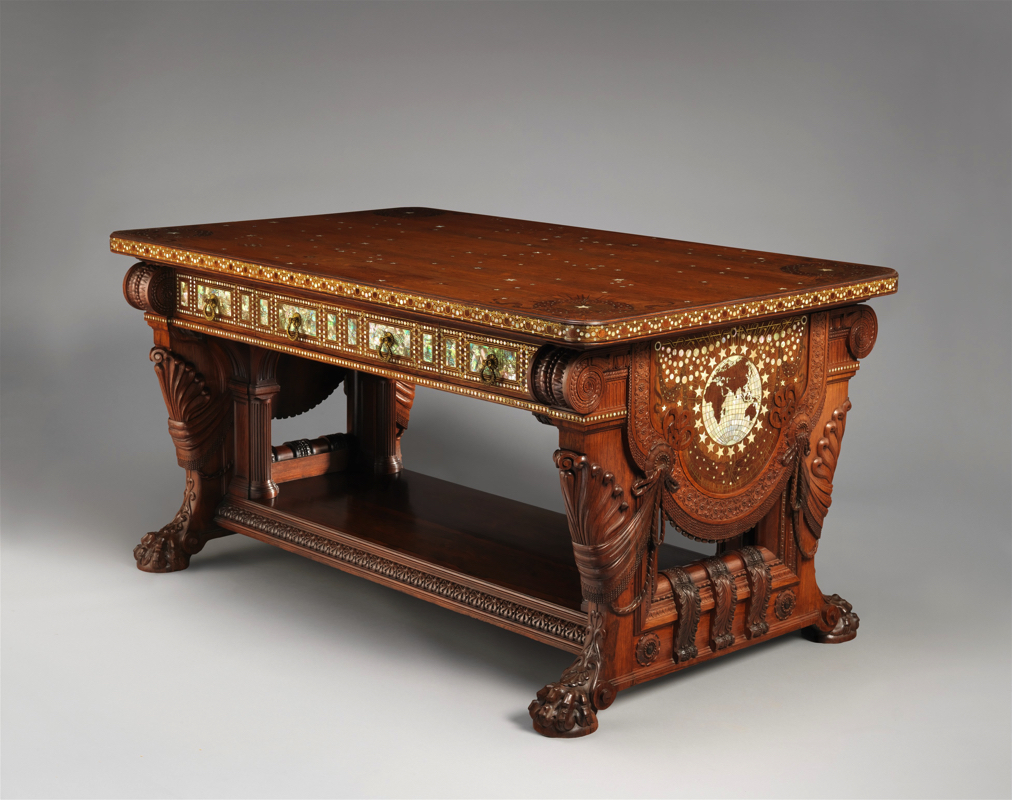
One of the most common ‘restoration’ mistakes involves over-production of old finishes with uniform modern varnishes or lacquers. Pulverising the surface down to bare wood, then heavily sanding and recoating in a mirror-like high-gloss sheen, eradicates the patina and rounds over original forms, as well as destroying evidence of original tool marks and surface textures. Drawers fronts are especially at risk of misguided ‘restoration’ because situated on the facade of a piece they are conspicuous. However the haunts of the historian and connoisseur of collecting are that they become painfully un-authored and damagingly undervalued. When reasonably possible, limited cleaning and conservation–using solvents compatible with the original finish, repaired then with shellac and wax–should be the guiding principle over re-finishing.
Though not as frequent as other elements the general application of hardware and locks can also be greatly misjudged. The loss of original handles or escutcheons is by no means uncommon, but what is often bought to replace these parts is not period but an era more attractive to the builder. A 17th century hall table may have a set of 20 th century brass reproductions fitted, which proved nothing like the original in profile, scale or method of attachment. Locks which do not sit flush can cause removal of part of the surrounding wood to be cut away, distorting the piece‘s original appearance, and in some cases making current scholarship impossible. An ideal solution to the problems could be to note original hardware whenever, be prepared to re-finish and repair it, find the correct period or at least high quality reuse copies and use a label to show when and where modifications have occurred.
Collectors too often lack the knowledge to interpret what are often perceived as minute losses and blemishes. Perhaps a few chips to the edges of a veneer on drawers, or something as small as a hairline crack or a minor warp are considered anomalies. However, such anomalies should not necessarily be eradicated. They might actually be part of the history of the object and their removal could constitute an overzealous attempt at ‘correction’. For some tables, especially Biedermeier or Regency examples, where the veneer patterns are crucial to their design, patching with selected old wood will be acceptable if undertaken with serious thought, with the idea of reversibility and proper documentation in mind. A responsible restorer applies a tables as a history rather than a pretty thing–a consideration that is already strongly backed by conservation departments at the British Museum and other prominent conservation workshops.
Finally, the legiti-mate conceptual pitfall into which several of the collectors fell is that of more aesthetic than informative restoration. It is tempting to conform a piece to an ideal for its age–removing later additions that appear un- historic, changing original surfaces to match other pieces of furniture, or “newfangling” interiors to contemporary standards. However, tables with drawers are often marked by ages and uses: 18th-century tables with 19th-century liners, provincial repairs with stray local wood, or handles reinforced by use not manufacture. A good restoration may retain or mimic this history, acknowledging that layers of use are intrinsic to the antique‘s significance.
Market Demand, Value, and the Contemporary Collector
In today‘s market, an antique table with drawers occupies a curious position between a work of decorative art and an object of utility. Relative to the more famous forms—such as commodes by recognized French ebenistes or spectacular bureau cabinets—many 18 th – and 19 th -century tables are still relatively affordable, especially in less showy Georgian, provincial, or Biedermeier examples. For a modern collector, their modest proportions and multi-functional use make them an attractive item for a domestic setting, where furniture must too often act as a practical yet unobtrusive element within the intended interior. Writing tables and side tables with drawers in particular have enjoyed a recent vogue in the light of more casual work spaces, reading nooks, and home offices.
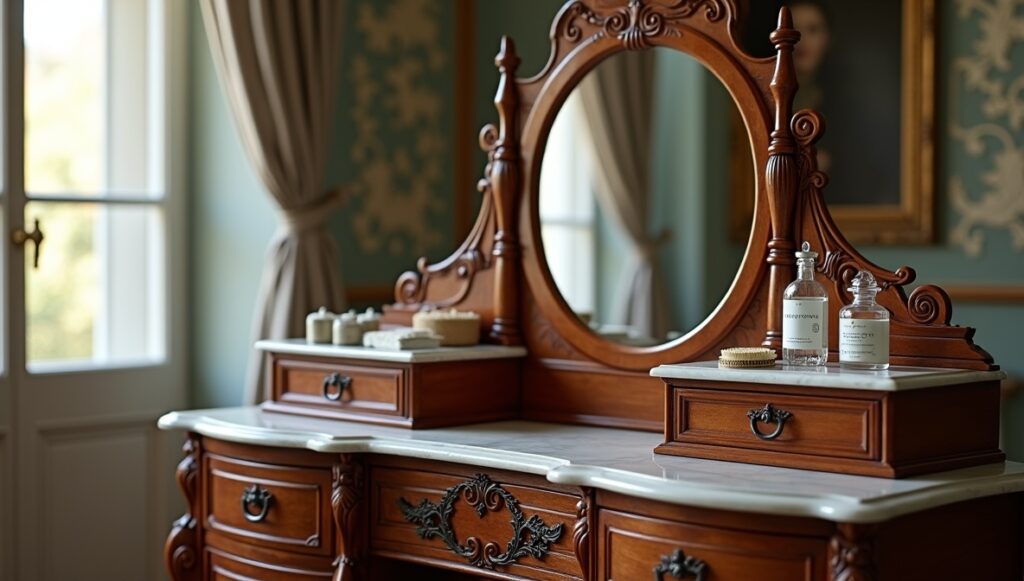
Market values are determined by the influence of many elements, such as style date, quality of manufacture and integrity, condition, provenance and rarity of form. A good Georgian mahogany writing table or work table with original hardware and unspoiled surface, or a documented Biedermeier work table with elegant veneer design, can realize good prices in the specialist market and at auction. Conversely a Victorian side table or commode with heavily restored surface, or lacking provenance, or of anonymous design, may be more modestly priced, particularly if the piece has been altered structurally or been over-flowered, although Victorian dressing tables and occasional tables with drawers can be in demand if the buyer is interested in the provision of storage, and visual appearance rather than academic qualities.
Regional preferences and collecting norms can affect market. Certain types of Georgian and Regency tables with drawers, for example, continue to be in demand in the Anglo-American market, as a direct result of the greater familiarity of those furniture styles both among the general public and within private household collections; therefore, stable selling prices can be achieved over a long period of time. Dominant styles in other regions, such as the Biedermeier and Empire, have enjoyed short-lived waves of appreciation, which have been stimulated by museum exhibitions and scholarly reports that offer a correction of earlier, negative perspectives. Sources such as the MAK (Museum fur angewandte Kunst) in Vienna and the Germanisches Nationalmuseum in Nuremberg have allowed scholars and collectors to broaden their knowledge of Central European furniture, which in turn influences the market.
All the same, younger buyers, buyers who are more design-aware than others, should be more attracted to the pared-down lines associated with Biedermeier, early 19 th century Scandinavian, or spartanly carved Georgian tables that have more than their fair share of drawers. Their ecological consciousness and interest in “slow interiors” should be prompting them to consider tables with exposed joints, hand-made fabrics and -mades, heavy sus6tains, and “second life” potential in people‘s homes as their homes evolve. In fact, even at those points where many a highly Victorian period carved tables have come down in value, tables with the honesty to display their solid construction become more desirable, for the resale value they offer and the fact that many a “dumb” piece with a drawer can still serve multiple purposes in contemporary homes (console tables in the entry, as small writing tables and laptop desks, dressing tables as bathroom mirrors). If the characteristic distinction of this typology–the Drawer–remains highly material, then it remains to served numerous purposes in small spaces.
Simultaneously, the marketplace is grappling with questions of value in relation to reproduction and authenticity. Magnificently crafted, historically authentic reproductions of decorative forms—some dating back as far as the late nineteenth and early twentieth centuries—blur lines of attribution and identify along the pricing spectrum. At the same time, the supply of authentic period pieces is diminishing, particularly at the highest quality level. Therefore, the inestimable value of expert guidance—whether in the form of evaluations, restorations, or connoisseurship—becomes all the more obvious to the collector attempting to maximize value. For the serious study, study, study, and connoisseurship-savvy collector, every replacement part, exotic join, and matured surface has considerable value, and the table with drawer provides the perfect lexicon for discovery: it rewards expertise, loyalty to authentic sources, and value estimation, all.
Conclusion: Why the Drawer Still Matters
A closer look reveals an otherwise hideous piece of furniture as far more than simply a slapdash bit of workmen’s ‘rough and ready’ carpentetry. As a ready functional store, the table-top with drawers also provides an extra-ordinary source for understanding the emergence of the modern domestic and bureaucratic existence; registering the shifts in conceptions of privacy and visual intrusion, masculinity and femininity, the pen and the keyboard, the factory and the office, and the work being done. The passage from the Early 17th century attached table and single indecipherable, ‘de-individualized’ draw to the myriad writing, working, dressing tables of the late 17th and 18th century where self-evidence of storage and surface as an integral part of the working table-stand, then storing away-its raison d’etre-registers people‘s growing accretion of wealth, information and the means to display what they own. For every over-crenellated, ticked-off, heavily painted drawerrun—the dedicated carriageway—is the archive of every operation, an image of departure and arrival.
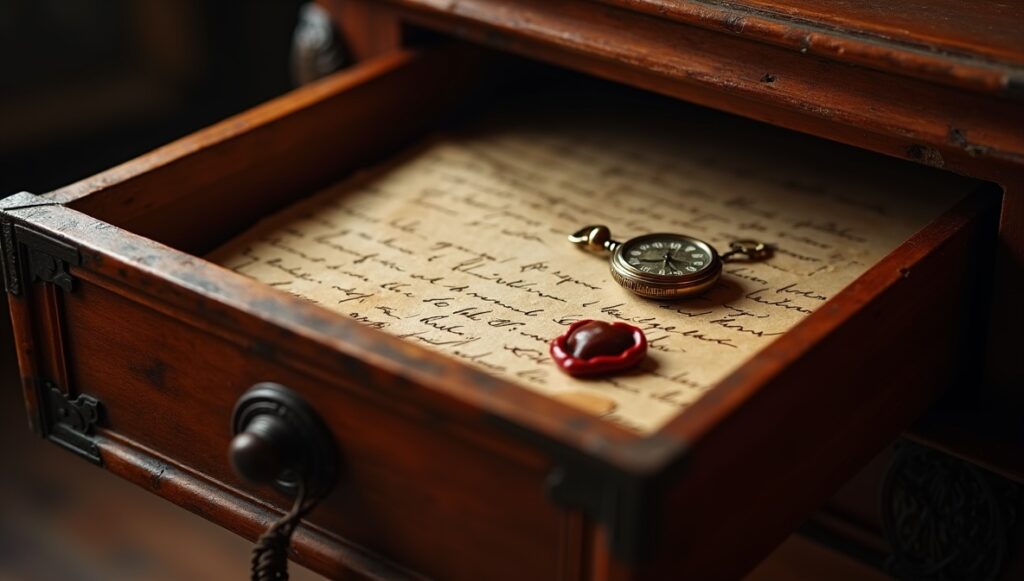
In their workmanship, these tables offer a language of constructural and decorative signifier that is the very basis of the European cabinetmaker‘s trade: they use their drawers as rehearsing grounds for their joiner—they use their fronts as lining for their inlay and veneer—you use their handles and knobs as adorable little constructed images cramming a dozen stylistic modes into five square centimetres. The collector whose eye is enriched by reading up on all these signs will gain an acculturation into trade, technology and aesthetic fancy that ranges from terpene plantations in the Caribbean to workshops of Viennese veneer horse traders; will glide thence to London timber merchants and craftsmen of various kinds and then on to Paris ebenistes. What museums and archives that preserve and record such objects are enabling is a language of communication with their makers and viewers.
Today, tables with drawers enchant both antiques and the contemporary because they are so intact as they have always been. They are repositories of letters, journals, relics, private objects; they are small sites of demarcation and concealment within the domestic interior; they persist through colonial territory and the decades of disrepair that follow by virtue of their years of amative care. The articulation of a new consciousness of their resilience counters the adoration of the antiquated that has oppressed modern America. The durability of tables with drawers offers an alternative to the short-lived technologies and fashions that fashion the culture of rapid disposal: objects more durable than their owners, often existent more than once, capable of alternative use, of alteration, of transmission, and ideally intended for a future buyer. By assisting in the identification of real tables, by investigating the degree to which the substances and patterns of their creation reveal themselves to us, and by venerating their signs of age, we begin the task of collective cultural remembrance.
Ultimately, the “hidden history” of antique tables with drawers lies not only in the documents and inventories that record them but in the interiors of the drawers themselves—the worn bottoms, the faint ink stains, the shadow of a long-removed divider. These humble compartments help us to reconstruct how earlier generations organized their lives, valued their belongings, and managed the interplay of work and intimacy. In an era once again preoccupied with storage, privacy, and the arrangement of domestic space, returning to these historical precedents is more than an antiquarian exercise. It is an opportunity to recognize that many of our supposedly modern concerns were already negotiated, day by day, at the modest threshold of a wooden drawer.
AI Notice: Some visual content in this article may have been created or enhanced using artificial intelligence (AI) for artistic, editorial or illustrative purposes. Learn more about our approach in our AI & Editorial Principles.