Franz von Stuck
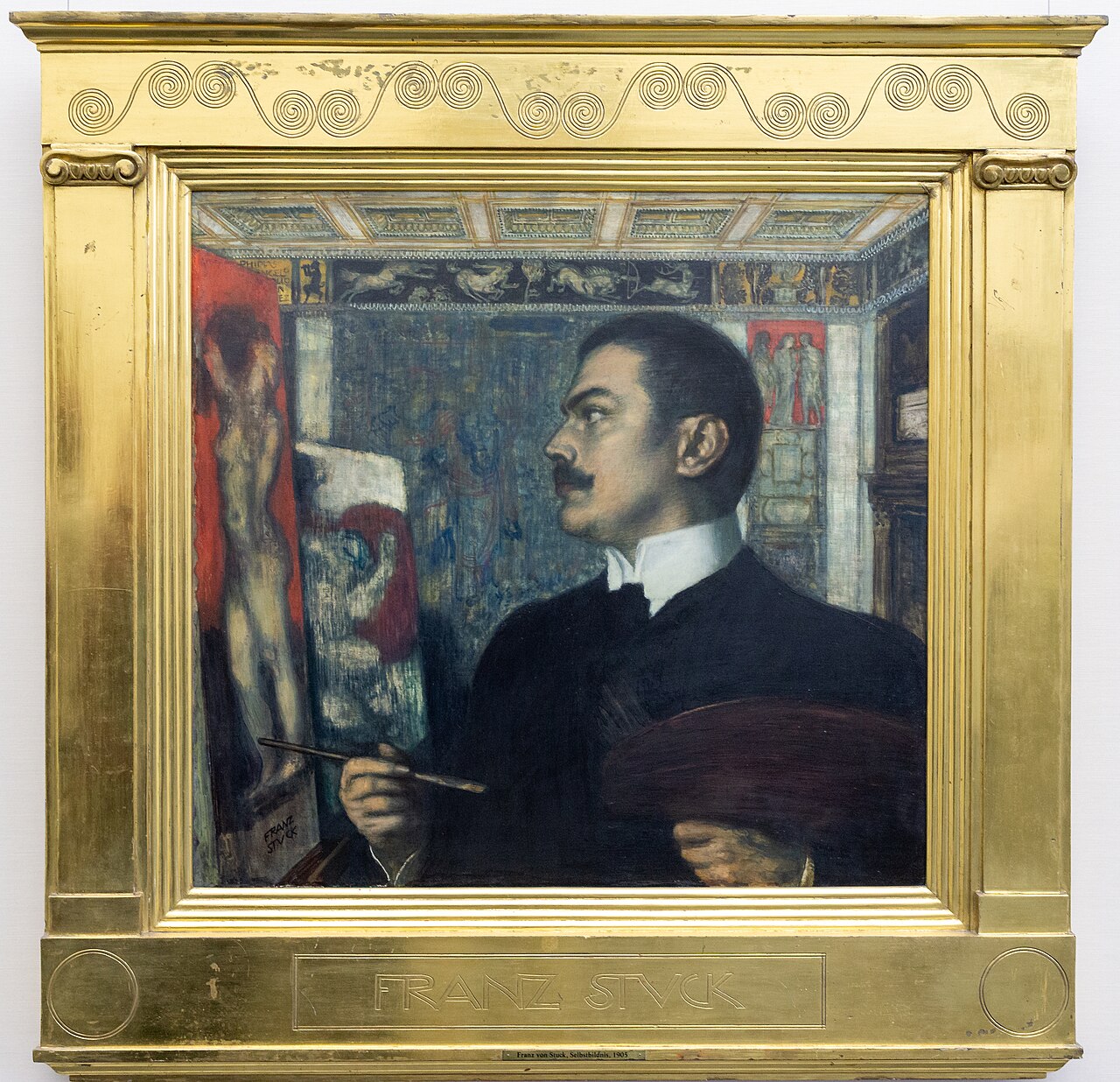
Franz von Stuck (1863–1928) stands as one of the defining figures of late-19th- and early-20th-century German art. A painter, sculptor, printmaker and decorative artist, Stuck synthesized classical form, mythological subject matter and the sensual symbolism characteristic of the fin de siècle into a distinctive visual language. His work—powerful in composition, often theatrical in lighting and strongly oriented around archetypal themes such as the femme fatale, mythic combat, fate and decadence—helped shape Munich as a major center of modern artistic life. Beyond his canvases, Stuck’s design of his own residence and studio, Villa Stuck, became a Gesamtkunstwerk that consolidated his influence on the nascent Jugendstil (German Art Nouveau) and on generations of artists who passed through Munich.
Early Life
Can You Name the Masterpiece?
Ten masterpieces. Ten questions. How well do you know the history of art?
Franz Stuck was born on February 23, 1863, in Tettenweis, a rural village in Lower Bavaria. He came from modest circumstances: his father was a bricklayer and builder. Early aptitude for drawing and draughtsmanship was recognized in the provincial context, and Stuck’s curiosity and ambitions led him to Munich—the cultural magnet for aspiring Bavarian artists—where he arrived as a young man determined to pursue a professional career in art.
Munich in the 1870s and 1880s provided Stuck both academic training and exposure to contemporary debates about realism, historicism and the growing interest in symbolism and decorative art. The urban-artistic environment and the interplay between historical painting and new aesthetic movements left a lasting imprint on his development.
Education and Training
Can You Guess the Artist?
Three clues. One artist. How quickly can you identify the painter?
Stuck’s formal artistic training took place at the Academy of Fine Arts in Munich, the pre-eminent German institution of its day. At the Academy he absorbed rigorous academic drawing and composition methods—discipline that remained visible in his mastery of form and anatomy throughout his career. The Munich Academy emphasized a synthesis of careful draughtsmanship, historical knowledge and painterly skill, all of which Stuck combined with a personal appetite for allegory and myth.
While rooted in academic technique, Stuck was alert to emerging tendencies in Europe: symbolist currents from France and Belgium, aestheticism, and the growing reaction against strictly historical subject painting. He supplemented academy training with private work and developing an independent studio practice that married academic solidity with imaginative and decorative impulses.
Career Development
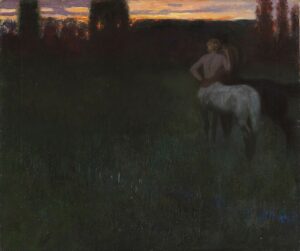
Franz von Stuck’s career accelerated in the 1890s as he found an audience for his dramatically staged mythological subjects. He became a prominent figure in Munich’s artistic circles and was closely associated with the Munich Secession movement—a group of artists who sought to break from academic conservatism and to promote modern styles and exhibitions. His reputation as a painter was cemented by high-profile exhibitions and by critical attention to his bold iconography and theatrical presentation.
In the mid-1890s Stuck began teaching and gained official recognition as a professor at the Munich Academy, where he influenced a generation of younger artists. Equally significant was his role as a designer: between 1897 and 1899 he created Villa Stuck in Munich as his home, atelier and statement of artistic identity. The Villa, with its integrated interior furnishings, murals and sculptural works, became both a showpiece and a practical laboratory for Stuck’s decorative and typological ideas. Today the building functions as Museum Villa Stuck, preserving his oeuvre and the environment in which it was produced.
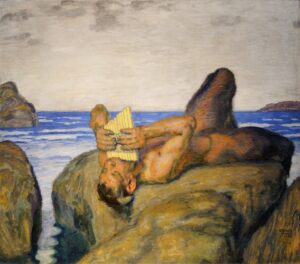
Stuck’s international profile grew along with his domestic success. His paintings and sculptures were reproduced in journals and catalogues, disseminating his visual tropes—serpents, sphinxes, classical nudities, and chiaroscuro-driven figures—throughout Europe and beyond. He maintained an active studio practice until his death in 1928, producing paintings, sculptures, and graphic works that spanned themes from myth to modern anxieties.
Artistic Style
Franz von Stuck’s style is characterized by a fusion of classical draftsmanship with symbolist drama and decorative clarity. Several features define his approach:
– Monumental figuration: Stuck’s figures often possess a sculptural solidity. He favored strong contours, modeled anatomy, and a sense of volume derived from his training in classical form.
– Dramatic lighting: His use of theatrical light and shadow heightens psychological tension and emphasizes salient forms, lending his canvases an almost cinematic presence.
– Allegorical themes: Stuck’s subjects frequently draw on mythology, biblical episodes and literary motifs, but he interprets them through late-19th-century sensibilities—emphasizing temptation, fatal beauty and existential conflict.
– Femme fatale imagery: Among his most persistent motifs is the powerful, erotic and dangerous woman—often a Salome, sphinx or ‘sin’ figure—who embodies both desire and moral consequence.
– Decorative integration: Stuck designed furniture, interiors and sculptural elements. His work often reads as part of an integrated decorative scheme, where painting, sculpture and design complement one another.
– Synthesis of styles: While formally grounded in academic practice, Stuck embraced aspects of Symbolism and Jugendstil. His pictorial space could be flattened or ornamented when the decorative effect served thematic purpose.
Technically, Stuck’s palette could range from muted tones to richer hues depending on subject matter, but there is always an economy of color that supports form and allegory rather than mere ornament.
Influences and Inspirations
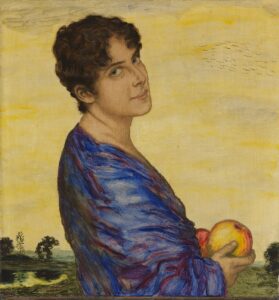
Stuck drew on a wide range of sources, synthesizing them into a singular voice:
– Classical antiquity: His study of Greco-Roman art informed his emphasis on anatomically disciplined figures and mythic subject matter.
– Renaissance and Baroque masters: Compositional boldness and chiaroscuro in his work trace a lineage to artists who used dramatic lighting and theatrical staging.
– Symbolism and Decadence: European symbolist writers and painters influenced Stuck’s thematic focus on inner life, archetypal figures and the darker sides of desire and fate.
– Wagnerian drama and myth: The cultural ambience of fin de siècle Germany, with its renewed interest in myth and music drama, is visible in Stuck’s operatic compositions and heroic or tragic narratives.
– Decorative arts and the Gesamtkunstwerk ideal: Influences from decorative movements, including the Arts and Crafts and Jugendstil, shaped his designs for interiors and furniture as components of a unified artistic environment.
Stuck’s ability to translate these influences into evocative, immediately legible images contributed to his popularity and his ability to address both elite and public tastes.
Famous Works
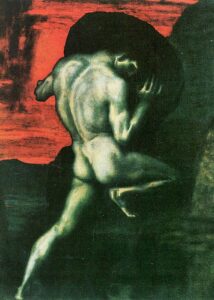
Franz von Stuck produced a number of works that became emblematic of his career and of the Munich art scene around the turn of the century. The following notable works illustrate his range as a painter and sculptor; for each, a concise description, the year, medium and the principal public collection where a major version is held are provided.
– The Sin (Die Sünde)
– Year: 1893
– Medium: Oil on canvas
– Current museum/collection: Neue Pinakothek, Bavarian State Painting Collections, Munich (principal version)
– Explanation: The Sin is perhaps Stuck’s most famous image—an image of a nude woman sitting atop a dark background with a large serpent coiling around her. The painting captured the fin-de-siècle fascination with temptation and moral ambiguity. The dramatic simplicity of the composition, the figure’s direct gaze and the symbolic presence of the serpent made this work an icon of Stuck’s femme fatale repertoire and circulated widely as a reproduction, amplifying his fame.
– Salome
– Year: circa 1906 (Stuck produced several Salome variations across years)
– Medium: Oil on canvas
– Current museum/collection: Museum Villa Stuck, Munich (principal version)
– Explanation: Stuck’s Salome paintings tap into the biblical and literary fascination with the dangerous seductress. His depictions focus on psychological intensity and ritualistic atmosphere rather than narrative detail—Salome becomes a symbol of desire’s consequences. Technical virtuosity in rendering skin tones and sumptuous textiles anchors the allegory in sensory reality.
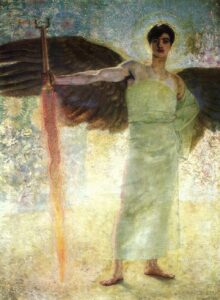
– Self-Portrait with the Sphinx (Selbstbildnis mit Sphinx)
– Year: circa 1905–1910
– Medium: Oil on canvas
– Current museum/collection: Neue Pinakothek, Munich / Museum Villa Stuck (principal holdings)
– Explanation: Self-portraits were a vehicle for Stuck to explore identity and artistic persona. In his Self-Portrait with the Sphinx the artist positions himself alongside a mythic creature—suggesting the artist’s affinity with mystery, enigma and classical themes. The image blends psychological introspection with theatrical allegory.
– The Wild Hunt (Die Wilde Jagd)
– Year: circa 1899–1900
– Medium: Oil on canvas
– Current museum/collection: Städtische Galerie im Lenbachhaus, Munich (principal version)
– Explanation: Drawing on Germanic myth, The Wild Hunt showcases Stuck’s interest in folklore and the uncanny. The dynamic composition and vigorous brushwork communicate the tumult of mythic pursuit. Here Stuck leans into narrative force and the expressive potential of myth, blending Romantic subject matter with his disciplined draftsmanship.
– Warrior and Amazon (Krieger und Amazone)
– Year: circa 1900
– Medium: Bronze sculpture
– Current museum/collection: Museum Villa Stuck / various German public collections (principal cast in Villa Stuck)
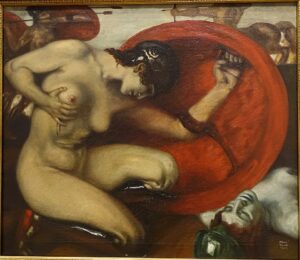
– Explanation: As a sculptor, Stuck translated his sculptural sensibility from the canvas into three dimensions. Warrior and Amazon reflects his preoccupation with heroic conflict and the interplay of masculine and feminine archetypes. The bronze surface, patina choices and formal modeling demonstrate his command of sculptural media and his ability to make allegory tangible.
– Wounded Centaur (Der verwundete Kentaur)
– Year: circa 1899
– Medium: Marble or bronze (versions in both media)
– Current museum/collection: Museum Villa Stuck / German public collections (principal version in Villa Stuck)
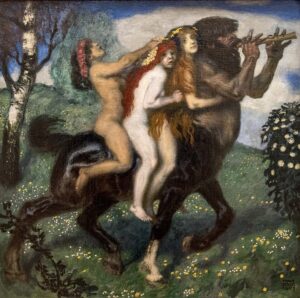
– Explanation: The wounded centaur theme allowed Stuck to probe classical mythology and compromised heroism. The figure’s dual nature—human and animal—enabled explorations of civilized form versus instinct, a recurring motif in his work. Sculptural treatment emphasizes anatomy, pathos and the dramatic potential of the human-animal hybrid.
Note: Stuck created multiple versions and variants of many of these motifs (especially Salome and scenes of “sin”), and principal versions of his paintings and sculptures can be found in several public collections—most prominently Museum Villa Stuck and the Neue Pinakothek in Munich, which together hold key works representing his career.
Legacy and Influence
Franz von Stuck’s legacy extends across multiple domains of twentieth-century art:
– Propagation of Symbolist imagery: Stuck helped popularize symbolist subject matter in Germany, offering a visual vocabulary—mythic bodies, femme fatales, archetypal beasts—that influenced contemporaries and younger artists.
– Pedagogical influence: As a professor and mentor in Munich, Stuck taught a generation of artists and encouraged an approach that valued both academic skill and imaginative themes. His atelier helped position Munich as a center for innovative figurative art at a time when Paris often dominated the European scene.
– Integration of art and design: Through Villa Stuck and his applied art, he modeled the idea of the artist as a total designer, prefiguring later developments in modernist thinking about interdisciplinary practice.
– Contribution to Jugendstil and succeeding movements: While not an Art Nouveau artist in the narrow ornamental sense, Stuck’s decorative sensibility and emphasis on stylized motifs resonated with the broader Jugendstil movement, contributing to a German variant of modern aesthetics.
– Lasting iconic images: Paintings like The Sin became visual shorthand for fin de siècle anxieties and produced a durable cultural resonance that outlived many contemporaneous fashions.
Although fashions changed with the emergence of Expressionism and abstraction, Stuck’s work remained an important reference point for issues of myth, identity and the body in modern art.
Market Value and Collectibility
Franz von Stuck occupies a significant position in the art market for late 19th- and early 20th-century European painting and sculpture. Factors affecting value include subject matter (major mythological canvases and iconic motifs like The Sin command higher prices), condition, provenance and rarity (unique large-scale paintings and original bronzes are more desirable).
– Auction performance: Major works by Stuck have achieved strong results at auction, with top-tier paintings and bronzes reaching high five- and in some cases seven-figure sums in euros or dollars, depending on market conditions and the rarity of the piece.
– Collectibility: Collectors value Stuck for his aesthetic singularity, the cross-disciplinary nature of his output (paintings, sculptures, prints, interior design) and his canonical status in German art history. Works with secure provenance, exhibition history or inclusion in museum collections typically perform better commercially.
– Prints and drawings: Stuck’s graphic oeuvre—etchings, lithographs and drawings—offers accessible entry points for collectors. These works are collectible at more modest price levels but can still appreciate, especially those with museum-quality provenance.
– Decorative objects: Furniture and decorative objects designed by Stuck for Villa Stuck or in his style are sought after for collectors of Jugendstil and Art Nouveau decorative arts.
– Advice for buyers: Condition reports, exhibition and publication history, and provenance are critical. Because Stuck produced multiple versions of subjects, authentication and catalogue references are important for high-value purchases. Working with established dealers and auction houses experienced in German fin de siècle art reduces risk.
Market interest in Stuck is often cyclical but sustained by institutions and collectors interested in Symbolism, Munich Secession artists and the decorative arts of the period.
Museums and Collections
Major public institutions holding substantial works by Franz von Stuck include:
– Museum Villa Stuck, Munich — the artist’s former residence, now a museum with many major works, sculptures and interior designs.
– Neue Pinakothek (Bavarian State Painting Collections), Munich — houses key paintings by Stuck, including principal versions of major canvases.
– Städtische Galerie im Lenbachhaus, Munich — collects works associated with Munich’s art scene around 1900 and holds works by Stuck.
– Staatliche Kunstsammlungen, various German museums — several regional museums hold paintings, sculptures and prints by Stuck.
– International institutions — prints, drawings and selected paintings by Stuck appear in collections such as British museums and European modern art collections (many museums hold examples of his graphic work).
Because Stuck was both prolific and influential locally, Munich institutions—especially Villa Stuck—remain primary destinations for viewing his work in context.
Interesting Facts
– Villa Stuck as Gesamtkunstwerk: Franz von Stuck designed Villa Stuck as an integrated living and working environment—staging painting, sculpture, furniture and mural decoration as a unified artistic statement. The Villa remains a rare intact example of this ambition.
– Reproducibility and fame: Early in his career Stuck’s images circulated widely through reproductive prints and illustrated journals, turning motifs like The Sin into widely recognized cultural icons.
– Multiple media: Stuck was active across media—oil painting, tempera, drawing, printmaking, bronze and stone sculpture, furniture and interior design—demonstrating a plural practice rare for many contemporaries.
– Public honors: Stuck received official recognition and awards in his lifetime, which helped cement his status in German cultural life and led to commissions and students at the Academy.
– Ambiguous reputation: While admired in his time, Stuck’s association with fin de siècle decadence and later shifts in taste meant that his reputation fluctuated during the 20th century; recent decades have seen renewed scholarly interest in his contributions to Symbolism and applied arts.
FAQ
Who was Franz von Stuck and why is he important?
Franz von Stuck was a German painter, sculptor, printmaker and designer active around the turn of the 20th century. He is important for his fusion of classical technique with symbolist themes, his influential role in Munich’s artistic life, and his integrated design work exemplified by Villa Stuck. His images, especially those of myth and the femme fatale, became emblematic of fin de siècle aesthetics.
What are Franz von Stuck’s most famous paintings?
Among Stuck’s best-known paintings are The Sin (Die Sünde, 1893), his Salome variations, and a number of dramatic mythological canvases that depict centaurs, hunts and heroic conflict. The Sin remains the single most iconic image associated with his career.
Where can I see Franz von Stuck’s work in person?
The principal place to see Stuck’s work is Museum Villa Stuck in Munich, which preserves his studio, interior designs and a substantial number of paintings and sculptures. Other significant holdings are in Munich’s Neue Pinakothek and the Lenbachhaus. Various regional and international museums also have prints and selected paintings.
How much do works by Franz von Stuck cost today?
Values vary widely: original large-scale paintings and sculptures by Stuck can command high five-figure to seven-figure prices, depending on rarity, condition and provenance. Prints and drawings are more affordable and present accessible collecting opportunities. Consultation with specialists and auction house records will give precise market indications for individual works.
What artistic movements is Franz von Stuck associated with?
Stuck is associated primarily with Symbolism, the Munich Secession and the broader tendencies of Jugendstil (German Art Nouveau) in terms of decorative integration. While rooted in academic training, his subject matter and decorative sensibility align him with fin de siècle currents across Europe.
AI Notice: Some visual content in this article may have been created or enhanced using artificial intelligence (AI) for artistic, editorial or illustrative purposes. Learn more about our approach in our AI & Editorial Principles.