
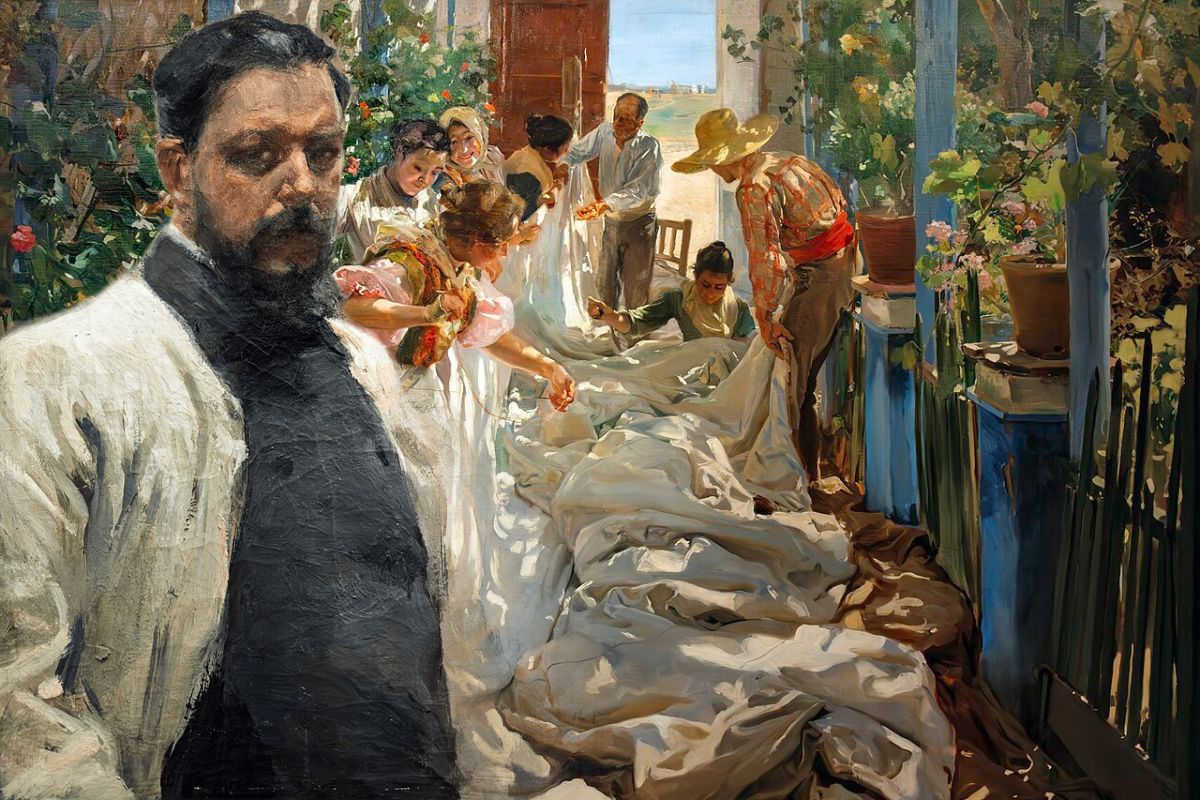
Joaquin Sorolla
Joaquín Sorolla y Bastida (1863–1923) is widely regarded as one of Spain’s most luminous painters, celebrated for his extraordinary ability to capture the effects of sunlight and the sensory immediacy of Mediterranean life. Working at the turn of the 20th century, Sorolla developed a distinctive visual language that combined a rigorous academic training with a plein-air enthusiasm for color and movement. His oeuvre ranges from intimate family portraits and sun-drenched beach scenes to socially engaged history paintings and monumental murals commissioned for international patrons. For collectors, curators and scholars, Sorolla represents a pivotal bridge between Spanish academicism and modern European painting: formally grounded yet overtly modern in his chromatic audacity and painterly freedom.

Early Life
Can You Name the Masterpiece?
Ten masterpieces. Ten questions. How well do you know the history of art?
Joaquín Sorolla was born on February 27, 1863, in Valencia, Spain. His childhood in the coastal city of Valencia and the surrounding Valencian community profoundly shaped his subject matter and his relationship with light and atmosphere. He lost his father at a young age and was raised in modest circumstances; early responsibilities compelled Sorolla to work while pursuing an artistic vocation. The sea, fishermen and the rhythms of working-class life became enduring motifs throughout his career, reflected in both his sympathetic portrayals of coastal populations and his interest in the luminous interplay between skin, fabric and water.
Sorolla’s formative years in Valencia afforded him early exposure to local artistic traditions and to a Mediterranean palette of clear light and saturated color. Although the family circumstances were not privileged, a combination of local patronage, scholarships and his evident talent permitted him to pursue formal studies and to travel, widening his exposure to regional and international idioms.
Education and Training
Can You Guess the Artist?
Three clues. One artist. How quickly can you identify the painter?
Sorolla’s formal education began at the Escuela de Bellas Artes in Valencia, where he received instruction in traditional academic drawing and painting. The rigorous academic training instilled in him a mastery of draftsmanship and composition, foundations that persisted even as his style shifted toward freer brushwork. He won scholarships that allowed him to study in Madrid, where he entered the Escuela Superior de Pintura at the Real Academia de Bellas Artes de San Fernando. There he encountered the canonical traditions of Spanish art and benefitted from an environment that emphasized life drawing, anatomy and the study of Old Master works.
A decisive period of growth occurred when Sorolla traveled abroad. He spent time in Barcelona and Rome, followed by productive stays in Paris, where contemporary French painting — including Impressionism and the work of painters such as Édouard Manet and Claude Monet — left a demonstrable mark on his palette and technique. Nevertheless, Sorolla never adopted a wholesale stylistic conversion; his assimilation of modern tendencies always remained mediated by his academic foundations and a distinctly Spanish sensibility.
Career Development
Sorolla’s career advanced through a combination of critical recognition, important commissions and international exhibitions. He gained early attention for works that addressed social issues — most notably his 1899 painting La herencia maldita (commonly translated as The Sad Inheritance), a dramatic tableau depicting crippled children bathing in seawater under the supervision of a compassionate priest. The painting received significant acclaim at national exhibitions and established Sorolla’s reputation beyond regional circles.

During the first decade of the 20th century Sorolla consolidated a commercial and institutional success that allowed him to pursue major commissions. His portraits of prominent figures — politicians, industrialists and cultural elites — became a steady source of income and visibility. These portrait commissions often emphasized psychological presence and the tactile richness of fabrics, evidencing Sorolla’s dual interest in representation and painterly sensation.
International acclaim reached its apogee with the commission from Archer Milton Huntington for a monumental series of murals commemorating the provinces of Spain. Executed between 1911 and 1929 (the project extended beyond Sorolla’s lifetime), the “Visión de España” (Vision of Spain) cycle is a monumental testament to his ability to scale up his sunlit canvases into an encyclopedic national panorama. Installed at the Hispanic Society of America in New York, the murals brought Sorolla to the attention of an American audience and underscored his status as an artist of international consequence.
In his later years Sorolla continued to paint prolifically: genre scenes, landscapes, and family portraits, particularly of his wife Clotilde and their children, recur in his late oeuvre. He maintained a rigorous practice of working outdoors, often completing studies at the beach and studio works in quick, energized brushstrokes. Sorolla’s career was productive until ill health curtailed his activity; he died in Madrid on August 10, 1923.
Artistic Style
Sorolla’s style is identifiable by its mastery of light, brisk yet controlled brushwork, and a color sense that privileges luminosity over chiaroscuro. His approach is sometimes categorized as luminism — a term that describes artists’ sustained preoccupation with the depiction of natural light — although Sorolla’s work synthesizes elements from several contemporary movements rather than fitting neatly into a single school.

Key stylistic features:
– Light as subject: Sorolla treats sunlight not only as an environmental condition but as a primary subject. The way light reveals texture, delineates forms and animates surfaces is central to his pictorial project.
– Loose, fluent brushwork: Across studies and finished canvases, Sorolla employs brisk, confident brushstrokes that suggest form without fully describing it. This painterly economy intensifies sensations of immediacy and movement.
– High-key palette: His harmonies favor warm, sun-washed tones — ochres, warm whites, ultramarine and vivid greens — often juxtaposed to produce shimmering chromatic contrasts.
– Composition rooted in observation: Even when producing large-scale works, Sorolla retained a commitment to observation from life. Figures are placed within believable spatial contexts and often captured in a fleeting, candid moment.
– Psychological intimacy: Sorolla’s portraits, even when commissioned, frequently convey an intimacy and immediacy that goes beyond formal likeness. The painter sought to render the sitter’s presence through gesture, gaze and the tactile rendering of flesh and fabric.
In sum, Sorolla’s technique blends the observational intensity of plein-air painting with an academic structural sensibility; the result is a body of work that reads as both modern and profoundly rooted in Spanish tradition.
Influences and Inspirations
Sorolla’s visual vocabulary was shaped by multiple influences:
– Spanish tradition: The legacy of Velázquez and Goya — especially their naturalistic attention to human presence and psychological depth — informed Sorolla’s portraiture and compositional rigor.

– French Impressionism: Sorolla absorbed the Impressionists’ devotion to light and atmospheric effect, translating those concerns into a Mediterranean idiom characterized by stronger contrasts and more saturated color.
– Naturalism and social realism: Early social-themed works reveal Sorolla’s interest in depicting the social realities of his time, reflecting a broader European concern for realism and social engagement in art.
– The Mediterranean environment: The light, color and life of the Valencian coast were constant sources of inspiration. Beaches, fishermen, domestic interiors and gardens serve as recurring motifs that allowed Sorolla to study the interaction between human figures and luminous settings.
– Personal relationships: Family members, especially his wife Clotilde and their three children, repeatedly served as models. These intimate studies enabled Sorolla to explore both the personal and the formal dimensions of his practice.
Sorolla’s assimilation of these varied influences resulted in a personal idiom: a dynamic, light-filled realism that remains instantly recognizable.
Famous Works
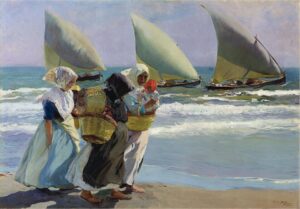
Below are five notable works by Joaquín Sorolla, with brief explanations of each.
– Artwork name: Walk on the Beach (Paseo a orillas del mar)
Year: 1909
Medium: Oil on canvas
Current Museum or Collection: Museo Sorolla, Madrid
Explanation: Walk on the Beach is one of Sorolla’s most celebrated images of familial intimacy and seaside leisure. The painting depicts Clotilde and their daughter walking along a sunlit shoreline, their white garments billowing in the coastal breeze. Sorolla’s handling of sunlight on fabric and skin is exemplary: delicate highlights and cool shadows convey the volumetric presence of the figures without heavy modeling. The composition combines a spontaneous, photographic immediacy with a refined balance that showcases Sorolla’s mastery of modern, sunlit portraiture.
– Artwork name: The Sad Inheritance (La herencia maldita)
Year: 1899
Medium: Oil on canvas
Current Museum or Collection: Museo de Bellas Artes, Valencia
Explanation: The Sad Inheritance marks a critical juncture in Sorolla’s career: a large, socially engaged work that addresses the plight of disabled children receiving therapeutic seawater baths under the supervision of a priest. The painting is notable for its emotional directness and its dramatic yet naturalistic depiction of light and human suffering. Sorolla’s palette is restrained and the composition built around an architecture of empathy; the work demonstrates his ability to combine narrative content with formal painterly concerns and contributed to his national recognition.
– Artwork name: The Return from Fishing (Regreso de la pesca)
Year: 1894
Medium: Oil on canvas
Current Museum or Collection: Museo de Bellas Artes, Valencia
Explanation: The Return from Fishing exemplifies Sorolla’s early interest in coastal life and the daily labor of fishermen. The vivid rendering of sea spray, wet skin and weathered boats shows his facility with varied surfaces under sunlight. The painting communicates both the physical exhaustion of labor and the luminous vitality of the maritime environment, establishing motifs that he would revisit throughout his career.
– Artwork name: Vision of Spain: Valencian Orchard (from the “Visión de España” series)
Year: 1913–1919 (part of the larger series executed over 1911–1929)
Medium: Oil on canvas (mural panels)
Current Museum or Collection: Hispanic Society of America, New York
Explanation: The Visión de España murals represent Sorolla’s monumental engagement with national identity and regional diversity. Commissioned by Archer M. Huntington for the Hispanic Society of America, the cycle comprises large panels depicting regional customs, costumes and landscapes. The Valencian-themed panels are exemplary for their radiant color, figural abundance and compositional sweep. These murals allowed Sorolla to translate his intimate beach scenes and genre studies into a grand public format, showcasing both his technical prowess and his vision of Spain’s cultural heterogeneity.
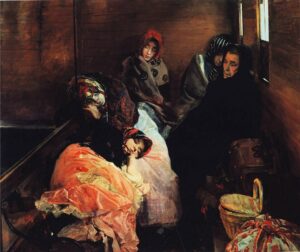
– Artwork name: Sewing the Sail (Cosiendo la vela)
Year: 1896
Medium: Oil on canvas
Current Museum or Collection: Museo Sorolla, Madrid
Explanation: Sewing the Sail is an intimate domestic and occupational scene that blends genre observation with a delicate study of texture and light. The painting captures women engaged in mending a sail, their concentrated gestures framed by folds of fabric and shafts of light pouring into the workspace. Sorolla’s interest in depicting the tactile qualities of cloth and the way light animates surfaces is evident here; the painting stands as a testament to his ability to elevate everyday labor into subjects of painterly investigation.
Legacy and Influence
Sorolla’s legacy is multifaceted. Within Spain, he is celebrated as a national master who reshaped the visual conversation about light and modern representation. Internationally, Sorolla is acknowledged for his contribution to the evolution of plein-air and impressionistic tendencies on the Iberian Peninsula. His large-scale public works, particularly the Visión de España series, extended his influence into museum practice and the iconography of national identity.
Academically, Sorolla occupies an important position in studies of late 19th- and early 20th-century painting. His fusion of academic discipline with impressionist spontaneity provides fertile ground for analysis: scholars examine his painterly process, his social and cultural commitments, and his role in transnational artistic dialogues between Spain and France, and later between Spain and the United States.
For contemporary painters, Sorolla’s economy of brushstroke and his prioritization of natural light continue to serve as instructive models. Museums and exhibitions dedicated to Sorolla have periodically renewed interest in his work, situating him within broader histories of modernity, nationalism and the development of modern Spanish art.
Market Value and Collectibility
Sorolla’s market remains strong among collectors of 19th- and early 20th-century European art. Several factors influence the market value of Sorolla works:
– Subject and size: Large, finished oil canvases — particularly those with striking coastal or social themes — command the highest prices. Smaller studies and drawings are more accessible but still appreciate when in good condition and with clear provenance.
– Provenance and exhibition history: Works with a distinguished provenance or those that have been included in major museum exhibitions tend to achieve premium prices at auction.
– Condition and conservation: Sorolla’s looser brushwork, while visually dynamic, places a premium on the technical condition of the paint surface. Well-preserved canvases with stable varnish typically fetch higher valuations.
– Market trends: Interest in Spanish painting fluctuates with broader market cycles, but Sorolla benefits from sustained institutional support and periodic exhibitions that renew collectors’ interest.
Typical ranges vary widely: smaller studies and drawings may trade at several thousand to tens of thousands of dollars, while major oils by Sorolla have achieved prices in the high six- to seven-figure range at auction. Collectors should consult specialists and auction house catalogues for up-to-date valuations and provenance research before making acquisitions.
Museums and Collections
Joaquín Sorolla’s works are held in numerous museums and private collections worldwide. Key public repositories include:
– Museo Sorolla, Madrid: The artist’s former home and studio, now a museum, holds one of the most comprehensive collections of his paintings, drawings and personal effects.
– Hispanic Society of America, New York: The site of the monumental Visión de España murals and a major resource for Sorolla scholarship.
– Museo de Bellas Artes, Valencia: As Sorolla’s native region, Valencia’s museums preserve important early and mature works, particularly those connected to coastal life.
– Major international museums and regional European collections: Various institutions maintain representative Sorolla works in their holdings; these collections support periodic loans and retrospectives that promote international access to his art.
Collectors and curators frequently rely on these institutions for research, condition reports and loan collaborations when mounting exhibitions or considering purchases.
Interesting Facts
– Sorolla the photographer: Sorolla used photography as a tool for composition and study. Photographs of models and landscape studies informed many of his large-scale compositions, providing references while preserving the spontaneity of his pictorial decisions.
– A working studio-home preserved: Museo Sorolla in Madrid remains in the artist’s former house, providing visitors with a rare glimpse into his working and domestic environment, including original furniture, sketches and decorative objects that informed his practice.
– A late-career American commission: Archer Huntington’s patronage and the subsequent Visión de España commission marked Sorolla’s most significant international recognition and established his reputation in the United States.
– Master of quick study: Sorolla was renowned for producing rapid studies en plein air that captured the essence of a moment; he would often translate these studies into larger, more finished studio works without losing the immediacy of the original impression.
– Artistic family life: Many of Sorolla’s most tender and well-known paintings feature his wife Clotilde and their children as models, creating an autobiographical strand within his broader oeuvre that conveys domestic affection alongside technical virtuosity.
FAQ
Who was Joaquín Sorolla and why is he important?
Joaquín Sorolla was a Spanish painter (1863–1923) celebrated for his mastery of sunlight and color. He is important for bridging academic traditions with modern plein-air techniques, producing both intimate portraits and large-scale public murals that shaped perceptions of Spain at home and abroad.
Is Sorolla considered an Impressionist?
Sorolla is often associated with Impressionism because of his focus on light and plein-air practice, but he is not a strict Impressionist. His academic training and narrative interests differentiate him: he merged impressionistic brushwork and color with structured composition and a realist sensibility.
Where can I see Sorolla’s most important works?
Major concentrations of Sorolla’s works are at Museo Sorolla in Madrid and the Hispanic Society of America in New York (home of the Visión de España murals). Regional museums in Valencia also hold significant examples of his coastal and social-themed paintings.
Are Sorolla’s paintings valuable for collectors?
Yes. Sorolla’s works are sought after by collectors of 19th- and early 20th-century European painting. Large finished oils and works with strong provenance or exhibition histories command higher prices, while studies and drawings are more accessible but still collectible.
What subjects did Sorolla prefer to paint?
Sorolla favored coastal scenes, family portraits, social-realist subjects and regional customs. Recurrent themes include children at the beach, fishermen and market scenes, as well as commissioned portraits of prominent figures. His sustained interest was the depiction of light across varied surfaces — skin, water and fabric.
AI Notice: Some visual content in this article may have been created or enhanced using artificial intelligence (AI) for artistic, editorial or illustrative purposes. Learn more about our approach in our AI & Editorial Principles.