
Edward Atkinson Hornel
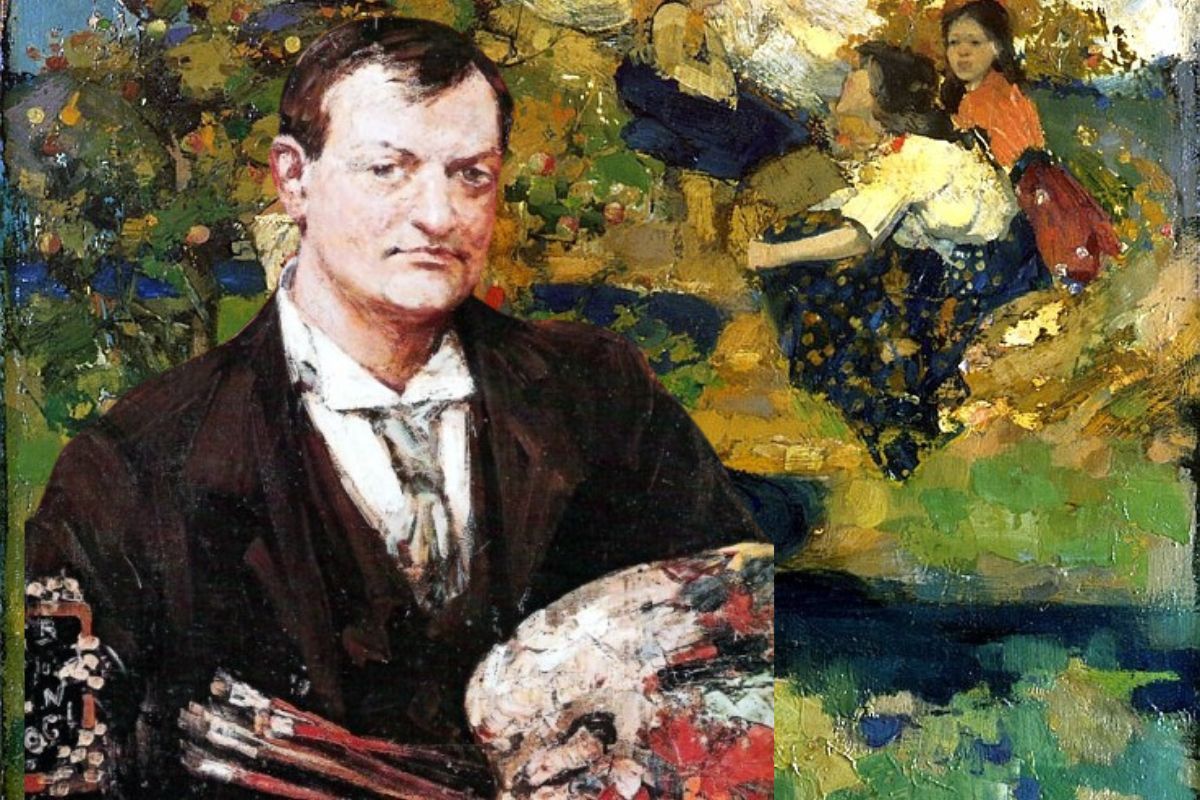
Edward Atkinson Hornel (1864–1933) stands among the most distinctive painters to emerge from late 19th- and early 20th-century Scotland. A member of the Glasgow Boys and a leading figure in the Kirkcudbright artists’ colony, Hornel developed a decorative, color-rich approach that blended Scottish naturalism with strong Japonisme influences. His work—often populated with children, young women, abundant flowers and decorative patterning—combined a painterly bravura with an interest in design, decorative motif and the relationship between figure and landscape. For collectors, curators and scholars of Victorian and Edwardian art, Hornel occupies a significant place: his canvases bridge realist tendencies and a more international, decorative modernism that anticipated later developments in British art.
Early Life
Can You Name the Masterpiece?
Ten masterpieces. Ten questions. How well do you know the history of art?
Edward Atkinson Hornel was born in 1864 in Scotland. He grew up during a period of rapid social and cultural change and came of age in the aftermath of the Aesthetic and Pre-Raphaelite movements, which shaped public taste and the art market. Hornel’s early environment—both the urban centers where he received training and the coastal rural landscapes of Dumfries and Galloway where he later settled—left a deep imprint on his subject matter and palette. In youth he displayed an affinity for drawing and design that pointed him toward a professional artistic career rather than a conventional trade.
Education and Training
Hornel’s formal artistic education combined conventional training with exposure to progressive circles. He studied at institutions that emphasized drawing from life and encouraged attention to naturalistic detail. Early training sessions focused on anatomy, draughtsmanship and the disciplined use of line, while his contemporaneous involvement with the Glasgow Boys brought him into contact with peers who favored direct observation and an unvarnished engagement with contemporary life.
Can You Guess the Artist?
Three clues. One artist. How quickly can you identify the painter?
Beyond academic instruction, Hornel undertook travel and study tours that profoundly influenced his development. A notable trip to Japan—either directly or through intensive study of Japanese art and prints—introduced him to compositional flattening, decorative patterning and an alternative sense of spatial organization. Hornel also benefited from informal mentorship and collaboration with established Scottish artists; those relationships helped him refine his technical strengths and to interpret decorative sources within figurative painting.
Career Development
Hornel’s career took shape in two overlapping contexts: the progressive art scene of Glasgow and the artists’ community in Kirkcudbright. Early exhibitions with Glasgow groups brought him public attention and connected him to critics and patrons interested in new directions in Scottish painting. His association with the Glasgow Boys—a loosely organized group of artists who reacted against academic conventions and embraced plein-air techniques, modern subject matter and an international outlook—was central to his professional identity.
In the mid- to late-1890s Hornel consolidated his reputation through large decorative canvases, figurative compositions that favored children and young women amid lush floral settings, and collaborations with contemporaries such as George Henry. These projects were well received in Britain and on the continent and were shown in salons and galleries that catered to collectors of progressive Scottish art.
A decisive moment in Hornel’s career was his relocation to Kirkcudbright, where he purchased Broughton House and its garden. The house served as both studio and showcase for his work and became a focal point for visiting collectors. The coastal landscape and the light of southwestern Scotland further enriched his palette and subject matter. Throughout the first decades of the 20th century, Hornel continued to paint, exhibit and receive commissions; his later years involved consolidating his legacy through gifts and the curation of his house collection.
Artistic Style
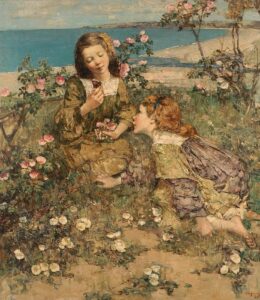
Hornel’s style is characterized by a lush decorative sensibility, a rich and often jewel-like palette, and a treatment of surface that alternates between painterly bravura and fine patterning. Key stylistic features include:
– Coloristic emphasis: Hornel favored saturated colors and deliberate juxtapositions that heighten decorative effect. His use of golds, deep greens, and intense floral hues gives many canvases an almost tapestry-like quality.
– Japonisme and flattened space: Influences from Japanese woodblock prints appear in Hornel’s flattened planes, cropped compositions and attention to surface pattern. He adapted these devices within western figurative painting to create compositions that are at once intimate and decorative.
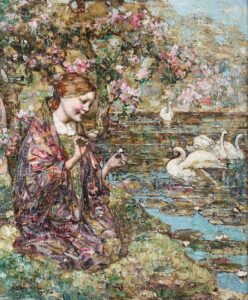
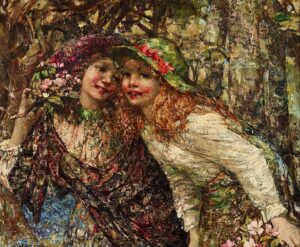
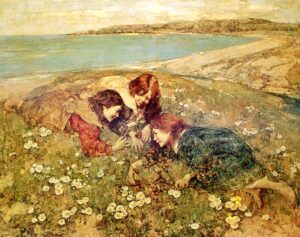
– Figural focus: Hornel frequently painted children or young women, often in contemplative poses and surrounded by ornamental foliage. The figures are typically integrated into their settings rather than presented as distinct portrait subjects.
– Surface treatment: From thin washes to impasto accents, Hornel used varied brushwork to create textural contrast—delicate rendering for skin and facial features, bolder strokes for flowers and foliage.
– Decorative punctuation: Repeated motifs—flowers, patterned textiles, stylized foliage—serve both compositional and symbolic roles, intensifying the overall ornamental impact.
Overall, Hornel’s work stands at an intersection: it remains figurative and rooted in observation, but it embraces a decorative vocabulary that aligns him with broader international trends in late 19th-century art.

Influences and Inspirations
Hornel’s inspirations were diverse and layered:
– Japanese art (Japonisme): The vocabulary of Japanese prints—tilted perspectives, pattern emphasis, asymmetrical compositions and bold color contrasts—left a clear mark on Hornel’s approach to composition and surface.
– The Glasgow Boys: As part of this progressive Scottish circle, Hornel absorbed a commitment to direct observation, often pairing it with an interest in modern decorative schemes and design.
– Pre-Raphaelite and Aesthetic movements: While Hornel moved beyond the strict iconography of the Pre-Raphaelites, their attention to detail, beauty, and ornament continued to inform his sensibility.
– Scottish landscape and light: The coastal scenery and gardens of Kirkcudbright provided recurring motifs and a natural source of color and pattern that Hornel adapted into decorative tableaux.
– Decorative arts and theatre: Hornel’s work shows a concern with set-like compositions and decorative staging. The boundary between painting and applied design was porous in his practice, and he often treated canvases as modern decorative objects.
Famous Works
Below are five notable artworks by Edward Atkinson Hornel. For each work the title, approximate year, medium and a current museum or collection are provided, along with a concise explanation of significance and content.
– The Druids
– Year: c. 1891
– Medium: Oil on canvas
– Current Museum/Collection: Kelvingrove Art Gallery and Museum, Glasgow
– Explanation: A collaborative work executed with George Henry, The Druids is emblematic of the Glasgow Boys’ decorative ambitions. The painting presents a ring of robed figures in a stylized natural setting, combining monumental figuration with patterned foliage. It illustrates Hornel’s interest in theatrical composition and his ability to integrate figure and environment into a unified decorative whole. The work attracted notice for its ambitious scale and for the partnership between two leading Scottish painters.

– Spring (Decorative Panel)
– Year: c. 1895–1900
– Medium: Oil on panel
– Current Museum/Collection: Broughton House, Kirkcudbright (Hornel collection)
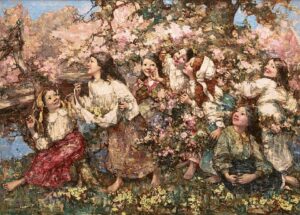
– Explanation: One of a series of seasonal or garden-themed panels that Hornel produced during his mature period, Spring showcases the artist’s decorative palette—pale pinks, greens and gold—applied to a composition of young girls and abundant blossoms. Intended as a decorative object as much as an easel painting, the work demonstrates Hornel’s fusion of figuration and ornament, and his ability to translate plein-air observation into an artificially heightened, poetic scene.
– Bathers
– Year: c. 1898
– Medium: Oil on canvas
– Current Museum/Collection: National Galleries of Scotland
– Explanation: Bathers is a recurring subject in Hornel’s oeuvre and here serves to display the artist’s interest in the human figure set within a decorative landscape. The composition focuses on young women or girls at the water’s edge, with rhythmic repetitions of form and a shimmering treatment of water and foliage. This painting highlights Hornel’s synthesis of naturalistic detail and decorative flatness—figures have weight and volume, but they are integrated into a patterned, ornamental environment.
– A Japanese Girl
– Year: c. 1893
– Medium: Oil on canvas
– Current Museum/Collection: Aberdeen Art Gallery & Museums
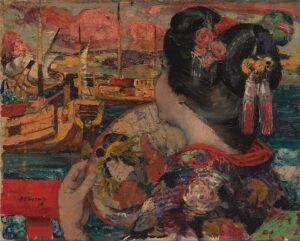
– Explanation: A direct manifestation of Hornel’s engagement with Japonisme, A Japanese Girl features a solitary figure in clothing and setting influenced by Japanese aesthetics. The painting combines intimate portraiture with stylized background motifs, revealing Hornel’s fascination with foreign costume, decorative textiles and the visual vocabulary of Japanese prints. It also demonstrates his sensitivity to delicate coloring and pattern contrasts.
 – White Lilies
– Year: c. 1905
– Medium: Oil on canvas
– Current Museum/Collection: Private Scottish Collection (formerly displayed at Kirkcudbright)
– Explanation: White Lilies is representative of Hornel’s flower-and-figure compositions. The canvas places a young subject amid a luxuriant display of lilies, articulated with both careful brushwork and decorative flares. The painting exemplifies Hornel’s gift for harmonizing figuration with botanical motifs and remains a sought-after example for collectors of late Victorian and Edwardian decorative painting.
Legacy and Influence
Edward Atkinson Hornel’s legacy is multifaceted. Artistically, he helped to expand the vocabulary of Scottish painting by integrating international decorative influences—especially Japanese visual strategies—into a localized, figurative practice. Hornel’s work signaled a move toward a more integrated art of surface and design that anticipated later developments in British modernism and the Arts and Crafts movement.
Institutionally, Hornel contributed to the cultural life of Kirkcudbright, transforming Broughton House into an artistic hub and leaving behind a curated environment that continues to attract scholars and visitors. His paintings and personal collection helped to cement the town’s reputation as an artists’ colony.
For contemporary artists and designers, Hornel’s work offers a resource in color harmony, pattern usage and the balance between ornament and representation. For collectors and museums, his canvases represent an important strand of late Victorian and early Edwardian decorative figuration that bridges regional Scottish traditions and broader international currents.
Market Value and Collectibility
Hornel’s market presence reflects a steady interest among collectors of Scottish painting, late Victorian art and decorative works influenced by Japonisme. Key considerations for market value include:
– Rarity and quality: Major works from Hornel’s mature period—large decorative canvases or significant collaborations—command the highest prices. Smaller studies, panels and works on paper are more accessible.
– Provenance and exhibition history: Pieces with well-documented provenance, exhibition records or links to Broughton House or major Scottish collections typically attract premium bids.
– Condition: As with all oil paintings, condition and any conservation history materially affect price; well-preserved Hornel works are sought after.
– Market trends: Interest in late 19th-century decorative painting and Scottish art has been consistent among UK and international collectors. Prices can vary by auction house and by the visibility of the work in exhibitions or publications.
On the secondary market, Hornel paintings have appeared periodically at major UK auction houses, with top-tier works fetching notable sums relative to the Scottish art market. For serious collectors, Hornel represents both aesthetic value and a historically significant link to a pivotal moment in British art.
Museums and Collections
Edward Atkinson Hornel’s works are held in a number of public and private collections, reflecting his importance in Scottish cultural history. Notable repositories include:
– Broughton House (Kirkcudbright): Hornel’s former home and primary repository for many of his paintings, studies and personal effects. The house and garden offer insights into his working environment.
– Kelvingrove Art Gallery and Museum (Glasgow): Holds works by Hornel and his contemporaries, reflecting his role in the Glasgow art scene.
– National Galleries of Scotland: The national collection includes examples of Hornel’s work and places him within the broad sweep of Scottish art.
– Aberdeen Art Gallery & Museums: A regional institution that has collected Hornel’s work, demonstrating his reach across Scotland.
– Private collections: Significant Hornel canvases are also held in private hands, both within the UK and internationally. Provenance through these collections has helped maintain interest in his work.
Exhibitions and loans from these collections have periodically reintroduced Hornel to new audiences and reinforced his importance to studies of late Victorian decorative painting.
Interesting Facts
– Hornel’s house, Broughton House in Kirkcudbright, is preserved as a historic site and displays many original paintings, Japanese prints and items from his working life—offering a rare, intact view of an artist’s domestic and creative environment.
– He collaborated with fellow artist George Henry on significant works, a partnership that exemplifies the cooperative spirit of the Glasgow Boys and their shared decorative aims.
– Hornel’s pronounced attraction to Japanese art was part of a broader European fascination with Japonisme; he translated imported visual motifs into a distinctively Scottish idiom.
– Unlike many of his contemporaries, Hornel emphasized decorative panels and series as much as single easel pictures, reflecting a crossover between fine art and applied design.
– His depictions of children and young women—often amid dense floral settings—helped establish a recognizable visual niche that remains immediately identifiable to students of the period.
FAQ
Who was Edward Atkinson Hornel?
Edward Atkinson Hornel (1864–1933) was a Scottish painter associated with the Glasgow Boys and the Kirkcudbright artists’ colony. He was known for decorative, color-rich paintings that combined figurative subjects—frequently children and young women—with patterned, often floral environments and visible Japonisme influences.
What are the defining characteristics of Hornel’s work?
Hornel’s paintings are notable for their strong decorative quality, saturated palette, use of pattern and ornament, and an integration of figure and environment. He often employed flattened planes and compositional devices inspired by Japanese prints, combined with naturalistic observation.
Where can I see Hornel’s paintings today?
Key places to view Hornel’s work include Broughton House in Kirkcudbright (his former home), Kelvingrove Art Gallery and Museum in Glasgow, the National Galleries of Scotland and regional institutions such as Aberdeen Art Gallery. Works also appear in private collections and in loans to exhibitions.
Are Hornel’s paintings valuable for collectors?
Yes. Hornel’s mature decorative canvases and significant works are sought after by collectors of Scottish art and late Victorian/Edwardian painting. Market value depends on size, condition, provenance and exhibition history. Auction prices for major works can be substantial within the specialist market.
How did Japanese art influence Hornel?
Japanese art influenced Hornel in compositional flattening, asymmetrical layouts, patterned backgrounds and a focus on decorative surface. He adapted these elements into Western figurative painting, creating canvases that marry natural observation with aesthetic principles derived from Japonisme.
Concluding note: Edward Atkinson Hornel’s combination of painterly skill, decorative imagination and cross-cultural receptivity places him at a fruitful intersection of Scottish and international art at the turn of the 20th century. His surviving paintings and the curated environment of Broughton House continue to reward close looking and scholarly attention, and his works remain important to collectors and institutions interested in the era’s distinctive decorative modernity.
AI Notice: Some visual content in this article may have been created or enhanced using artificial intelligence (AI) for artistic, editorial or illustrative purposes. Learn more about our approach in our AI & Editorial Principles.