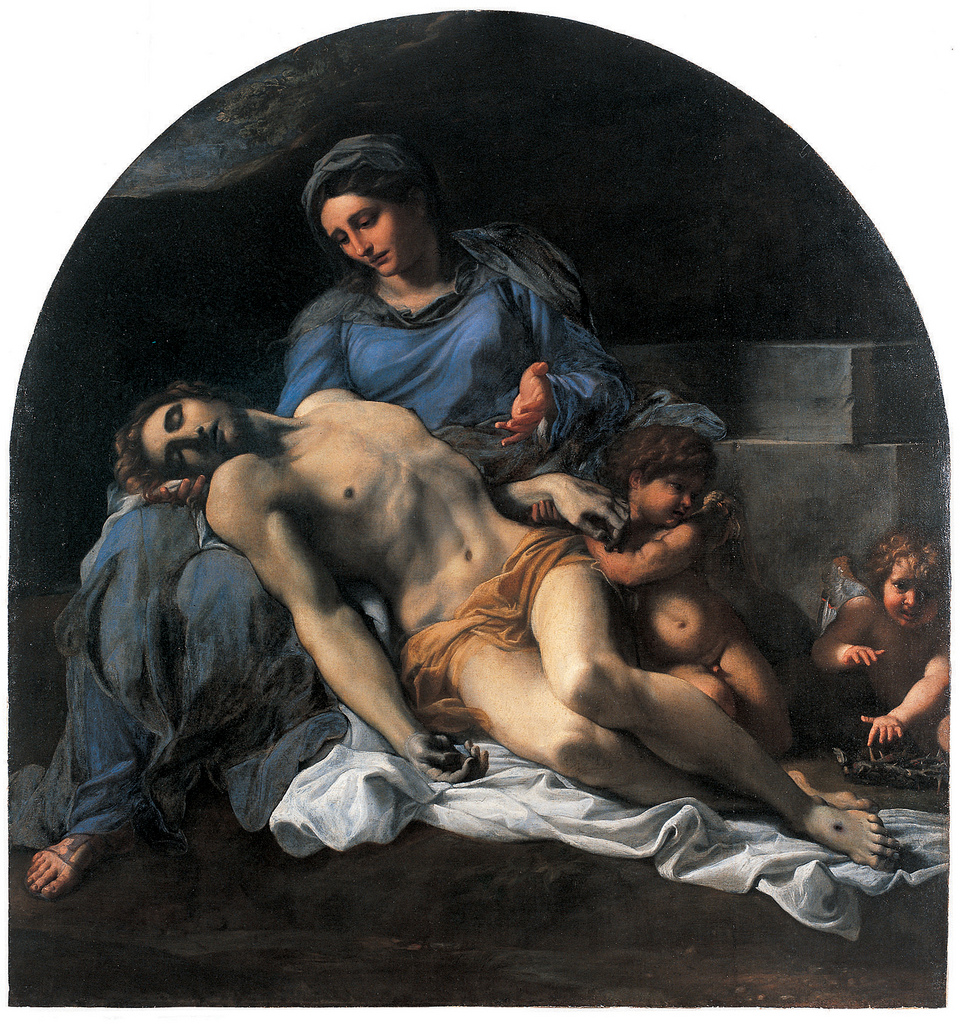
Annibale Carracci’s Pietà confronts the viewer with a devotional image that feels both intensely human and classically composed: the dead Christ, held and mourned, presented not as distant theology but as immediate grief. Painted at the hinge of the late Renaissance and the early Baroque, Carracci’s treatment of the subject helped redefine what sacred art could do—move the heart, clarify doctrine, and demonstrate painterly intelligence in a single, persuasive image. In an age when the Catholic Church demanded clarity and emotional force in religious imagery, Carracci’s Pietà became a model of disciplined pathos: restrained enough to be credible, powerful enough to be unforgettable.
Carracci, the Pietà Theme, and the Counter-Reformation Context
Annibale Carracci (1560–1609) emerged from Bologna during a period of profound artistic and religious realignment. In the decades after the Council of Trent (1545–1563), Catholic patrons, bishops, and religious orders increasingly favored art that was legible, doctrinally sound, and emotionally compelling. The Pietà—the Virgin mourning the dead Christ—answered these aims perfectly. Its imagery invited meditation on sacrifice and redemption while offering artists a structured, time-honored arrangement of bodies, gestures, and symbols.
Can You Name the Masterpiece?
Ten masterpieces. Ten questions. How well do you know the history of art?
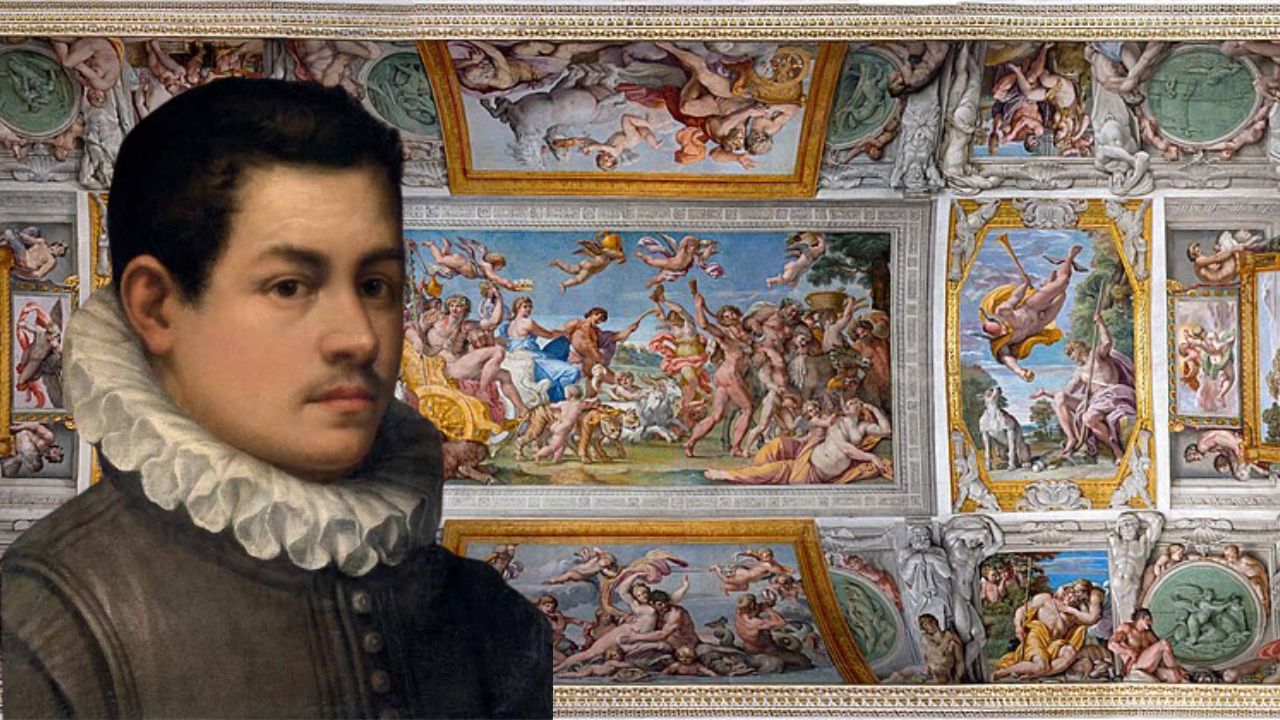
And Carracci‘s achievement is that he managed to absorbed these various traditions without becoming derivative. Drawing from all three major patristic sources: that of High Renaissance masters (Michelangelo‘s sculpativeness, Raphael‘s sense of composition); those of Venetian color and the innovating naturalism of the period, he created a language both classical and direct. He is always considered by art historians as one who set the reformist energy of the Baroque in motion in painting and this is especially true of Rome: where his frescoes in the Palazzo Farnese originated a new high style of painting. His Pieta pictures and therefore the rest of a broader mainstream: ways of revitalizing sacred art with straightforwardness, effective and credible emotion and rigorous structure.
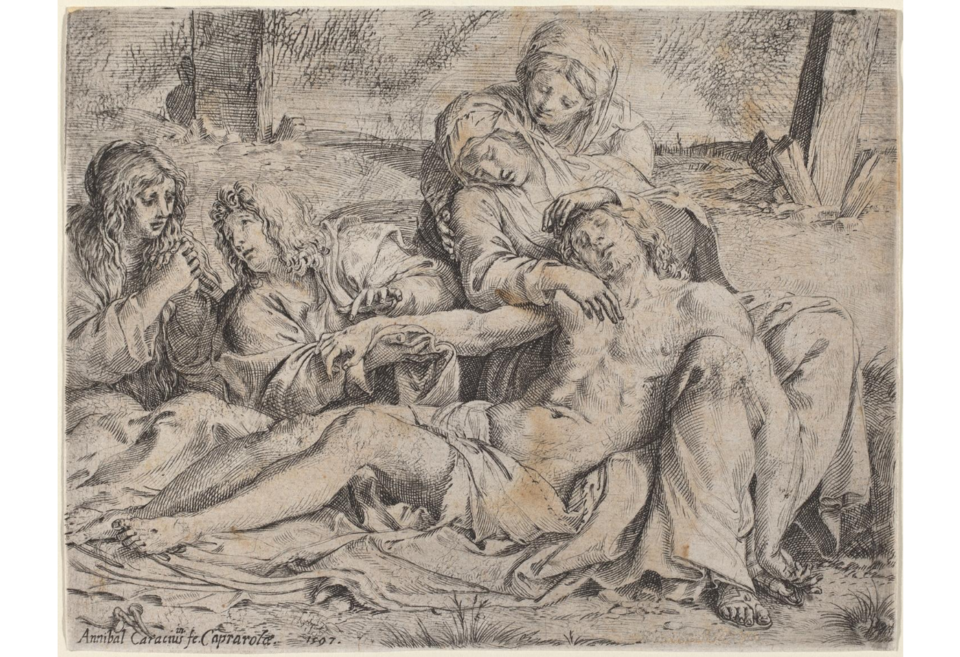
Carracci is characterized as a crucial “bridge,” by both academic and museum discourse. The Metropolitan Museum of Art has announced a special show on Annibale Carracci, the “key figure in the development of Italian Baroque painting,” compendiously noting his synthesis of prior Renaissance values with new naturalism and a new degree of Psychological penetrance (The Met, Heilbrunn Timeline of Art History). That synthesis is the very reason his treatments of the Pieta are historically crucial: they exemplify a Counter-Reformation aesthetic without degenerating in just that propaganda.(Devotion supported by craft, not sacrificed for it.)
Visual Analysis: Composition, Emotion, and Technique
Carracci’s Pietà compositions typically balance a clear geometric structure with carefully staged intimacy. The grouping of Christ and the Virgin forms a stable, monumental core; supporting figures and drapery rhythms guide the eye without confusing the narrative. This is not accidental: Carracci and his circle in Bologna (including his brother Agostino and cousin Ludovico) prized drawing, anatomy, and compositional planning as foundations for persuasive painting. The result is a scene that reads instantly—even at a distance—yet yields more on close looking: the tension between weight and support, the quiet eloquence of hands, the measured fall of light.
Can You Guess the Artist?
Three clues. One artist. How quickly can you identify the painter?
Emotion in Carracci is neither theatrical nor cold. The Pietà is a subject that can veer into excessive display, but Carracci tends toward contained grief. The Virgin’s sorrow is legible in posture and facial expression, not exaggerated gestures. Christ’s body is rendered with attentive naturalism—enough to register mortality—while still maintaining idealized dignity. This careful calibration aligns with the post-Tridentine insistence that sacred images should instruct and move the faithful without confusing them. A succinct way to describe the effect is “controlled pathos”: the painting seeks to deepen devotion through credible human feeling, disciplined by classical order.
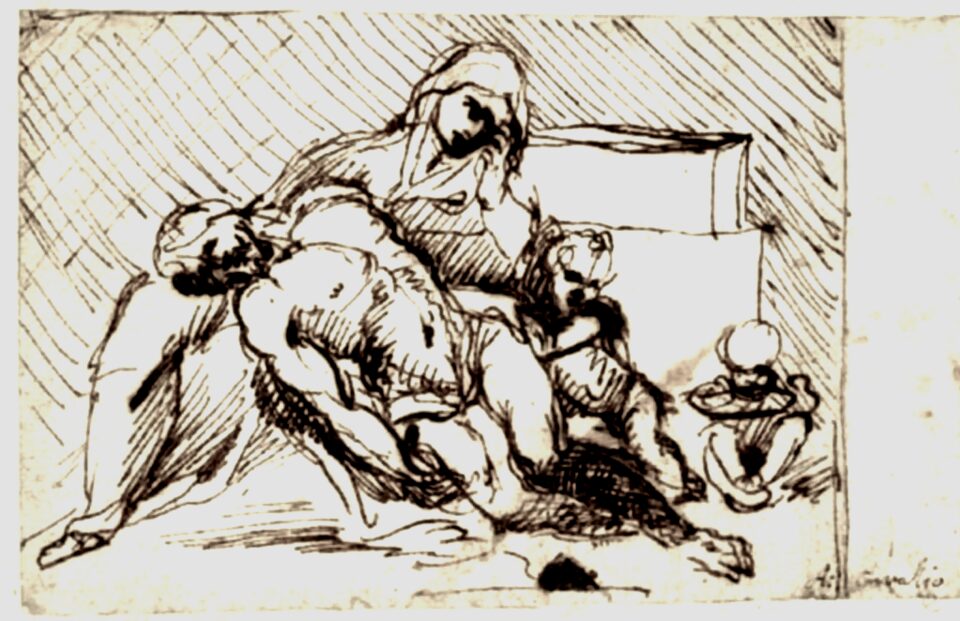
In terms of technique, Carracci’s paint handling further enhances this psychological sensibility. Delicate blending in the flesh areas, gentle but muscular chiaroscuro, and combined colorist harmony evoke a tone of reverence and respect. The work, from its paint materiality its ability to remind us of the heat and life sucked from our bodies, the weight of our limbs, the chill of stone and artifact its potential to serve as a vessel for theology becomes, in terms of its craft, a model of the Incarnation itself. As the Museum’s discussion of Baroque painting indicates, the combination of emotional intimacy and religious power, of the wedded object and compositional mastery, elucidates the spiritual intent. For example, the Louvre Museum including in its primers about Italian painting calls out illustration of seventeenth-century artists’ use of “composition and light as tools to focus off and strengthen religious story” (Louvre Museum, collections and learning resources), and Carracci’s Pietà is an early example.
Reception, Legacy, and Where to Study Carracci Today
Carracci’s impact radiated through Rome and across Europe. His approach offered an alternative to both late Mannerist complexity and purely sensational naturalism: a balanced method that younger painters could adopt for altarpieces and private devotional works alike. The Carracci academy tradition in Bologna emphasized study from life, careful drawing, and engagement with admired masters—principles that shaped generations of artists. In the Pietà, those principles converge: it is at once studied and heartfelt, academic in structure and tender in effect.
When it comes to modern audiences, perhaps the best means of appreciating Carracci‘s standing are comparative analyses of institutional approaches. The Heilbrunn Timeline essays at the Metropolitan Museum of Art place Carracci in the context of larger trends in early Baroque Rome and Bologna, and its object entries (where relevant) demonstrate how to analyze technique, iconographic content, and patronage based on close visual observation. The Victoria and Albert Museum (V&A) publishes similar easy-to-access studies of Catholic visual culture and the social dimension of European art. These help one grasp why early modern devotion invested so much importance in the Pietà (Victoria and Albert Museum, collections and interpretive texts).
In the US, Smithsonian Institution collections and educational programming offer rich resources to situate European sacred art in broader histories of patronage, collecting and display, especially how religious imagery relocated from church to museum and private collection. That relocation inevitably changes how we understand, say, a Pietà today now not a devotional tool but an artwork to be studied for art and history. Although the best curatorial writing never fails to advocate for both the picture‘s spiritual significance and its artistic acumen.
Key Characteristics of Annibale Carracci’s Pietà (Summary Table)
| Aspect | Typical Carracci Approach | Why It Matters |
|---|---|---|
| Historical context | Late 16th–early 17th century; Counter-Reformation Italy (Bologna/Rome) | Explains demand for clarity and devotional impact |
| Composition | Stable, classical structure; clear focal grouping | Makes the narrative immediately legible |
| Emotion | Controlled grief; credible human tenderness | Aligns with post-Tridentine ideals of persuasion without excess |
| Naturalism | Anatomically convincing body of Christ; restrained idealization | Supports theological themes of Incarnation and sacrifice |
| Light and color | Focused illumination; harmonized palette | Directs attention and intensifies meditation |
| Legacy | Influential model for early Baroque religious painting | Demonstrates Carracci’s role in shaping European visual culture |
Authoritative Quotes and Sources
Art-historical authority on Carracci is anchored in major institutions and established scholarship. The Metropolitan Museum of Art characterizes Annibale Carracci as “a key figure in the development of Italian Baroque painting,” underscoring his centrality to the period’s stylistic transformation (The Metropolitan Museum of Art, Heilbrunn Timeline of Art History). This institutional framing helps explain why his handling of the Pietà is not merely a personal interpretation but a historically consequential one.
In order to see the doctrinal pressure on such images, one must also turn to Church documents. The decrees on holy images of the Council of Trent (which is discussed at length in most Counter-Reformation studies) stated that images should not lead to errors or deviations in faith, nor to “errors and confusions,” but rather to “proper religion and veneration.” The wording is strictly pastoral and legal, not aesthetic, but the authority of those decrees was felt throughout Italy. The clarity of composition and the restraint of emotion in Carracci‘s painting can be interpreted as a painterly response to this context.
As for further reading, reliable sources are often the essays found in museum websites (e.g. the Met‘s here; the Louvre‘s education pages here; V&A collection texts here) and peer-reviewed art-historical journals. For any given Pieta in the series attributed to Carracci, begin by consulting the museum entry at the institution that holds it (provenance, date, other technical information) and then compare academic and curatorial opinions among museums. This process, a normal part of curatorial work, avoids attribution mistakes and maps the layers of meaning, from chapel to collection to museum gallery.
Frequently Asked Questions
What does “Pietà” mean in art?
“Pietà” refers to an image of the Virgin Mary mourning over the dead body of Christ. It is closely related to themes of Lamentation and Entombment but is distinct in its focus on Mary’s sorrow and intimate contact with Christ.
Why is Annibale Carracci’s Pietà considered important?
Carracci helped redefine religious painting at the start of the Baroque by combining classical composition with persuasive naturalism and sincere emotion. His Pietà images exemplify the Counter-Reformation aim of clear, moving sacred art.
Where can I learn about Carracci through reliable institutions?
Start with the Metropolitan Museum of Art’s Heilbrunn Timeline essays on Baroque painting, then consult interpretive resources from the Louvre Museum and the Victoria and Albert Museum. For broader educational context on art in museums and collecting histories, the Smithsonian Institution’s resources are useful.
How does Carracci differ from Caravaggio in religious art?
Caravaggio often heightens drama through stark lighting and uncompromising realism. Carracci typically favors a more classical structure and moderated emotional tone—naturalistic but harmonized, aiming for clarity and ideal balance.
Was the Pietà subject mainly for churches or private devotion?
Both. The Pietà appeared in altarpieces and chapels, but it also flourished as a smaller-scale devotional image for private prayer, especially in Catholic Italy during the late 16th and 17th centuries.
Annibale Carracci’s Pietà endures because it solves a difficult artistic problem with rare authority: how to paint grief that is believable, sacred, and formally beautiful at once. Rooted in the Counter-Reformation’s demand for clarity and devotion, and shaped by Carracci’s disciplined classicism and humane naturalism, the image became a touchstone for early Baroque religious art. Studied through major institutions—The Met, the Louvre, the V&A, and the Smithsonian’s educational frameworks—it remains a compelling case study in how painting can unite theology, emotion, and craft into a single, persuasive vision.
AI Notice: Some visual content in this article may have been created or enhanced using artificial intelligence (AI) for artistic, editorial or illustrative purposes. Learn more about our approach in our AI & Editorial Principles.