
The Hidden Meaning Behind Albrecht Dürer’s Melencolia I—What Most Miss
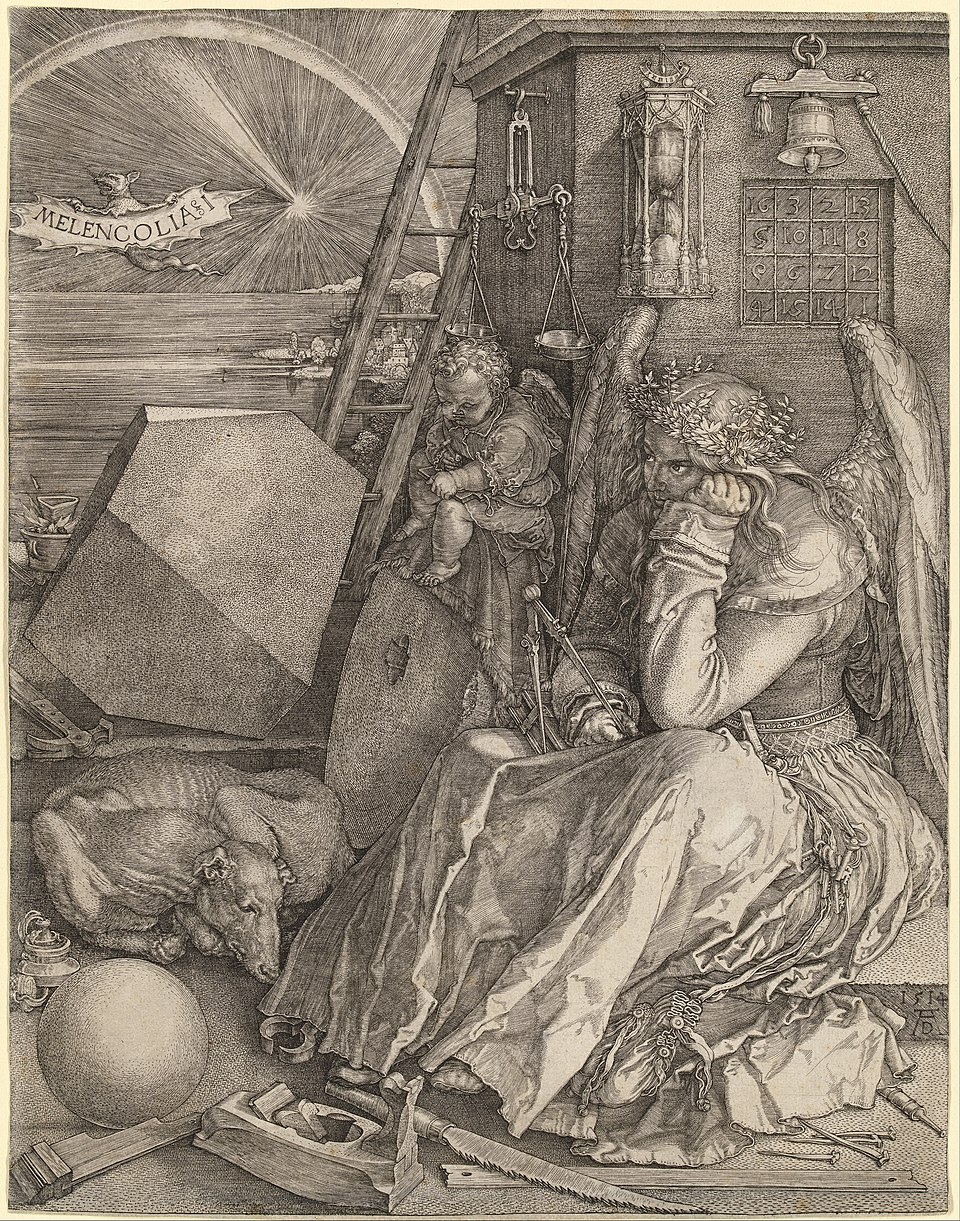
In 1514, in the imperial city of Nuremberg at the height of the Northern Renaissance, Albrecht Dürer created an image so intellectually charged that it still reads like a visual manifesto for modern creativity: Melencolia I. A winged figure sits immobilized among tools, numbers, and a strange, faceted stone—surrounded by the instruments of making, yet unable to make. With this single copperplate engraving, Dürer gave lasting form to a state many recognize instantly: the tension between ambition and paralysis, knowledge and uncertainty, spiritual longing and earthly limitation.
Historical Context: Nuremberg, the Northern Renaissance, and 1514
Dürer (1471–1528) worked in Nuremberg, a major center of printing, metallurgy, and humanist scholarship within the Holy Roman Empire. The early sixteenth century—often described as the Northern Renaissance—saw artists and scholars applying mathematics, classical learning, and close observation to art and science. Dürer’s circles included humanists and publishers who were connected to broader European currents linking Germany, Italy, and the Low Countries.
Can You Name the Masterpiece?
Ten masterpieces. Ten questions. How well do you know the history of art?
Melencolia I was made in 1514, a year often pointed to by scholars as being important in Durer‘s own life. And it‘s an engraving produced at a time when the European imagination was struggling to make sense of new ideas about nature, about the cosmos, and the evolving relationship of empiricism to faith, and of geometry as a worthy discipline. Durer, as many know, was a connoisseur of measurements and proportions. He later wrote his own texts on geometry and human proportions.
Most museum institutions tend to portray Durer as the protagonist of printmaking’s “high art” phase. Such institutions as the Metropolitan Museum of Art, to give one instance, stress the unmatched sophistication and international circulation that Durer’s prints garnered making the engraving a sophisticated and intellectual practice, disseminated across courts and campuses of higher learning and into the cabinets of collectors. What this has to do with Melencolia I is this the engraving wasn’t made simply for display, but for contemplation, debate, and replication among its learned viewers.
What Melencolia I Shows: Symbols, Objects, and a Suspended Mind
Can You Guess the Artist?
Three clues. One artist. How quickly can you identify the painter?
The engraving depicts a winged, laurel-crowned figure—often read as an allegory—seated with a distant, heavy gaze. Around her lie tools associated with measurement and craft: a compass, saw, plane, nails, a ladder, and a balance. A dog sleeps; a putto (a child-like figure) scribbles on a tablet; a bell and hourglass suggest time’s passing; and a blazing celestial body (often described as a comet or star) throws light across a dark sky.
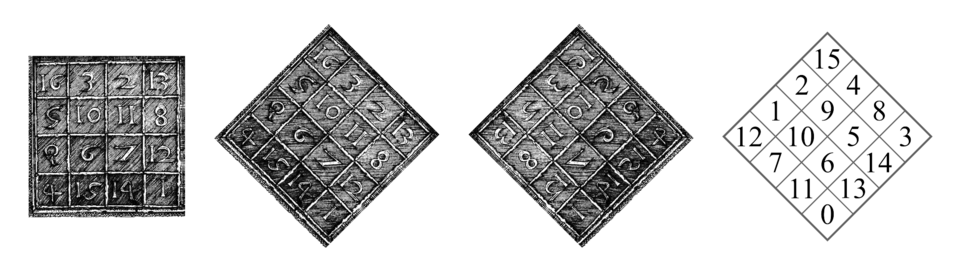
Among the elements, the most debated one is the magic square at top right (which is a four-by-four square where the sum of all columns, rows and diagonal is equal). At bottom row, there is “15” and “14”, read as initials date (1514). Durer‘s fusion of mathematics in the center of a work about mental and psychological depression is the key: the brain may be calculative, but its state is depressing.
And then there is the mysterious polyhedron (or Durer‘s solid, as it‘s also known), an oddly truncated solid that presents itself, like a block of inert matter, as a monumental presence. With its clear planes, geometry can be brought to bear, but the object still seems morose: a barrier as much as an accomplishment. As the Victoria and Albert Museum explained in its educational material about Renaissance-period artworks and technologies, artists at this time began to combine expertise in craft with theoretical exploration; Melencolia I is about what happens when this combination doesn‘t resolve into calm.
Interpreting “Melancholy”: From Medieval Temperaments to Renaissance Genius
To understand Melencolia I, it helps to recall that “melancholy” was not only an emotion but a theory. From antiquity through the medieval period, European medicine and philosophy often explained temperament via the four humors. Melancholy was associated with “black bile,” heaviness, Saturnine influence, and contemplative withdrawal. By the Renaissance, however, melancholy could also be revalued—linked to exceptional intellectual ambition and artistic genius.
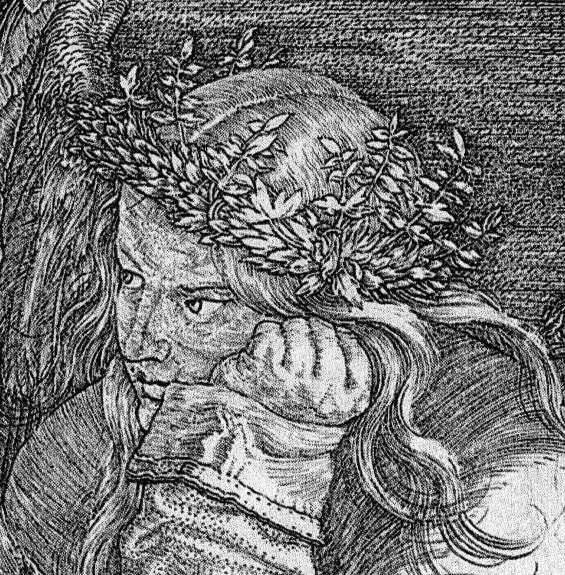
The title’s “I” has generated debate: some scholars interpret it as indicating the first type or degree of melancholy—perhaps the melancholy of the imaginative faculty, connected to artists and makers. In this reading, Dürer’s image becomes an allegory of creative intellect burdened by the limits of earthly tools and human finitude. The engraving does not simply portray sadness; it stages a philosophical problem about whether knowledge, measurement, and skill can ever fully grasp truth.
Museums and research libraries consistently point viewers toward this intellectual context. The Metropolitan Museum of Art describes Dürer’s prints as dense with humanist learning and symbolism, inviting learned interpretation rather than straightforward narrative reading. Likewise, institutions such as the Smithsonian—through its broader collections and scholarship on European print culture—underscore how prints circulated ideas, not just images, in early modern Europe, shaping how educated audiences engaged with science, religion, and the self.
Technique and Authority: Why This Engraving Is a Masterclass in Printmaking
Technically, Melencolia I is a landmark of engraving: the tonal range from velvety blacks to silvery highlights is achieved through controlled networks of lines, cross-hatching, and subtle transitions. Dürer’s command makes metal feel atmospheric—night sky, stone, cloth, fur—while maintaining razor-sharp symbolic clarity. This is one reason the work remains a reference point in the study of printmaking.
The engraving also reflects the early modern belief that art could be a form of knowledge. Dürer’s later theoretical writings on proportion and measurement align with what the image implies: that the maker’s world is built from tools, numbers, and geometry. Yet the central figure’s posture suggests the cost of such striving—an emotional and metaphysical fatigue that the instruments cannot solve.
Authoritative voices have long recognized the work’s canonical status. Art historian Erwin Panofsky, in his influential scholarship on Dürer, famously called Melencolia I “one of the great enigmatic masterpieces of world art,” capturing the consensus that the print’s meaning is inexhaustible without being arbitrary. That sense of controlled ambiguity—rich but structured—is precisely what makes the engraving enduring.
Key Characteristics of Melencolia I (Summary Table)
| Feature | What you see | Common interpretation | Why it matters |
|---|---|---|---|
| Winged central figure | Seated, gazing, inactive | Melancholy as creative paralysis / Saturnine contemplation | Embodies the psychological theme |
| Tools & measuring instruments | Compass, balance, woodworking tools | Human making, geometry, craft knowledge | Shows ambition and rational inquiry |
| Magic square | 4×4 numbered grid | Mathematical order; date “1514” embedded | Signals learned, humanist play |
| Polyhedron (“Dürer’s solid”) | Faceted stone form | Obstinate matter; geometric mystery | Links art to mathematics and limits |
| Hourglass, bell | Time markers | Mortality, pressure, time’s passage | Adds existential urgency |
| Celestial light | Bright object in sky | Revelation, fate, cosmic influence | Ties mood to cosmology |
Frequently Asked Questions
What does the “I” in Melencolia I mean?
Scholars disagree, but a leading interpretation is that it denotes a first category or degree of melancholy—often connected to the imaginative faculty and to artistic creation. It signals that Dürer is not depicting ordinary sadness, but a specific intellectual-spiritual condition recognized in Renaissance thought.
Is Melencolia I about depression?
Not in a modern clinical sense. It reflects early modern ideas of melancholy as a temperament and as a Saturn-associated condition linked to contemplation and genius. However, the engraving’s portrayal of immobilized thought and inner heaviness resonates strongly with modern experiences of creative blockage and despair.
Where can I see Melencolia I today?
Major impressions are held by leading institutions. The Metropolitan Museum of Art is a key public reference point for studying Dürer’s prints, and other major museum collections in Europe and North America also hold impressions. Collection access varies; many museums provide high-resolution images and scholarly notes online.
Why is the magic square important?
It demonstrates Dürer’s interest in mathematics and embeds an intellectual puzzle in the image. The presence of “15” and “14” is often read as a pointed dating device for 1514, merging symbolic meaning with signature-like authorship.
Why is this engraving considered so influential?
Because it unites technical mastery with a complex program of ideas—geometry, time, cosmology, craft, and psychological burden—at a moment when prints could circulate rapidly across Europe. It became a model for how an artwork can function as philosophical inquiry.
Sources and Further Reading (Credible Institutional References)
- The Metropolitan Museum of Art (Heilbrunn Timeline of Art History and collection entries on Albrecht Dürer’s prints)
- Victoria and Albert Museum (resources on Renaissance art, printmaking, and Northern European collections)
- Smithsonian Institution (collections and scholarship relating to European prints and the history of print culture)
- The Louvre Museum (research and collection context for Renaissance and early modern European art; relevant comparative material for symbolism and allegory)
(Note: Specific catalog entries vary by collection and edition; museum collection databases are the most reliable way to locate an institution’s current record for an impression.)
Conclusion
Albrecht Dürer’s Melencolia I endures because it makes a private, interior state legible through public symbols—tools, numbers, timepieces, and unyielding stone—without reducing it to a single explanation. Rooted in the intellectual world of Renaissance Nuremberg and shaped by the era’s fascination with mathematics, cosmology, and temperament theory, the engraving remains a masterpiece of both technique and thought: a portrait of the mind at the edge of its own capacities.
AI Notice: Some visual content in this article may have been created or enhanced using artificial intelligence (AI) for artistic, editorial or illustrative purposes. Learn more about our approach in our AI & Editorial Principles.


