Albrecht Dürer’s Apocalypse: The Shocking Images That Still Haunt Us
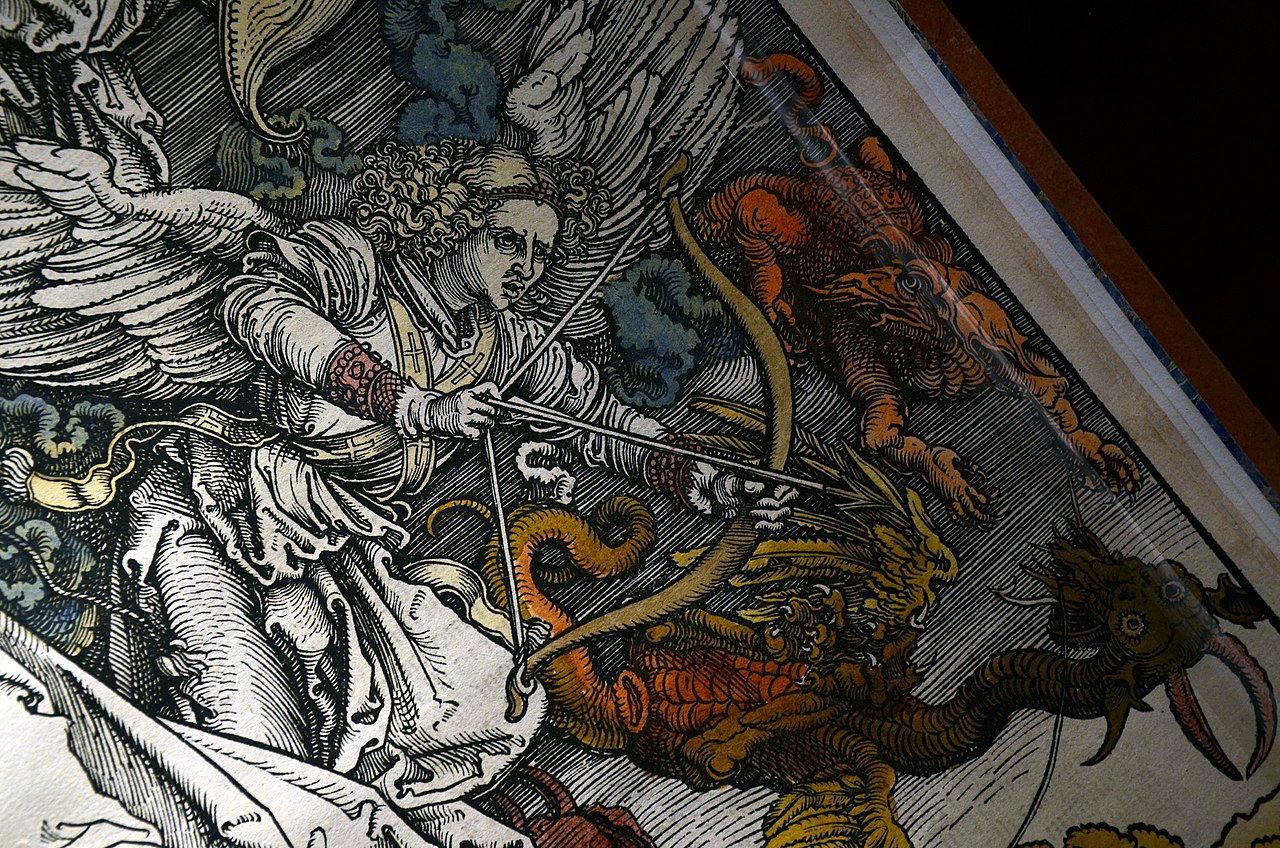
Albrecht Dürer’s Apocalypse is one of the rare moments in Western art when a book of images changed what “modern” looked like. In 1498—on the threshold of the year 1500, amid widespread eschatological anxiety in the Holy Roman Empire—Dürer published a sequence of woodcuts illustrating the Book of Revelation with a visual force Europe had not seen before. These prints did not merely “illustrate” scripture: they staged it as a lived, urgent drama, bringing cosmic catastrophe into the streets and architecture of late medieval Nuremberg. More than five centuries later, the Apocalypse remains a benchmark for how prints can shape religious imagination, artistic technique, and mass communication.
Origins and Historical Context of Dürer’s Apocalypse
The Apocalypse was produced in the late 1490s in Nuremberg, a major commercial and humanist center within the Holy Roman Empire. Dürer (1471–1528) had recently returned from formative travels and was establishing himself as a printmaker of exceptional ambition. In an era when printed books and broadsheets were rapidly expanding literacy and visual culture, Dürer recognized that woodcut—durable, reproducible, and relatively affordable—could carry complex imagery to wide audiences across German-speaking lands and beyond.
Can You Name the Masterpiece?
Ten masterpieces. Ten questions. How well do you know the history of art?
The turn of the 15th into the 16th centuries was filled with apocalyptic anticipation. Although the church did not encourage explicit time setting, the belief was often that the millennium would arrive with a dramatic climax, fanned by popular belief and prophetic pamphlets. Durer’s publication of a full Revelation cycle in 1498 coincided with this cultural zeitgeist, but was also a sound business move: he published it as an ‘art book’ (large woodcuts and text), presenting himself as a publisher as much as an artist.
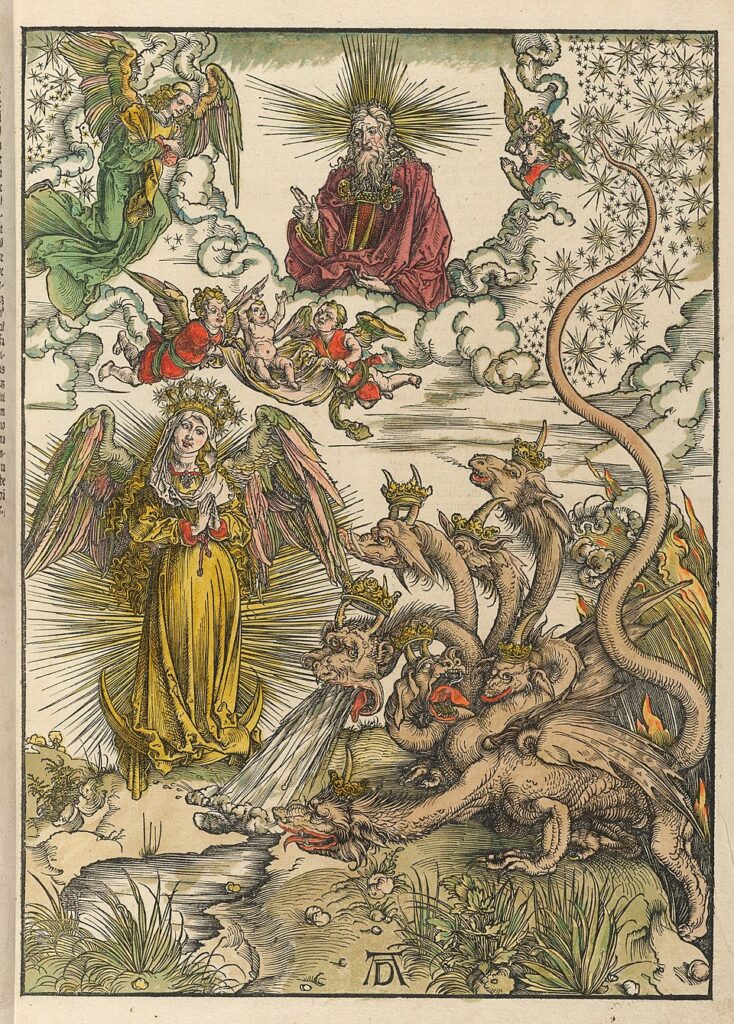
Works of art in museums and academic texts invariably stress just how innovative this publication was in making print a significant art medium. Durer‘s prints, as the Metropolitan Museum of Art writes, ‘did much to make his reputation outside Germany and to show how potent and expressive prints could be for advertising and selling’ (The Met, Heilbrunn Timeline of Art History). In other words, the Apocalypse is a crossroads of religious culture, late-medieval fears and hopes, and the early modern information economy.
Artistic Innovation: Woodcut Technique and Visual Language
Durer elevated the woodcut from a rather crude tool of illustration to a means of drama, texture, and eloquent detail. He used its strong contrasts and rhythmic line to emphasize his narrative with rather than simply illustrate. His compositions are tightly packed but easy to grasp as should be the case with images that are meant to spread and be “read.”
Can You Guess the Artist?
Three clues. One artist. How quickly can you identify the painter?
His technical skill even matches the collaborative production of prints. Dürer conceived the designs, which other woodcarvers translated into woodblocks. What makes the Apocalypse so remarkable is the degree to which the product retains an “inner” Dürer: line thickness creates recession, cross-hatching models shadow, and expressive faces and gestures are not lost even in teeming scenes filled with angels, beasts, and armies.
The V&A highlights the role of prints in Renaissance visual culture as “a major means of spreading artistic styles and ideas across Europe” (V&A, Prints collections and essays). Durer‘s Apocalypse demonstrates that relationship; it‘s an artwork as technology, built for influence in a world increasingly linked by trade routes, fairs, and the burgeoning market for books.
Interpreting the Images: Theology, Power, and Politics
The Revelation of John is a text of visions—symbolic, violent, and ultimately restorative. Dürer’s genius was to give these visions an immediacy that felt historically present rather than safely distant. In the famous Four Horsemen of the Apocalypse, death and disaster crash through the picture plane with startling momentum, compressing multiple threats into one wave of destruction. The message is not abstract doctrine; it is moral and social urgency rendered in ink.
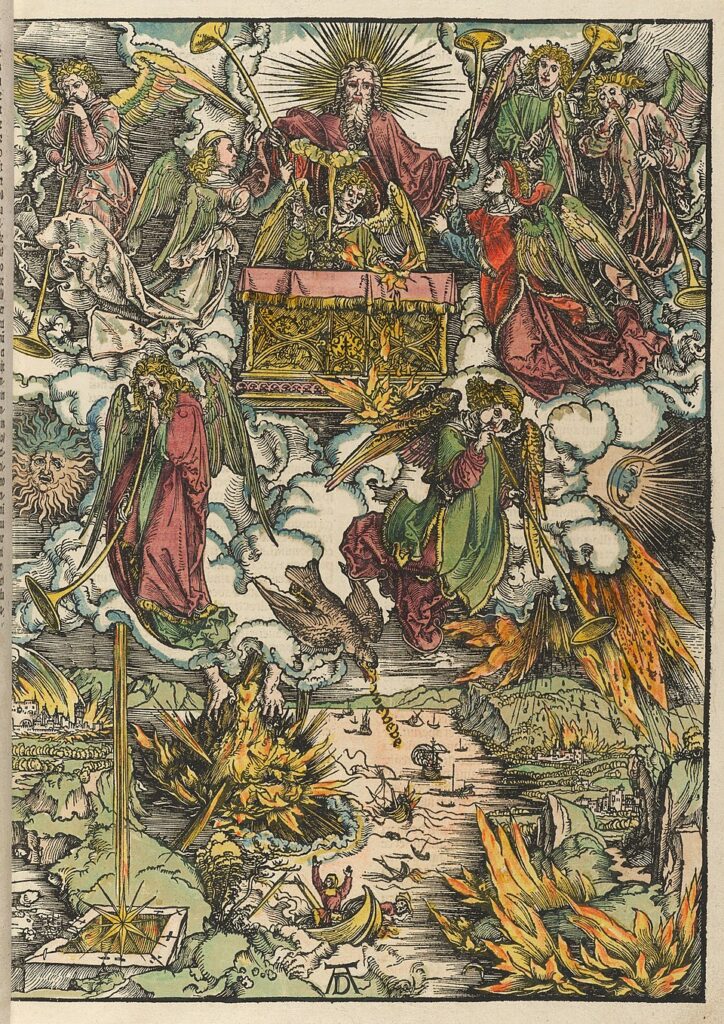
Yet Dürer’s imagery also reflects the political-theological tensions of late fifteenth-century Europe. Revelation had long been used to interpret contemporary crisis—wars, plague, and disputes between secular rulers and ecclesiastical authority. Dürer’s settings, costumes, and architectural cues frequently echo late medieval German life, a choice that makes the visions feel like warnings aimed at his own society. The Apocalypse thus participates in a broader tradition of using biblical prophecy as a mirror for governance, justice, and collective accountability.
Institutions such as the Smithsonian describe prints and illustrated books as central to the formation of public discourse in early modern Europe, precisely because they could circulate quickly and be discussed in homes, workshops, and taverns (Smithsonian resources on prints and print culture). Dürer’s Apocalypse should be read with that public function in mind: it is a theological narrative and an early modern media event.
Key Characteristics of Dürer’s Apocalypse (Summary Table)
| Aspect | Key Characteristics | Why It Matters |
|---|---|---|
| Date & Place | Published 1498, Nuremberg (Holy Roman Empire) | Links the series to millennial anxieties and a major print center |
| Medium | Woodcut prints issued as an illustrated book | Shows print’s power as both art and mass communication |
| Visual Style | Bold contrast, dense narrative, dramatic motion | Makes Revelation legible, urgent, and emotionally persuasive |
| Innovation | Elevated woodcut to a “high art” form | Helped define Renaissance printmaking standards |
| Audience | Broad European readership via trade networks | Demonstrates early modern cultural circulation |
| Iconic Plates | Four Horsemen, St. Michael, Whore of Babylon | Established enduring visual templates for Revelation |
Reception, Legacy, and Where to See Works Today
Dürer’s Apocalypse quickly secured his status as Europe’s most famous printmaker. Collectors, scholars, and artists sought his impressions, and his imagery influenced Northern Renaissance art for generations. The series also helped normalize the idea that a single artist could author a coherent “project” in print—conceptually unified, marketed, and distributed with consistent branding of quality and invention.
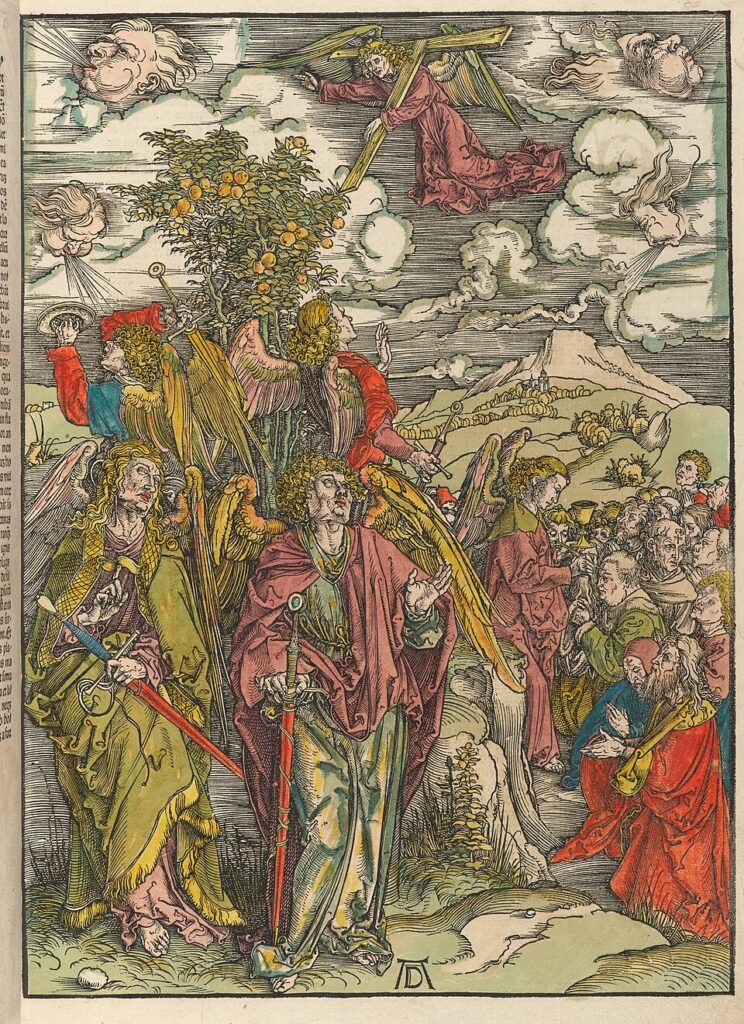
Over the long term, the Apocalypse shaped how Revelation was pictured in Europe. Later artists borrowed Dürer’s compositional solutions and symbolic shorthand. Even when painters and engravers moved toward different aesthetics, they continued to grapple with the benchmark Dürer set for narrative clarity and emotional force. In the history of the book, the Apocalypse is likewise a landmark: an illustrated publication where images do not simply accompany text but command interpretive authority.
Many leading institutions hold impressions from the series and related Dürer prints. The Metropolitan Museum of Art and the Victoria and Albert Museum maintain significant print collections and interpretive materials that situate Dürer within Renaissance print culture (The Met; V&A). Major European museums—including the Louvre—also preserve and exhibit Northern Renaissance prints and drawings, providing opportunities to compare Dürer’s graphic language with contemporaries and successors (Louvre collections and research resources).
Frequently Asked Questions
What is “Albrecht Dürer’s Apocalypse”?
It is a celebrated series of large woodcut prints illustrating the Book of Revelation, published by Dürer in 1498 in Nuremberg as an illustrated book.
Why did Dürer make the Apocalypse in 1498?
The period around 1500 was marked by heightened apocalyptic expectation and a booming print market. Dürer combined religious subject matter with an innovative publishing strategy to reach an international audience.
What makes the Four Horsemen woodcut so famous?
Its compressed, kinetic composition makes catastrophe feel immediate: multiple riders, victims, and spatial layers collide in a single surge. It demonstrates Dürer’s ability to turn complex theology into unforgettable visual narrative.
Was the Apocalypse connected to the Reformation?
It predates the Reformation (commonly dated from 1517), but it belongs to the same broader world of religious debate and intense engagement with scripture. Its wide circulation anticipates the later explosion of religious print culture.
Where can I study authentic impressions and scholarship?
Start with collection pages and essays from major institutions such as The Metropolitan Museum of Art, the Victoria and Albert Museum, the Louvre, and Smithsonian-affiliated resources, all of which provide curatorial context and bibliographies.
Albrecht Dürer’s Apocalypse is not only a masterpiece of Renaissance woodcut; it is a turning point in how images could persuade, disturb, and educate at scale. Created in 1498 Nuremberg at the edge of a new century, it fused theological intensity with technical brilliance and savvy publishing. Its influence endures because it made Revelation feel close—socially, politically, and emotionally—and because it proved that prints could carry the weight of history.
Authoritative sources referenced: The Metropolitan Museum of Art (Heilbrunn Timeline and collection materials); Victoria and Albert Museum (prints scholarship and collection resources); Louvre Museum (collections and research resources); Smithsonian Institution (print culture and educational resources).
AI Notice: Some visual content in this article may have been created or enhanced using artificial intelligence (AI) for artistic, editorial or illustrative purposes. Learn more about our approach in our AI & Editorial Principles.