Albrecht Dürer Paintings That Reveal Surprising Secrets in Plain Sight
Few painters changed the course of European art as decisively as Albrecht Dürer (1471–1528). Working at the hinge point between the Northern Renaissance and the Italian High Renaissance, Dürer fused empirical observation, mathematical design, and spiritual intensity into images that still feel startlingly modern. His paintings—whether commanding altarpieces made for public devotion or intimate portraits made for private prestige—show an artist determined to prove that German art could match the intellectual ambition of Florence and Venice while remaining rooted in Nuremberg’s thriving humanist culture.
Nuremberg, Humanism, and the Renaissance World
Dürer’s painting career was shaped by the energy of late 15th-century Nuremberg, a Free Imperial City within the Holy Roman Empire and a major center of trade, printing, and scholarship. In this environment, artists were increasingly exposed to new ideas about classical antiquity, proportion, and scientific inquiry. Dürer’s circles included prominent humanists, and his art reflects a Renaissance drive to unite craftsmanship with learning.
Can You Name the Masterpiece?
Ten masterpieces. Ten questions. How well do you know the history of art?
And his wanderings were too. He traveled to Italy (Venice, in particular) and saw the visual language of the Italian Renaissance: grand figuration, the unity of design and a canonization of oil painting as the transport of “high art.” Those experiences didn‘t scrub away his northern taste meticulous detail, bright light, symbolic weight but gave him new words to say what he had always said in German.
Museums and research centers place Durer still at the hub of European artistic traffic. The Metropolitan Museum of Art in New York positions him as an “icon of European art of the Renaissance in multiple media.” Collections and exhibitions in Europe and the US map his international networks. It is this multinational (or, if you prefer, dual-national) profile (a citizen of Nuremberg and a European artist) that clarifies why Durer paintings continue to be a touchstone for tracing how Renaissance art became truly “pan-European.”
What Defines Albrecht Dürer Paintings: Technique, Intellect, and Presence
Dürer’s paintings are often described as “precise,” but precision is only the surface. Underneath lies a structural intelligence—clear geometry, carefully calibrated space, and bodies that feel measured as well as observed. His approach reflects a broader Renaissance belief that art could be a form of knowledge. He pursued proportion and perspective not as tricks, but as tools to reach deeper truths about nature and the human figure.
Can You Guess the Artist?
Three clues. One artist. How quickly can you identify the painter?
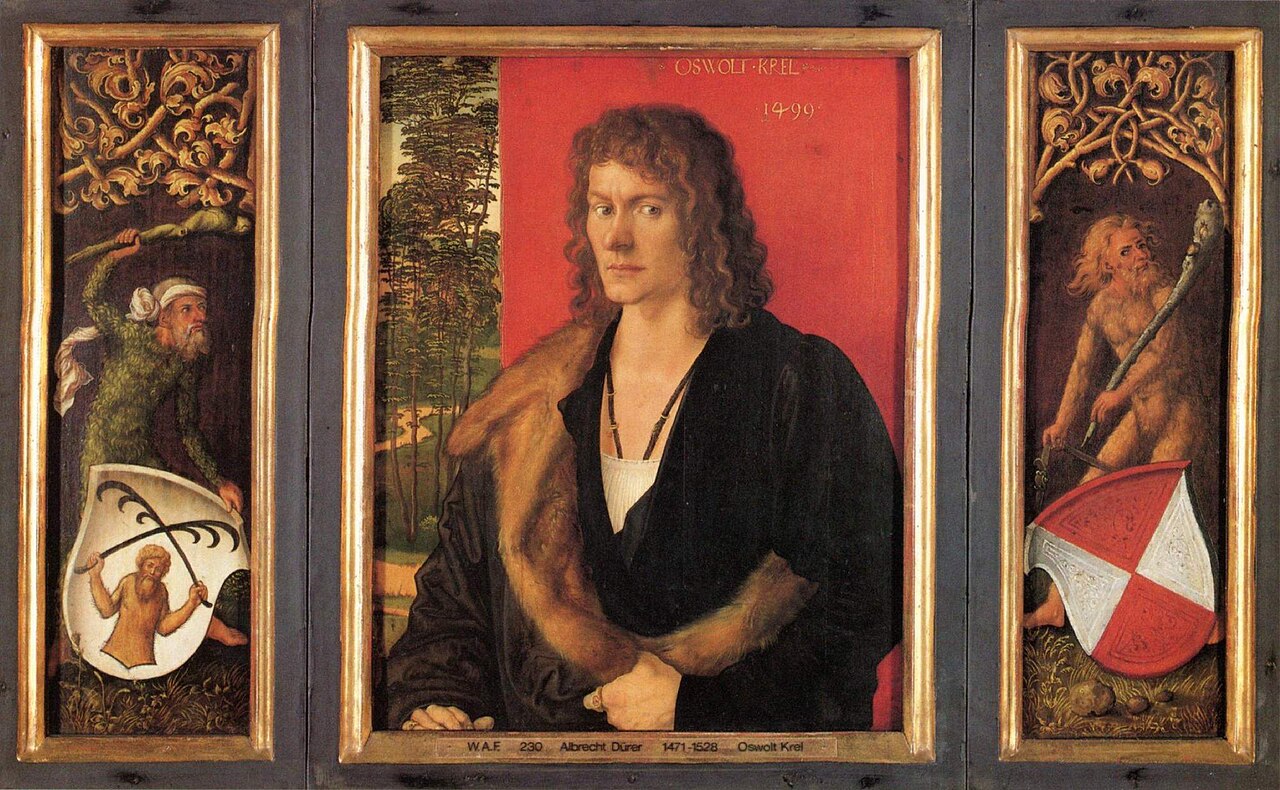
One reason Dürer’s painted works command authority is their psychological intensity. His portraits, in particular, are not merely likenesses; they are arguments about identity, status, and inner life. Across Europe in the 1500s, portraiture was becoming a key site where power, piety, and learning could be performed. Dürer’s sitters—whether patrons, scholars, or the artist himself—appear with a directness that still arrests modern viewers.
Dürer also understood painting’s public function in an age of religious upheaval. In the early 16th century, the Reformation transformed how images were commissioned and received in German-speaking lands. Dürer’s religious paintings and panels respond to long-standing Catholic visual traditions, yet they also anticipate a new era in which images were scrutinized for theology, clarity, and emotional truth.
Major Works and Why They Matter
The Self-Portrait (1500) is one of Dürer‘s most iconic paintings and it‘s seen as one of the greatest works of European self-fashioning ever made. The confrontational gaze and the pose of the Self-Portrait were viewed as the first time an artist would claim such a majestic authority, with the solemn grandeur that was previously only afforded to religious subjects. Its consistent presence in art historical literature is how Dürer elevated the status of painters in Northern Europe.
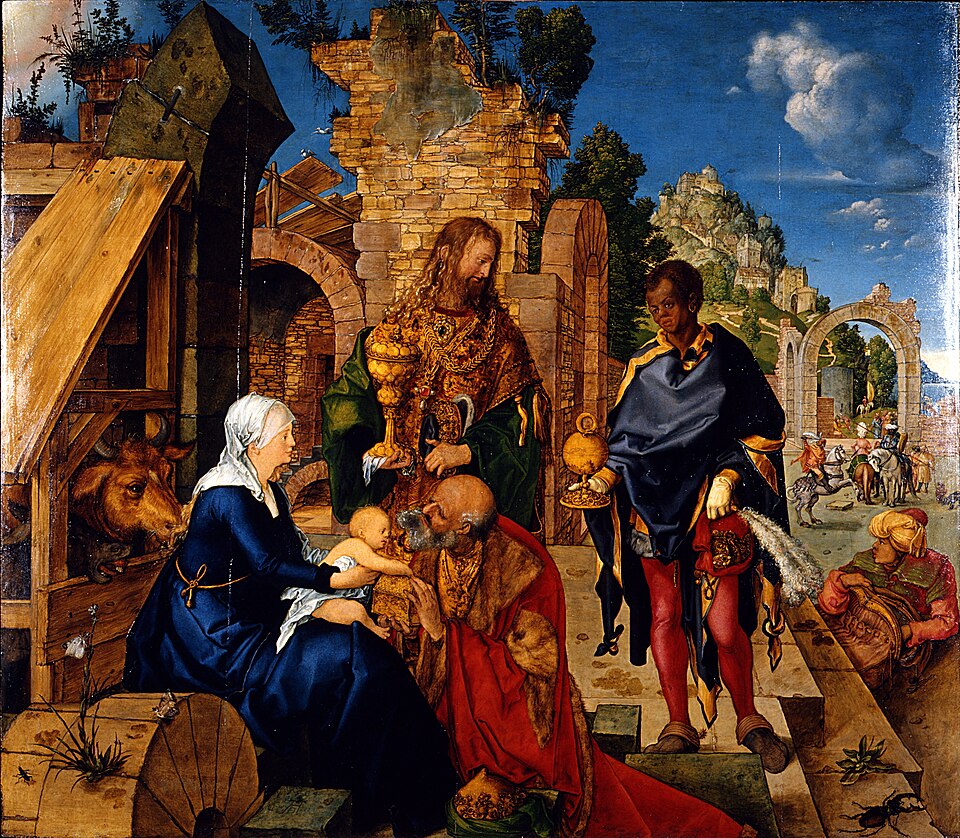
Just as important is the Adoration of the Magi (1504), an example of Durer‘s capacity to create dense devotion scenes that are at once legible and visually intricate. His Northern roots can be seen in the characters and textures of the painting; yet the overall design its contained space, its orderly composition marks his new Italian learning. It‘s a picture that speaks of both awe and organization.
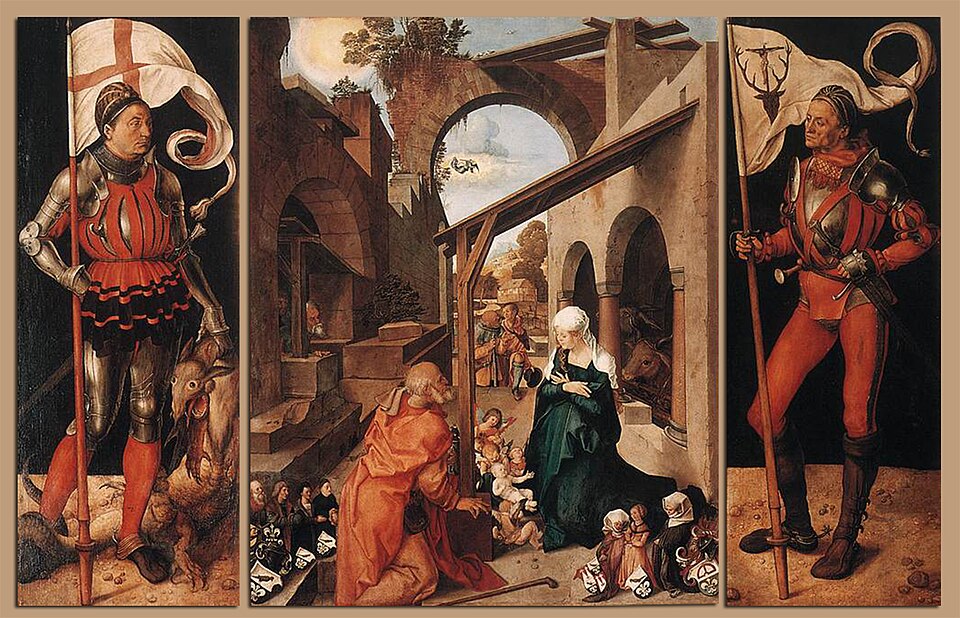
For public devotion and civic identity, Dürer’s large-scale commissions were crucial. The Paumgartner Altarpiece (c. 1500–1503) exemplifies the social world of Nuremberg patronage, where wealthy families supported religious art that also reflected their status and values. Altarpieces like this anchored communal worship while embedding donors into the sacred narrative—an approach typical of late medieval and early Renaissance Europe, executed with Dürer’s unusually analytical eye.
“The painter is concerned with the representation of visible things.” — Albrecht Dürer (widely cited from his theoretical writings on art and measurement)
This belief—art as a disciplined study of the visible world—helps explain why Dürer’s paintings remain foundational in museum collections and art history curricula.
| Characteristic | What it looks like in Dürer paintings | Why it matters historically |
|---|---|---|
| Analytical realism | Fine detail in faces, hands, hair, textiles | Reflects Northern Renaissance observation and workshop skill |
| Geometric structure | Balanced composition; measured space | Connects to Italian Renaissance ideals of harmony and perspective |
| Psychological portraiture | Direct gaze; individualized presence | Helps define modern portrait conventions in Europe |
| Symbolic density | Objects and settings carry layered meaning | Links late medieval devotional culture with Renaissance humanism |
| Technical refinement | Controlled oil technique, crisp contours | Shows mastery in an era of intensifying artistic competition |
When writing about Albrecht Dürer paintings, authoritative institutional context is essential—because attributions, dating, and interpretation depend on conservation science, archival research, and comparative study. Major museums do not merely display Dürer’s work; they help determine how we understand it through catalogues, technical imaging, and scholarly publications.
The Metropolitan Museum of Art is a critical reference point for Dürer scholarship, particularly for Renaissance art in dialogue across media. The Met’s curatorial research emphasizes how Dürer’s achievements in drawing and printmaking interact with painting—an important point because Dürer’s painted compositions often relate to preparatory studies and graphic inventions that circulated widely.
In Europe, institutions such as the Victoria and Albert Museum (V&A) offer crucial material context for Dürer’s world by holding Renaissance objects—textiles, metalwork, and devotional items—that resemble the very surfaces Dürer painted with such care. Meanwhile, collections and research connected to the Louvre Museum help situate Dürer within a broader continental narrative of Renaissance art, where Northern and Italian traditions were increasingly compared, collected, and theorized. In the United States, the Smithsonian Institution provides educational resources and object-based scholarship that support public understanding of the Renaissance and the evolving role of images in European culture.
“Artistic practice and scientific inquiry were intertwined in the Renaissance.” — a widely supported position in museum scholarship, echoed across major institutional catalogues and interpretive texts
This consensus matters for Dürer because his paintings make little sense without acknowledging his rigorous, quasi-scientific approach to seeing and measuring.
Frequently Asked Questions
1) What are the most famous Albrecht Dürer paintings?
Widely cited masterpieces include Self-Portrait (1500) and Adoration of the Magi (1504), along with major altarpiece panels such as the Paumgartner Altarpiece. While Dürer is also celebrated for prints, these paintings are central to his reputation as a Renaissance master.
2) Why is Dürer considered a Renaissance artist if he worked in Germany?
The Renaissance was not confined to Italy. Dürer belongs to the Northern Renaissance, and his travels to Italy—especially Venice—helped him absorb and reinterpret Italian ideas about proportion, composition, and artistic status. His work shows a direct conversation between Northern detail and Italian design.
3) Where can I see Albrecht Dürer works in major institutions?
Dürer’s works (across painting, prints, and drawings) are represented in leading museums, with strong interpretive resources at institutions such as The Metropolitan Museum of Art, and broader contextual holdings at the Victoria and Albert Museum, the Louvre Museum, and educational resources associated with the Smithsonian Institution.
4) How did religion shape Dürer’s paintings?
Dürer worked during a period of intense religious life and, later, Reformation controversy. His religious paintings reflect late medieval devotional practices while also displaying a Renaissance commitment to clarity, human presence, and naturalistic detail—qualities that shaped how sacred narratives could be understood by viewers.
Albrecht Dürer paintings remain essential because they are more than beautiful objects: they are evidence of a turning point in European culture, when art became inseparable from intellect, observation, and self-conscious authorship. Born in Nuremberg, but Italian in spirit, Durer created a pictorial dialect that most people still think of when they use the phrase “Renaissance masterpiece.” Once you look at his paintings with the help of authoritative museum interpretations and historical context, you begin to recognize not just an incredibly talented artist, but an artist obsessed with demonstrating that painting is a form of knowledge.
AI Notice: Some visual content in this article may have been created or enhanced using artificial intelligence (AI) for artistic, editorial or illustrative purposes. Learn more about our approach in our AI & Editorial Principles.