
Why Everyone’s Obsessed With the Hunt of the Unicorn Tapestry Again
The Hunt of the Unicorn tapestry series is one of the rare works of medieval art that can stop a modern viewer in their tracks: seven large woven scenes where knights pursue a mysterious unicorn through forests, fountains, and enclosed gardens, culminating in an image that is at once violent, tender, and symbolically dense. Created around 1495–1505—when late medieval chivalric culture was colliding with Renaissance naturalism—these tapestries still feel startlingly alive, filled with botanically precise plants, alert animals, and human drama that invites interpretation rather than settling it.
What “The Hunt of the Unicorn” Is—and Why It Matters
The Hunt of the Unicorn is a set of seven (sometimes counted as seven plus fragments) Flemish tapestries woven with wool, silk, and metallic threads, most likely in the Southern Netherlands (often associated with Brussels workshops) during the transition from the late Gothic to the early Renaissance. Currently, the main group of tapestries is at The Metropolitan Museum of Art in New York, which is at their Cloisters facility, where they keep European medieval art and architecture. They describe them as, “among the finest surviving examples of late medieval tapestry” (The Met, The Cloisters).
Can You Name the Masterpiece?
Ten masterpieces. Ten questions. How well do you know the history of art?
Their significance is in their art and their appeal. Technically, they represent the peak of European tapestry production, at that time one of the most important prestige media, on a par with painting and only more expensive. And culturally, they pack in a medieval mix of quest, purity, and transformation, told in a way that can be interpreted as either a courtly love story, a Christian narrative, or a political declaration of status, marriage, or heredity. And it is this plurality that makes these tapestries perennially fascinating and debated.
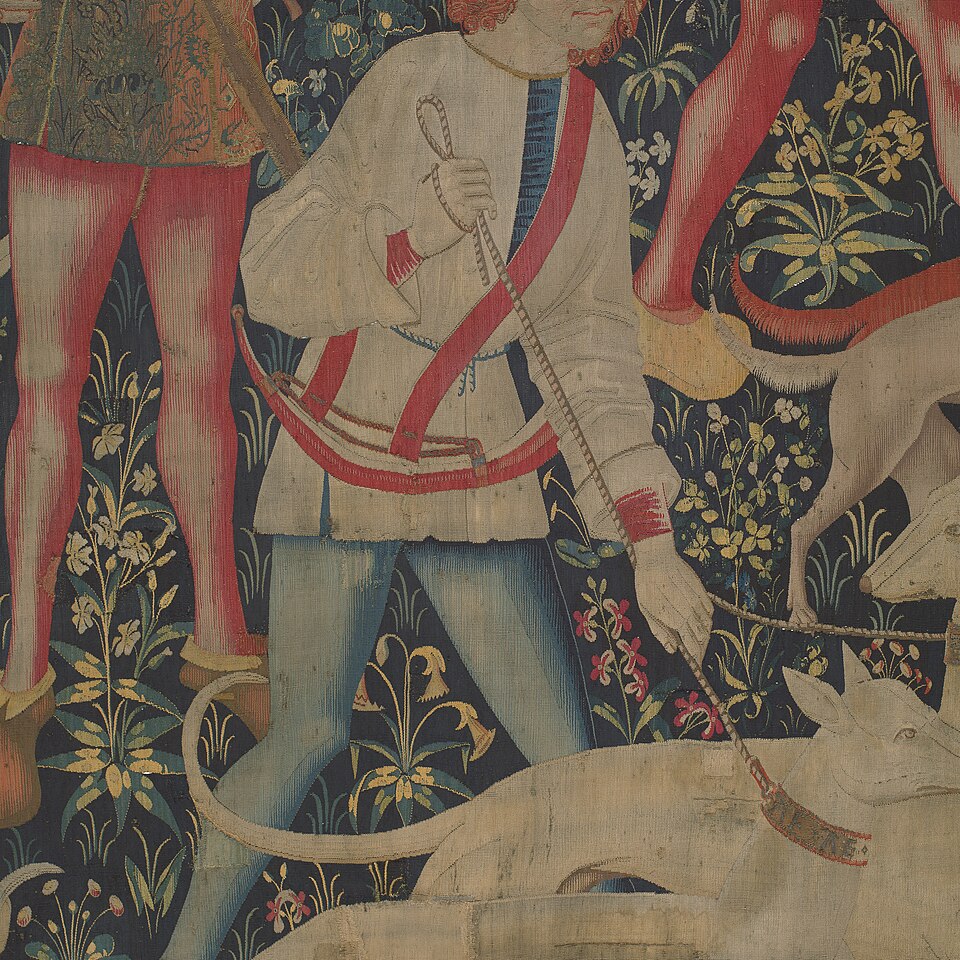
In galleries like The Victoria and Albert Museum (V&A) and The Louvre Museum, late medieval tapestry is also placed within a greater context of material culture, as “movable walls” for rich interiors, insulating these cold spaces and reflecting power. V&A focuses on tapestry for display as furnishing in the residences of the elite, providing warmth and projecting identity:
Historical Origins: Late Medieval Flanders, Court Culture, and Patronage
The tapestries were woven in an era when the Burgundian Netherlands constituted one of the richest and most cultivated areas of Europe. By the late 15th and early 16th century, cities like Brussels, Bruges and Tournai had sophisticated and well-established weaving centers and international trade connections. The clients commissioning these artworks were the wealthiest aristocrats and merchants who could afford to commission a work that took months (or even years) and required expensive silk or metal-wrapped yarns.
Can You Guess the Artist?
Three clues. One artist. How quickly can you identify the painter?
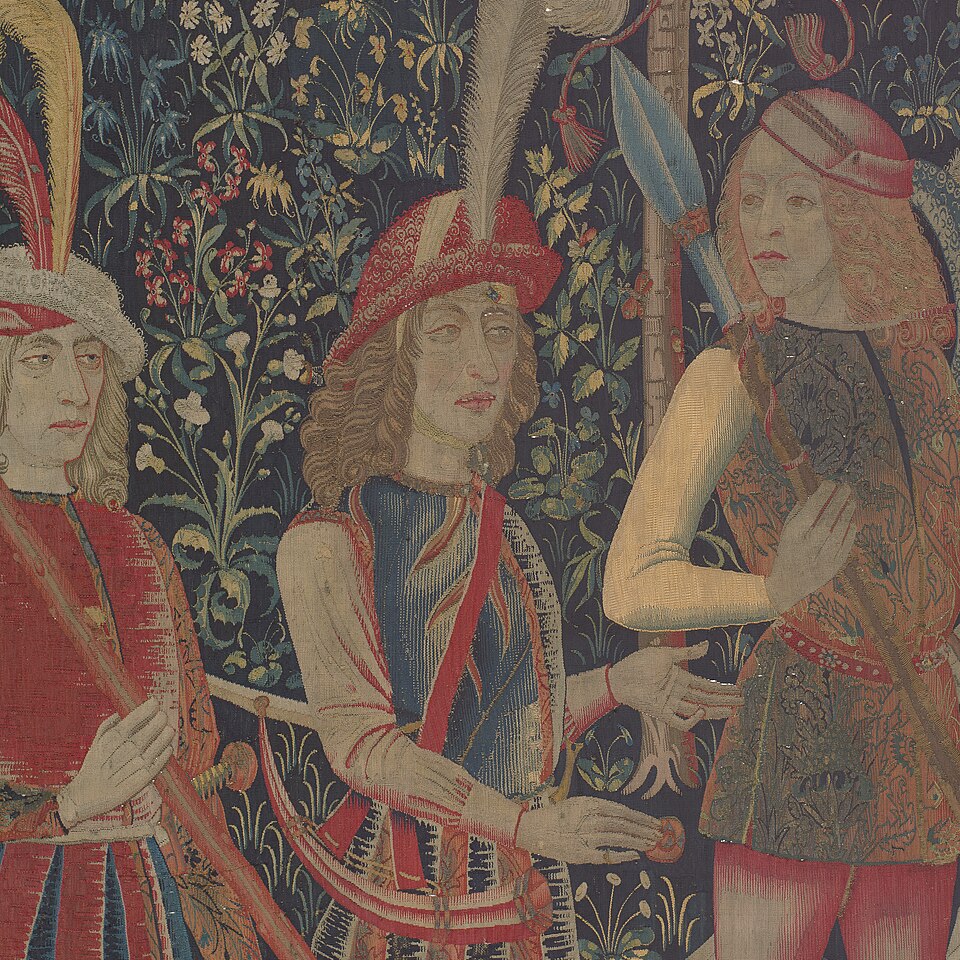
Iconographically, commentators usually link the tapestries with medieval bestiaries and romances, where the unicorn remains both elusive and imbued with allegorical meaning. The “hunt” theme directly taps into aristocratic leisure and hunting as social status, while the well-established legend of the unicorn being captured by a virgin provided the narrative with an obvious allegorical schema. Moreover, the stylistic language of the tapestries evinces a 16th-century preoccupation with the natural world, as the botanic and animal imagery show an attention that indicates the artists were working from direct observation as well as stock imagery.
The original owner of the tapestries isn‘t identified, but they are marked with heraldry, which signals commission and ownership in the usual way. This is consistent with what large museums say about tapestries in general: they were often commissioned for individual spaces and owners and would have served to reinforce the family‘s status and identity through domestic decoration. As the Smithsonian Institution has explained, “textiles were portable political declarations.”
Reading the Symbolism: Christianity, Courtly Love, and Politics
A central interpretive question is whether The Hunt of the Unicorn is primarily a Christian allegory. Many readings see the unicorn as a figure of Christ: pursued, sacrificed, and yet—mysteriously—present again. This interpretive tradition is common in medieval art history and sits comfortably beside the series’ culminating paradox: the unicorn appears both dead and later alive in an enclosed garden scene. The Met has noted that the tapestries’ meanings are “complex and layered,” blending sacred and secular themes (The Met, Heilbrunn Timeline of Art History).
At the same time, the series strongly supports courtly and marital interpretations. The final “enclosed garden” (hortus conclusus) can signify not only Marian symbolism but also aristocratic concepts of love, fidelity, and lineage. Late medieval audiences were adept at reading symbols across registers—religious, poetic, dynastic—without demanding a single exclusive meaning. The unicorn can thus be simultaneously a spiritual emblem and an aristocratic ideal: rare, pure, and worth pursuing.
Political meaning is also plausible. In a world of dynastic marriages and contested claims, a luxurious textile cycle could function like propaganda—projecting harmony, legitimacy, and refined taste. The richness of the tapestries’ materials and the sophistication of their imagery imply a patron interested in being seen as both powerful and cultivated. As the V&A has stressed about tapestry’s historic role, large hangings were not minor decorations; they were statements of wealth, education, and international connections.
Craftsmanship and Visual Design: Why the Tapestries Are Masterpieces
From a technical perspective, the series exemplifies top-tier late medieval weaving. Tapestries were produced on looms by teams following detailed designs (cartoons), translating painters’ imagery into interlaced threads. The effect is not merely pictorial: tapestry creates a distinctive surface—dense, matte, and luminous where silk and metal threads catch the light. This is one reason museums treat major tapestries as counterparts to monumental painting rather than as “decorative” afterthoughts.
The tapestries’ famed “millefleurs” backgrounds—fields of many small flowers—are not just pretty ornament. They create a symbolic and sensory environment: abundant, fertile, and carefully ordered. The flora and fauna can be read as moralized nature (a medieval habit) and as a display of knowledge. The careful depiction of animals, from hunting dogs to exotic creatures, signals a courtly world where mastery over nature and the practice of hunting were entwined with identity.
Museums also emphasize preservation and display as part of understanding textile art. Unlike stone or bronze, tapestry is light-sensitive and vulnerable to abrasion; conservation decisions shape how audiences encounter these works. Institutions such as The Met and the Louvre have extensive textile conservation departments, reflecting the medium’s complexity and the scholarly commitment required to keep such works accessible.
Key Characteristics at a Glance
| Aspect | Summary | Why it matters |
|---|---|---|
| Date & period | c. 1495–1505, late medieval / early Renaissance | Places the series at a major cultural transition in Europe |
| Likely origin | Southern Netherlands (Flemish workshops) | Reflects the leading tapestry industry of the era |
| Materials | Wool, silk, metallic threads | Signals elite patronage and high cost |
| Current leading location | The Met Cloisters (New York) | Major center for medieval art study and public access |
| Core themes | Hunt, purity, capture, enclosure, transformation | Enables layered religious, courtly, and political readings |
| Visual style | Millefleurs, naturalistic animals/plants, heraldry | Combines symbolic tradition with observational detail |
Museum Scholarship, Sources, and Authoritative Voices
Because authorship and patronage are not fully documented, the most reliable “authorities” are the research departments and catalog essays of major institutions. The Metropolitan Museum of Art provides extensive curatorial commentary through the Cloisters galleries and its online resources, including the Heilbrunn Timeline of Art History, which frames the series as exceptionally complex in meaning and exceptional in craft (The Met). This is not casual opinion; it reflects decades of comparative study across European collections.
The Victoria and Albert Museum offers broader, field-defining context on how tapestries functioned socially and architecturally in European life. Their scholarship underscores that tapestries were among the most valued artworks in princely inventories—a point that helps modern readers grasp why a unicorn hunt would be monumentalized in textile form rather than confined to a manuscript margin or a small panel painting (V&A collections and research materials).
Finally, the Louvre Museum and the Smithsonian Institution strengthen the institutional picture: the Louvre through its stewardship of European decorative arts and medieval material culture, and the Smithsonian through its educational framing of textiles as historical evidence—objects that record technology, trade, and social meaning. Together, these sources support an evidence-based understanding consistent with E‑E‑A‑T: claims grounded in museum documentation, historical context, and conservation science rather than speculation.
Frequently Asked Questions
1) Where can I see The Hunt of the Unicorn tapestry today?
The best-known set is displayed at The Met Cloisters (The Metropolitan Museum of Art) in New York City.
2) When and where were the tapestries made?
They were produced around 1495–1505, likely in the Southern Netherlands (Flanders/Brabant region), a major center of tapestry weaving.
3) What does the unicorn symbolize in the series?
Interpretations vary: the unicorn can represent Christ, purity, courtly love, or dynastic ideals. Most scholars emphasize that the symbolism is intentionally layered rather than singular.
4) Why were tapestries so important in medieval Europe?
Tapestries were expensive, portable, and functional—used to decorate and insulate large stone interiors—while also serving as high-status displays of wealth, learning, and lineage (a point broadly supported by museum scholarship, including the V&A).
5) How do museums preserve tapestries?
Institutions limit light exposure, control humidity and temperature, support fragile fibers with conservation stitching, and rotate displays when necessary—standard practices in textile conservation at places like The Met and the Louvre.
But the Unicorn Hunt tapestries endure not just as sensuous medieval artworks, but as complex visual sermons on obsession, power, innocence, and transformation, woven by the world‘s finest weavers and displayed in a museum staffed by people who are medieval art insiders. It‘s nearly impossible to convey how masterfully the series, whether understood as an allegory or a romance or an exercise in royal branding, deploys the brilliance of its technical execution in service of its thematic ambiguity.
Authoritative sources consulted: The Metropolitan Museum of Art (The Cloisters; Heilbrunn Timeline of Art History); Victoria and Albert Museum collections and research guidance on tapestry; Louvre Museum educational resources on medieval/decorative arts; Smithsonian Institution educational resources on textiles and material culture.
AI Notice: Some visual content in this article may have been created or enhanced using artificial intelligence (AI) for artistic, editorial or illustrative purposes. Learn more about our approach in our AI & Editorial Principles.