

Devonshire Hunting Tapestries: The Hidden Clue Experts Missed
The group commonly called the “Devonshire Hunting Tapestries” belongs to a long European tradition of hunt imagery woven for aristocratic display, yet the term itself is a modern convenience rather than a period designation. In inventories and household papers, such works more often appear under functional descriptions—“hangings of hunting,” “verdure with beasts,” or “forest pieces”—that blur our present categories. The tapestries associated with the Devonshire name are usually discussed in relation to the great English collecting houses, where Continental textiles entered through dynastic marriage, diplomatic gift, or the secondary market. Their visual grammar points insistently to the later sixteenth and seventeenth centuries, when Netherlandish workshops, especially in Brussels and surrounding weaving centers, produced large hunt sets for an international clientele.
Hunting tapestry cycles flourished in the context of Habsburg ceremonial culture; there the chase was an encoded performance of power and control. Hunt scenes carried connotations of rule, land, and inherited title even when it traveled, as it did, to England. These patterns were particularly suitable for the décor of the great house (long galleries, withdrawing rooms, state bedchambers), tapestry being insulating and iconographic and also shiftable from year to year. “Devonshire” refers not to a remote province, but a connoisseurial career: The acquisition of such sets by the great house; their cataloguing in family archives; their later authentication by antiquarians.
Can You Name the Masterpiece?
Ten masterpieces. Ten questions. How well do you know the history of art?
However, attribution has long over-relied on stylistic qualities alone: the muzzle of the hound, the cadence of leaves, the silhouette of the horse. While these criteria are helpful, they are also problematic since cartoons were disseminated through a variety of media, including drawings, stencils for woodcuts or copperplates, and printed books. Many compositional patterns were repeated or copied over several generations sometimes much longer which made dating by iconographic details treacherous. The “date” of the tapestries is thus a multiple notion: date of the cartoon, approximate date of weaving of each preserved panel, and later modifications (borders, linings, cuts) to adjust the hangings to new interiors.
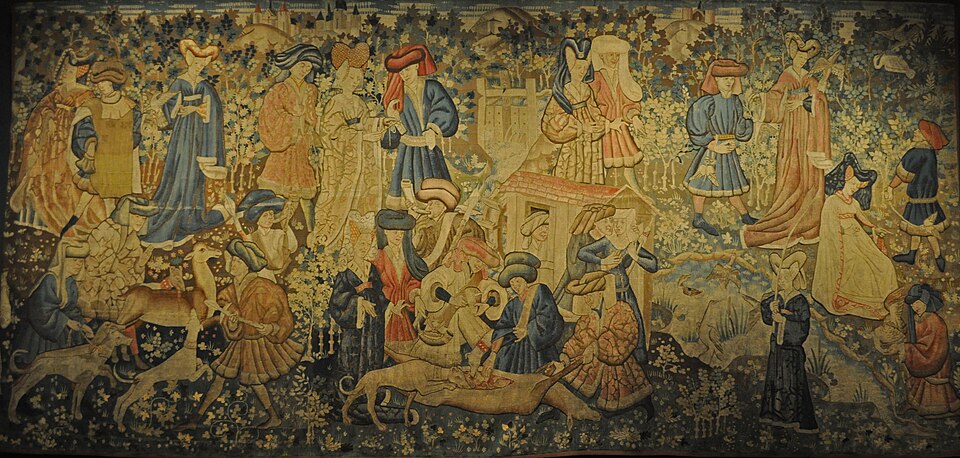
A more historically oriented triangulation would fall somewhere among textiles and objects. This includes the circulation of textiles within aristocratic families; the quotidian facts of early modern furnishings; and the business of tapestry manufacturing, straddling court and commerce. Transnationalism has been a recurrent thread of tapestry studies at places like the V&A, and scholarship more generally takes the hangings as hybrid artifacts, made in one context, remade in another and understood differently over time both in private homes and in the public realm. “Devonshire” is thus not a place but a biography, a marker of ownership, installation, and post-life that renders the tapestries interpretable in the present day.
Cultural and Symbolic Meaning
Hunt imagery is often reduced to “sporting scenes,” yet in early modern visual culture the chase staged the political order in miniature. The hunt’s structure—track, surround, pursue, take—mapped onto ideals of governance, discipline, and mastery over unruly nature. In tapestries, this symbolism becomes architectural: hung along walls, the woven forest creates an enclosing world in which the viewer is both spectator and participant. Such hangings spoke not only to the owner’s leisure but to their authority over land and animals, and—by extension—over people and resources.
Can You Guess the Artist?
Three clues. One artist. How quickly can you identify the painter?
However, perhaps the most important symbolic layer is the enacted, stylized violence of the scene. Whether it be deer, boar or bear, the quarry is presented in a point of extreme distress or at a precipice: cornered by the side of a river, pinned down by hounds or trapped in a clearing. The violence of its struggle is emphasized: antlers tilted up, bristles raised; victory is not achieved with ease or by the mere brute force of numbers but against a worthy foe. In elitist terms, it is the performed virtue of courage and steadfastness in the face of adversity. The retinue of hunters, with hounds and horns, leashes and lances, and the coordinated motion of a pack of horsemen, all suggest the hierarchy and discipline of an ideally constituted human community.
Borders, too frequently reduced to decorative elements, are crucial to meaning. A floral garland, a swag of fruit, a cartouche, grotesques or heraldic shields, these are not passive contexts; they announce that what we are looking at is a claim. Whether the themes convey humanistic erudition (classical personages, trophies, allegories) or a notion of bounty (pomegranates, grapes, sheaves of corn), the border places the subject at the centre of the owners’ world. And heraldry often acts as a signpost of lineage and association, a source of the false leads that are rampant in art attribution. Later owners could add shields, earlier coats could be overpainted to flatter new patrons.
There is one last meaning, both domestic and seasonal. Hunt tapestries were sometimes called “winter hangings”; they tended to be richly leafy and dark green, seen as warming. The context informed the reading the tapestry was a device as much as a picture: absorbing noise, deflecting heat and cold, transforming the stone interiors of country houses into a kind of theater. And for the country landlord, the landscape of the chase was paralleled on their own lands by the business of deer parks, game laws, and rights of chase.
“Tapestry is not an illustration hung on a wall; it is a wall made eloquent.”
—A recurrent curatorial sentiment in tapestry studies, reflecting the medium’s architectural function.
Craftsmanship and Materials
The Devonshire Hunting Tapestries, like most high-grade early modern hangings, were products of labor-intensive workshop systems. Woven on high-warp (haute-lisse) or low-warp (basse-lisse) looms depending on region and workshop, their execution required teams: master weavers translating cartoons into woven structure, journeymen handling passages of foliage and ground, specialists rendering faces, animals, and metallic effects. The “hand” of a workshop can sometimes be sensed in repeated solutions—how a weaver builds a leaf’s serrated edge, or models a horse’s shoulder through stepped color changes—but such signatures must be approached cautiously, because workshops standardized methods and shared cartoons.
Wool was chosen for both color and function. It was resilient and could absorb rich dyes ideal for the predominantly deep greens and browns of forest settings. The underlying material for weaving was wool, but silk, when it appears, is reserved for accent, catching glints of light on bridles, sheeny garments or on the surface of water establishing a tonal ranking across the field. The occasional use of threads wound with metal (silver or gold) can signal elevated status, but is less frequent on verdure-intensive hunts. The proportional amount of wool to silk, for instance, can indicate whether a hanging was targeting wealthy gentlemen or royal courts, even if the original design was from a courtly source.
Where dye analysis is performed, it can give a hint to the technicality of these pieces. Blues made from woad or indigo, reds from madder or cochineal, yellows from weld, greens created from over-dyeing (e.g. green from yellow and blue) show that they are working with quite sophisticated palettes. “Aged greens,” on many hunt tapestries, indicate that, through light degradation, the yellow has faded and this affects the perception of the depth of foliage. It is this shift, which can delude connoisseurship: if we see the forest as blue-green, maybe it was once warmer and golden, and with greater distance between the fore and the background.
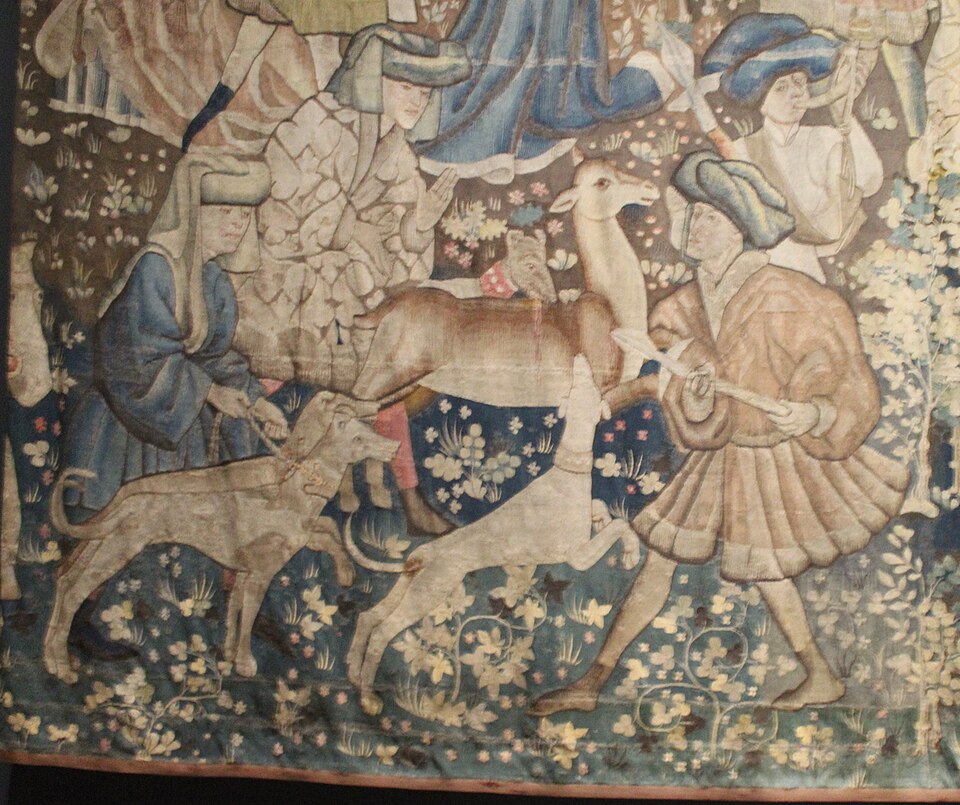
The fabric itself tells a story: warp density (warps per centimeter), how outlines are worked, how borders and fields are united. Some panels form a whole, others are modular and can be combined to fit a room a workshop could simply buy a larger number of panels to be woven. The seams are then not repairs but joints. Added to this are later changes in the fabric: panels cut down to frame paneling, cut out around doors, rotated from horizontal to vertical.
Craft Indicators at a Glance
| Feature | What it can indicate | Common pitfalls |
|---|---|---|
| Warp density and regularity | Workshop standards; intended quality tier | Later stretching and relining can distort counts |
| Wool/silk proportion | Market level; intended visual effects | Silk loss over time can understate original richness |
| Border integration | Original set design vs. later recombination | Borders are frequently swapped or reattached |
| Dye behavior (fading shifts) | Original color balance; dating clues | Light exposure varies by room and hanging position |
Historical Locations, Museums, and Archives
Any serious account of the Devonshire Hunting Tapestries must move between houses, museums, and documentary repositories. The great English collections—especially those associated with long-term aristocratic patronage—preserved tapestries not as isolated art works but as furnishing ensembles, sometimes with old labels, measurements, and repair records. Chatsworth House, long linked to the Dukes of Devonshire, is central to this narrative not simply because of what it holds, but because of what survives in the estate’s documentation: household accounts, inventories, and correspondence that record movement of hangings between rooms and seasons.
Museums provide the comparative framework without which connoisseurship becomes provincial. The Victoria and Albert Museum’s tapestry holdings and research infrastructure have shaped English-language understanding of Netherlandish weaving traditions. The Metropolitan Museum of Art and the Art Institute of Chicago also offer key comparanda, particularly for hunting and verdure types and for the study of borders as modular design elements. On the Continental side, Brussels’ historical primacy makes Belgian collections and civic archives relevant, while French institutions (including the Musée de Cluny’s medieval and Renaissance textiles) offer insight into the continuity of woven wall-hangings as elite culture.
Archives matter because tapestry was an industry with paperwork: contracts for cartoons, payments to workshops, shipping records, and—later—insurance valuations. Even when the “Devonshire” tapestries cannot be traced through a single unbroken line, the broader documentary ecology clarifies how such objects traveled. Estate papers sometimes record practical details that art-historical description omits: the cost of lining, the number of rings for hanging, or the decision to cut and re-edge a panel to accommodate a new chimney piece. These details can explain why a tapestry’s iconography seems oddly cropped or why a border motif abruptly stops.
Finally, conservation studios and their reports function as modern archives. Technical examination—fiber identification, dye testing, weave mapping, and infrared or raking-light photography—produces a layered record of interventions. When accessible, these reports can resolve long-standing debates about whether a coat of arms is original, whether a border has been reattached, or whether a suspiciously “fresh” passage is a later reweave. The history of the object, in other words, is now written as much in conservation files as in family inventories.
The Hidden Clue Experts Missed
The most persistent error in interpreting hunt tapestries associated with great houses has been to treat the central hunting narrative as the primary evidence for origin and date, while relegating the margins—selvedges, linings, and border turn-ins—to the status of mere condition issues. Yet it is precisely in these overlooked zones that the most reliable clues often survive. The “hidden clue” is not a single dramatic discovery but a category of evidence: the technical and logistical markers of use—how a tapestry was hung, moved, resized, and stabilized across centuries.
One especially revealing feature is the distribution of wear and light damage relative to hanging hardware. Old ring patterns, concentrated stress points, and repeated crease lines can indicate whether a tapestry spent long periods on a single wall, was frequently rolled, or was rehung in different rooms with different dimensions. When correlated with estate renovation phases—new paneling, altered window placements—these patterns can align a tapestry’s physical history with architectural history. Experts sometimes miss this because it requires thinking like a house steward as well as an art historian: not “what does this depict?” but “how did this function, year after year?”
Another overlooked clue is the back: early linings, patches, and inscriptions. Linings can contain fragments of earlier textiles, reused as thrift or convenience, and occasionally include dated materials—newspaper, stamped cloth marks, or tailor’s labels—linked to particular periods of restoration. More important, old repairs sometimes preserve original yarns or color relationships that have disappeared on the front due to abrasion. A protected fold may retain a green that reveals the intended palette, shifting interpretation of foreground/background modeling and bringing a workshop’s color habits back into view. In some cases, a border that seems stylistically “off” may prove to be correct once its original color balance is reconstructed.
Finally, the selvedge and its construction can hold workshop-level information: weave direction, finishing methods, and traces of original headings. While Brussels guild marks and city marks are famously valuable when present, they are not the only forensic tools. The manner in which the field meets the border, the presence of weft returns, and the evidence of later re-edging can show whether a tapestry was altered soon after weaving—perhaps to satisfy a specific room—or much later, in the age of antiquarian interior decoration. The clue, in short, is that the tapestry’s “biography of use” often identifies its true context more securely than iconographic comparison alone.
Collector Perspective: Taste, Provenance, and Interpretation
Collectors have long valued hunting tapestries for their ability to generate a complete environment—an immersive field of foliage, animals, and human activity that painting rarely achieves at comparable scale. In the eighteenth and nineteenth centuries, when country house display became increasingly self-conscious and historically referential, such hangings were recruited to build narratives of lineage and continuity. A hunt scene suggested not just aristocratic leisure but an inherited right to land and tradition, making it a potent furnishing for houses engaged in curating their own past.
From a collector’s perspective, the most consequential issue is provenance, because tapestry sets are unusually vulnerable to dispersal and recombination. A “set” may be a later assembly of panels from different origins, unified by similar borders or subject matter. Conversely, a genuine set may survive only in fragments, its coherence obscured by cuts made to accommodate doors and windows. Connoisseurship must therefore be paired with documentary rigor: old sale catalogues, estate inventories, and restoration bills can be as important as stylistic consistency.
Collectors also face interpretive decisions about display. Do you hang a panel with visible losses as an honest witness to age, or do you seek extensive reweaving to approximate original completeness? Do you preserve later armorial additions as part of the object’s history, or remove them to recover an earlier state? These choices are not purely aesthetic; they shape what future scholars can learn. The best collecting practice, aligned with museum standards, treats the tapestry as a palimpsest and documents any intervention meticulously.
A final collector concern is scale and architecture. Tapestries were made for rooms with different proportions than most modern interiors, and their impact depends on distance, lighting, and wall continuity. Where collectors once installed them in long galleries, today they may be encountered as single panels on isolated walls, a shift that changes both reading and condition. This is why the “hidden clue” of hanging history is so important: it reminds us that tapestries were designed as architectural partners, and that their meaning is inseparable from how they occupy space.
Restoration Insights: Ethics, Techniques, and the Evidence of Repair
Restoration of hunting tapestries is both technically demanding and ethically charged. The first task is stabilization: securing weak wefts, supporting splits, and addressing deformation caused by gravity and earlier hanging methods. Linings are often replaced or adjusted to provide even support and to reduce strain at the top edge. Yet every stitch added is also a scholarly intervention, because repairs can obscure original weave structures and erase evidence of use. For this reason, contemporary conservation tends to favor minimal, reversible treatments and extensive documentation.
Cleaning is another complex issue. Surface soils can dull color relationships, but washing—whether wet cleaning or controlled aqueous methods—carries risks, especially where dyes are unstable or where earlier repairs used incompatible fibers. Many hunt tapestries have undergone repeated campaigns of cleaning and repair, especially in the nineteenth and early twentieth centuries when aesthetic completeness was prized. Recognizing old reweaves is therefore essential: they can be historically interesting in themselves, reflecting past taste, but they can also mislead present interpretation if taken as original.
Reweaving, when undertaken, demands a high level of skill in matching yarn twist, dye tone, and weave behavior. Even excellent reweaving is usually detectable under magnification, and it should remain so: conservation ethics prefer that additions be discernible on close inspection. Of particular importance in hunting tapestries is the treatment of borders, which are often the most damaged due to proximity to furniture, doors, and handling. Because borders are also key evidence for attribution and set coherence, their restoration must be approached with caution. Over-restored borders can create a false sense of uniformity that erases the object’s real, uneven history.
Perhaps the most valuable restoration insight is methodological rather than technical: conservation reports are not ancillary paperwork but primary sources. A well-documented campaign records fiber types, dye observations, stitch maps, and photographs before and after treatment. This record enables future scholars to distinguish original from restored passages and to reconstruct earlier states. In the case of the Devonshire Hunting Tapestries, conservation documentation can illuminate exactly the “hidden clue” discussed above—the object’s life on the wall—by preserving evidence that would otherwise be tidied away.
Market Interest and Collector Demand
Demand for hunting tapestries has waxed and waned with the prevailing fashion in interiors and the existence of large architectural spaces. They were more in demand when Interiors were richly layered and historicalizing, and less in demand when they were minimalist, not for any loss of appreciation for the genre, but from limitations of size. Institutional demand for textiles as key objects for the history of Decorative Arts in recent decades has also helped to support continued scholarly interest despite unevenness in private collecting.
In this market, “name recognition” plays a less important role than provenance, dimensions and condition. And a pristine panel with well-maintained border, crisp color and good provenance may retain considerable collector appeal, unlike more heavily cut- or over-restored examples, whose value is dependent largely on the evidence of provenance as mere curiosities. More significantly, the market has become much more keenly aware of conservation considerations: collectors and museums now understand that owning tapestries carries the burden of continued conservation, from the carefully-filtered daylight required to light them, to proper hanging methods, to regular examination.
A third driver is the rethinking of hunt scenes and “verdure” in art history from being filler or decorative material to an expression of social and environmental value an illustration of land management, royal leisure, or the relationship between man and beast. Such complexity encourages buyers who crave objects that repay prolonged study, but it means that evidence in support of origin or attribution particularly to aristocratic estates needs to be far more robust.
For this reason, the “hidden clue” has market consequences. Pieces accompanied by rigorous technical documentation—evidence of original hanging methods, confirmed border integrity, and transparent conservation history—are more credibly situated in time and place. In a field where designs circulated and sets were often broken up, the object’s physical biography can be the most trustworthy anchor. The market, at its best, rewards that trustworthiness not through hype but through a preference for well-documented survivals.
The Devonshire Hunting Tapestries endure because they compress multiple histories into a single woven surface: the ceremonial language of the hunt; the transnational economies of Netherlandish weaving; the domestic pragmatics of insulation and display; and the long afterlife of aristocratic collections negotiating modernity. Their forests are not escapist backdrops but social theaters, staging hierarchy, land, and ritualized violence in a medium that literally formed the walls of elite life.
The fact that art historians have mostly overlooked telltale scratches in selvages, bindings, fraying, and earlier repairs to previous patches is essential to returning these tapestries to history. It‘s a reframing from some abstract stylistic designation like “Renaissance” or “Baroque” to the lived life of an object that‘s been hung, hung, taken down, rehung, washed, relined, and reenvisioned. That life is not an object‘s context; it‘s the object‘s prerequisite to being.
In a time of material histories, and the custodianship we‘re tasked with being careful of, these tapestries show us how meaning is constructed (and reconstructed) over time. They also remind us that textile arts are not small arts: these are the material threads of our history, and they still urge us to read what is shown, yes, but also what is lived, rewritten, and transmitted.
AI Notice: Some visual content in this article may have been created or enhanced using artificial intelligence (AI) for artistic, editorial or illustrative purposes. Learn more about our approach in our AI & Editorial Principles.